Menopausal hormone therapy can reduce bone loss and fracture risk. That is a genuine part of its evidence base, but it does not answer every question about who should use it, which formulation to choose, or whether it is the best treatment for established osteoporosis.
The Women’s Health Initiative, or WHI, is especially useful because it measured actual fractures in large randomized trials rather than relying only on bone-density changes. Reading its two hormone regimens separately, and then considering what happened after treatment ended, gives a clearer picture of the benefit.
Bone density and fracture prevention are different outcomes
A DXA scan estimates bone mineral density, or BMD. A fracture is a clinical event. Better BMD is useful, but a treatment’s effect on a scan should not automatically be treated as proof of fewer broken bones unless fracture outcomes have also been studied.
WHI provides both types of information. Its fracture findings are therefore particularly important when discussing systemic menopausal hormone therapy and skeletal health. They also offer a useful contrast with other hormone research in which a favorable density result did not translate into fewer fractures.
Our TRT bone-density and fracture review describes that separate evidence in men. Findings from testosterone trials should not be transferred to menopausal estrogen therapy, or vice versa. The hormone, population, regimen, and clinical outcome all matter.
WHI estrogen plus progestin: who was studied?
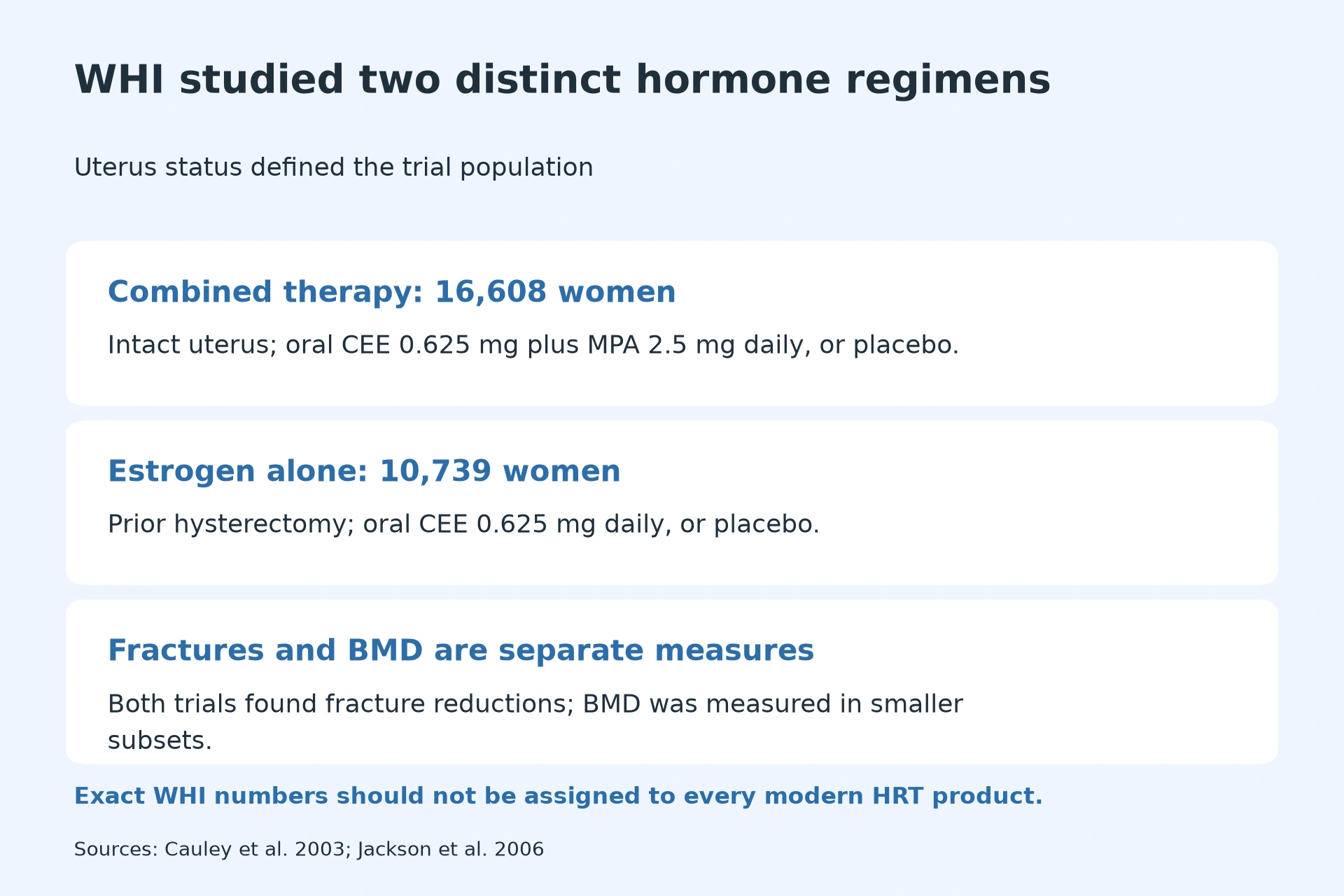
The combined-therapy trial enrolled 16,608 postmenopausal women aged 50–79 with an intact uterus. Participants were randomized to oral conjugated equine estrogen, or CEE, 0.625 mg daily plus medroxyprogesterone acetate, or MPA, 2.5 mg daily, or placebo. The fracture analysis reported an average 5.6 years of follow-up. Original combined-therapy fracture report.
There were 8,506 women assigned active treatment and 8,102 assigned placebo. Bone density was measured in a smaller subset of 1,024 participants. The full fracture population and the BMD subset should not be confused.
This regimen is not the same as transdermal estradiol plus oral micronized progesterone. WHI remains highly informative, but its exact results should keep the tested formulation and population attached.
How much did fracture risk change?
During the reported treatment period, 733 women in the combined-hormone group, or 8.6%, experienced a fracture, compared with 896 women in the placebo group, or 11.1%. The hazard ratio was 0.76, with a 95% confidence interval of 0.69–0.83. WHI fracture results.
The crude difference between the reported proportions is about 2.5 percentage points over an average 5.6 years. The 24% relative hazard reduction and the 2.5-percentage-point absolute difference are different ways of describing the comparison. Neither is an annual fracture probability for every HRT user.
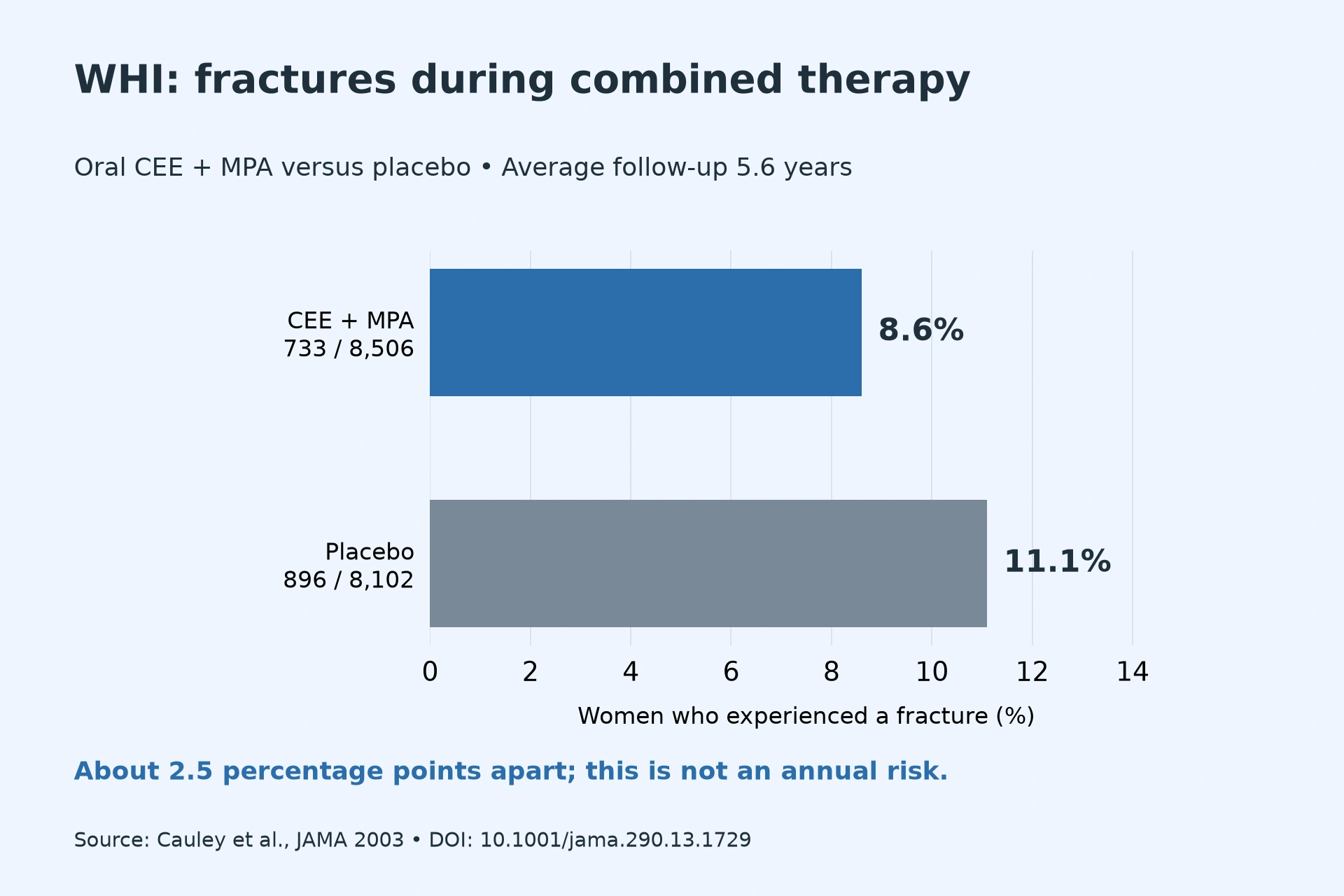
The endpoint included confirmed osteoporotic fractures; it was not a hip-fracture-only percentage. At three years, total hip BMD in the measured subset increased 3.7% with combined therapy versus 0.14% with placebo. The fracture and BMD findings point in the same favorable direction, but they remain distinct measurements.
Why a bone benefit did not mean an overall benefit for every participant
The combined-therapy paper also examined a global index intended to summarize important benefits and harms across multiple disease outcomes. It did not find an overall net benefit for that regimen in the studied population, even among women classified at high fracture risk.
That does not negate the fracture reduction. It means that improving one outcome does not automatically settle the entire treatment decision. A person considering HRT may value relief of hot flashes and night sweats, while also needing a careful discussion of clotting, cardiovascular, breast, uterine, and other personal risks.
The correct response is neither “HRT does nothing for bones” nor “bone protection makes HRT right for everyone.” Our HRT risks-and-benefits guide explains how the broader discussion is individualized.
WHI estrogen alone: a separate population and regimen
The estrogen-alone trial randomized 10,739 women aged 50–79 who had undergone hysterectomy to oral CEE 0.625 mg daily or placebo. The fracture report followed participants for an average 7.1 years. Original estrogen-alone fracture and BMD report.
Estrogen reduced the reported hazard of hip fracture, with a hazard ratio of 0.65 and confidence interval of 0.45–0.94. It also reduced clinical vertebral fractures, wrist/lower-arm fractures, and total fractures. The total-fracture hazard ratio was 0.71, with a confidence interval of 0.64–0.80.
Those are relative hazard estimates, not percentage-point reductions. A hazard ratio of 0.65 does not mean that 35 of every 100 women avoided a hip fracture. The absolute effect depends on baseline risk and follow-up.
This trial also did not show a significant overall net benefit when its monitored health outcomes were summarized in the global index. Again, a demonstrated skeletal benefit is one part of a wider assessment.
Why uterus status matters in interpreting the studies
WHI did not simply assign all women to estrogen alone or estrogen plus progestin as interchangeable choices. The combined regimen was studied in women with a uterus; estrogen alone was studied in women who had undergone hysterectomy.
For most women with an intact uterus using systemic estrogen, an appropriate progestogen is needed to protect the uterine lining. That is a different reason for treatment than bone protection. The Menopause Society’s hormone-therapy overview explains this distinction.
Our guides to estrogen and progesterone and HRT after hysterectomy can help frame the discussion. A person should not choose estrogen alone because its fracture numbers appear favorable without considering why the original study population received that regimen.
What happened after hormone therapy stopped?
A later WHI analysis examined 15,187 women who continued active hormone therapy or placebo through the intervention period and did not use hormone therapy during the postintervention period. It followed fractures for up to five years after stopping. Original post-treatment fracture report.
In the former combined-therapy group, total-fracture rates were 28.9 per 1,000 person-years versus 29.9 in former placebo users. The hazard ratio was 0.97, with a confidence interval of 0.87–1.09. In the estrogen-alone trial, rates were 31.1 versus 36.9 per 1,000 person-years, with a hazard ratio of 0.85 and confidence interval of 0.73–0.98, suggesting some residual benefit for total fractures.
Hip fractures were uncommon and did not show a meaningful difference between former treatment and placebo groups. The investigators found no evidence of a transient or sustained excess fracture rebound after stopping compared with former placebo users.
The comparison is important: it was former hormone users versus former placebo users, not a randomized comparison of stopping versus continuing indefinitely. The follow-up does not prove bone density never declines after stopping, that all protection persists, or that a high-risk person can stop any bone treatment without a plan.
How does this fit with osteoporosis guidance?
The Endocrine Society’s osteoporosis guideline recommends treatment for postmenopausal women at high fracture risk and commonly uses bisphosphonates as initial therapy. It suggests menopausal hormone therapy for selected women with suitable characteristics, including younger age or proximity to menopause, bothersome symptoms, low clotting risk, and situations in which other options are not appropriate. Guideline recommendations.
The guideline is not a rule that every person must try the same sequence. It illustrates why symptom treatment and fracture prevention should be considered together with alternatives. A previous fragility fracture, very low BMD, or other major risk factor can change the discussion substantially.
Calcium and vitamin D adequacy, suitable activity, fall prevention, and evaluation of other causes of bone loss remain part of care. Supplements alone should not be assumed to replace medication when fracture risk warrants treatment.
What about patches, low-dose vaginal estrogen, and newer labels?
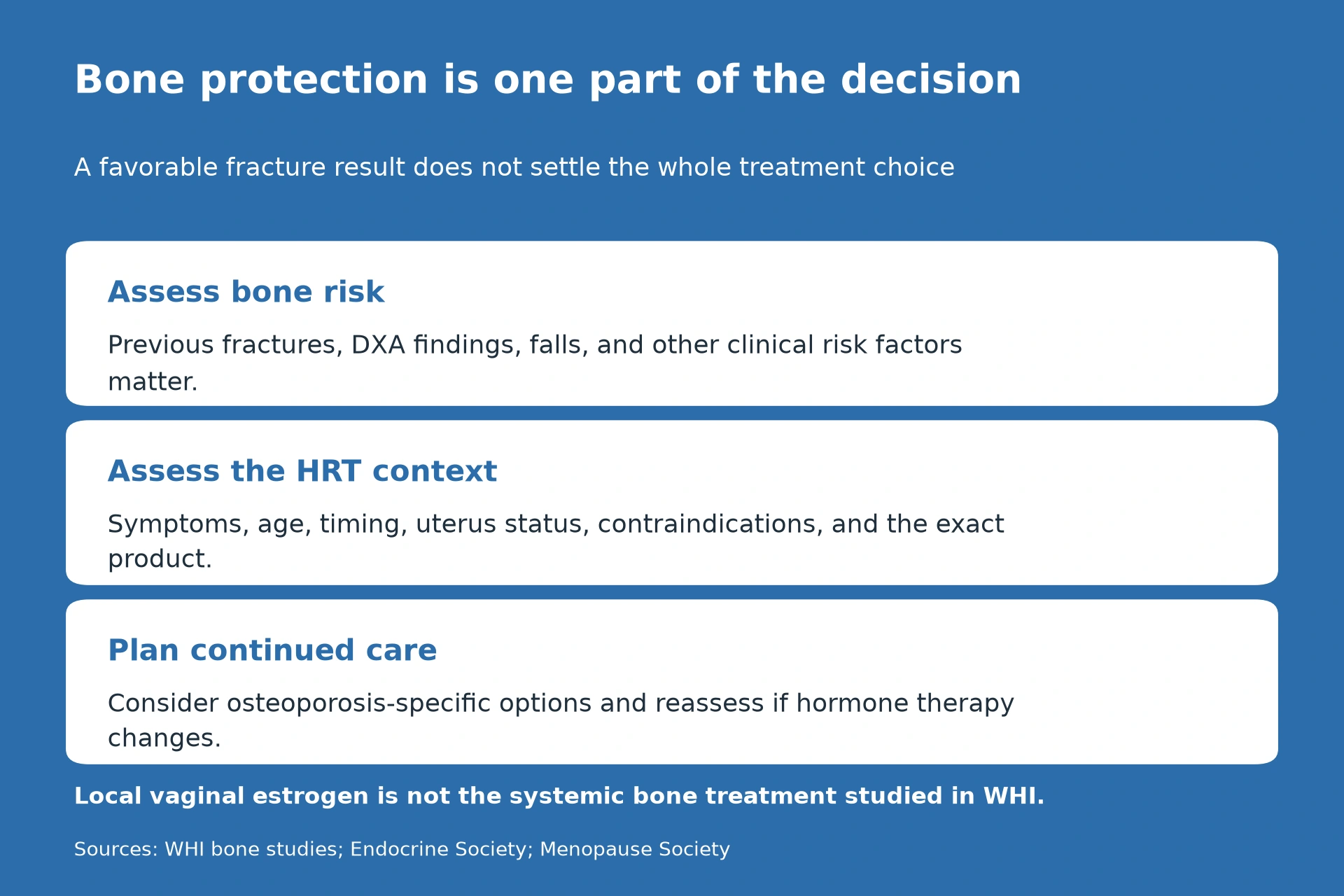
The exact WHI fracture estimates came from the studied oral CEE regimens. They should not be copied onto every dose, route, or combination as though all have identical direct fracture-outcome evidence. This is especially important when distinguishing systemic HRT from low-dose vaginal estrogen used for local genitourinary symptoms.
Our vaginal-estrogen versus systemic-HRT guide explains why local treatment should not be assumed to provide the systemic bone protection discussed here. Our HRT monitoring guide addresses the follow-up conversation.
In February 2026, the FDA announced approved labeling changes for an initial six menopausal hormone products, removing certain cardiovascular, breast-cancer, and probable-dementia statements from their boxed warnings. This product-label update does not erase the original trial results or establish that every formulation has the same benefit-risk profile. Review the current label for the exact product. FDA announcement.
The separate HRT and dementia evidence review explains why bone, symptom, and dementia outcomes should not be bundled into one universal prevention claim.
Questions for an HRT and bone-health appointment
- Have I had a fracture that suggests underlying bone fragility?
- What do my DXA results and other risk factors indicate, and do I need further evaluation?
- Is the main purpose of HRT symptom relief, bone-loss prevention, or both?
- How do my age, time since menopause, uterus status, and personal risks affect the options?
- Would an osteoporosis-specific medicine be more appropriate for my fracture risk?
- What is the plan for reassessing bone health if HRT changes or stops?
For a broader starting point, read our menopause hormone-therapy guide and questions before starting HRT. CoreAge Rx’s estrogen information page can support a discussion about the exact formulation and indication; a product page does not establish that a particular regimen is right for your bone risk.
Watch: a brief explanation of osteoporosis risk
Mayo Clinic’s short video introduces why women should pay attention to osteoporosis risk. It is background education about bone health, not a summary of every WHI benefit and harm.
Common questions about HRT and fractures
Did WHI measure actual fractures or just scan changes?
It measured actual fractures in the large randomized populations and BMD in smaller subsets. That direct fracture evidence is an important strength of the research.
Is estrogen alone safer or better for bones than combined therapy?
The two trials enrolled different populations based on hysterectomy status and had different follow-up. Their fracture hazard ratios should not be used as a simple head-to-head ranking or as a reason to omit needed uterine protection.
Does stopping HRT cause an immediate fracture rebound?
The WHI post-treatment analysis did not find excess fracture risk compared with former placebo users during the reported follow-up. That does not eliminate the need to reassess an individual’s bone risk and plan ongoing care.
Is low-dose vaginal estrogen an osteoporosis treatment?
It should not be assumed to provide the systemic bone protection discussed in these trials. Local genitourinary treatment and systemic hormone therapy have different purposes and exposure patterns.
What is the most useful takeaway?
HRT has real randomized evidence for fracture reduction with the studied systemic regimens. The decision still depends on the whole person: symptoms, bone risk, formulation, uterus status, contraindications, and appropriate alternatives.
Original papers and supporting sources
The references distinguish full research papers, published abstracts, and official guidance. This educational narrative review is not a systematic review or an individual treatment recommendation. Sources were checked in October 2026.
- Cauley JA et al. Effects of estrogen plus progestin on risk of fracture and bone mineral density: the Women’s Health Initiative randomized trial. (2003). Published abstract reviewed. DOI: 10.1001/jama.290.13.1729.
- Jackson RD et al. Effects of conjugated equine estrogen on risk of fractures and BMD in postmenopausal women with hysterectomy: results from the women’s health initiative randomized trial. (2006). Published abstract reviewed. DOI: 10.1359/jbmr.060312.
- The Menopause Society. Hormone Therapy. Professional society patient guidance.
- Watts NB et al. No Increase in Fractures After Stopping Hormone Therapy: Results From the Women’s Health Initiative. (2017). Full text reviewed. DOI: 10.1210/jc.2016-3270. Open full text.
- Endocrine Society. Pharmacological Management of Osteoporosis in Postmenopausal Women, 2019/2020. Professional guideline.
- FDA. Labeling changes to six menopausal hormone therapy products, February 12, 2026. FDA labeling announcement.