You do not automatically need to stop eating dairy when you start Ozempic or Wegovy. The more useful question is which food, amount, and symptom are involved. A glass of milk, a small portion of hard cheese, a large milkshake, and a lactose-free yogurt are different foods; one uncomfortable experience does not establish that all dairy is unsuitable.
Semaglutide can cause gastrointestinal symptoms, but nausea after a meal does not by itself diagnose lactose intolerance. Lactose intolerance is also different from milk allergy. Sorting out those possibilities can help you keep useful foods in your diet while getting the right assessment for persistent symptoms. Ozempic label, NIDDK lactose intolerance
Does semaglutide cause lactose intolerance?
The reviewed Ozempic and Wegovy labels describe digestive adverse reactions and delayed stomach emptying. They do not establish that semaglutide routinely creates a new inability to digest lactose. A symptom beginning during treatment is worth reporting, but timing alone cannot show the mechanism. Ozempic prescribing information, Wegovy prescribing information
Lactose is the sugar naturally present in milk and many milk products. Lactose malabsorption means the small intestine does not digest all the lactose consumed. Lactose intolerance refers to the digestive symptoms that occur with that problem; not everyone with malabsorption has symptoms. NIDDK definitions
If you previously tolerated a small yogurt but now feel sick after a large creamy dessert, several things changed at once. The portion, ingredients, fat content, other foods, medicine dose, and background illness may all be relevant. Keep the example specific when you speak with the care team.
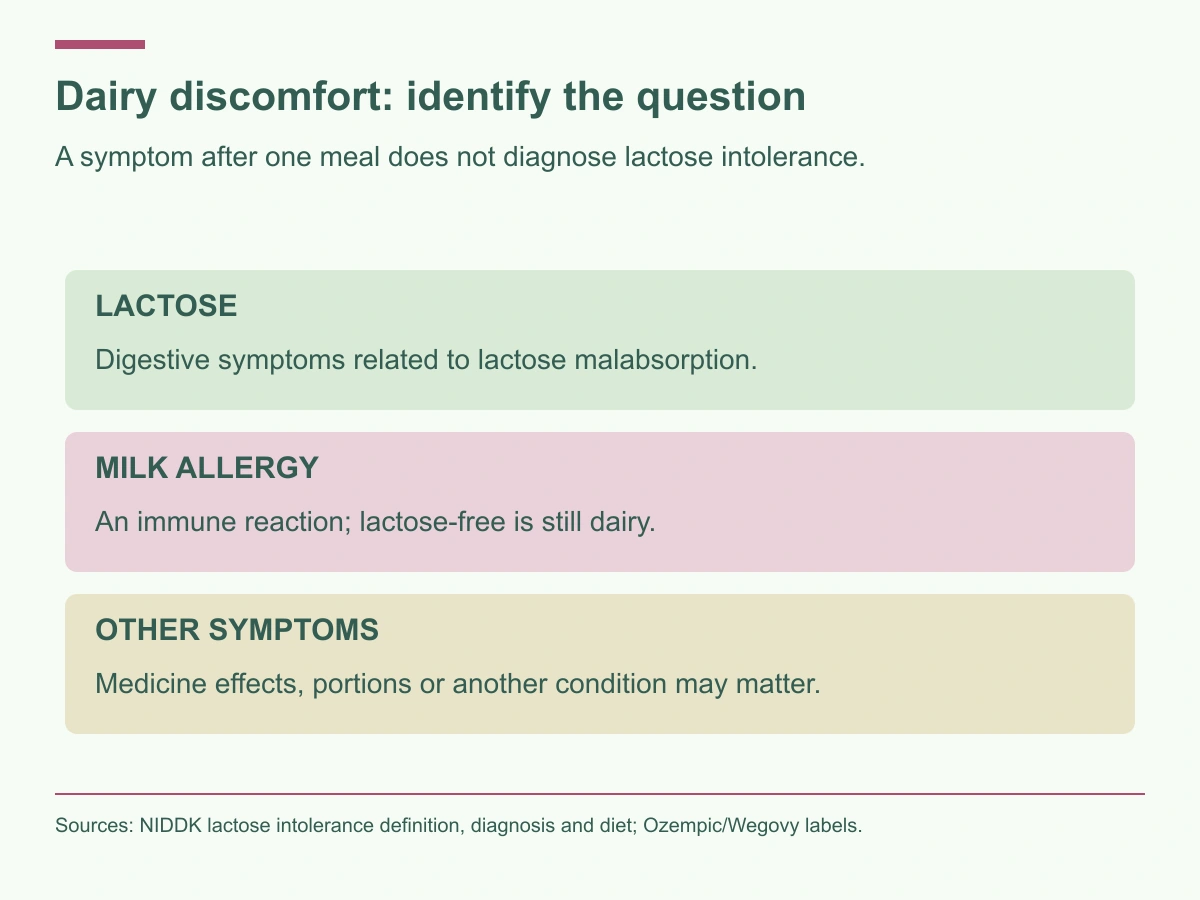
Lactose intolerance, milk allergy, and ordinary nausea
| Possibility | Useful distinction | What to discuss |
|---|---|---|
| Lactose intolerance | A digestive response related to lactose malabsorption | Gas, bloating, diarrhea, amount eaten and repeated patterns |
| Milk allergy | An immune-system reaction, not a lactose-digestion problem | Known allergy history and any concerning reaction |
| Treatment-related digestive symptoms | Can occur with semaglutide and may overlap with food symptoms | Dose changes, nausea, vomiting, fullness and ability to eat |
| Another digestive condition or illness | Can resemble a food intolerance | Persistent symptoms, pain, fever or a change from your usual pattern |
NIDDK distinguishes milk allergy from lactose intolerance and notes that conditions such as celiac disease, inflammatory bowel disease, and irritable bowel syndrome can have similar symptoms. A food diary is useful information, not a definitive test. Definition and facts, diagnostic assessment
Breathing difficulty, throat or facial swelling, fainting, or other severe allergic symptoms needs emergency care. Do not try lactose-free milk as a home test after a suspected serious milk reaction: removing lactose does not establish that milk proteins are absent.
Which dairy foods may be easier to tolerate?
For people with lactose intolerance, NIDDK describes several possibilities: smaller amounts with meals, yogurt, hard cheeses such as cheddar or Swiss, lactose-reduced products, and lactase products. Tolerance varies; these are options to discuss, not guarantees that a particular food will be comfortable. NIDDK food guidance
Start the conversation with foods you actually enjoy and can afford. If plain yogurt already works for you, there may be no reason to replace it solely because you started an injection. If regular milk repeatedly causes symptoms, ask whether a lactose-free version or another calcium-containing food would make sense.
A label saying “Greek,” “high protein,” or “organic” does not by itself answer the lactose question. Read the actual product information. Our Fairlife milk guide discusses a specific filtered-milk category, while the protein-shake guide separates product labels from broad weight-loss claims.
What about ice cream, cream sauces, and large milkshakes?
These foods cannot be treated as equivalent to a small portion of plain yogurt. A dessert or restaurant drink may combine dairy, a large volume, added sugars, and other ingredients. If it causes discomfort, record the whole meal rather than attributing everything to lactose immediately.
For example, “a large milkshake after a fried dinner” gives a clinician more information than “milk makes me sick.” It also offers a more practical nutrition question: would a smaller serving, a different meal combination, or a different food be more comfortable? Those changes should fit your symptoms and dietary needs rather than become a rule that dairy is forbidden.
The semaglutide nausea guide explains why persistent vomiting or very poor intake requires clinical review. Avoid repeatedly testing a rich meal when you are already struggling to keep food or fluids down.
Is lactose-free the same as dairy-free?
No. Lactose-free milk remains a milk product. A plant-based beverage may contain no dairy, but its nutrition can be quite different from milk or from another plant-based beverage. Check the ingredients and Nutrition Facts rather than treating the carton names as interchangeable.
Compare the serving size, protein, calcium, vitamin D when listed, and added sugars. FDA’s label guidance explains that the numbers apply to the labeled serving and that serving size describes a customary amount, not a personal recommendation. If you drink more than one serving, account for that amount. FDA Nutrition Facts guide
Replacing a regular source of protein and calcium with a beverage that supplies little of either can change the overall diet. NIDDK recommends maintaining adequate calcium and vitamin D when managing lactose intolerance and discussing nutrition needs with a doctor or dietitian. NIDDK nutrient guidance

Can you still get enough protein without dairy?
Yes, an eating plan can include other protein foods, but the replacement should be deliberate. Consider foods you tolerate, your preferences, and any kidney or other medical advice. Our balanced-meal guide and protein breakfast ideas can help you identify options to discuss with a dietitian.
If dairy was your easy breakfast or evening snack, removing it without a replacement may simply leave you eating less. That matters when appetite is already reduced. Tell the care team if meals are becoming very small, repetitive, or difficult to finish.
The protein and muscle article explains why preserving nutrition and physical function deserves attention during weight loss. A protein powder is not automatically necessary, and a shake may itself contain milk ingredients. Check its label rather than assuming a sports product is lactose-free.
Where can lactose be less obvious?
NIDDK notes that milk ingredients can appear in baked foods, prepared meals, meal-replacement drinks, protein products, and some products described as nondairy creamers. Ingredient names such as milk, lactose, whey, curds, and milk solids can be relevant. Foods containing lactose
Keep this proportionate to your situation. Someone who tolerates modest amounts may not need the same degree of avoidance as someone whose symptoms occur with small exposures. A known milk allergy requires its own allergy plan; the lactose discussion does not replace it.
If you are concerned about lactose in a tablet, ask a pharmacist about the exact preparation. Do not stop a prescription because an internet ingredient list for a different manufacturer includes lactose. The amount, formulation, and your clinical history all need context.
Does the timing of dairy around the dose matter?
Ozempic injection and Wegovy injection have labeled administration instructions that permit use with or without meals. The labels do not set a universal dairy-free interval around the injection. Avoid inventing a rule that milk must be separated by several hours. Ozempic administration, Wegovy administration
Wegovy tablets are different. The current label instructs taking a tablet in the morning on an empty stomach with water, up to four ounces, then waiting at least 30 minutes before food, other beverages, or other oral medicines. Milk is not the water specified in those directions. Confirm the exact product and route rather than transferring injection instructions to a tablet.
If you use another oral semaglutide product or a compounded preparation, ask for its own instructions. Our semaglutide questions guide can help organize product and follow-up questions, but it does not replace the label supplied with your prescription.
A useful food-and-symptom record
For several relevant meals, write down the food, approximate portion, time, symptoms, and any recent medicine change. Include what else was eaten or drunk. Record whether symptoms occur after non-dairy meals too; that detail can prevent the review from focusing too narrowly on one ingredient.
An example might read: “Plain yogurt with breakfast was comfortable; a large evening milkshake was followed by bloating and diarrhea. The weekly dose changed two days earlier.” This is an example of useful detail, not a diagnostic pattern or proof of a medicine-food interaction.
Ask the clinician whether a supervised dietary trial or testing is appropriate. NIDDK describes hydrogen breath testing as one possible part of diagnosis. Avoid long-term, increasingly restrictive elimination diets based only on an online symptom checklist. How lactose intolerance is assessed

When food experiments should give way to medical assessment
Persistent vomiting, severe or lasting abdominal pain, inability to maintain fluids, markedly reduced urine, or fainting needs prompt assessment. Semaglutide labeling includes pancreatitis, serious digestive reactions, and volume-depletion kidney injury warnings. Do not keep switching milk brands while an urgent problem goes unassessed. Ozempic warnings, Wegovy warnings
Also report unexplained weight loss beyond the intended plan, ongoing diarrhea, or a diet that has become too limited. The goal is tolerable, adequate nutrition, not enduring symptoms as proof that treatment is working.
For service questions, see CoreAge Rx semaglutide information. Ask about the exact preparation and clinical follow-up. Compounded medicines are not FDA approved and should not be assumed equivalent to the branded products discussed here. FDA compounding guidance
Frequently asked questions
Must everyone avoid cheese on Ozempic?
No. Individual tolerance and the overall meal matter. Some hard cheeses contain less lactose than other dairy foods, but they are not automatically appropriate for every allergy or nutrition plan.
Can lactose-free milk still upset my stomach?
It can. Lactose is only one possible explanation for symptoms, and lactose-free milk still contains other milk components. Persistent symptoms deserve a broader assessment.
Is yogurt a treatment for semaglutide nausea?
No specific yogurt is established here as a nausea treatment. It may be a useful food if you tolerate it. Repeated vomiting or poor intake needs a care plan rather than reliance on one food.
Should I stop semaglutide to see whether dairy feels better?
Discuss symptoms and any treatment change with the prescriber. A self-directed medication interruption is not a reliable lactose-intolerance test and may affect the condition being treated.
Educational information for adults; individual treatment decisions require a qualified clinician. Sources reviewed October 6, 2026. Original AI-generated article images depict fictional people and objects, not patient outcomes. Other editorial images are illustrative. Graphics summarize the cited sources.