Headlines about hormone replacement therapy and dementia can point in opposite directions. One says hormones increase risk; another says they may protect memory. Often, those headlines describe different women, different treatments, and different outcomes. Understanding those differences is more useful than choosing the most reassuring headline.
This research guide examines six original reports: the two major WHIMS dementia papers, KEEPS-Cog, ELITE-Cog, the KEEPS Continuation study, and a large UK Biobank analysis published in August 2026. It explains what each can contribute to an HRT discussion and where the evidence remains uncertain. For everyday symptom assessment, start with our companion guide to brain fog during menopause.
First, separate brain fog, cognitive tests, and dementia
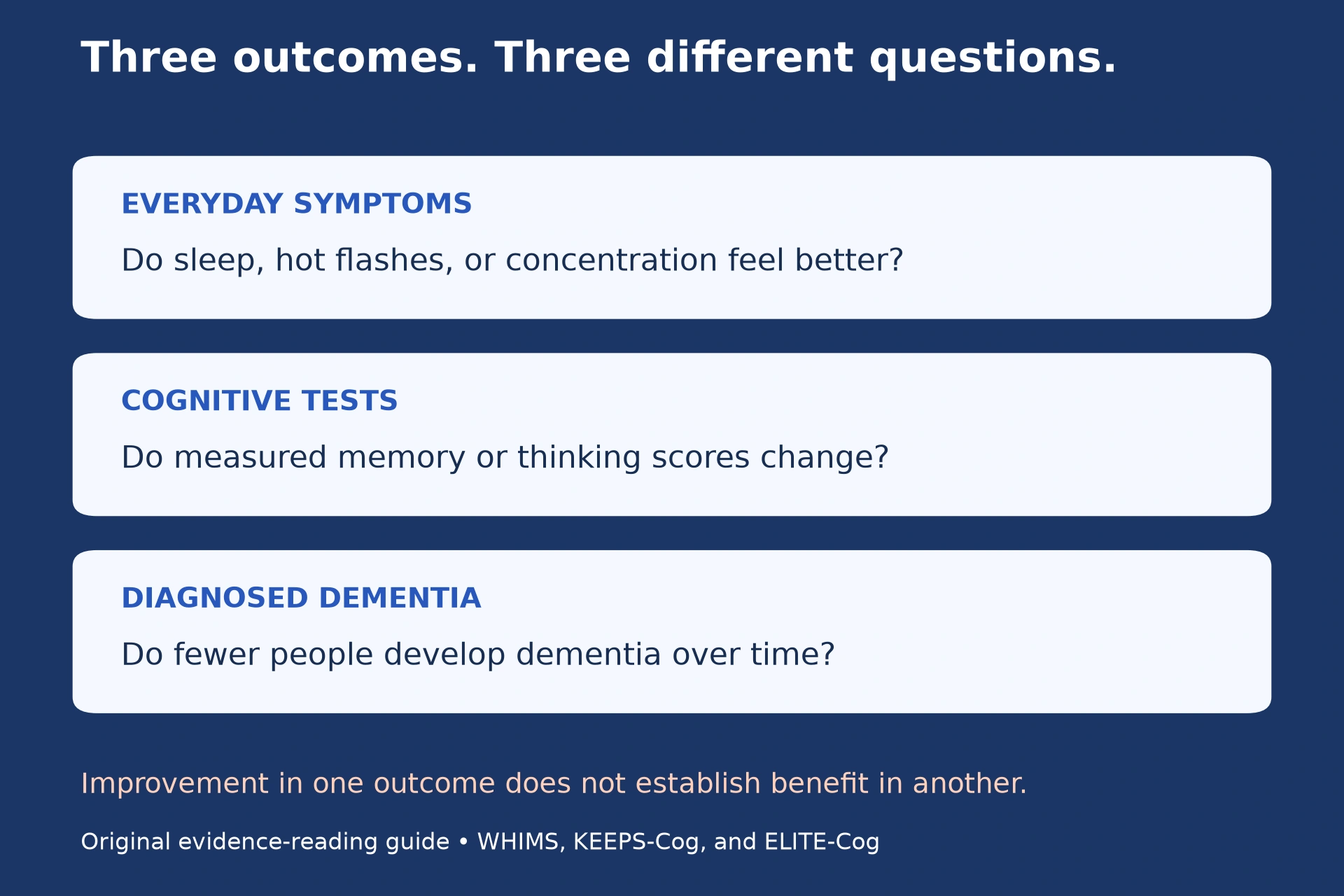
“Brain fog” describes experiences such as losing a word, struggling to concentrate, or feeling less mentally efficient. It is a symptom description, not a diagnosis of dementia. Sleep disruption, hot flashes, mood symptoms, and other health problems can overlap with these complaints. Mayo Clinic’s explanation emphasizes that symptom context. Mayo Clinic
Researchers can instead measure performance on tasks of memory, attention, or planning. These scores may help detect a treatment effect, but a few years of test results do not automatically answer whether someone develops dementia decades later. A study of diagnosed dementia requires a different outcome and enough follow-up to observe cases.
That distinction matters when a person reports better concentration after treatment. The improvement may be valuable without demonstrating a change in Alzheimer’s disease biology. Our guide to HRT, hot flashes, and sleep explains how to track symptom changes separately.
Watch: a short explanation of menopause brain fog
Mayo Clinic’s Dr. Juliana Kling introduces the symptom question in this 2023 video. Use it for context about menopause complaints; it is not a report of a dementia-prevention trial.
WHIMS: what the older-women dementia trial found
The Women’s Health Initiative Memory Study, or WHIMS, included a randomized trial of 4,532 women aged 65 or older who did not have probable dementia at entry. Participants received either oral conjugated equine estrogens, abbreviated CEE, plus medroxyprogesterone acetate, abbreviated MPA, or placebo. These are specific hormone formulations, not a test of every product called HRT.
The 2003 report recorded 40 probable dementia cases among 2,229 women assigned combined hormones, compared with 21 among 2,303 assigned placebo. Mean follow-up was about 4.05 years. The hazard ratio was 2.05, with a 95% confidence interval of 1.21 to 3.48. A hazard ratio compares the rate of an event over follow-up; it is not the percentage of participants who experienced the event. Original WHIMS combined-therapy report
What did that mean in absolute numbers?
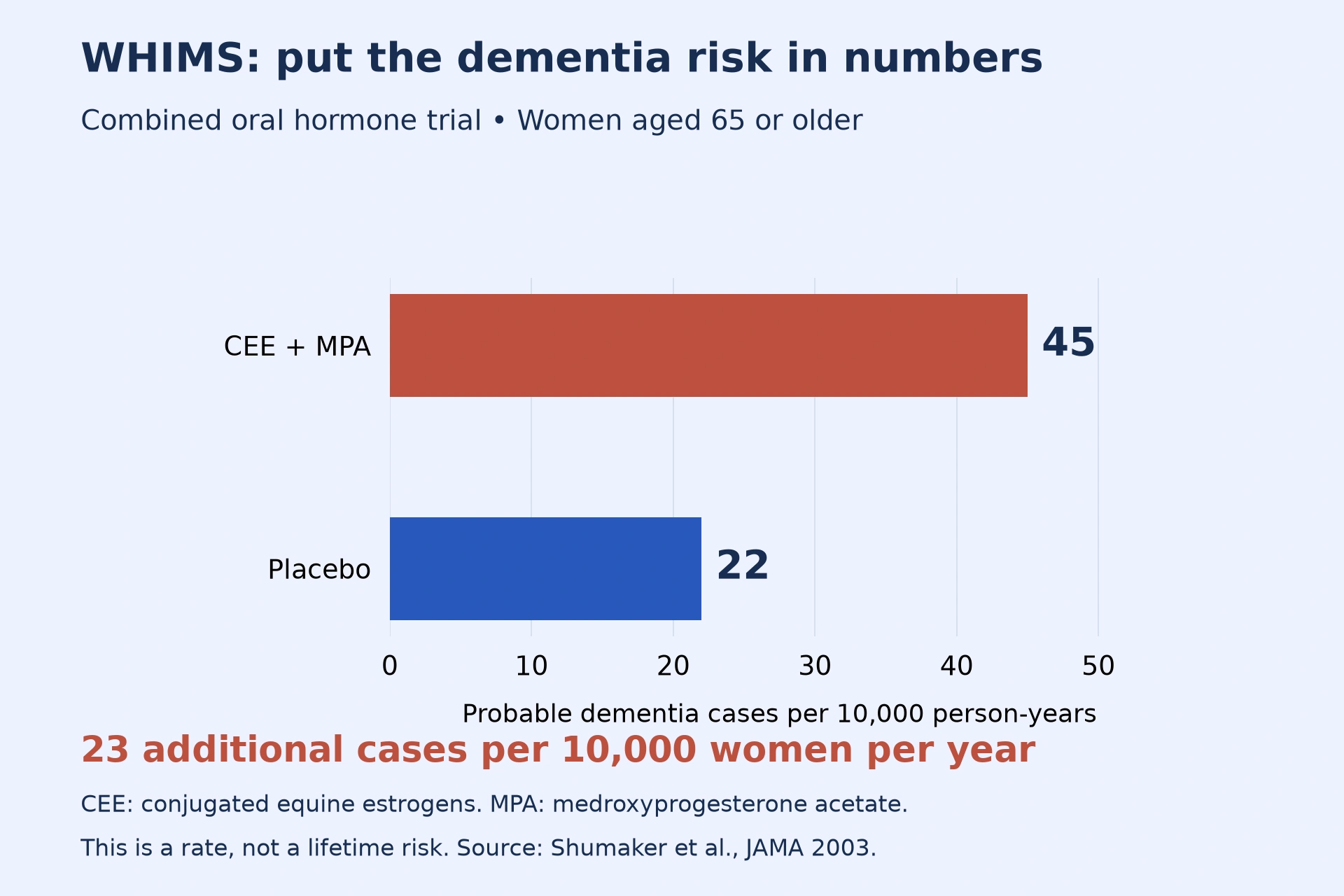
The reported rates were 45 versus 22 probable dementia cases per 10,000 person-years. The difference was about 23 additional cases per 10,000 women per year in this study population. Person-years combine the time participants contributed: 10,000 people followed for one year contribute 10,000 person-years.
That is a clearer description than “twice the risk” on its own. It also keeps the denominator and time period visible. These are annualized rates from this trial, not a prediction that a particular percentage of all HRT users will eventually develop dementia.
How far can the finding travel?
Random assignment makes WHIMS important evidence about the regimen and population studied. It does not make the result a direct estimate for a 48-year-old starting transdermal estradiol for hot flashes. Age, time since menopause, formulation, route, and treatment duration can differ.
The reverse inference is also unsupported: because WHIMS enrolled older women, it does not follow that HRT must protect younger women’s brains. That requires evidence from younger populations with appropriate outcomes. Our overview of HRT risks, benefits, and timing puts these questions within the broader treatment decision.
Estrogen alone: a separate WHIMS result
The 2004 WHIMS report included an estrogen-alone trial in 2,947 women, aged 65 to 79, with prior hysterectomy. It compared oral CEE with placebo. There were 28 probable dementia cases in the estrogen group and 19 in the placebo group; the hazard ratio was 1.49, with a 95% confidence interval of 0.83 to 2.66. Original estrogen-alone report
Because that interval includes 1, the dementia-only result was not statistically significant. It did not demonstrate a reduction, and the wide interval leaves uncertainty about the true effect. “Not statistically significant” does not mean the study proved the treatments identical. The combined endpoint of probable dementia or mild cognitive impairment was increased with estrogen alone in that report.
The two WHIMS regimens were not randomized against each other in one interchangeable group. Uterus status helped determine which trial a woman entered. Their results therefore should not be used as a head-to-head test proving that a specific progestogen caused the difference. For practical treatment context, see HRT after hysterectomy and why estrogen and progesterone have different roles.
KEEPS-Cog: testing treatment closer to menopause
KEEPS-Cog addressed a different population. Its 693 participants were, on average, 52.6 years old and 1.4 years past their final menstrual period. They were generally healthy, recently postmenopausal women with low cardiovascular risk.
The randomized groups received low-dose oral CEE, transdermal estradiol, or placebo. Both active estrogen groups also received cyclic oral micronized progesterone. Treatment was planned for four years. Cognitive analyses included 662 women with baseline and at least one follow-up assessment; mean cognitive follow-up was about 2.85 years. Neither hormone regimen produced a benefit in the measured cognitive outcomes. KEEPS-Cog, 2015
This is useful reassurance about the absence of a detected cognitive decline attributable to treatment over the study period in this selected population. It is not evidence that patches improve memory or prevent Alzheimer’s disease. The study was too small and too short to answer the dementia-incidence question.
Attrition also matters: roughly one quarter did not provide a cognitive assessment at month 48, although the statistical models used available earlier observations. Participants were predominantly White and well educated. These features limit how confidently the results apply to every person considering HRT.
ELITE-Cog: did earlier treatment improve memory?
The “timing hypothesis” proposes that hormone effects may depend on when treatment begins relative to menopause. ELITE-Cog tested this idea by comparing oral estradiol with placebo within two groups: women within six years of menopause and women 10 or more years past menopause. Women with a uterus also received cyclic vaginal micronized progesterone or matching placebo.
Among 567 women in the analysis, mean treatment duration was 57 months. For the primary verbal-memory measure, the standardized estradiol-minus-placebo difference was −0.06, with a 95% confidence interval of −0.22 to 0.09. This was not a statistically significant difference. There was no significant evidence that the treatment effect differed between the earlier and later groups. Executive function and global cognition also showed no significant treatment differences. ELITE-Cog, 2016
The result did not confirm an early window in which estradiol improved these cognitive abilities. It also was not designed to determine the risk of developing Alzheimer’s disease. A timing argument about symptom treatment or cardiovascular health cannot simply be transferred to dementia prevention.
These findings do not cover every situation involving estrogen deficiency. The authors specifically caution against generalizing to premature menopause, primary ovarian insufficiency, people in the menopausal transition, or those already living with cognitive impairment or dementia.
KEEPS Continuation: what longer follow-up added
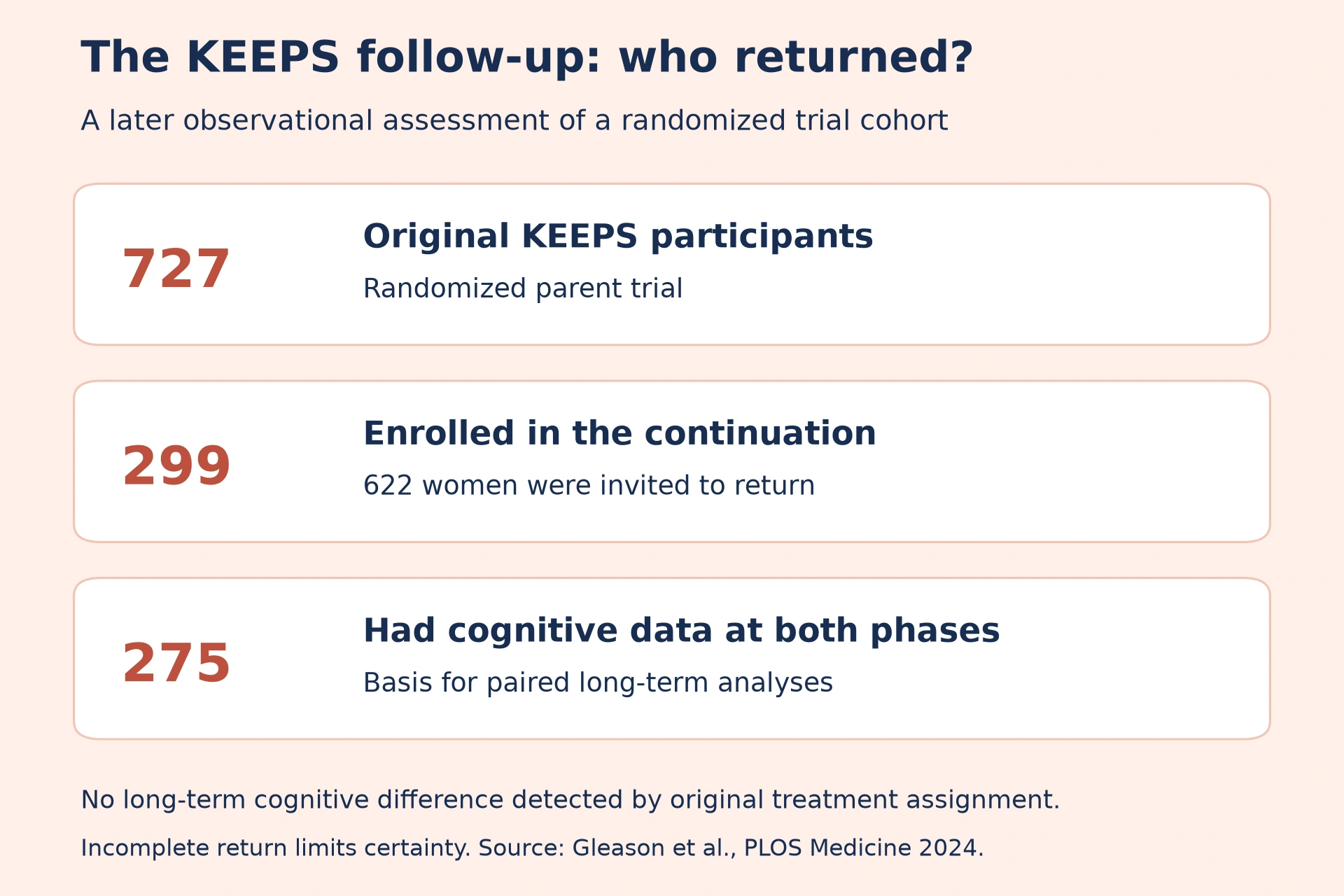
The 2024 KEEPS Continuation paper revisited the original cohort after the randomized treatment period had ended. Of 727 original KEEPS participants, 622 were invited to return, 299 enrolled in the continuation, and 275 had cognitive data from both phases. Investigators did not detect a long-term cognitive benefit or harm associated with original hormone assignment. KEEPS Continuation, 2024
This was an observational follow-up of a randomized cohort, not a new trial assigning continuous HRT throughout all the intervening years. Some participants used systemic hormones after the original trial. Many original participants did not return, and returners differed from nonparticipants on some baseline cognitive measures. Those limits matter when interpreting reassuring long-term results.
The continuation is also not an independent replication in an entirely new group of women. It extends information about KEEPS participants. Counting the two publications as two unrelated populations would overstate how much independent evidence is available.
The major trials at a glance
| Report | Population and design | What was measured | Main interpretation |
|---|---|---|---|
| WHIMS combined therapy, 2003 | 4,532 women aged 65 or older; randomized CEE plus MPA versus placebo | Probable dementia | Increased dementia rate with this regimen in this population |
| WHIMS estrogen alone, 2004 | 2,947 women aged 65–79 with hysterectomy; randomized CEE versus placebo | Probable dementia and mild cognitive impairment | No dementia-prevention benefit; dementia-only estimate was imprecise |
| KEEPS-Cog, 2015 | Recently postmenopausal women; oral CEE or estradiol patch versus placebo | Cognitive tests over up to four years | No cognitive benefit detected; not a dementia-incidence trial |
| ELITE-Cog, 2016 | Earlier and later postmenopause groups; oral estradiol versus placebo | Memory, executive function, global cognition | No detected cognitive benefit or treatment-by-timing difference |
| KEEPS Continuation, 2024 | Observational reassessment of the original KEEPS cohort | Longer-term cognitive performance | No detected effect of original assignment; incomplete return limits certainty |
The table is a map of different research questions, not a ranking of prescriptions. The linked original papers above provide the full methods and estimates.
What the 2026 UK Biobank study adds
In August 2026, Squires and colleagues reported an observational analysis of 183,450 postmenopausal women, with about 13.3 years of average follow-up and 3,948 dementia diagnoses. HRT exposure was self-reported. The exposed group included current users and women reporting at least a year of use; the reference group included never-users and those with shorter use.
After adjustment for measured health and social factors, HRT use was associated with an all-cause dementia hazard ratio of 0.90 (95% CI, 0.84 to 0.96). For Alzheimer’s disease specifically, it was 0.84 (95% CI, 0.77 to 0.92). These are relative associations, not reductions of 10 or 16 percentage points in an individual’s absolute risk. Original UK Biobank paper
Why the association does not establish prevention
Women who choose or receive HRT may differ from other women in education, healthcare access, underlying health, and behaviors. Statistical adjustment helps account for measured differences; it cannot guarantee removal of all differences that influence both treatment use and dementia risk. The authors identify this residual confounding and healthy-user selection as limitations.
The analysis also lacked information on formulation, dose, and route. It therefore cannot establish that a particular estradiol patch, estrogen tablet, progesterone capsule, or combination prevents dementia. Diagnoses came primarily from hospital records, which can miss milder disease or misclassify its subtype.
Read the subgroup headlines carefully
The study reported stronger associations in some groups, including women classified as having surgical menopause and those starting HRT at certain ages. Its surgical category included hysterectomy and/or removal of both ovaries; those procedures do not have identical hormonal consequences.
Although a favorable association appeared among APOE ε4 carriers, the overall statistical test did not establish a significant interaction between APOE status and HRT. In plain language, a significant result in one subgroup and a nonsignificant result in another does not itself prove that treatment effects differ between them.
These findings support further research. They do not validate APOE testing as a way to select an HRT prescription for dementia prevention, and they do not turn an observed age range into a proven prevention window.
What do current guidance and FDA label changes mean?
NICE’s menopause guideline advises against offering either combined or estrogen-only HRT specifically to prevent dementia. Its risk discussions distinguish estrogen-only treatment from combined treatment, including the potential increased dementia risk when combined HRT is started at age 65 or older. Guidance about appropriate menopause care should be read alongside the evidence, rather than inferred from one headline. NICE recommendations
In February 2026, the FDA announced approved labeling changes for six menopausal hormone therapy products, removing cardiovascular disease, breast cancer, and probable dementia risk statements from their boxed warnings. This followed the agency’s November 2025 initiative. A change to the most prominent warning is not approval of HRT to prevent dementia, and the announcement did not establish that every product’s label had already changed. Product-specific labeling and personal clinical assessment still matter. FDA announcement
What this means for an HRT consultation
Begin with the problem you want treatment to improve. Is it disruptive hot flashes, nighttime waking, vaginal symptoms, or another accepted indication? Our menopause hormone therapy guide provides the broader overview, while questions to ask before starting HRT can help prepare for the visit.
| Question to ask | Why it helps |
|---|---|
| What symptom or indication are we treating? | Sets a measurable goal without implying dementia prevention |
| Is the prescription systemic or local? | Prevents applying systemic-trial results indiscriminately to low-dose vaginal treatment |
| Which estrogen and progestogen are proposed, and why? | Connects the evidence to the actual formulation and uterus status |
| How will we assess persistent memory complaints? | Keeps sleep, mood, medications, and other possible causes in view |
| When will we review benefits, adverse effects, and continued need? | Makes follow-up part of the decision |
For readers exploring formulations, CoreAge Rx’s estrogen information page explains systemic and local options. The oral progesterone information page describes its role alongside systemic estrogen when appropriate; that page currently lists it as coming soon. These product descriptions do not establish dementia-prevention benefits or show that an offered formulation is identical to a trial regimen. A clinician determines whether any prescription is suitable.
Watch: expert discussion of cognitive complaints
In this May 2025 Menopause Society video, Dr. Pauline Maki discusses cognitive complaints in relation to hot flashes, mood, sleep, and treatment options. It offers clinical context rather than new randomized dementia evidence, and it predates the August 2026 UK Biobank paper discussed above.
Common questions about HRT and dementia risk
Should I start HRT only to lower my Alzheimer’s risk?
The evidence reviewed here does not establish that benefit, and NICE advises against HRT for dementia prevention. A symptom-based HRT discussion is a different decision. Family history and concerns about cognition deserve attention, but they do not convert HRT into a proven preventive treatment.
Does feeling clearer on HRT mean my dementia risk has fallen?
No such conclusion can be drawn from symptom improvement alone. Better sleep or fewer hot flashes may improve day-to-day functioning. Cognitive tests and later dementia diagnoses are separate outcomes, and neither can be inferred from feeling more focused.
Is an estrogen patch proven safer for the brain than a pill?
These studies do not establish that claim. KEEPS-Cog found no cognitive benefit with either its patch or oral regimen, and the 2026 observational study lacked route information. Route can matter for other aspects of care; our estrogen patch versus pill guide explains why those considerations need their own evidence.
Should everyone stop HRT at 65 because of WHIMS?
WHIMS does not directly answer whether a person who started treatment years earlier should automatically stop on a particular birthday. Initiating a regimen in an older study population and reviewing ongoing treatment are different decisions. Discuss the indication, formulation, health changes, and current benefits with the prescribing clinician; our guide to how long to take HRT explains that review.
What if memory problems are getting worse?
Do not assume progressive problems are simply menopause or wait for HRT to solve them. Difficulty managing familiar tasks, getting lost, or changes noticed by others warrant clinical assessment. Sudden confusion, new weakness, or trouble speaking can be stroke signs: call 911 immediately. CDC stroke guidance The practical menopause brain-fog guide covers symptom tracking and other explanations to discuss.
Original papers and supporting sources
This is an educational narrative review of selected major studies, not a systematic review or a treatment recommendation. The WHIMS summaries use the original published abstracts; KEEPS-Cog, ELITE-Cog, KEEPS Continuation, and the 2026 UK analysis were checked against accessible full texts. Study sizes overlap where a report follows an existing cohort. Evidence and product-page details were checked October 7, 2026.
- Shumaker SA, et al. Estrogen plus progestin and the incidence of dementia and mild cognitive impairment in postmenopausal women: WHIMS. JAMA. 2003;289:2651–2662. DOI: 10.1001/jama.289.20.2651.
- Shumaker SA, et al. Conjugated equine estrogens and incidence of probable dementia and mild cognitive impairment in postmenopausal women. JAMA. 2004;291:2947–2958. DOI: 10.1001/jama.291.24.2947.
- Gleason CE, et al. Effects of hormone therapy on cognition and mood in recently postmenopausal women: KEEPS-Cog. PLOS Medicine. 2015;12:e1001833. DOI: 10.1371/journal.pmed.1001833.
- Henderson VW, et al. Cognitive effects of estradiol after menopause: a randomized trial of the timing hypothesis. Neurology. 2016;87:699–708. DOI: 10.1212/WNL.0000000000002980.
- Gleason CE, et al. Long-term cognitive effects of menopausal hormone therapy: findings from the KEEPS Continuation Study. PLOS Medicine. 2024;21:e1004435. DOI: 10.1371/journal.pmed.1004435.
- Squires S, et al. Hormone replacement therapy and dementia risk among postmenopausal women: identifying responsive subgroups in the UK Biobank. Alzheimer’s & Dementia. 2026;22:e71679. DOI: 10.1002/alz.71679.
- NICE NG23: menopause identification and management, including recommendation 1.6.5 on dementia prevention.
- FDA: approved labeling changes to six menopausal hormone therapy products, February 12, 2026.
- Mayo Clinic: does menopause cause brain fog?, June 7, 2023; and The Menopause Society’s cognitive-complaints discussion, May 14, 2025.