Semaglutide is best known for its effects on blood sugar and body weight. The FLOW trial asked a different question: could it reduce serious kidney-related outcomes in adults who already had both type 2 diabetes and chronic kidney disease?
The answer was encouraging, but specific. FLOW supports a kidney-protection benefit in the population studied. It does not show that everyone taking semaglutide needs it for kidney protection, that it treats every kidney disorder, or that it replaces the other parts of kidney care.
What counts as kidney health in this research?
Two measurements help explain who entered FLOW. Estimated glomerular filtration rate, or eGFR, is an estimate of how well the kidneys filter blood. Urine albumin-to-creatinine ratio, or UACR, measures leakage of the protein albumin into urine relative to urine creatinine. They answer different questions. A person can have clinically important albumin leakage even before filtration becomes severely reduced.
A kidney-outcomes trial also distinguishes a laboratory change from an event that substantially affects a person’s health. A modest change in a blood test is not the same as needing dialysis. FLOW therefore used a predefined combination of major outcomes and examined the rate of filtration decline separately. Understanding that design makes the headline more useful than simply saying semaglutide is “good for the kidneys.” Read the original FLOW report.
For the basic medication questions, start with our semaglutide guide. This article focuses on the evidence behind the kidney claim.
Who participated in FLOW?
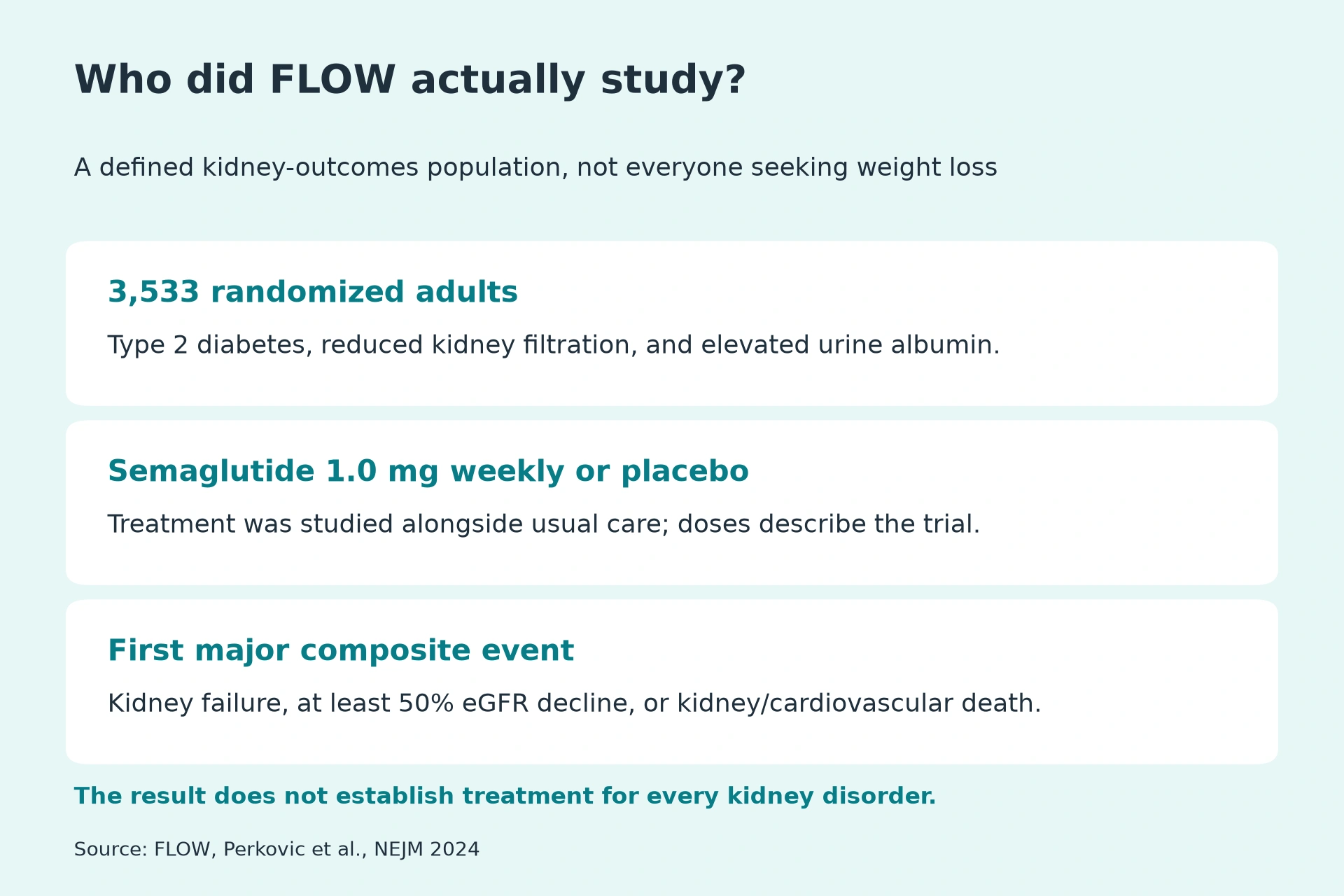
Participants had type 2 diabetes plus chronic kidney disease with specified combinations of reduced eGFR and elevated UACR. One eligible group had an eGFR of 50–75 with UACR above 300 and below 5,000 mg/g. Another had an eGFR of 25 to below 50 with UACR above 100 and below 5,000 mg/g. These were people at meaningful risk of further kidney and cardiovascular problems, rather than a general sample of people seeking weight loss.
Researchers assigned participants to subcutaneous semaglutide, targeting 1.0 mg weekly, or matching placebo. The treatment was studied alongside usual care. The dose and trial eligibility describe the research; they are not instructions for choosing or changing an individual prescription.
The study was stopped early after a prespecified interim review supported efficacy. Median follow-up was 3.4 years. Early stopping does not erase a randomized finding, but it matters when asking what the study can say about much longer treatment or very late effects. Novo Nordisk funded the trial.
What was the primary outcome?
The main outcome combined the first occurrence of:
- Kidney failure, including dialysis, transplantation, or an eGFR below 15.
- A sustained reduction of at least 50% in eGFR from baseline.
- Death from kidney-related or cardiovascular causes.
Including cardiovascular death makes clinical sense in a high-risk kidney population, but it also means the main result is not a dialysis-only result. “24% fewer kidney failures” is an inaccurate shorthand for the primary finding.
FLOW also reported a kidney-specific composite that omitted cardiovascular death. Its hazard ratio was 0.79, with a 95% confidence interval from 0.66 to 0.94. That supports a kidney-specific benefit while keeping the definitions clear. The exact question being counted matters as much as the headline percentage. FLOW methods and results.
How large was the difference in absolute terms?
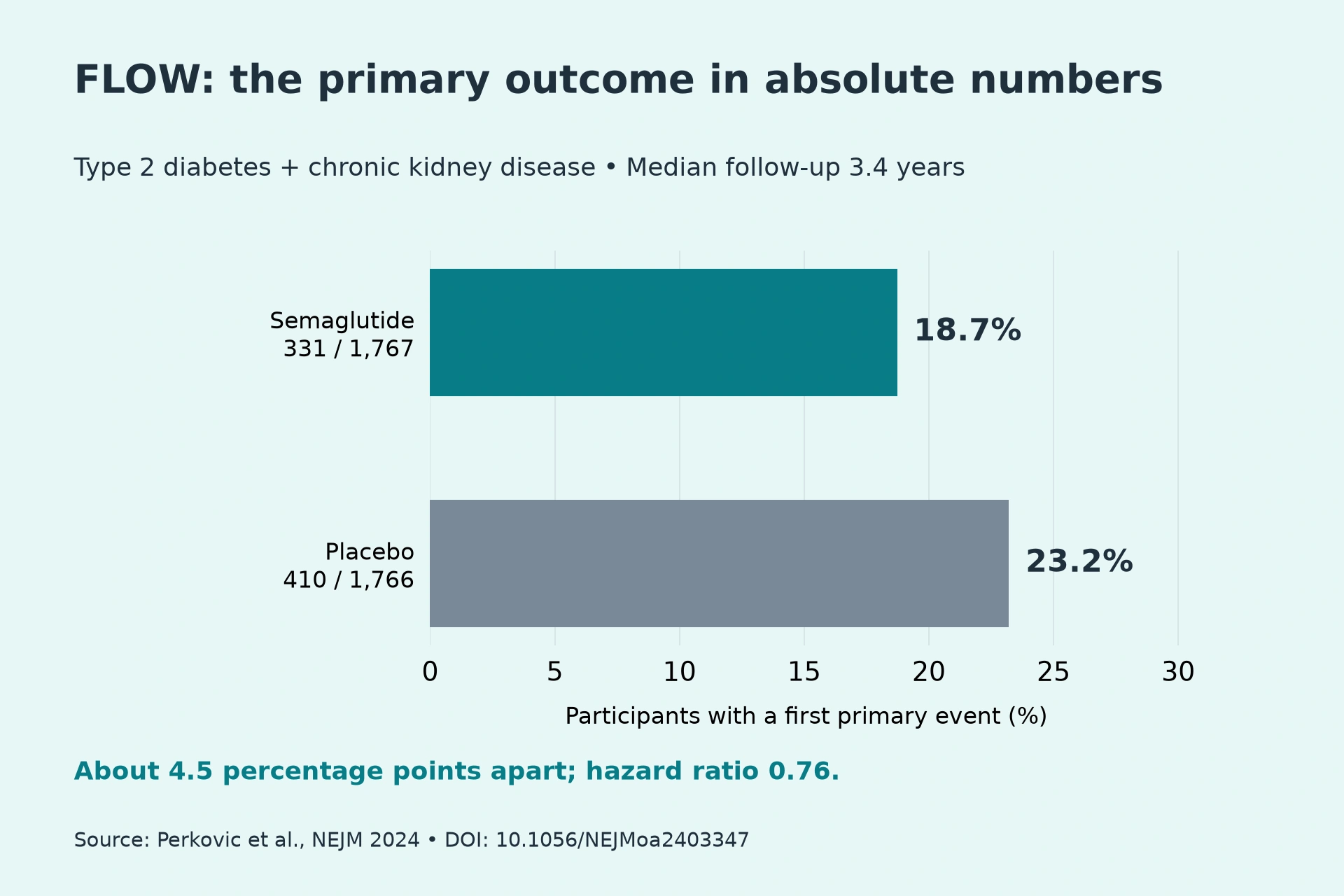
There were 331 first primary-outcome events among 1,767 people assigned semaglutide, compared with 410 among 1,766 assigned placebo. Dividing events by randomized participants gives approximately 18.7% versus 23.2%: a crude difference of about 4.5 percentage points during the study.
These simple proportions help readers picture the magnitude. They are not the same statistical measure as the trial’s time-to-event hazard ratio, which accounts for when events occur and follow-up. Neither figure is a personal prediction for someone with different kidney function, diabetes status, medications, or follow-up time.
The 95% confidence interval around the primary hazard ratio was 0.66–0.88. In practical terms, the data supported a benefit but did not pin its exact size to a single certain percentage. Reporting both the interval and the absolute counts is more informative than presenting 24% alone.
The mean annual fall in eGFR was also slower with semaglutide, with a between-group difference of 1.16 mL/min/1.73 m² per year. That describes a difference in the average slope of decline. It does not mean every participant’s eGFR rose by that amount, or that established kidney damage was reversed.
What did FLOW say about heart outcomes and survival?
Prespecified confirmatory analyses favored semaglutide for major cardiovascular events and death from any cause. The reported hazard ratios were 0.82 and 0.80, respectively. These outcomes reinforce why diabetes, kidney disease, and cardiovascular health are often managed together.
They should still be read within FLOW’s population. The evidence is distinct from trials that enrolled people primarily because of obesity and established cardiovascular disease. Our semaglutide heart-health research review explains SELECT and SOUL, while our HFpEF trial review looks at a different heart-failure question.
These are complementary bodies of evidence, not interchangeable reasons to prescribe. A person may meet the eligibility pattern of one trial but not another.
Can semaglutide add benefit to an SGLT2 inhibitor?
This is a clinically important question because SGLT2 inhibitors are another medication class used in diabetes and kidney care. A prespecified FLOW analysis divided participants according to whether they used an SGLT2 inhibitor at baseline. Only 550 of the 3,533 participants were in that subgroup. Read the original subgroup paper.
Among baseline SGLT2 inhibitor users, primary events occurred in 41 of 277 semaglutide participants and 38 of 273 placebo participants. The hazard ratio was 1.07, with a wide confidence interval of 0.69–1.67. Among nonusers, it was 0.73. The statistical test for a difference between subgroup effects was not significant.
That combination of findings needs careful wording. The analysis did not establish that semaglutide has no benefit when added to an SGLT2 inhibitor. It also did not prove a large additional kidney-event benefit in the smaller subgroup. There were too few participants and events for that level of certainty. The researchers specifically discussed the limited power and the value of a trial directly testing combination strategies.
For an individual, the useful next step is a review of the complete kidney-care plan, not choosing one drug from a comparison of subgroup headlines. Do not stop a prescribed SGLT2 inhibitor or blood-pressure medicine because another treatment has favorable research.
How can a kidney-protective medicine also carry a kidney warning?
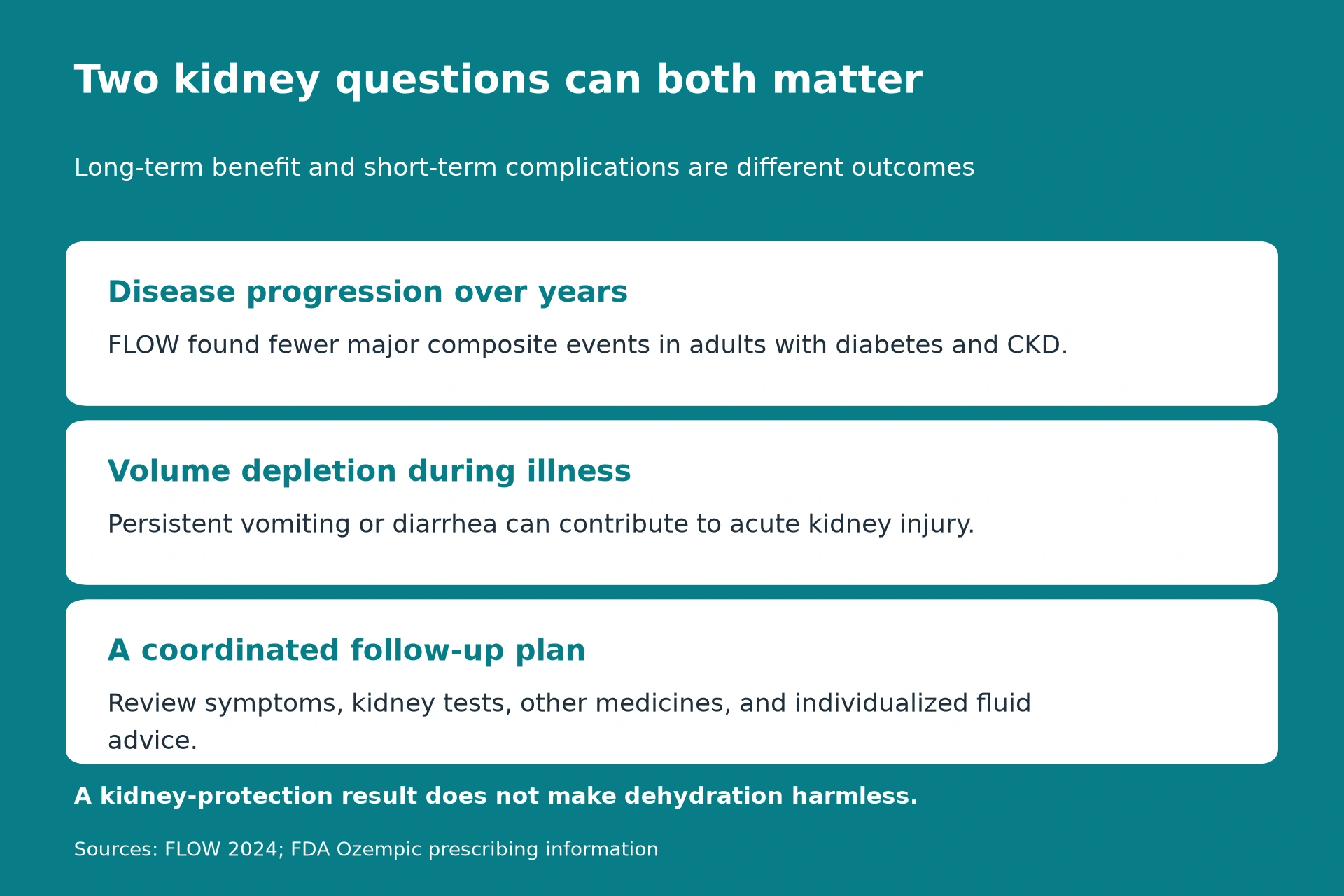
Long-term disease protection and short-term complications can coexist. Semaglutide commonly causes gastrointestinal symptoms. Persistent vomiting or diarrhea can reduce fluid intake and circulating volume, which can contribute to acute kidney injury. The current Ozempic prescribing information includes a warning about acute kidney injury due to volume depletion. See the FDA label.
This does not contradict FLOW. One finding concerns average outcomes over years in a defined population; the warning concerns a complication that can occur during treatment, especially when fluid losses are significant. Serious adverse events overall were reported in 49.6% of semaglutide participants versus 53.8% of placebo participants in FLOW, but an average safety comparison does not make an individual’s persistent symptoms harmless.
Our semaglutide nausea and vomiting guide explains what to report. People with kidney disease or heart failure should ask for individualized fluid advice rather than assume that drinking very large amounts is appropriate. Inability to keep fluids down, faintness, or markedly reduced urination warrants prompt medical assessment.
What is approved, and what should not be assumed?
The FDA-approved Ozempic injection label includes reducing the risk of sustained eGFR decline, end-stage kidney disease, and cardiovascular death in adults with type 2 diabetes and chronic kidney disease. The product, formulation, indication, and prescribed regimen matter. A result from injectable semaglutide cannot automatically be assigned to every product described with the same ingredient name. Current label.
If you are exploring care through CoreAge Rx, the semaglutide information page is a place to begin a product-specific discussion. Ask which formulation is being considered, its approval status and indication, and how the evidence applies to your diagnosis. FLOW should not be presented as proof that a different preparation has the same kidney outcome benefit.
The trial also does not establish semaglutide as a treatment for kidney stones. Our GLP-1 and kidney-stone guide addresses that separate concern. Similarly, research on semaglutide should not be relabeled as a tirzepatide trial; see our Mounjaro and kidney disease guide for questions about that medication.
Watch the publisher’s FLOW summary
This short NEJM video introduces the study question and main result. Use the paper and the discussion above for the endpoint definition, absolute counts, and limits of generalization.
Questions to bring to a kidney or diabetes appointment
- What are my current eGFR and UACR, and how have they changed? One result may need context from earlier tests and current illness.
- Do I resemble the population in FLOW? Diabetes type, kidney stage, albuminuria, and other conditions affect relevance.
- Which parts of my kidney-protection plan are already in place? Review blood pressure, glucose management, and the existing medication list together.
- What is the plan if nausea, vomiting, or poor intake develops? Ask whom to contact and which symptoms require urgent review.
- Which outcomes are we trying to improve? Weight, glucose, albuminuria, long-term kidney events, and day-to-day symptoms are related but different targets.
Common questions about semaglutide and kidneys
Does FLOW show that semaglutide cures chronic kidney disease?
No. It shows fewer major composite events and slower average filtration decline during follow-up. Cure, reversal of all damage, and elimination of future dialysis risk were not established.
Do I need diabetes to benefit?
FLOW enrolled people with type 2 diabetes. It cannot by itself answer the same kidney-outcomes question in people without diabetes. Other research may address other populations, but the FLOW result should keep its eligibility boundaries attached.
Should a lower eGFR make me stop treatment myself?
No isolated trial summary can answer that personal decision. A clinician needs to consider the size and timing of the change, hydration, illness, other medications, and the reason for treatment. Sudden symptoms or a sharp change merit timely review rather than self-adjustment.
Is the 24% figure the same as a 24% chance of avoiding dialysis?
No. It is a relative hazard reduction for a combined outcome that included cardiovascular death and substantial eGFR decline as well as kidney failure. The crude event proportions were about 18.7% and 23.2%, and neither is a dialysis-only percentage.
What is the most useful takeaway?
FLOW adds strong randomized evidence for semaglutide in a defined diabetes-and-CKD population. Its greatest practical value is helping a clinician and patient consider an additional evidence-based option within a complete care plan.
Original papers and supporting sources
The references distinguish full research papers, published abstracts, and official guidance. This educational narrative review is not a systematic review or an individual treatment recommendation. Sources were checked in October 2026.
- Perkovic V et al. Effects of Semaglutide on Chronic Kidney Disease in Patients with Type 2 Diabetes. (2024). Published abstract reviewed. DOI: 10.1056/nejmoa2403347.
- Mann JFE et al. Effects of semaglutide with and without concomitant SGLT2 inhibitor use in participants with type 2 diabetes and chronic kidney disease in the FLOW trial. (2024). Full text reviewed. DOI: 10.1038/s41591-024-03133-0. Open full text.
- FDA. Ozempic prescribing information. Current FDA product label.