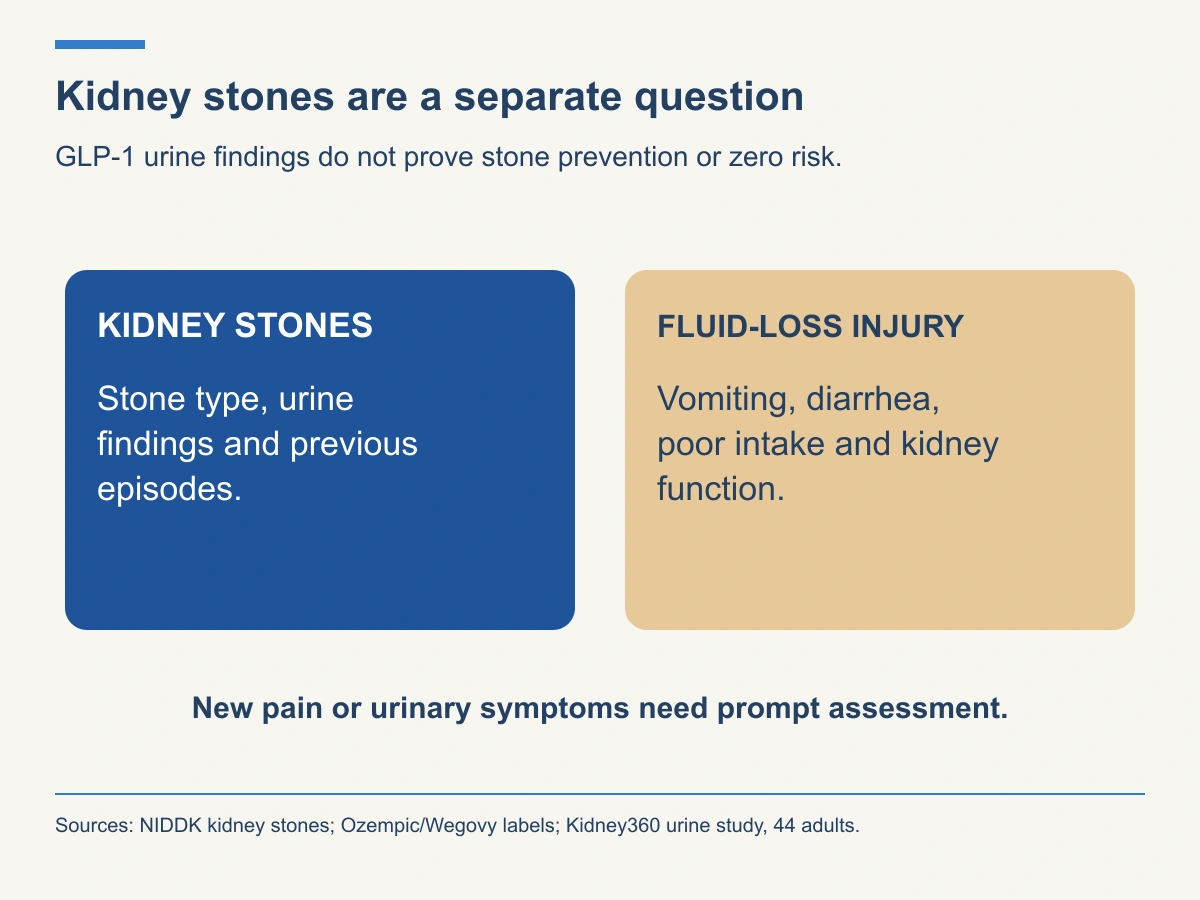
Kidney stones are not the same problem as the dehydration-related kidney injury described in GLP-1 medicine warnings. The evidence reviewed here does not establish that semaglutide or tirzepatide directly causes stones, but it also cannot guarantee that a person taking one will never develop a stone. Your previous stone history, fluid intake, symptoms, and the actual prescription all matter.
If you have sharp side or back pain, blood in the urine, painful urination, fever, or difficulty passing urine, seek prompt medical assessment. Do not assume a new pain is an ordinary injection side effect or wait for your next routine weight-management appointment. NIDDK stone symptoms
What is a kidney stone?
A kidney stone is a solid deposit that forms from substances in urine. NIDDK describes high levels of calcium, oxalate, and phosphorus as contributors to stone formation. These substances can normally be present without causing a problem; the conditions in the urine and the person’s susceptibility matter.
Stone type is useful information, especially after a previous episode. Calcium oxalate, calcium phosphate, uric acid, and cystine stones do not all lead to identical nutrition recommendations. A general instruction to eliminate every food associated with stones can leave someone with an unnecessarily restrictive diet. NIDDK causes, stone-specific nutrition
If you previously passed a stone or had it removed, ask whether a stone analysis is available. Bring the report to the clinician managing your weight medicine. Remembering only that you had “kidney trouble” leaves out the distinction between stones, infection, reduced kidney function, and an episode of dehydration.
What does the GLP-1 research actually show?
A retrospective study examined 44 adults with obesity and a history of kidney stones who received GLP-based treatment. Researchers compared 24-hour urine collections before and during treatment over a median follow-up of about 1.1 years. Participants used several medicines, including semaglutide and tirzepatide, and some switched between them. This was not a trial assigning people randomly to one medicine or another.
Urine oxalate decreased, while changes in the reported calcium oxalate, calcium phosphate, and uric acid supersaturation measures were not statistically significant. Supersaturation describes a chemical environment relevant to crystal formation; it is not a count of painful stone episodes. The authors specifically state that the study did not assess new stone events. Kidney360 primary study
That is reassuring information about the measured urine findings in this small group. It is not proof that a medicine prevents stones, that every GLP-1 product has the same effect, or that an individual’s stone was unrelated to treatment. Diet was not controlled, and the design could not separate medication effects from weight loss and changes in eating.
Stones and acute kidney injury: why the distinction matters
Ozempic and Wegovy labeling warns about acute kidney injury associated with volume depletion, often involving nausea, vomiting, or diarrhea. Volume depletion means the body has lost fluid. The warning calls for attention to symptoms and kidney monitoring when clinically appropriate; it does not describe all kidney problems as stones. Ozempic label, Wegovy label
| Question | Kidney-stone discussion | Fluid-loss kidney-injury discussion |
|---|---|---|
| What is the concern? | A stone forming or moving in the urinary tract | Kidney function being affected during fluid loss |
| What history helps? | Previous stones, analysis, prevention plan | Vomiting, diarrhea, intake, kidney disease and other medicines |
| What should be reported? | Side pain, blood in urine, painful or difficult urination | Poor fluid intake, less urine, persistent digestive symptoms or marked weakness |
| Can symptoms diagnose it? | No; evaluation may be needed | No; evaluation may be needed |
The problems can overlap, and a table cannot sort out a current episode. Describe all the symptoms together. “I have flank pain, vomited repeatedly, and am passing very little urine” is more useful than deciding in advance that it must be dehydration or must be a stone.
Our semaglutide nausea and vomiting guide explains what to report when digestive symptoms interfere with intake. The Mounjaro kidney-health guide covers a separate product-specific discussion.
How much water should you drink?
NIDDK identifies adequate fluid intake, mainly water, as a central part of stone prevention. It also directs people to discuss the appropriate amount with a health professional. Someone with kidney failure, heart-related fluid restrictions, or another individualized plan should not adopt a large internet water target without review. NIDDK prevention guidance
Make the conversation practical. Explain whether you avoid drinking because nausea makes it difficult, forget fluids during work, or cannot easily access a bathroom. A clinician or dietitian can help fit the plan to your routine. The point is consistent, suitable intake, not forcing a large amount at once or trying to flush out a prescription.
Ask what to do on days with vomiting, diarrhea, heat exposure, or unusually heavy activity. If you cannot keep fluids down or urine output falls markedly, seek timely advice. A routine hydration goal is not a treatment for an obstruction, infection, or significant kidney injury.

Do calcium stones mean you should stop eating calcium?
Not automatically. NIDDK explains that getting enough calcium from food can help because calcium in the digestive tract can bind substances that otherwise contribute to some stones. The name “calcium stone” does not mean all calcium-containing foods should be removed. Calcium and stone nutrition
Ask about the amount and sources appropriate for your stone type and overall health. A recommendation about food calcium is not automatically a recommendation to start a calcium supplement. Bring supplements, antacids, and fortified drinks to the review so the team can consider the complete intake.
If milk causes symptoms, our dairy and semaglutide guide discusses lactose-reduced choices and nutrient replacement. Avoid solving one concern by removing an entire food group without considering what will take its place.
What about high-protein diets and oxalate?
Stone-prevention advice may include changes to sodium, animal protein, or oxalate, depending on the stone. NIDDK also emphasizes that a person still needs enough protein. “More protein at any cost” and “avoid all protein” are both poor substitutes for an individualized eating plan. Stone-specific food guidance
Tell a dietitian if your weight-management routine now relies heavily on meat, cheese, packaged protein snacks, or repeated shakes. Bring actual labels and portions. A product marketed for fitness may still matter to sodium intake, and the word “plant-based” does not establish that every ingredient fits an oxalate plan.
Our protein and muscle guide explains why maintaining nutrition and function matters during weight loss. Use that goal alongside your stone-prevention plan. The balanced-meal guide can help organize alternatives without turning a list of possible restrictions into a very limited menu.
Could another medicine be relevant?
A medication review should include the complete list, not only the newest injection. The Kidney360 paper discusses prior evidence involving other weight-loss approaches, including topiramate, orlistat, and some bariatric operations. Its discussion does not mean those treatments have interchangeable mechanisms or that you should discontinue one yourself. Primary study and discussion
Include prescriptions for migraines, blood pressure, diabetes, and previous stones, as well as over-the-counter pain medicines and supplements. Explain any changes in dose or schedule. A urologist may need information from the weight-management prescriber, and the prescriber may need the results of your stone evaluation.
For pain-relief questions, see ibuprofen with semaglutide. That guide explains why current dehydration and kidney history affect an NSAID decision. Pain should not be repeatedly covered up while a worsening urinary problem goes unevaluated.
Does Ozempic’s kidney indication mean it prevents stones?
No. Ozempic has a labeled kidney risk-reduction indication for a specified population with type 2 diabetes and chronic kidney disease. That is a different clinical question from preventing urinary stones. A benefit demonstrated for one outcome and population should not be converted into a claim about every kidney condition. Ozempic indications
Similarly, the absence of a direct stone-causing conclusion here is not a personal clearance to start treatment. The clinician still needs to assess the actual indication, contraindications, tolerability, other medicines, and previous kidney history.
CoreAge Rx’s semaglutide and tirzepatide pages provide service information to discuss during an assessment. Compounded preparations are not FDA approved, and findings for a branded product or research cohort do not establish the same evidence for every compounded preparation. FDA compounding information

What should you bring to an appointment?
Prepare a short record with the medicine name and formulation, recent changes, dates of symptoms, and your previous stone reports if available. Note vomiting or diarrhea, approximate fluid intake, changes in urination, and any fever. Include the prevention plan you were already given rather than starting from scratch.
Useful questions include whether stone analysis or urine testing would help, whether food or fluid advice should change, and who will coordinate follow-up. Ask which symptoms need urgent care and what to do if illness affects the next medicine dose. Get product-specific instructions instead of independently skipping, repeating, or switching treatment.
Frequently asked questions
Can I have a stone while taking a GLP-1 medicine?
Yes. Taking a medicine does not make stones impossible. The available study cannot predict an individual’s risk or establish the cause of a new event. New urinary symptoms deserve assessment.
Is every episode of back pain a kidney stone?
No. Back pain has many possible causes. Sharp side pain with urinary symptoms is a reason to seek prompt medical advice, not a way to diagnose yourself. Fever, difficulty urinating, or severe illness makes waiting particularly inappropriate.
Should I stop my injection if I suspect a stone?
Seek assessment and ask the prescriber for instructions about the actual medicine. The symptom, hydration status, kidney findings, and treatment indication affect that decision. Do not let a dosing question delay urgent care.
Can drinking extra water guarantee prevention?
No. Suitable fluid intake is important, but prevention can also depend on stone type, diet, medicines, and other health conditions. A fluid plan should fit your clinical situation rather than promise that a stone will never recur.
Educational information for adults; individual treatment decisions require a qualified clinician. Sources reviewed October 6, 2026. Original AI-generated article images depict fictional people and objects, not patient outcomes. Other editorial images are illustrative. Graphics summarize the cited sources.