Tirzepatide’s sleep-apnea research is more specific than a claim that weight loss makes people snore less. The SURMOUNT-OSA program used overnight sleep testing in two randomized trials and measured changes in breathing interruptions, oxygen-related burden, and patient-reported sleep outcomes.
Those results helped support the FDA’s approval of Zepbound for moderate-to-severe obstructive sleep apnea in adults with obesity. They also raise practical questions: who was studied, how much did breathing improve, and does improvement mean someone can stop using a positive-airway-pressure device?
Start with the diagnosis, not the snoring
Obstructive sleep apnea, or OSA, involves repeated narrowing or blockage of the upper airway during sleep. Snoring can be one clue, but snoring alone neither establishes the diagnosis nor measures its severity. A sleep study records breathing events and other features that a bed partner, smartwatch, or symptom checklist cannot fully replace.
The apnea-hypopnea index, or AHI, counts apneas and hypopneas per hour of sleep. An apnea is a pause in airflow; a hypopnea is a partial reduction that meets the testing criteria. The trials used AHI to quantify the main outcome. This is a different measurement from body weight, daytime fatigue, or oxygen saturation at one moment.
For everyday diagnosis and treatment questions, our tirzepatide and sleep-apnea guide provides a practical introduction. Here, we examine the original research and the boundaries of the findings.
Why were there two SURMOUNT-OSA trials?
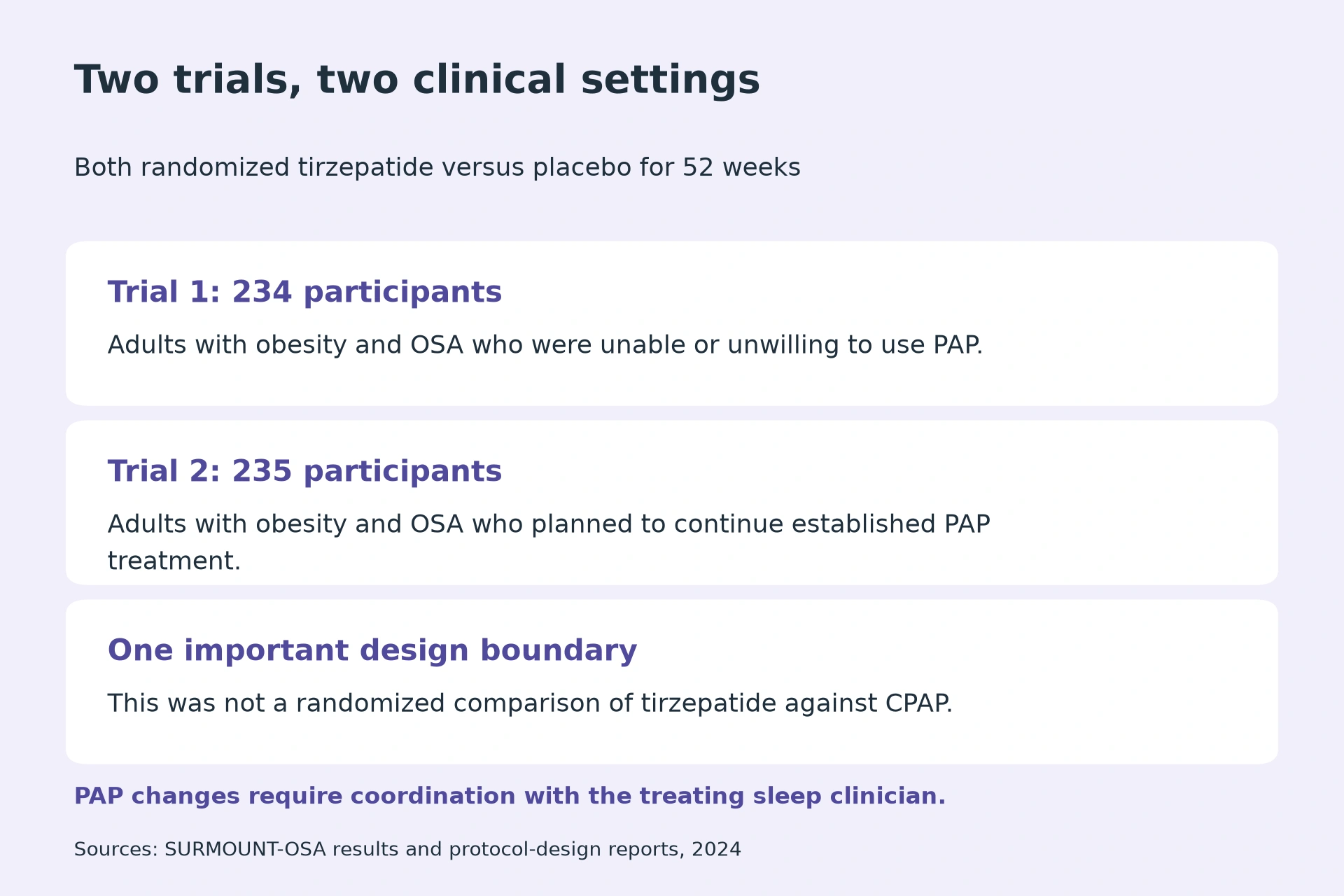
Both trials enrolled adults with obesity and moderate-to-severe OSA. Trial 1 included people unable or unwilling to use positive airway pressure, or PAP. Trial 2 included people who had used PAP for at least three consecutive months and planned to continue it during the study. Researchers randomized tirzepatide versus placebo separately within each group. Original results paper.
That design addresses two real clinical settings. It does not create a head-to-head comparison of tirzepatide against CPAP. Comparing the two trials’ results as though participants had been randomly assigned to “medicine or machine” would misread the study.
There were 234 participants in trial 1 and 235 in trial 2. Treatment lasted 52 weeks and targeted the maximum tolerated tirzepatide dose of 10 or 15 mg weekly after escalation. Participants also received lifestyle counseling. Eli Lilly funded the program. The separate design paper explains the planned methods; it is not a third independent efficacy trial.
What changed in breathing interruptions?
Participants generally had substantial disease at entry. Mean baseline AHI was 51.5 events per hour in trial 1 and 49.5 in trial 2. Those group averages help explain why a large numerical reduction was possible; the results should not be projected unchanged onto someone with only mild OSA.
At week 52, the estimated average changes were:
| Trial | Tirzepatide | Placebo | Estimated difference between groups |
|---|---|---|---|
| Trial 1: not using PAP at baseline | −25.3 events/hour | −5.3 events/hour | −20.0 events/hour |
| Trial 2: established PAP users | −29.3 events/hour | −5.5 events/hour | −23.8 events/hour |
The 95% confidence intervals for the between-group differences were −25.8 to −14.2 in trial 1 and −29.6 to −17.9 in trial 2. Both results strongly favored tirzepatide. These are changes in breathing events per hour, not percentage-point changes in the number of people with OSA. Trial results and outcome definitions.
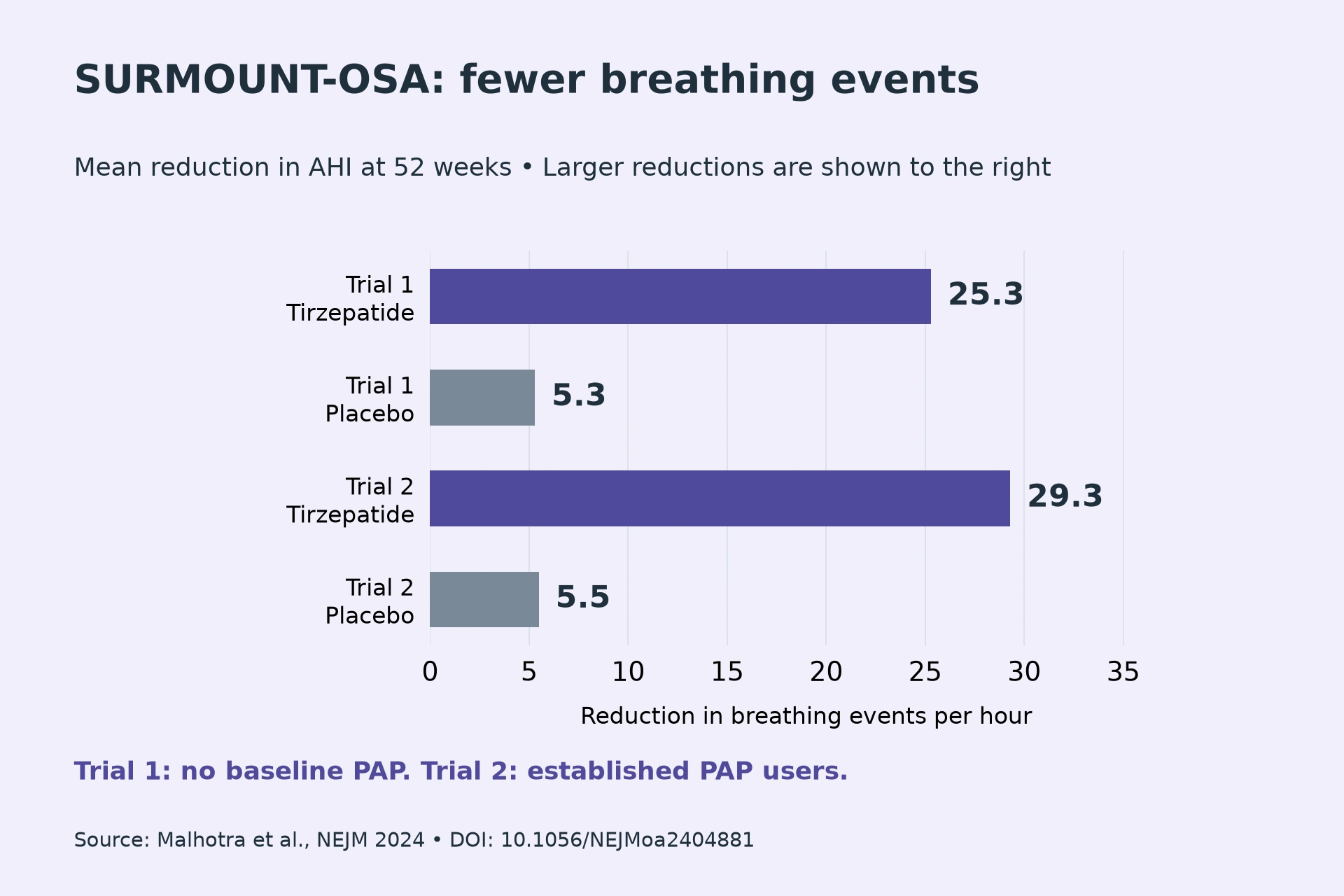
An average reduction of roughly 25–29 events per hour can be clinically meaningful in someone who starts with severe disease. But “meaningful improvement” and “no remaining sleep apnea” are different conclusions. Individual responses varied, and many participants continued to have residual disease.
Did participants become free of sleep apnea?
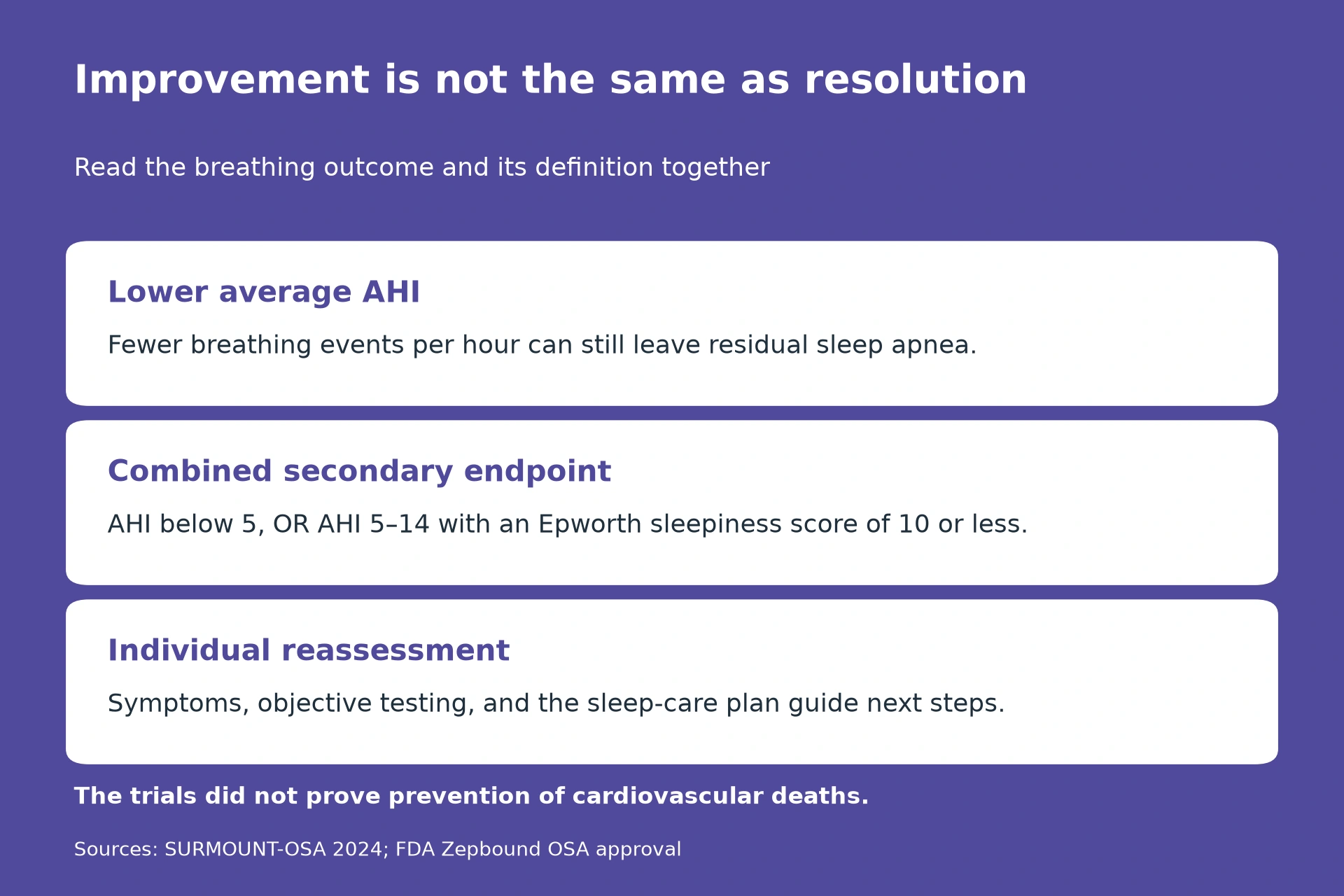
The study reported a combined secondary endpoint: either an AHI below 5, or an AHI of 5–14 accompanied by an Epworth Sleepiness Scale score of 10 or less. The second part allows some remaining breathing events with less daytime sleepiness. It is therefore broader than complete normalization of AHI.
The proportions meeting this combined endpoint were 42.2% with tirzepatide versus 15.9% with placebo in trial 1, and 50.2% versus 14.3% in trial 2. Calling all of these participants “cured” would erase the actual definition. Calling the trial a guarantee that half of every clinic’s patients can discard CPAP would go further still.
A treatment decision after weight loss requires review of symptoms, repeat objective testing when appropriate, other health conditions, and the sleep clinician’s assessment. Improvement in snoring or a lower number on the scale is not enough on its own.
The important detail about PAP during testing
Participants in trial 2 generally continued PAP as part of their usual treatment. For the research assessments, however, they were instructed to suspend PAP for seven days before selected sleep studies and patient-reported assessments, including the week-52 assessment. That protocol helped researchers measure underlying OSA without the immediate effect of PAP. Methods in the original paper.
This was a supervised research procedure. It should not be copied at home. A reader who only hears that participants were “on CPAP” might assume the reported AHI was measured while their machine was actively correcting their breathing. A reader who hears that they temporarily stopped it might assume stopping is routinely safe. Both interpretations miss the context.
Our TRT and sleep-apnea guide addresses a separate treatment consideration for readers also exploring testosterone therapy. Make sure every prescriber knows about the sleep-apnea diagnosis and the current treatment plan.
What about oxygen burden, blood pressure, and sleep quality?
Tirzepatide improved several prespecified secondary measures, including body weight, sleep-apnea-specific hypoxic burden, inflammation markers, systolic blood pressure, and reported sleep impairment or disturbance. Hypoxic burden summarizes features of event-related oxygen drops, such as their frequency, depth, and duration. It adds information beyond merely counting events.
Those findings strengthen the evidence that the treatment affected more than a single score. They do not establish that it prevented cardiovascular deaths or heart attacks in this population. The trials lasted one year and were not designed to answer long-term cardiovascular-event questions.
The authors also noted that the minimum clinically important changes for the particular PROMIS sleep questionnaires were not established in clinical practice. A statistically significant score difference needs interpretation; it should not automatically become a claim that every participant slept dramatically better.
For research involving actual heart-failure outcomes, see our semaglutide and tirzepatide HFpEF review. Different outcomes require their own evidence.
How much of the effect came from weight loss?
Excess body fat can contribute to upper-airway obstruction, so weight reduction is an important part of the clinical explanation. The FDA’s approval announcement states that the observed improvement in OSA was likely related to body-weight reduction with Zepbound. FDA approval announcement.
SURMOUNT-OSA does not let us cleanly divide each participant’s breathing improvement into a fixed percentage caused by weight loss and a fixed percentage caused by another mechanism. A plausible biological explanation is not the same as a directly randomized comparison of mechanisms.
This also means the findings do not automatically apply to people who have OSA without obesity. The original trials excluded that population. OSA can involve several anatomical and physiological contributors, and treatment remains individualized.
What does the FDA approval cover?
The FDA approved Zepbound, the branded tirzepatide product, for moderate-to-severe OSA in adults with obesity, alongside a reduced-calorie diet and increased physical activity. The announcement was dated December 20, 2024. It is a defined indication for a specific approved product, not a blanket approval of every product described as tirzepatide. FDA details.
If you are reviewing CoreAge Rx’s tirzepatide information page, ask about the exact preparation, approval status, indication, and coordination with sleep care. The trial should not be used to imply that a different formulation has independently demonstrated the same OSA outcome.
Our tirzepatide questions guide and comparison of semaglutide and tirzepatide can help organize that conversation. Semaglutide’s evidence should not be substituted for the SURMOUNT-OSA tirzepatide trials; our Ozempic and sleep-apnea article explains that distinction.
Side effects and ongoing treatment still matter
The most frequently reported adverse events in SURMOUNT-OSA were gastrointestinal, generally mild to moderate. Real-world tolerability can affect whether someone reaches or remains on a studied regimen. Persistent symptoms deserve a treatment review rather than pressure to match the trial’s target dose.
Read our tirzepatide nausea and reflux guide for practical reporting questions. The withdrawal-study review explains why maintenance planning belongs early in obesity treatment. SURMOUNT-OSA did not establish how long an OSA benefit persists after tirzepatide is stopped.
Watch the publisher’s study explanation
NEJM’s short video summarizes the two trials. The full paper remains the source for the exact endpoint definitions and the PAP-assessment protocol.
Questions for your sleep clinician
- What did my sleep study show beyond the overall AHI, including oxygen changes and sleep position?
- Do I meet the population and indication discussed in this research?
- How will my PAP treatment and any medication treatment be coordinated?
- What objective reassessment would be needed before changing device settings or considering discontinuation?
- How will side effects, weight maintenance, blood pressure, and daytime sleepiness be followed?
Common questions about the evidence
Is tirzepatide an immediate replacement for CPAP?
No. The trial evaluated a year of treatment and included a separate group that continued PAP in usual care. It did not compare starting tirzepatide with starting CPAP as interchangeable options, and it does not justify independently stopping a device.
Does less snoring mean the apnea has resolved?
Not necessarily. Symptoms and breathing-event measurements can move differently. A clinician may recommend repeat testing to assess the underlying disorder rather than relying on snoring alone.
Were people with diabetes included?
SURMOUNT-OSA excluded type 1 and type 2 diabetes. The approved indication and an individual’s overall care need to be evaluated separately from the exact trial enrollment rules. The results should not be described as a dedicated diabetes-and-OSA trial.
Did these trials show fewer heart attacks?
No. They showed improvements in OSA measures and several related risk markers. Long-term cardiovascular events were outside what this one-year program could establish.
What should someone take from the research?
Tirzepatide produced substantial improvements in objectively measured OSA in adults with obesity. The useful clinical question is how that evidence fits a coordinated sleep and weight-management plan, including reassessment of residual disease.
Original papers and supporting sources
The references distinguish full research papers, published abstracts, and official guidance. This educational narrative review is not a systematic review or an individual treatment recommendation. Sources were checked in October 2026.
- Malhotra A et al. Tirzepatide for the Treatment of Obstructive Sleep Apnea and Obesity. (2024). Full text reviewed. DOI: 10.1056/nejmoa2404881. Open full text.
- Malhotra A et al. Tirzepatide for the treatment of obstructive sleep apnea: Rationale, design, and sample baseline characteristics of the SURMOUNT -OSA phase 3 trial. (2024). Full text reviewed. DOI: 10.1016/j.cct.2024.107516. Open full text.
- FDA. First medication approval for obstructive sleep apnea, December 20, 2024. FDA approval announcement.