Appendicitis has been reported in clinical trials of Wegovy, but that finding does not prove that semaglutide causes appendicitis or establish the risk for every GLP-1 medicine. The immediate clinical issue is more straightforward: new, severe, persistent, or worsening abdominal pain should not be dismissed as an expected medication side effect.
If you think you may have appendicitis, seek medical care immediately. Do not wait for your next injection day, a routine follow-up, or an online reply. Understanding a possible medication association can come after the urgent symptoms have been assessed.
What does the Wegovy label actually report?
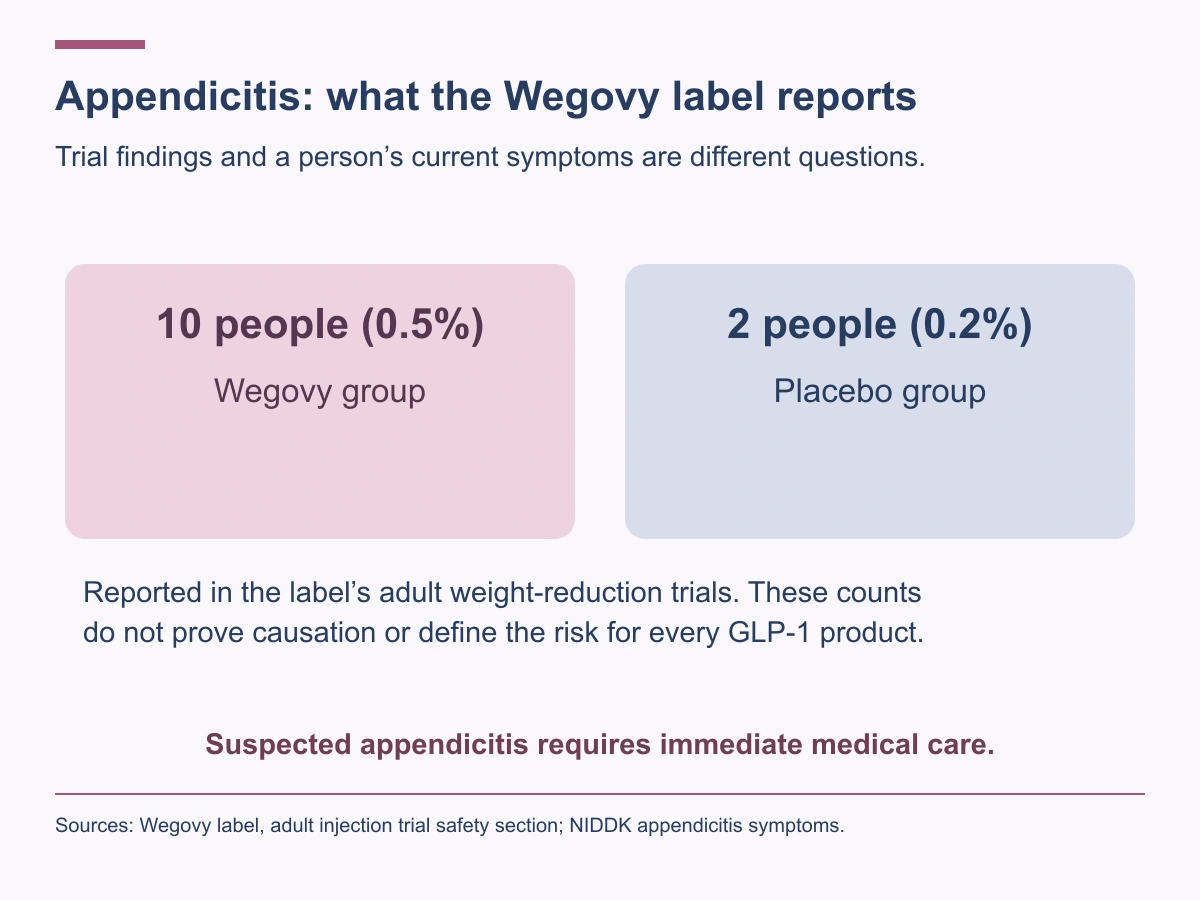
The current Wegovy prescribing information reports appendicitis, including perforated appendicitis, in 10 treated adults, or 0.5%, and two placebo recipients, or 0.2%, in the relevant weight-reduction clinical trials. The statement appears in the adult injection trial safety information. Wegovy prescribing information.
These are small numbers of observed events in defined trial populations. They are not a yearly risk estimate, a lifetime risk, or the chance that an individual’s current stomach pain is appendicitis. The percentages also should not be applied automatically to oral semaglutide, a different dose, another brand, or tirzepatide.
| What the finding tells us | What it does not establish |
|---|---|
| Appendicitis occurred in participants in both groups | That every event in the treatment group was caused by the medicine |
| The reported proportion was higher in the Wegovy group | A precise personal prediction or a class-wide rate |
| The label includes the finding for clinicians to consider | A diagnosis based on symptoms or injection timing alone |
A careful article needs both parts: acknowledge the finding and preserve its limits. Ignoring the label would be incomplete; converting it into a universal causal claim would also go beyond the evidence.
Why does “reported after treatment” differ from “caused by treatment”?
A health event can occur during treatment for several reasons. It may be related to the medicine, to an underlying condition, or to something that would have happened regardless. Randomized trials help compare groups, but an individual safety observation still needs interpretation, especially when events are uncommon.
Case reports can also draw attention to a possible problem. They are useful for describing what happened to a particular person, but they do not provide a reliable denominator: they do not tell us how many people took the medicine without the event. A report alone cannot produce a meaningful incidence rate.
For readers, the practical consequence is to avoid two shortcuts. A headline about a possible association should not become a personal diagnosis. At the same time, uncertainty about causation should not delay care for concerning pain.
What are the symptoms of appendicitis?
NIDDK describes abdominal pain as the most common symptom. It may begin near the belly button and move toward the lower right side, worsen over hours, or become worse with movement, coughing, or deep breathing. Nausea, vomiting, appetite loss, fever, and abdominal swelling can also occur. NIDDK appendicitis symptoms.
Not everyone has the classic pattern. Some people lack typical symptoms, so the absence of fever or a textbook location does not safely rule it out. Constipation or diarrhea can occur too, which makes it particularly unhelpful to assume that every bowel change is a familiar GLP-1 effect.
Appendicitis is a medical emergency. If it is suspected, NIDDK advises immediate evaluation. The purpose of recognizing possible symptoms is to obtain care, not to confirm the diagnosis at home.
Can I tell the difference from ordinary medication nausea?
Not reliably from a symptom checklist alone. GLP-1 medicines can cause gastrointestinal symptoms, and their labels also describe more serious conditions that may present with abdominal pain. A change in severity, persistence, location, or accompanying symptoms is important information for a clinician.
Do not let a previous mild episode determine how you respond to a new one. Pain that feels different, worsens, or prevents normal activity deserves assessment. Repeated vomiting, an inability to keep fluids down, or feeling seriously unwell should also prompt timely care.
Our Wegovy stomach-pain guide and semaglutide nausea and vomiting guide explain related questions. Neither replaces emergency assessment when appendicitis or another acute problem is possible.
What other conditions may need consideration?
Abdominal symptoms can have many causes, including gallbladder disease, pancreatitis, urinary problems, intestinal obstruction, and reproductive-system conditions. A clinician considers the symptom pattern, medical history, examination, and testing rather than choosing a diagnosis solely from the medication list. NIDDK diagnostic overview.
Wegovy and Mounjaro labeling includes pancreatitis warnings. Persistent or severe abdominal pain, sometimes extending to the back and with or without vomiting, needs urgent attention. If pancreatitis is suspected, the labeling directs discontinuation and appropriate medical management. Do not wait to sort out whether the pain is pancreatic or appendiceal yourself. Wegovy label; Mounjaro label.
Pain with urinary symptoms also deserves assessment. Our Mounjaro, Zepbound, and back-pain guide and GLP-1 kidney-stone guide discuss those separate possibilities without assuming the medicine caused them.

Does constipation mean the appendix is blocked?
No. Constipation does not diagnose appendicitis, and most discussions of constipation should not be turned into a claim that a person’s appendix is obstructed. NIDDK lists several possible causes of appendicitis, including material that blocks the appendix, enlarged tissue after infection, and inflammatory bowel disease; in many cases the cause is unclear. NIDDK causes.
That information does not establish a proven chain from GLP-1 treatment to constipation to appendicitis in an individual. A plausible explanation is not the same as demonstrated causation.
If constipation comes with severe or worsening pain, vomiting, marked swelling, or inability to pass gas, seek medical advice promptly rather than assuming that additional home treatment will settle it. Our constipation guide covers ordinary management questions, but suspected acute abdominal illness requires its own assessment.
How do clinicians diagnose appendicitis?
The assessment typically includes your symptoms and medical history, a physical examination, and selected laboratory or imaging tests. Blood tests can help identify inflammation or problems such as dehydration. Urine testing and pregnancy testing may help evaluate other causes or guide imaging decisions. NIDDK diagnosis.
Ultrasound, CT, or MRI may be used depending on the clinical situation. The choice is individualized; not every patient needs the same test. Imaging can also identify another explanation for the pain or complications that change treatment.
Avoid using online descriptions of examination maneuvers as a home diagnostic test. Pressing on your abdomen or trying to reproduce a particular response cannot safely replace a professional assessment. It can also provide false reassurance if the response is not what you expected.
What should you tell the emergency or urgent-care team?
Bring or describe the exact medicine, route, dose, and time of the last dose, along with other prescriptions and supplements. If your medicine is compounded, include the dispensing label or a clear photo of it so the team can identify the preparation and concentration.
Explain when the pain began, where it started, whether it moved, and how it has changed. Mention vomiting, fever, bowel or urinary changes, recent food or fluid intake, previous abdominal operations, and any possibility of pregnancy when relevant.
Do not delay seeking care while trying to assemble perfect records. A brief accurate account is enough to begin. The clinical team can clarify details while assessing you.
What if surgery or sedation is needed?
Tell the anesthesia team that you use a GLP-1 medicine. Wegovy and Mounjaro labeling discusses delayed gastric emptying and reported pulmonary aspiration during general anesthesia or deep sedation. The team needs the exact product and recent dosing history when planning care. Wegovy anesthesia warning; Mounjaro anesthesia warning.
An urgent condition should not be managed by following a generic internet instruction to wait a certain number of days after an injection. The treating team decides how to address urgency and anesthesia-related considerations together.
Our semaglutide and surgery guide is useful background for planned procedures. For suspected appendicitis, the immediate priority remains prompt evaluation and the instructions of the clinicians treating the acute problem.
How is appendicitis treated?
Treatment depends on the findings and whether complications are present. NIDDK describes surgical removal of the appendix as the usual approach and notes that antibiotics alone may be appropriate for some selected cases. A burst appendix, abscess, or other complication changes the treatment plan. NIDDK treatment overview.
The choice cannot be made from the name of a weight or diabetes medicine. Do not use leftover antibiotics or try to manage suspected appendicitis with a laxative, supplement, or dietary change while waiting for it to pass.
After treatment, follow the surgeon’s or clinician’s recovery instructions. Ask the prescribing team how diabetes or weight-management care should be coordinated during recovery, especially if eating is limited or doses have been missed.

Should I stop my GLP-1 medicine permanently?
An article cannot decide that for you. The answer depends on the diagnosis, the medicine’s role, the course of the illness, and the treating team’s assessment. Seek urgent advice about the next dose when significant symptoms develop rather than continuing or permanently stopping based on a general rule.
After an interruption, do not assume you should restart at the previous dose. Our missed semaglutide doses guide and missed tirzepatide doses guide explain why product-specific instructions and the length of the gap matter.
Questions people often ask
Is the Wegovy figure the same for Mounjaro or Zepbound?
No. A trial figure for one product and population is not a class-wide estimate. Different drugs, doses, populations, and study designs cannot be treated as identical simply because the medicines affect related pathways.
Can appendicitis happen without a fever?
Yes, a person may not have the classic collection of symptoms. Absence of fever should not be used to dismiss worsening abdominal pain or to delay evaluation when appendicitis is suspected. NIDDK symptom guidance.
Does pain right after an injection prove a medication reaction?
No. The timing is worth reporting, but it does not establish a cause. A new acute condition and a medicine-related effect can both require medical attention; the response should be based on the symptoms and assessment, not an assumption about timing.
What is the most important action?
Treat possible appendicitis as urgent. Bring the medication details, describe the symptoms clearly, and let the clinical team determine the cause and treatment. The uncertainty around a drug association is a research question; concerning symptoms are a care question that should be addressed now.
Educational information for adults; individual treatment decisions require a qualified clinician. Sources reviewed October 6, 2026. Original AI-generated article images depict fictional people and objects, not patient outcomes. Other editorial images are illustrative. Graphics summarize the cited sources.