Low libido in women can reflect changes in health, medicines, sleep, stress, relationships, comfort, or life stage. It does not automatically mean that a hormone level is low or that treatment is necessary. What matters is how your desire has changed, whether the change bothers you, and what else is happening in your life and body.
If you want help, a useful assessment looks beyond a single symptom or laboratory result. Desire, physical arousal, orgasm, and pain are related but different experiences. Understanding which concern matters most to you can make the conversation more productive and the treatment more relevant.
Is low desire always a medical problem?
No. People vary in how often they want sexual activity, and preferences can change over time. There is no universal frequency that defines a healthy sex life. A mismatch between your preferences and someone else’s expectations does not automatically mean something is wrong with you.
ACOG notes that it can be normal not to feel desire until sexual activity has begun. This is sometimes described as responsive desire. It does not mean you should participate in unwanted activity or push through discomfort. Interest, consent, comfort, and your own wishes all matter. ACOG sexual-health guidance.
A persistent change that causes distress is worth discussing, especially when it differs from your usual experience. You can also seek help for pain, dryness, relationship difficulties, or medication effects without first deciding whether you meet the definition of a sexual disorder.
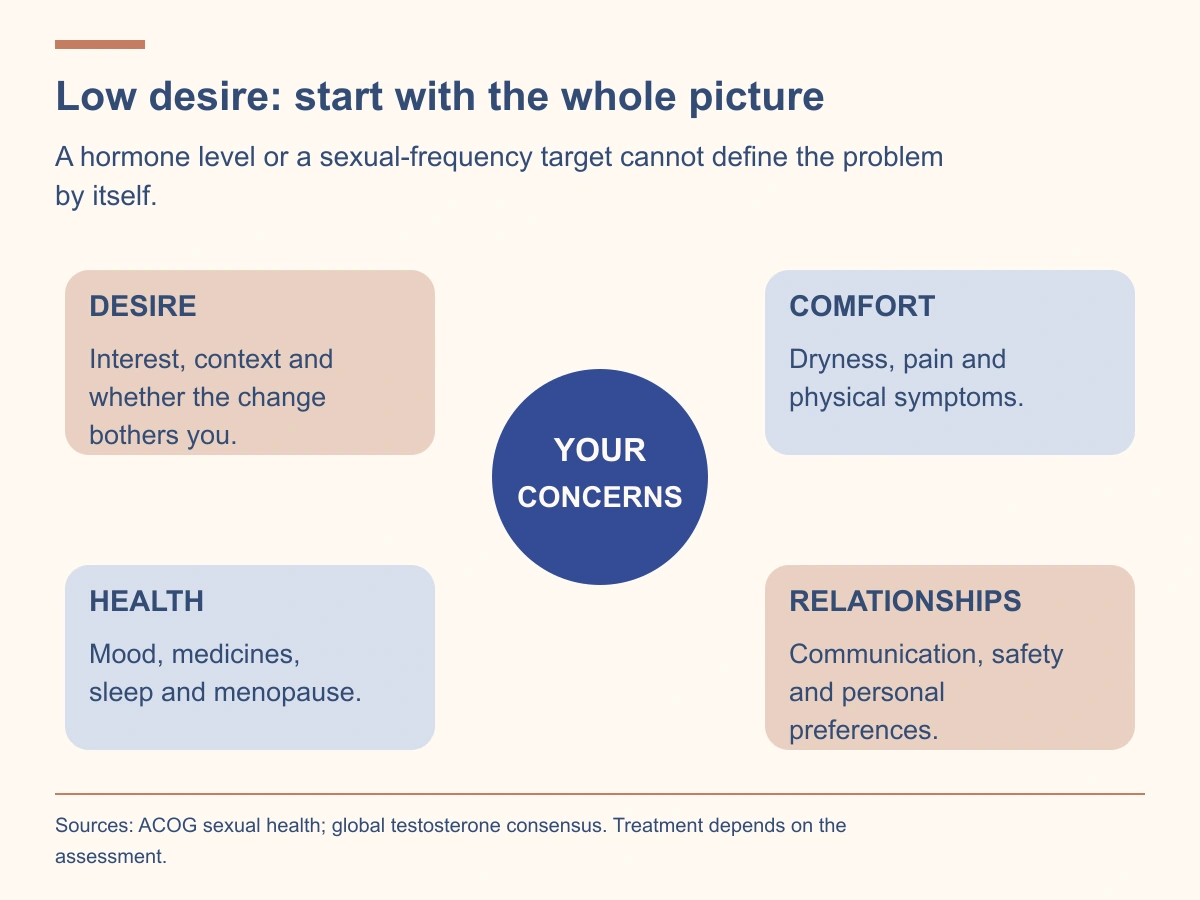
Separate desire, arousal, orgasm, and comfort
The phrase “low libido” can hide several different questions. Someone may want intimacy but avoid it because penetration hurts. Another person may feel interested but have difficulty becoming physically aroused. Someone else may notice delayed orgasm after starting an antidepressant.
| Concern | A useful way to describe it |
|---|---|
| Desire | “My interest has changed, and that change bothers me.” |
| Arousal | “I feel interested, but my physical or emotional response is different.” |
| Orgasm | “Reaching orgasm is harder, slower, or less satisfying than before.” |
| Pain or dryness | “Discomfort is making sexual activity unpleasant or something I avoid.” |
| Relationship context | “Our expectations differ, or I do not feel comfortable or safe.” |
These categories can overlap. A clinician should not assume that a medicine advertised for desire will solve pain, or that a lubricant will address every reason for low interest. ACOG describes separate approaches depending on the actual concern. ACOG assessment and treatment overview.
What can contribute to a change in libido?
ACOG lists hormonal transitions, some illnesses and medications, cancer treatment, depression, anxiety, stress, relationship difficulties, and past negative sexual experiences among possible contributors. Sleep, physical comfort, and how you feel about your body can also influence the experience. ACOG causes and arousal discussion.
That range is a reason to ask broad questions, not to assume the cause is purely psychological. Physical symptoms and life circumstances often interact. Pain can reduce interest, disrupted sleep can leave little energy for intimacy, and worry about symptoms can make an encounter feel pressured.
A useful history includes when the change began, whether it happens in every setting, and whether there was a new medicine, illness, pregnancy-related change, or major stressor around the same time. Timing helps frame the assessment but does not prove a single cause.
How can menopause affect sexual wellbeing?
Perimenopause and menopause can coincide with changes in sleep, hot flashes, vaginal comfort, and sexual experience. Some people mainly notice dryness or pain; others notice a broader change in interest. Those are different treatment targets.
ACOG discusses vaginal moisturizers, lubricants, vaginal estrogen, and other options for specific comfort-related concerns. Addressing pain or dryness may make intimacy more comfortable, but that should not be presented as a guaranteed treatment for every form of low desire. ACOG treatment guidance.
Our vaginal estrogen versus systemic HRT guide explains why local and systemic treatments are not interchangeable. The broader menopause hormone therapy guide and HRT risks and benefits article can help you prepare questions about your symptoms and medical history.
If you are reviewing CoreAge Rx’s estrogen treatment information, ask which symptoms the proposed treatment is intended to address and what follow-up it requires. A hormone product should not be assumed to be a universal libido treatment.
Could an antidepressant be contributing?
Yes, some antidepressants can affect sexual function. Lexapro’s label describes decreased libido and delayed or absent orgasm in women and emphasizes that the underlying psychiatric condition can also contribute. Zoloft labeling likewise includes sexual adverse effects. Lexapro sexual-dysfunction information; Zoloft prescribing information.
The timing and the specific symptom matter. It is useful to explain whether interest changed, orgasm became more difficult, or discomfort appeared. A clinician may consider several approaches while also protecting the benefits of psychiatric treatment.
Do not abruptly stop an antidepressant to test whether desire returns. Both labels describe problems associated with abrupt discontinuation and recommend a gradual reduction when stopping is appropriate. The prescriber should guide that decision. If you also take tirzepatide, our Mounjaro and antidepressant guide covers coordination of the broader medicine plan.

What is HSDD?
Hypoactive sexual desire disorder, or HSDD, is a clinical term used in the indications for certain desire treatments. Those drug labels describe acquired, generalized low desire that causes marked distress or interpersonal difficulty and is not explained by specified medical, psychiatric, relationship, or medication factors. “Acquired” means it developed after a period without the problem; “generalized” means it is not confined to a particular situation or partner.
The clinical assessment is more nuanced than checking a few boxes online. A low score on a questionnaire or an infrequent sex life does not by itself establish eligibility for a prescription. The reason for the change, your preferences, and competing explanations matter. Addyi indication; Vyleesi indication.
If medication effects, painful sex, depression, or relationship issues are central, those deserve direct attention. A label that excludes medication-induced low desire should not be treated as automatically covering that situation.
Which prescription treatments are currently relevant?
Two FDA-approved medicines have specific HSDD indications, and their current labels differ. This summary was checked on October 6, 2026; it is an orientation for discussion, not a recommendation to start either product.
| Treatment | Current labeled population and important distinctions |
|---|---|
| Addyi, or flibanserin | Women younger than 65 with acquired, generalized HSDD meeting the label’s criteria; taken regularly at bedtime |
| Vyleesi, or bremelanotide | Premenopausal women with acquired, generalized HSDD meeting its criteria; an injection used as directed before anticipated sexual activity |
Addyi’s December 2025 labeling changed the indication to women under 65, rather than limiting it to premenopausal women. Older articles can therefore give an outdated account. It still is not a general sexual-performance enhancer, and eligibility requires the specific assessment in the label. Current Addyi label.
Addyi carries important risks involving low blood pressure, fainting, sedation, alcohol timing, certain interacting medicines, and liver impairment. Vyleesi is contraindicated in uncontrolled hypertension or known cardiovascular disease and can cause nausea and pigmentation changes. The prescriber must review the full labeling and your circumstances. Addyi safety information; Vyleesi safety information.
Ask how a worthwhile response will be defined and when treatment should be reassessed. The Addyi label calls for stopping after eight weeks if there is no improvement. These medicines are options for particular situations, not substitutes for addressing pain, an unsafe relationship, or an untreated medical condition.
What about testosterone for women?
The international consensus statement on testosterone therapy supports a specific evidence-based role for postmenopausal women diagnosed with HSDD after a full biopsychosocial assessment. That assessment considers physical health, psychological wellbeing, and relationship or social context. The statement does not support testosterone as a general treatment for every symptom attributed to aging or “hormone imbalance.” Global consensus statement.
It also states that no blood androgen cutoff can distinguish women with and without sexual dysfunction. A testosterone result cannot diagnose the cause of low desire by itself. Testing may have a role in assessing and monitoring a proposed treatment, which is a different purpose.
Off-label prescribing, the exact preparation, dose exposure, monitoring, and uncertainty about longer-term safety all need explicit discussion. The consensus cautions against approaches that produce above-physiologic levels and against compounded testosterone because of evidence and quality concerns. Do not borrow a partner’s testosterone or infer a dose from a product intended for men.
Are hormone tests always necessary?
There is no single universal “libido panel” that answers every case. Testing should follow the history and clinical findings. The consensus statement’s warning about testosterone cutoffs is especially relevant when a commercial test presents one number as a complete explanation. Consensus assessment recommendations.
Ask what each proposed test is intended to clarify and how the result would change care. A review may focus first on pain, medication timing, mood, sleep, or menopausal symptoms. Examination may be useful for some physical concerns, and the clinician should explain what is proposed and seek your consent.
Our HRT testing and monitoring guide offers related questions about symptom-based assessment and follow-up. Testing and treatment are most useful when they address a defined clinical question.

What can you discuss before considering a new medicine?
ACOG describes practical options such as communication, reducing pressure around sexual activity, exploring preferences, lubricants or moisturizers for appropriate symptoms, and counseling or sex therapy. Pelvic floor physical therapy or other targeted care may be relevant when pain or pelvic symptoms are involved. ACOG treatment options.
These are not instructions to force desire or persist through painful activity. You can choose forms of closeness that feel comfortable, discuss boundaries, and pause activities that hurt. A partner’s participation can be helpful when you want it, but you can also seek care privately.
If a topical product is being proposed, ask which outcome it is meant to affect. Our Scream Cream questions guide distinguishes preparation-specific evidence and local effects from broader claims about desire. A compounded cream should not be presented as interchangeable with an FDA-approved HSDD medicine.
How to prepare for a conversation about low desire
You do not need polished medical language. A simple statement such as “My interest has changed and I would like help understanding it” is enough to start. Bring a list of medicines and supplements, and note any accompanying dryness, pain, bleeding, sleep problems, or mood changes.
Useful questions include:
- Which part of my experience are we trying to improve?
- Could a medical condition or medicine be contributing?
- Are pain or menopausal symptoms a separate treatment target?
- What benefit is realistic from the proposed option, and what are its risks?
- How will we know whether the treatment is helping me?
- What alternatives fit my preferences if I do not want medication?
The aim is a plan that reflects your own wellbeing and goals. Low desire is a reason for a thoughtful conversation when it concerns you, not proof that you need a particular hormone or product.
Educational information for adults; individual treatment decisions require a qualified clinician. Sources reviewed October 6, 2026. Original AI-generated article images depict fictional people and objects, not patient outcomes. Other editorial images are illustrative. Graphics summarize the cited sources.