
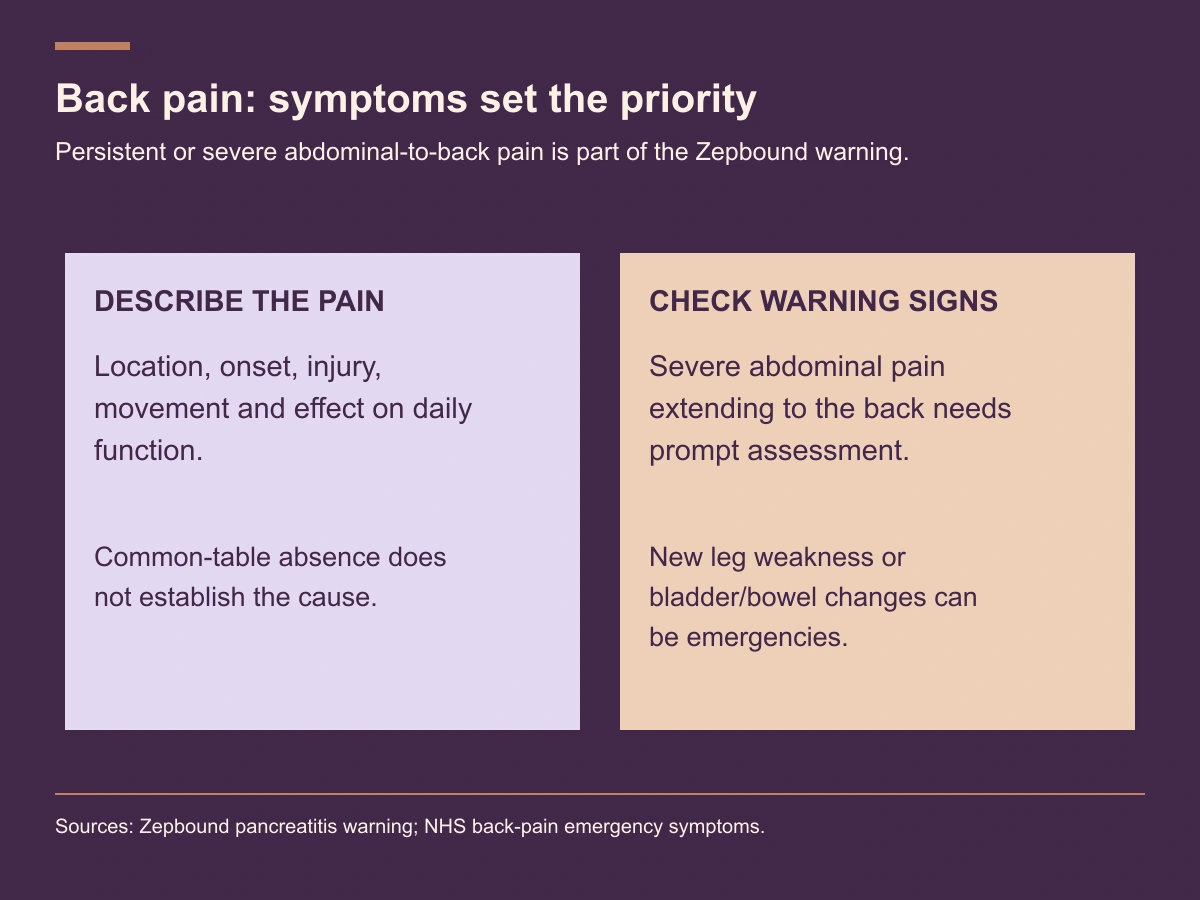
Back pain is not named in the current Zepbound label’s common adult adverse-reaction table. That does not rule out a treatment-related concern or tell you what caused a particular episode. More importantly, persistent or severe abdominal pain that can spread to the back is part of the label’s pancreatitis warning and needs prompt attention.
Location and associated symptoms matter. A sore lower back after lifting, severe upper abdominal pain extending into the back, and back pain with fever or urinary symptoms are different situations. Do not treat all three as a routine injection effect.
When to seek urgent or emergency care
The Zepbound label advises watching for persistent or severe abdominal pain, sometimes radiating to the back, with or without nausea or vomiting. If pancreatitis is suspected, the medicine should be discontinued and appropriate management started. Contact a clinician promptly for that symptom pattern; severe illness may require emergency care. Zepbound pancreatitis warning.
Do not wait for the next planned dose increase to discuss serious pain. Tell the assessing team the actual medication, last dose, symptoms and other prescriptions. This pattern does not prove pancreatitis, but it should not be dismissed as ordinary back soreness.
General back-pain guidance also identifies emergency warning signs such as new weakness or numbness in both legs, loss of sensation around the genitals or anus, bladder or bowel changes, chest pain, or pain after a serious accident. NHS back-pain guidance.
| Symptom pattern | Appropriate next step |
|---|---|
| Persistent or severe abdominal pain that extends to the back | Obtain prompt medical assessment and follow the Zepbound warning and clinician instructions |
| Back pain with new leg weakness, saddle-area numbness, or bladder/bowel changes | Seek emergency care |
| Severe sudden pain, rapidly worsening pain, fever or feeling generally ill | Seek urgent medical assessment |
| Back or side pain with blood in urine, painful urination or inability to urinate | Obtain prompt assessment for a urinary cause |
| Mild localized soreness without warning signs | Discuss persistence, function and the actual history with the care team |
The table helps distinguish review priorities. It does not diagnose the cause or establish that the last category is always safe to manage at home.
What the label finding means
Zepbound contains tirzepatide. Its common adult adverse-reaction table includes digestive symptoms, injection-site reactions, fatigue and other defined reactions from specified trials. Back pain is not named in that particular table. The table has a reporting threshold and is not an exhaustive catalog of all possible symptoms. Current Zepbound prescribing information.
A symptom absent from a common table may still need assessment. Conversely, beginning after an injection does not establish that Zepbound caused it. Existing spine or muscle problems, a recent injury, infection, urinary symptoms, other medicines and activity changes may also be relevant.
Our what is Zepbound guide provides general medicine context. For back pain, the next useful step is a symptom-specific review rather than assuming the general side-effect list explains the episode.
Use the exact product name
Zepbound and Mounjaro both contain tirzepatide but have different labeled indications. A compounded tirzepatide preparation is a separate product with its own pharmacy and prescription information. Do not call every weekly injection “Zepbound” when asking for advice.
Bring the package or prescription details. If a compounded product is involved, include the concentration, prescribed amount and pharmacy name without attempting to convert a dose yourself. Our compounded tirzepatide side-effect guide explains why product identity and dosing errors require separate questions.
Why abdominal pain radiating to the back matters
Pancreatitis is inflammation of the pancreas. NIDDK describes upper abdominal pain that can spread to the back, along with possible nausea, vomiting, fever or feeling seriously ill. Severe or worsening abdominal pain and other concerning symptoms call for prompt care. NIDDK pancreatitis symptoms.
This does not mean that ordinary lower-back soreness is pancreatitis. It means the abdomen-to-back pattern should be recognized and evaluated rather than normalized as a harmless medicine effect. A clinician may need an examination, tests and the full history to distinguish causes.
Describe where the pain began. Did it start in the upper abdomen and travel into the back, or was it localized near the spine after movement? Is it persistent, worsening, related to meals or accompanied by vomiting? Avoid deciding the diagnosis from a symptom diagram.
Do not take another dose simply to test whether the pain happens again. When a warning symptom is present, obtain instructions from the assessing clinician about the medicine and the next steps.
Back or flank pain can have urinary clues
Kidney stones can produce sharp pain in the back, side, lower abdomen or groin. Blood in urine, painful or frequent urination, inability to urinate, fever and chills are other symptoms NIDDK identifies. These warrant prompt medical assessment. NIDDK kidney stone symptoms.
The source explains a possible symptom pattern; it does not establish that Zepbound causes kidney stones. Back pain with a urinary symptom should not be automatically attributed to the injection or to dehydration without assessment.
If vomiting, diarrhea or low fluid intake is occurring, report it separately. Drinking more water is not a substitute for evaluating severe pain, fever, inability to urinate or blood in urine. People with kidney or heart conditions may also have individualized fluid advice.
Our Mounjaro and kidney-disease guide discusses another tirzepatide brand and distinguishes renal dosing language from fluid-loss monitoring. It does not diagnose a new urinary problem.

Muscle, joint and activity history still matter
Lower-back pain commonly has causes such as muscle strain, and sometimes a precise cause is not obvious. General guidance recommends review when pain persists, interferes with daily life, occurs with unexplained weight loss, or has other concerning features. Back-pain causes and care.
Think about recent lifting, a new exercise routine, prolonged sitting, an awkward movement or a prior back condition. A treatment start and a new workout may occur in the same week. Keeping both on the timeline prevents the injection date from becoming the only fact considered.
Weight changes do not by themselves establish the cause of new pain. Do not assume that back soreness means the medicine is “burning fat,” or that it proves a specific muscle deficiency. Persistent pain and function need their own assessment.
For an exercise discussion, our walking after meals guide explains a modest activity approach and the limits of the research. It is not a back rehabilitation prescription. A new pain problem may need tailored activity advice before using a general exercise plan.
Be careful with self-selected pain medicines
An online interaction checker cannot determine which pain reliever is suitable for someone with vomiting, possible dehydration, kidney disease, a bleeding history or other prescriptions. Ask the pharmacist or clinician about the actual medicine, dose and intended duration.
Our ibuprofen, alcohol and tirzepatide guide discusses pain-relief questions that require more than checking whether the names “interact.” Do not combine products with duplicate ingredients or use a pain reliever to postpone assessment of a warning symptom.
The same principle applies to muscle relaxants, sedatives and supplements. Something that reduces discomfort or causes sleepiness does not necessarily address the cause of the pain. Bring any product you have already taken to the medication review.
For mild soreness after a clinician has assessed the situation, follow the individualized activity and symptom-management plan. Avoid adopting an aggressive stretch routine from a video if it worsens pain or if neurologic symptoms are present.
A short record can make the appointment more useful
Note the pain’s location, onset, duration, severity and effect on walking, sleep or ordinary tasks. Include abdominal symptoms, vomiting, fever, urinary changes, leg symptoms and any injury. Add the last Zepbound dose and recent dose changes.
Useful follow-up questions are:
- Does this need an examination or tests now?
- Which symptoms mean I should seek emergency care?
- What is the plan for the next dose?
- Which pain medicines or activities are suitable for my history?
- When should I contact the team again if it does not improve?
If pain is severe or accompanied by warning signs, seek care first. Recording symptoms should support assessment rather than delay it.

Treatment choices come after the pain assessment
A temporary symptom plan, a medication pause and a permanent treatment switch are different decisions. If the team recommends holding treatment, ask for written restart or replacement instructions. Do not derive a new dose from another tirzepatide product’s chart.
Our switching between semaglutide and tirzepatide guide addresses why there is no simple milligram conversion. The GLP-1 treatment-choice guide can help organize longer-term questions once the acute issue is addressed.
CoreAge Rx describes its tirzepatide service and semaglutide service for adults exploring care. These are commercial pathways requiring evaluation, not treatments for undiagnosed back pain. Compounded medicines are not FDA-approved and should be considered only for a medical need that cannot be met by an approved medicine. FDA compounding guidance.
Frequently asked questions
Is back pain a common Zepbound side effect?
It is not named in the reviewed common adult reaction table. That precise finding does not rule out a medicine-related concern or identify the cause of a person’s pain.
How can I tell whether the pain is pancreatitis?
You cannot confirm that from symptoms alone. Persistent or severe abdominal pain, sometimes spreading to the back, warrants prompt assessment under the label warning. The care team determines the diagnosis and medicine plan.
Can I take my next injection if my back hurts?
Obtain advice based on the actual symptoms and severity. Warning symptoms should be assessed promptly. There is no universal continue-or-skip rule for every back-pain episode.
Does pain mean I need more water?
Not necessarily. Fluid intake is one part of the history, but severe pain, urinary symptoms, fever or vomiting can need assessment. Do not use hydration as the explanation before checking concerning symptoms.
Can I use ibuprofen?
Ask about your full history and other medicines. Kidney function, fluid loss, bleeding risk and other conditions may affect suitability. A general answer about Zepbound alone is insufficient.
Should I switch medicines immediately?
First address urgent symptoms and clarify the cause as far as possible. Any switch needs a prescriber-led plan for the actual products, timing and follow-up; pain alone does not supply an equivalent replacement dose.
Educational information for adults; individual treatment decisions require a qualified clinician. Sources reviewed October 2, 2026. Original AI-generated article images depict fictional people and objects, not patient outcomes. Other editorial images are illustrative. Graphics summarize the cited sources.