
Tonic water is a carbonated drink that contains quinine for its characteristic bitter flavor. Some versions also contain substantial sugar, while light and diet products use different formulations. It should not be treated as a weight-loss drink or as a way to take prescription quinine.
The practical questions are what is in the exact bottle, how much you drink, and whether quinine is suitable for your situation. “Tonic,” “light,” and “diet” are not interchangeable descriptions. The reviewed Canada Dry U.S. regular-product ingredient list includes carbonated water, high-fructose corn syrup, and quinine. Canada Dry product information.
What is quinine good for?
Quinine has two very different contexts. In a carbonated beverage, it is used as a flavor ingredient. As a prescription medicine, quinine is used to treat malaria, with professional selection and monitoring. MedlinePlus explains that it should not be used to prevent malaria and should not be used to prevent or treat nighttime leg cramps. MedlinePlus quinine information.
Those medical uses and cautions do not make tonic water a treatment. A drink’s taste, name, or botanical story cannot establish that it treats cramps, burns fat, or provides a therapeutic medicine dose. Do not substitute a beverage for a prescribed treatment or obtain quinine capsules for weight management.
MedlinePlus also describes serious potential risks of the medicine, including severe bleeding problems, kidney damage, abnormal heart rhythms, and severe allergic reactions. These are reasons prescription quinine needs appropriate medical use, not a reason to convert a drug dose into a home tonic-water recipe.
How is quinine regulated in U.S. carbonated drinks?
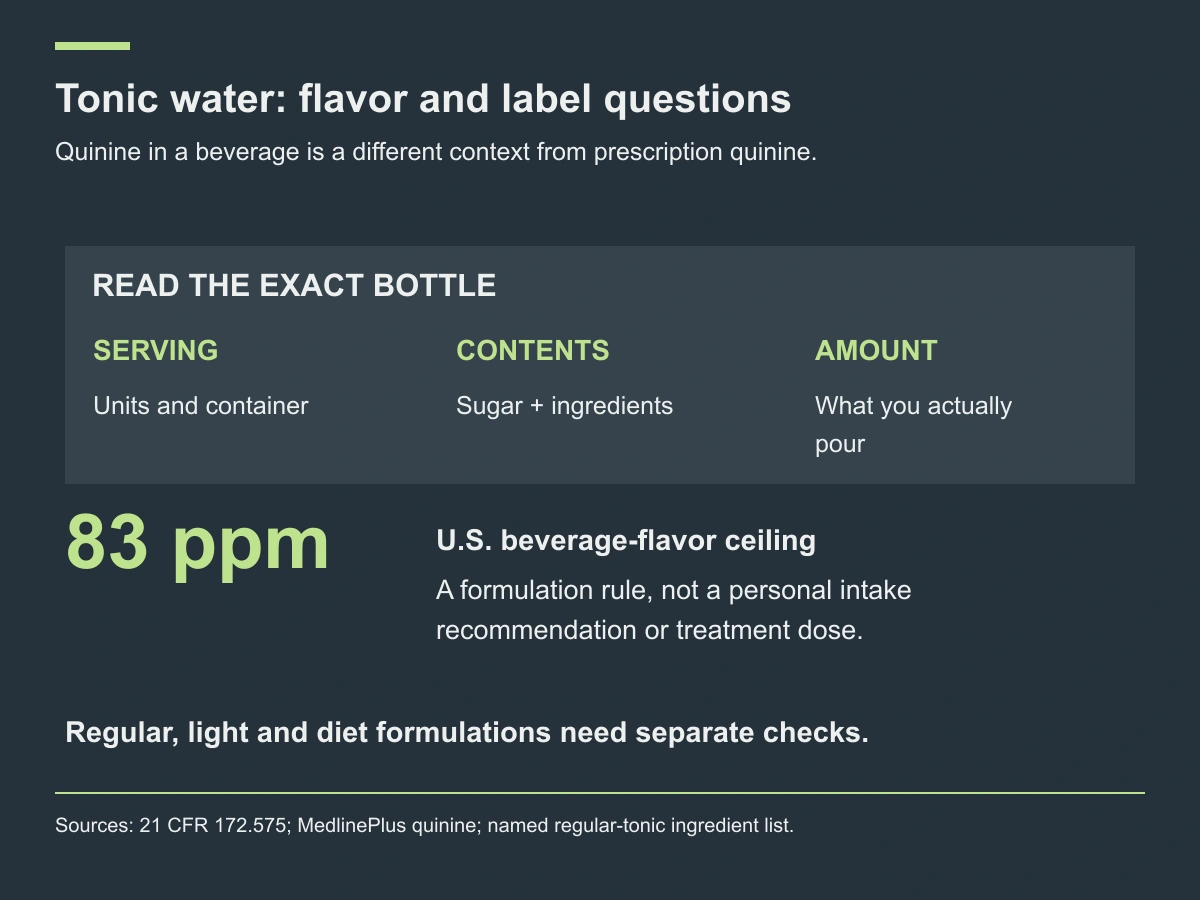
The U.S. food provision at 21 CFR 172.575 permits quinine in carbonated beverages as a flavor, subject to a concentration ceiling of 83 parts per million, expressed as quinine. It also requires a prominent declaration that quinine is present. The current provision was checked on October 2, 2026. U.S. quinine food provision.
The ceiling is a product-formulation rule. It is not a recommendation to consume that concentration, a daily personal allowance, or a treatment dose. It also does not tell you the exact quinine amount in a particular bottle, since the actual formulation may be below the permitted ceiling.
Avoid online calculations that turn this maximum into “how much tonic to drink for cramps” or a personal safety threshold. An ingredient’s permitted food use does not establish suitability for every person or equivalence to a prescription capsule.
Does tonic water help with weight loss?
There is no reason to treat its quinine flavor as a fat-loss mechanism. For everyday weight-management decisions, the relevant drink information includes serving size, calories, sugars, and the amount consumed. A bitter flavor does not tell you that a beverage is unsweetened.
A change from a frequently consumed sugar-sweetened drink to a drink with fewer calories may change overall intake. That does not mean every replacement produces a predictable weight change, and it does not make tonic water necessary. Plain water or another suitable unsweetened drink may fit the same practical goal.
Our water and drinks guide discusses beverage choices and individualized hydration needs. The calorie-intake guide explains why total needs differ. A drink choice should fit the whole eating pattern rather than become a special rule intended to override meals.
Regular, light, diet, and sparkling water are different
Read the exact panel and ingredient list before deciding that two bottles are equivalent. “Light” may mean fewer calories than a comparison product, while a diet or zero-sugar formulation may use a different sweetener. Neither description establishes that quinine is absent.
| Drink description | What to check on the actual product | What not to assume |
|---|---|---|
| Regular tonic water | Serving size, sugars, calories, and quinine declaration. | That bitterness means no sugar. |
| Light tonic water | The actual calorie and sugar amounts and reference serving. | That light means zero sugar or zero calories. |
| Diet or zero-sugar tonic | Sweetener ingredients, calories, serving size, and quinine. | That the product is quinine-free or a medical treatment. |
| Plain sparkling water | Ingredients and any flavoring or sweetener additions. | That every carbonated drink has the same contents. |
| A mixed drink | Every ingredient and the full amount consumed. | That a mixer label describes the complete drink. |
These are label-reading categories, not a numerical ranking of every brand. Product names, formulations, countries, and package sizes can differ. A current bottle is more useful than borrowing a nutrition value from an unrelated tonic-water listing.
How should you compare labels fairly?
Start with the serving quantity and units. Check whether the panel refers to fluid ounces, milliliters, one can, or another amount. Then check servings per container. A bottle holding more than one serving can contribute more than the first per-serving number you notice.
Compare similar amounts when choosing between products. If two reference servings differ, their numbers are not a direct comparison until the amounts are aligned. Do not silently convert a webpage’s value to another serving size or assume that a different country’s product has the same recipe.
If a website and the package show inconsistent serving information, use the current package and contact the manufacturer if needed. Do not turn an uncertain online panel into an exact personal calorie calculation. The same discipline applies to food labels; our Fairlife milk comparison shows how named products and defined serving references keep comparisons clear.

What matters when tonic is part of a mixed drink?
The complete drink includes the mixer and any other ingredients. A zero-sugar mixer does not mean that fruit juice, syrup, a sweetened spirit, or another addition contributes nothing. Likewise, the mixer serving on the bottle may differ from the amount poured into a tall glass.
Notice the ordinary recipe and portion you actually use. This can be a practical observation rather than a requirement to record every drink indefinitely. If your goal is to change a repeated beverage habit, identify which ingredient or portion is relevant before changing the whole routine.
If alcohol is part of the drink and you take a GLP-1 medicine, our Ozempic and alcohol guide discusses glucose, intake, and symptom questions. A diet mixer cannot establish a safe alcohol amount or remove the need to review alcohol-related concerns with the care team.
Is diet tonic water automatically a better choice?
It may fit a person’s preference for fewer sugars or calories, but that is not the only consideration. Check ingredients, taste, portion, and any medical advice relevant to the individual. A product with a different sweetener is not automatically necessary for successful weight management.
Also consider whether you specifically want tonic’s bitter flavor. If you simply want a carbonated unsweetened drink, a suitable sparkling water may serve that purpose without adding quinine. Read its label too, since flavored and sweetened versions can differ.
There is no need to force a drink you dislike solely because a weight-loss article calls it ideal. A routine is easier to evaluate when it addresses an actual habit and fits your access, preferences, and clinical needs.
What if you have reacted to quinine before?
Tell your clinician or pharmacist about any previous quinine reaction. MedlinePlus advises reporting an allergy to quinine and relevant related medicines before prescription use. If a beverage declares quinine, do not assume it is suitable simply because its amount differs from a capsule. MedlinePlus precautions.
Avoid conducting a home exposure test to see whether a previous reaction will recur. Ask about the actual ingredient and the history. Seek emergency help for breathing difficulty, throat swelling, collapse, or another severe reaction.
This is also why “natural botanical ingredient” is not a sufficient safety answer. The identity of the substance, prior reactions, other medicines, and the clinical situation matter more than its origin story.
Can tonic water treat nighttime leg cramps?
Do not use tonic water as a self-directed quinine treatment for cramps. MedlinePlus warns that prescription quinine has not been shown effective for preventing or treating nighttime leg cramps and can cause serious or life-threatening effects. A beverage formulation does not solve that evidence or safety problem. Quinine important warning.
If cramps are frequent, severe, or new, discuss the pattern with a clinician. Mention other symptoms, medicines, exercise changes, and anything you have tried. A proper assessment can address possible causes rather than treating the symptom with a drug-related ingredient found in a drink.
The beverage concentration ceiling should not be used to design a cramp regimen. It regulates a permitted flavor use, not a clinical instruction for drinking a specified number of glasses.
How does this fit with GLP-1 treatment and hydration?
If nausea or low appetite affects eating and drinking, review the overall pattern with the prescribing team. Choosing a lower-sugar mixer does not address inadequate food intake, persistent vomiting, or another symptom that needs care. The balanced-meals guide can help organize ordinary food choices once the clinical situation is understood.
Ozempic’s label warns about kidney injury associated with volume depletion, often after digestive reactions. If you cannot keep fluids down or urine output falls, seek advice promptly rather than trying a “tonic” as a remedy. Ozempic volume-depletion warning.
Follow individualized fluid advice if you have a heart or kidney condition. Our GLP-1 illness guide discusses what belongs in a sick-day plan. A general beverage comparison cannot decide whether a prescription should continue during an illness.

A practical change to try discussing
Choose one repeated drink habit to review: the product, the amount poured, the extras added, and when it replaces or accompanies food. You may find that a smaller amount, a different mixer, or plain water is the relevant change. You may also discover that hydration access rather than sugar intake is the bigger problem.
Keep the goal specific and realistic. Changing a drink should not require skipping meals, using a laxative, or pursuing dehydration to lower the scale. If weight or appetite concerns persist, seek a broader assessment rather than assign the problem to one bottle.
Frequently asked questions
Is tonic water the same as soda water?
No. Tonic contains quinine for bitterness and may contain sugar or other sweeteners. Plain sparkling water has a different ingredient pattern. Check the actual products rather than use the terms interchangeably.
Does zero sugar mean zero quinine?
No. Sugar and quinine are separate ingredients and label questions. A zero-sugar version can still be tonic water. Read the ingredient list and the quinine declaration rather than infer its absence from the nutrition panel.
How much tonic water is safe every day?
There is no universal personal amount established by the food concentration rule. Suitability depends on the product and the individual’s history and medical needs. Do not convert the 83 ppm ceiling into a daily drinking prescription.
Does quinine improve metabolism or burn belly fat?
Its beverage role is flavoring, and its prescription context concerns specific medical uses. Neither establishes a fat-loss effect from tonic water. Consider the complete diet and the actual drink contents instead.
Can I discuss weight-management options beyond drinks?
Yes. If you are exploring CoreAge care, the semaglutide and tirzepatide pages can help organize a provider conversation. Confirm the actual treatment, formulation, eligibility, and follow-up needs; tonic water is not a substitute for clinical assessment.
Educational information for adults; individual treatment decisions require a qualified clinician. Sources reviewed October 2, 2026. Original AI-generated article images depict fictional people and objects, not patient outcomes. Other editorial images are illustrative. Graphics summarize the cited sources.