Abdominal pain is a reported Wegovy side effect, but severe, persistent, or worsening pain should not be treated as something you simply need to tolerate. The current label also warns about pancreatitis, gallbladder disease, severe gastrointestinal reactions, and kidney injury associated with dehydration. The location, intensity, duration, and accompanying symptoms help determine the next step. Wegovy prescribing information.
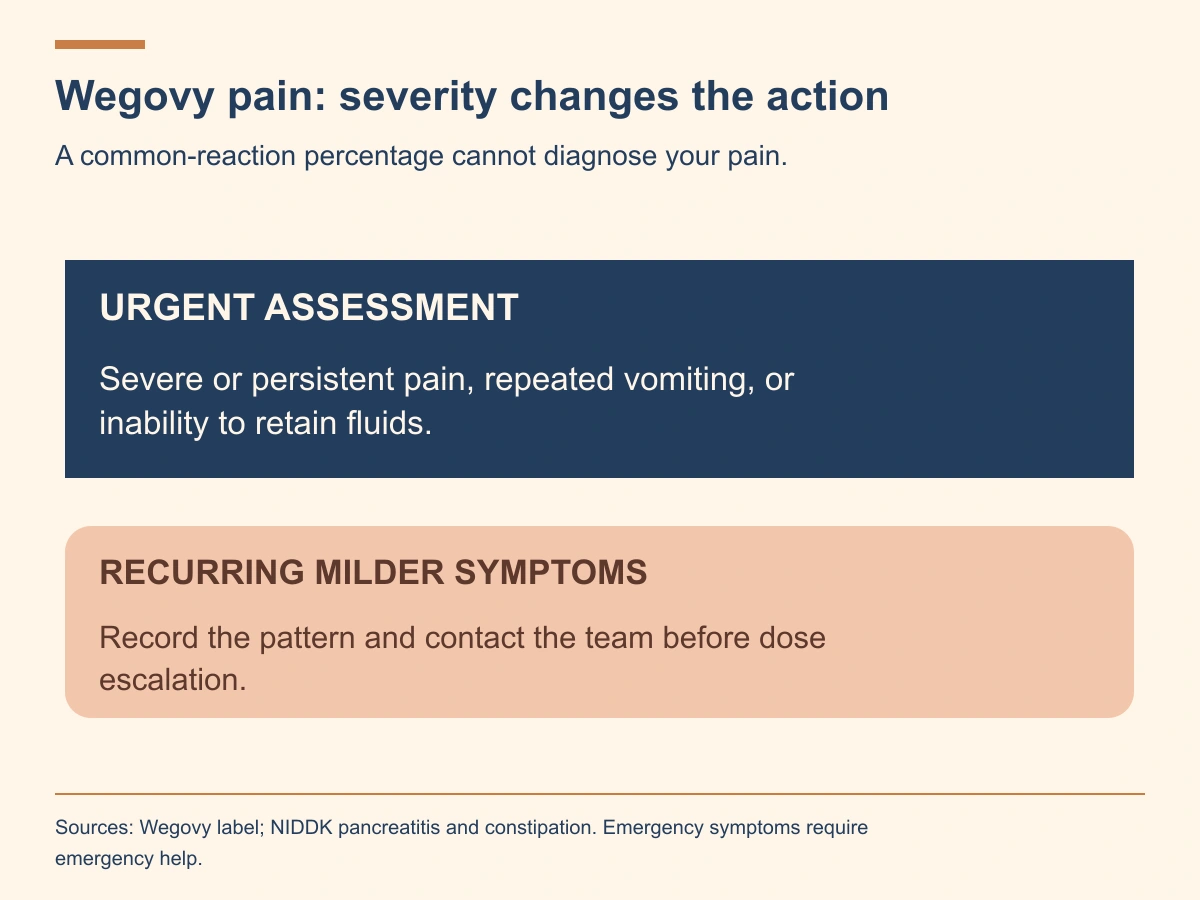
Seek urgent medical assessment for severe or persistent abdominal pain, particularly with vomiting or pain extending to the back. Breathing difficulty, rapid facial or throat swelling, or collapse requires emergency help. If symptoms are milder but recurring, contact the prescribing team before escalating the dose or adding medicines to cover them up.
How common was abdominal pain in Wegovy trials?
In the label’s pooled adult weight-reduction trials of the 2.4 mg weekly injection, abdominal pain was reported by 20% of Wegovy-treated participants and 10% of placebo-treated participants. The groups included 2,116 and 1,261 people, respectively. Wegovy adult injection trial table.
The table’s abdominal-pain category includes several related reports, such as upper or lower abdominal pain, tenderness, discomfort, and epigastric discomfort. It does not mean that every report had the same cause or severity. It also does not give a diagnosis for someone reading the table.
These figures belong to the specified injection trials. They should not be copied onto every oral formulation, newer dose, adolescent population, or compounded semaglutide preparation. A percentage is useful only when the product, participants, and outcome remain clear.
Describe the symptom before choosing a remedy
“Stomach pain” can mean burning near the upper abdomen, pressure after a meal, cramping, lower abdominal pain, or pain extending to the back. Use ordinary words to describe what you feel, and point out the location if you are examined. You do not need to choose a medical diagnosis first.
Record whether the pain is constant or comes and goes, when it began, and whether it has changed. Include recent dose changes, meals, bowel movements, vomiting, fever, and fluid intake. If the symptom is severe, do not delay seeking care to complete a diary.
Our semaglutide nausea and vomiting guide covers related meal-tolerance questions. Nausea and pain can occur together, but a familiar history of nausea should not cause new severe pain to be dismissed.
Which patterns need faster assessment?
Our guide to GLP-1 medicines and appendicitis explains the Wegovy label finding and its limits. Suspected appendicitis needs immediate medical care.
This table describes reasons to seek help, rather than a way to diagnose yourself.
| Symptom pattern | Why it matters | Appropriate response |
|---|---|---|
| Severe or persistent abdominal pain, sometimes extending to the back | Pancreatitis is among the label warnings | Seek urgent assessment and report Wegovy use |
| Upper abdominal pain with fever, yellowing eyes or skin, or other significant symptoms | Gallbladder or another abdominal condition may need evaluation | Obtain prompt medical care |
| Repeated vomiting, little urine, or inability to keep fluids down | Dehydration can affect kidney function | Seek timely urgent advice or assessment |
| Constipation with constant pain, inability to pass gas, vomiting, or bleeding | This exceeds a simple self-care constipation question | Seek care right away |
| Brief, mild discomfort that repeatedly returns | Treatment tolerance and other causes need review | Contact the prescribing team before the next escalation |
The NIDDK pancreatitis guidance, NIDDK constipation guidance, and Wegovy label support these distinctions. Symptoms may overlap, so one reassuring feature does not cancel a more concerning one.
What does the pancreatitis warning mean?
Pancreatitis is inflammation of the pancreas. The Wegovy label describes possible persistent or severe abdominal pain, sometimes radiating to the back, with or without nausea or vomiting. It directs discontinuation and appropriate management if pancreatitis is suspected. Wegovy pancreatitis warning.
That is a reason for urgent clinical evaluation, not a diagnosis to make from a symptom checklist. Do not take another dose while trying to prove that severe persistent pain is only indigestion. Tell the assessing clinician the exact product, last dose, and other medicines so they can provide the next treatment instructions.
NIDDK notes that acute pancreatitis can make someone seriously ill and identifies worsening pain, vomiting, fever, jaundice, or shortness of breath among reasons for immediate care. Waiting for every possible symptom to appear can delay assessment. NIDDK symptoms and care guidance.
How is gallbladder disease different?
The current Wegovy label reports an increased occurrence of gallstones and gallbladder inflammation. It notes that substantial or rapid weight loss can increase gallstone risk, while the observed increase with Wegovy remained after accounting for weight loss. Wegovy gallbladder warning.
The label’s adult injection trials reported gallstones in 1.6% of Wegovy-treated participants versus 0.7% with placebo, and gallbladder inflammation in 0.6% versus 0.2%. Those are trial findings, not a test that identifies the cause of your pain or a guarantee about your individual risk.
Our GLP-1 medicines and gallstones guide provides more context. A clinician may need an examination, tests, or imaging depending on the presentation. Treating presumed reflux repeatedly should not replace assessment of persistent or significant upper abdominal symptoms.

Could it be constipation, reflux, or meal-related discomfort?
It could, but those possibilities need to be considered in context. Wegovy’s trial table includes constipation, indigestion, bloating, and reflux-related reports. The presence of these common effects does not make all abdominal symptoms harmless. Wegovy adverse-reaction information.
For a milder recurring pattern, note meal size, eating pace, bowel changes, and which foods or drinks seem to coincide with symptoms. Avoid making so many changes at once that you cannot tell what helped. The GLP-1 constipation guide explains the bowel-history questions and when constipation needs more than self-care.
If acid symptoms are the concern, the omeprazole and Wegovy guide distinguishes the actual medicine and route. Starting an over-the-counter product does not establish the cause of the pain, and persistent symptoms should still be reviewed.
Does a dose increase explain the pain?
The timing is useful information, but it cannot settle the diagnosis. Tell the clinician when each dose was taken, whether a recent increase occurred, and whether symptoms began before or after it. Also mention a restart after a gap or a change in formulation.
Do not accelerate, split, or reduce doses independently to see what happens. Ask the prescribing team whether the current symptoms change the next planned step. If symptoms are severe or suggest a serious reaction, seek urgent care rather than waiting for a routine titration appointment.
Our semaglutide missed-dose and restart guide explains why a longer interruption is different from one late dose. Restarting at a previously tolerated dose after a gap is not automatically the right plan.
Why food and fluid tolerance matter
Pain becomes more concerning when it prevents adequate eating or drinking. Repeated vomiting or diarrhea can lead to volume depletion, and the label warns about associated acute kidney injury. Report reduced urination, significant dizziness, or inability to retain fluids. Wegovy kidney warning.
If you have a kidney or heart condition or a prescribed fluid restriction, ask for advice suited to that situation. A generic instruction to drink a large fixed amount may not fit. The team needs to understand both the symptoms and the existing care plan.
For people taking insulin or medicines that increase insulin release, reduced food intake also raises glucose-management questions. Follow the agreed monitoring and sick-day plan, and contact the diabetes team when you cannot eat normally. Do not change insulin solely because an online article mentions abdominal symptoms. NIDDK hypoglycemia guidance.
Will changing the injection site fix stomach pain?
There is no basis here to promise that it will. An injection location and a digestive symptom are different questions. Changing sites should follow the product instructions and training, while recurring or severe abdominal symptoms need their own assessment.
The Wegovy injection guide explains device and administration questions. Do not assume that an injection into the abdomen directly means the medicine entered the stomach, or that switching to the thigh can rule out a serious abdominal condition.
If the amount delivered was uncertain, contact the pharmacist or prescriber rather than repeating a full dose. An administration error or extra dose belongs in the symptom history and may require specific advice.

What should you send the prescribing team?
A useful message includes the exact medicine and formulation, last dose and recent changes, pain location, severity, duration, and effect on meals and fluids. Add vomiting, fever, bowel changes, urine changes, and medicines you have already tried. State clearly if symptoms are getting worse.
Ask who will decide about the next dose and whether an in-person assessment is needed. Routine messaging is not the right channel for an emergency. Keep the product label available if another clinician is evaluating you.
CoreAge Rx’s semaglutide page describes offered compounded care. A compounded preparation is not FDA-approved Wegovy, and brand-specific trial rates or device instructions should not be assumed to apply to it. Tell the team what was actually dispensed. FDA compounding explanation.
Frequently asked questions
How long should I wait for stomach pain to improve?
There is no universal waiting period that makes severe or worsening pain safe. Seek prompt assessment for concerning symptoms. Milder recurring discomfort also deserves review, particularly before a dose increase.
Does abdominal pain mean I have pancreatitis?
No. Many conditions can cause abdominal pain. The label warning explains why a concerning pattern needs assessment; it does not diagnose the cause from an online description.
Can I keep taking pain medicine until the next visit?
Ask a clinician or pharmacist about the actual product and symptoms. Repeatedly covering up significant pain can delay evaluation, and pain medicines have their own precautions. Seek urgent care when warning signs are present.
Is the 20% trial figure my personal risk?
No. It describes a broad symptom category in specified adult 2.4 mg injection trials. It does not predict your symptoms, their severity, or what will happen with a different formulation.
Educational information for adults; individual treatment decisions require a qualified clinician. Sources reviewed October 5, 2026. Original AI-generated article images depict fictional people and objects, not patient outcomes. Other editorial images are illustrative. Graphics summarize the cited sources.