Unsweetened Pure Leaf tea can be a useful alternative to a sugar-sweetened drink, but the tea itself is not a weight-loss treatment. The exact variety, bottle size, portion, and additions matter. Pure Leaf’s manufacturer distinguishes unsweetened tea from Sweet Tea, whose ingredient list includes sugar. A shared brand name does not make their nutrition interchangeable. Manufacturer unsweetened description, Sweet Tea ingredients.
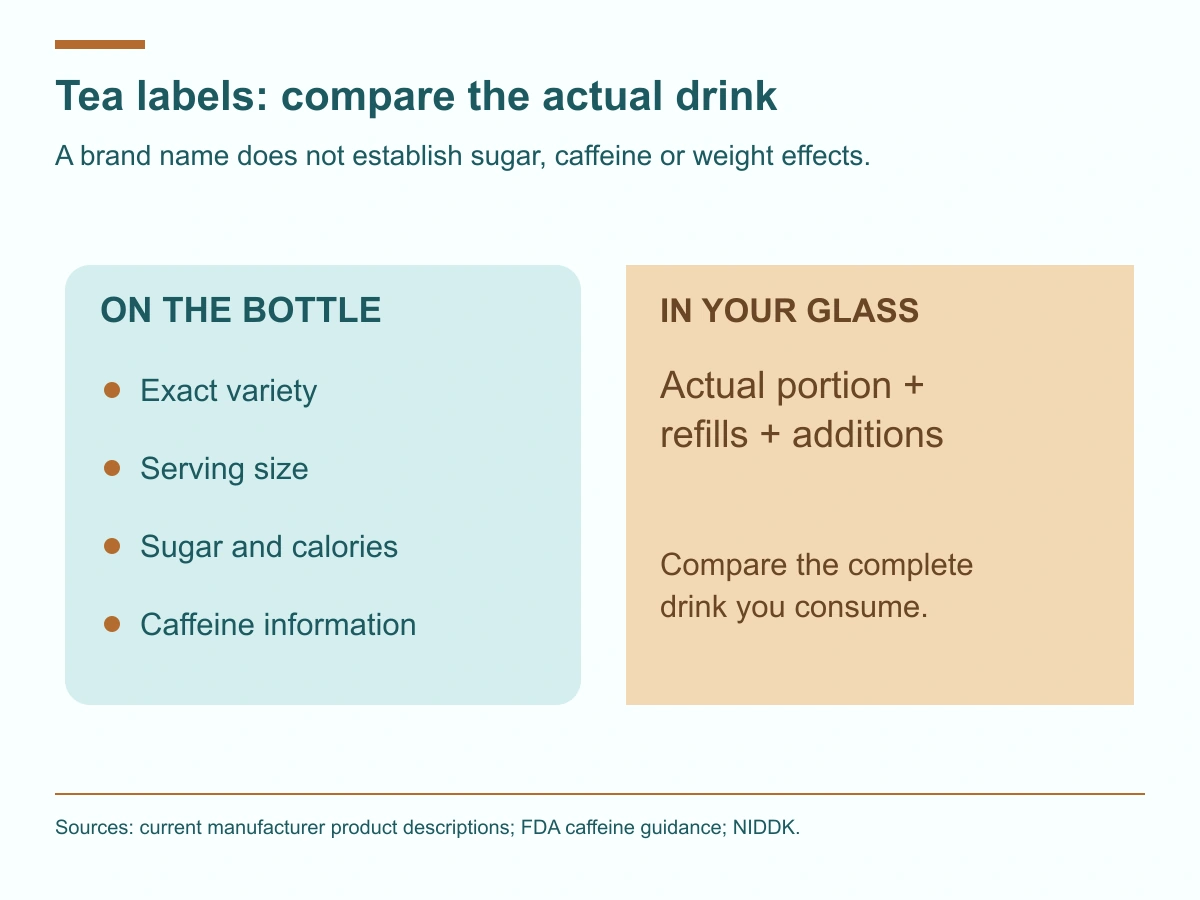
A practical decision starts with the bottle you actually buy. Read its Nutrition Facts, ingredients, and any caffeine information, then compare the amount you normally drink. This is more useful than a generic claim that “tea burns fat” or a caffeine number copied from a different flavor or package.
Start with the exact variety
Check the full product name rather than stopping at “Pure Leaf.” Unsweetened, sweetened, extra-sweet, flavored, and zero-sugar products may differ. Availability and formulations can also change, so the package in your hand is the reference for the drink you will consume.
The manufacturer page reviewed for Sweet Tea identifies brewed black tea, sugar, and citric acid. Its unsweetened product description explicitly states that it contains no sugar. These are specific product descriptions; they do not establish the ingredients of every product sold under the brand.
Our sweet tea versus soda comparison explains why a drink’s name is less informative than its actual sugar, serving size, and caffeine information. “Tea” and “soda” are categories, not complete nutrition facts.
How could a beverage swap help?
Replacing a calorie-containing sweet drink with an unsweetened choice may lower calories from beverages if the rest of the pattern does not compensate for that change. The benefit would come from the overall substitution, not a special fat-burning property of one bottled tea.
For example, compare your usual lunch drink with the amount of unsweetened tea you would actually have. If you keep both drinks, or add syrup to the new one, the change is different. If you choose a smaller sweet tea that you enjoy and can consistently portion, evaluate that actual pattern rather than an imagined perfect substitute.
NIDDK’s weight-management guidance emphasizes an eating pattern that can be maintained over time. Drinks are one part of that pattern alongside meals, activity, and other health factors. NIDDK eating and physical activity guidance.
A useful label-reading sequence
| Label detail | What to check | Why it changes the comparison |
|---|---|---|
| Full product name | Flavor and whether it is sweetened | One brand can contain very different drinks |
| Serving size | The volume used for the listed nutrition | A serving may differ from the amount you pour |
| Servings per container | Whether the whole bottle is one or several servings | Container totals can exceed a single serving |
| Calories and added sugars | The values for the amount you consume | A front-label impression may miss the relevant quantity |
| Ingredients | Sugar, sweeteners, flavorings, and tea type | “Zero sugar” and “unsweetened” need not mean the same formulation |
| Caffeine information | A current value for the exact package, if available | A different size or variety may have a different amount |
Keep the comparison simple enough to use in a store. You do not need to classify every ingredient as good or bad to decide whether a drink fits your routine. If caffeine information is missing and matters for a medical reason, ask the manufacturer or pharmacist rather than assuming zero.
Does brewed tea directly cause weight loss?
The evidence discussed for tea often involves a different product: concentrated green-tea extracts, isolated ingredients, or a study regimen that does not match a bottle of black tea. NCCIH describes possible modest effects from green tea’s catechins and caffeine, with results varying by product and circumstances. That is not evidence that a specific Pure Leaf drink produces a predictable amount of weight loss. NCCIH green-tea evidence.
A study about one extract cannot establish what happens when someone drinks a different tea with lunch. The type of tea, preparation, amount, comparison group, and outcome all matter. A laboratory or short-term metabolic finding also does not establish a lasting change in body weight.
Our peppermint tea and green tea guide separates beverage choices from broader weight claims. Enjoying tea is a sufficient reason to drink it; it does not need an unsupported treatment claim attached to it.

How much caffeine is in Pure Leaf?
Use the information for the exact flavor and package. Do not assume that every bottle contains the same amount, or that a number reported by a retailer for one size applies to another. The manufacturer also cautions that formulations and packaging may change.
This article does not supply a universal Pure Leaf caffeine number because that would obscure those product differences. If the package provides a per-serving value, calculate the amount for your actual portion. If it provides a per-bottle value, avoid treating that as a value per cup.
FDA notes wide variation in caffeine sensitivity and recommends considering all sources. Coffee, tea, chocolate, energy drinks, some supplements, and other products can contribute to the day. A modest amount in one drink may become more significant when several sources are combined. FDA caffeine guidance.
Is the FDA’s 400 mg figure a personal target?
No. FDA cites 400 mg per day as an amount not generally associated with negative effects for most adults. It also stresses differences in sensitivity, health conditions, medicines, and how quickly people eliminate caffeine. That figure is not a recommendation to drink up to a particular number. FDA adult caffeine guidance.
Caffeine can contribute to palpitations, sleep disruption, anxiety, jitters, an upset stomach, nausea, or headache. If you notice a pattern, review the total intake and timing with a healthcare professional. Pregnancy, breastfeeding, and some medical situations require their own discussion rather than a generic adult limit.
The decaf tea and caffeine guide explains why decaffeinated does not always mean caffeine-free. Our sleep and weight-management guide can help you consider whether an evening drink is affecting sleep, even when its sugar content suits your goals.
What about honey, lemon, or a homemade sweetener addition?
Additions change the final drink. Honey, sugar, syrup, milk, or creamer should be included in the comparison if you use them. A drink labeled unsweetened does not remain the same nutrition choice after a sweetener is added at home.
A practical approach is to notice how much you usually add and whether you enjoy a smaller amount. There is no need to describe a preferred drink as forbidden. The important part is evaluating the preparation you actually consume, including refills, rather than the unopened bottle alone.
Lemon or another flavor addition does not turn tea into a proven weight-loss remedy. If you enjoy the flavor, treat it as a preference. Our lime and lemon water article explains related claims about flavoring water and expected weight effects.
Can you drink tea while taking a GLP-1 medicine?
Bring the question back to the actual treatment and symptoms. A tea label does not establish whether nausea, reflux, a racing heart, or poor sleep is caused by the drink, a medicine, or something else. Review the amount, timing, and all other medicines with your care team when symptoms occur.
If semaglutide makes eating difficult, do not use tea to replace meals or to suppress hunger further. The semaglutide nausea guide covers meal tolerance and when symptoms need medical attention. Repeated vomiting or inability to retain fluids requires assessment rather than an experiment with a different beverage.
CoreAge Rx’s semaglutide page describes offered compounded care for people seeking a clinical evaluation. It is a separate prescription discussion from a drink choice. Compounded medicines are not FDA approved and should not be represented as equivalent to approved brands. FDA compounding explanation.

Is bottled tea a meal replacement or a hydration plan?
A bottle of tea does not provide the variety of nutrients found in a balanced meal. If you regularly replace lunch with a drink because you are busy or have little appetite, consider how the rest of the day supplies protein, energy, and other nutrients. Our balanced-meal guide provides a more useful framework.
Likewise, a beverage preference does not define a personal fluid target. People with fluid restrictions, kidney disease, heart disease, or persistent vomiting may need specific advice. The appropriate question is what you can drink comfortably within your own care plan.
Tea and concentrated tea supplements also need separate consideration. NCCIH describes adverse effects and reported liver injury with some green-tea extracts, especially tablets or capsules. That information should neither be used to frighten someone about every brewed drink nor ignored when someone adds an extract supplement.
Frequently asked questions
Is unsweetened Pure Leaf better for weight management than Sweet Tea?
It can reduce sugar from that drink when it replaces a sweetened version. The overall effect depends on portions, additions, and the rest of the eating pattern. It does not guarantee weight loss.
Does zero sugar mean no caffeine?
No. Sugar content and caffeine are different label questions. Check both for the actual variety rather than assuming one tells you the other.
Can I drink it at night?
Consider caffeine sensitivity and sleep. A drink that fits your sugar goals may still be inconvenient near bedtime. If sleep is repeatedly affected, discuss a lower-caffeine or caffeine-free option and the broader routine.
How many bottles should I drink to lose weight?
There is no evidence-based bottle count for that purpose. Choose portions based on preference, caffeine, nutrition, and any individual medical advice. Treat tea as a beverage within a broader plan rather than a dose of a weight-loss treatment.
Educational information for adults; individual treatment decisions require a qualified clinician. Sources reviewed October 5, 2026. Original AI-generated article images depict fictional people and objects, not patient outcomes. Other editorial images are illustrative. Graphics summarize the cited sources.