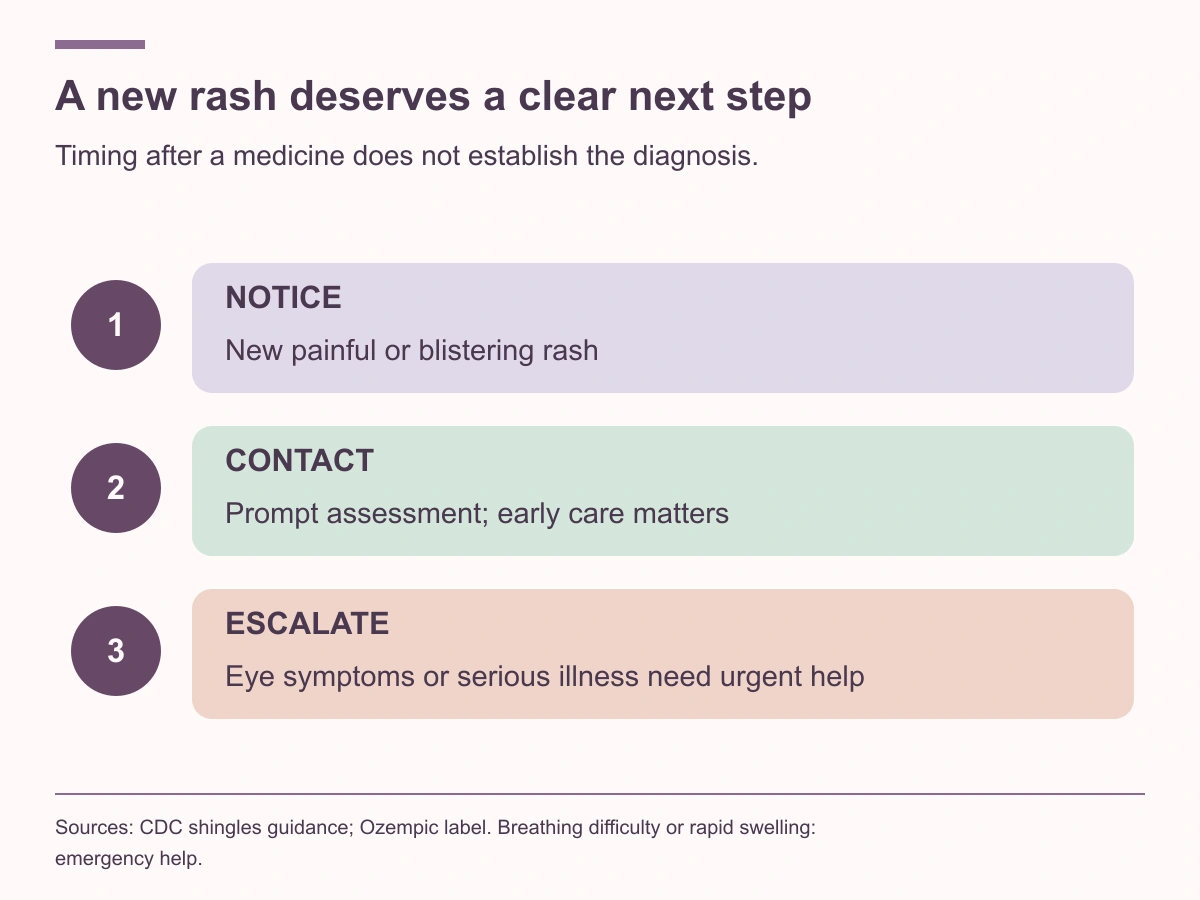
Shingles is caused by reactivation of the varicella-zoster virus, the virus that causes chickenpox. The current Ozempic prescribing information does not list shingles as a recognized adverse reaction. A rash that appears during treatment still needs assessment: the timing alone cannot establish its cause, and early treatment matters when shingles is suspected. CDC shingles overview, Ozempic prescribing information.
Contact a healthcare professional promptly for a new painful or blistering rash. A rash near the eye, eye pain, or a change in vision needs urgent evaluation because shingles can affect vision. Sudden facial or throat swelling, trouble breathing, or collapse is an emergency and may signal a serious allergic reaction rather than an ordinary skin complaint.
Why can shingles appear years after chickenpox?
After chickenpox, the virus can remain in the body and reactivate later as shingles. The person does not need a new exposure to someone with shingles for this to happen. Age and conditions or treatments that weaken immune defenses can increase risk. CDC cause and risk guidance.
CDC identifies certain cancers, HIV, transplant-related immune suppression, and medicines such as steroids among relevant risk factors. Many people do not remember having chickenpox, and absence of that memory does not rule out previous infection.
A person may start Ozempic during the same period of life when shingles becomes more likely for unrelated reasons. That possibility is one reason a clinician considers age, immune health, medicines, and the symptom pattern together rather than using only the date a prescription began.
What does the Ozempic label establish?
Ozempic contains semaglutide. Its current U.S. label includes specified type 2 diabetes, cardiovascular, and kidney indications. Its common adverse reactions are primarily digestive symptoms, including nausea, vomiting, diarrhea, abdominal pain, and constipation. Shingles is not included in the label’s adverse-reaction listing. Current Ozempic label.
That observation has a limited meaning. It does not prove that a particular person’s rash is unrelated to any medication, nor does it establish that the person cannot develop shingles while taking Ozempic. A product label is not a diagnostic test for a rash.
The label separately warns about serious hypersensitivity reactions, including anaphylaxis and angioedema. A clinician needs to distinguish those reactions from infections and other skin conditions. Our Ozempic side-effects guide provides broader context, while this article focuses on shingles questions.
Which symptoms make shingles a possibility?
Shingles often causes pain, itching, or tingling before a rash appears. The rash commonly develops on one side of the body or face, sometimes as a stripe. Blisters typically scab over in seven to ten days, and the rash often clears over two to four weeks. Those are general patterns, not a countdown to use instead of care. CDC symptoms and complications.
Fever, headache, chills, or an upset stomach can also occur. Some people have a less typical presentation, and a painful area without a rash can be difficult to diagnose. Do not decide that the problem is definitely shingles because an online photograph resembles it.
Tell the clinician where symptoms began, whether they are on one or both sides, when blisters appeared, and whether pain preceded the skin change. Mention immune-suppressing medicines and any new prescriptions, supplements, soaps, or skin products. A complete timeline gives the examination more context.
Different rash patterns need different responses
This comparison organizes the information to report. It cannot identify the diagnosis at home.
| What you notice | Why it matters | Useful next step |
|---|---|---|
| A new painful or blistering rash, often on one side | Shingles is one possibility and antiviral treatment is time-sensitive | Contact a clinician promptly |
| Rash on the face with eye pain or vision changes | Eye involvement can threaten vision | Obtain urgent assessment |
| Rapid face, lip, tongue, or throat swelling or breathing difficulty | A serious allergic reaction is possible | Seek emergency help |
| A small local skin change where a medicine was injected | Several causes are possible | Report progression, pain, warmth, and timing to the care team |
| A widespread or rapidly worsening rash, especially while immunocompromised | The illness may need more urgent evaluation | Seek prompt medical care |
If fever is part of the episode, our Ozempic and fever guide helps distinguish a medicine question from the need to assess an illness. Do not wait for a perfect fit with a table before seeking care for severe symptoms.
Why is early contact important?
CDC identifies acyclovir, valacyclovir, and famciclovir as antiviral medicines used to treat shingles. Early treatment can shorten the illness and reduce acute symptoms. Its clinical guidance says treatment is most effective within 72 hours of symptom onset. CDC clinical treatment guidance.
That timeframe is a reason to contact a clinician early, not a reason to give up seeking care after three days. The clinician can assess the actual presentation, whether new lesions are appearing, immune status, and possible complications. Do not borrow someone else’s antiviral prescription or select a regimen from a search result.
The treatment plan may also address pain and skin comfort. Tell the prescriber about kidney disease, other medicines, and any difficulty eating or drinking so those issues can be considered when treatment is chosen.

Should Ozempic be stopped during shingles?
A suspected shingles episode does not supply a universal Ozempic stop-or-continue instruction. Contact the prescribing team and the clinician treating the rash. They need to consider the diagnosis, severity of illness, food and fluid intake, glucose management, and any new medicines.
The Ozempic label has specific instructions to discontinue and treat promptly if a serious hypersensitivity reaction occurs. Breathing difficulty or rapid swelling requires emergency care. That situation should not be confused with deciding how to manage a diagnosed viral rash during routine diabetes treatment. Ozempic hypersensitivity warning.
If illness prevents normal eating or drinking, follow the sick-day and glucose-monitoring plan provided by your diabetes team. The risk of low glucose can be higher with insulin or a sulfonylurea, and dehydration from vomiting or diarrhea deserves attention. Our Ozempic, metformin, and glipizide guide explains related medicine-review questions.
Can someone else catch shingles from you?
A person does not catch shingles directly from someone with shingles. However, someone without immunity to varicella can acquire the virus and develop chickenpox after exposure to active shingles lesions. CDC describes spread through contact with blister fluid or inhalation of virus particles from the blisters. CDC transmission guidance.
CDC advises covering the rash, avoiding touching or scratching it, and washing hands often. Until lesions dry and scab, avoid contact with susceptible pregnant people, premature or low-birth-weight infants, and people with weakened immune systems. Ask the treating clinician about precautions appropriate to your household or work setting.
This matters even if pain is mild. Contagiousness is not measured by how uncomfortable the rash feels. A clinician can help decide when normal activities and contact are appropriate for the specific situation.
Who should discuss the shingles vaccine?
CDC recommends two doses of Shingrix for adults age 50 and older. It also recommends two doses for adults age 19 and older who are or will be immunodeficient or immunosuppressed because of disease or treatment. Those are distinct eligibility groups. CDC vaccine recommendations.
Taking Ozempic by itself is not the same as receiving an immune-suppressing treatment. Ask the clinician or pharmacist to review your age, health history, medicines, and prior vaccines rather than inferring eligibility from the Ozempic prescription alone.
A previous shingles episode does not remove the recommendation for eligible adults. CDC says Shingrix should not be given during an acute shingles episode. Discuss timing once the acute illness has been evaluated. The vaccine is preventive care; it does not treat a rash already present.
What if pain continues after the rash clears?
Persistent nerve pain after shingles is called postherpetic neuralgia. CDC describes it as the most common complication and notes that it can last months or years. Risk and severity increase with age. CDC complication guidance.
Tell the clinician about pain that disrupts sleep, work, dressing, or ordinary activities. A healed-looking skin surface does not mean persistent pain should be dismissed. Treatment may need to address the continuing symptom rather than repeating the original rash treatment without review.
Our sleep and weight-management guide provides general context for discussing disrupted sleep. For pain-relief product questions, the Tylenol and Ozempic guide explains ingredient overlap and individual precautions; it does not select a shingles pain regimen.

Keep medication and product names clear
Bring the actual Ozempic package and a complete medicine list, including any newly prescribed antiviral or pain treatment. The Ozempic medication-interaction guide can help organize that conversation. An online checker cannot assess a rash or determine why it occurred.
CoreAge Rx’s semaglutide page describes offered compounded care. Compounded semaglutide is not FDA-approved Ozempic, and it should not inherit the branded product’s approval or evidence by name alone. Identify the actual preparation when seeking advice about symptoms. FDA compounding explanation.
Frequently asked questions
Does a rash after my first dose prove Ozempic caused shingles?
No. Timing is important to report, but it does not establish a diagnosis or causation. A clinician should assess the rash and consider the full health and medication history.
Can shingles occur without a typical stripe of blisters?
Presentations vary, and diagnosis can be harder before a rash appears. Seek assessment for a concerning painful area or new rash rather than relying on photographs or a single pattern.
Is it too late to call after 72 hours?
No. Early treatment is most effective, but later symptoms, new lesions, eye involvement, immune suppression, or persistent pain still require evaluation. Do not use the early-treatment window as a reason to delay further.
Does having shingles once mean I cannot have it again?
No. Shingles can recur. Discuss prevention and vaccine eligibility with the clinician after the acute episode has been addressed.
Educational information for adults; individual treatment decisions require a qualified clinician. Sources reviewed October 5, 2026. Original AI-generated article images depict fictional people and objects, not patient outcomes. Other editorial images are illustrative. Graphics summarize the cited sources.