Gout is not listed among the common adverse reactions in the current Mounjaro prescribing information. That does not determine why a particular person develops a painful joint after starting treatment. New joint pain deserves assessment, especially when the joint is hot, swollen, or difficult to use. Do not assume it is a routine tirzepatide side effect or diagnose gout from its timing alone. Mounjaro prescribing information.
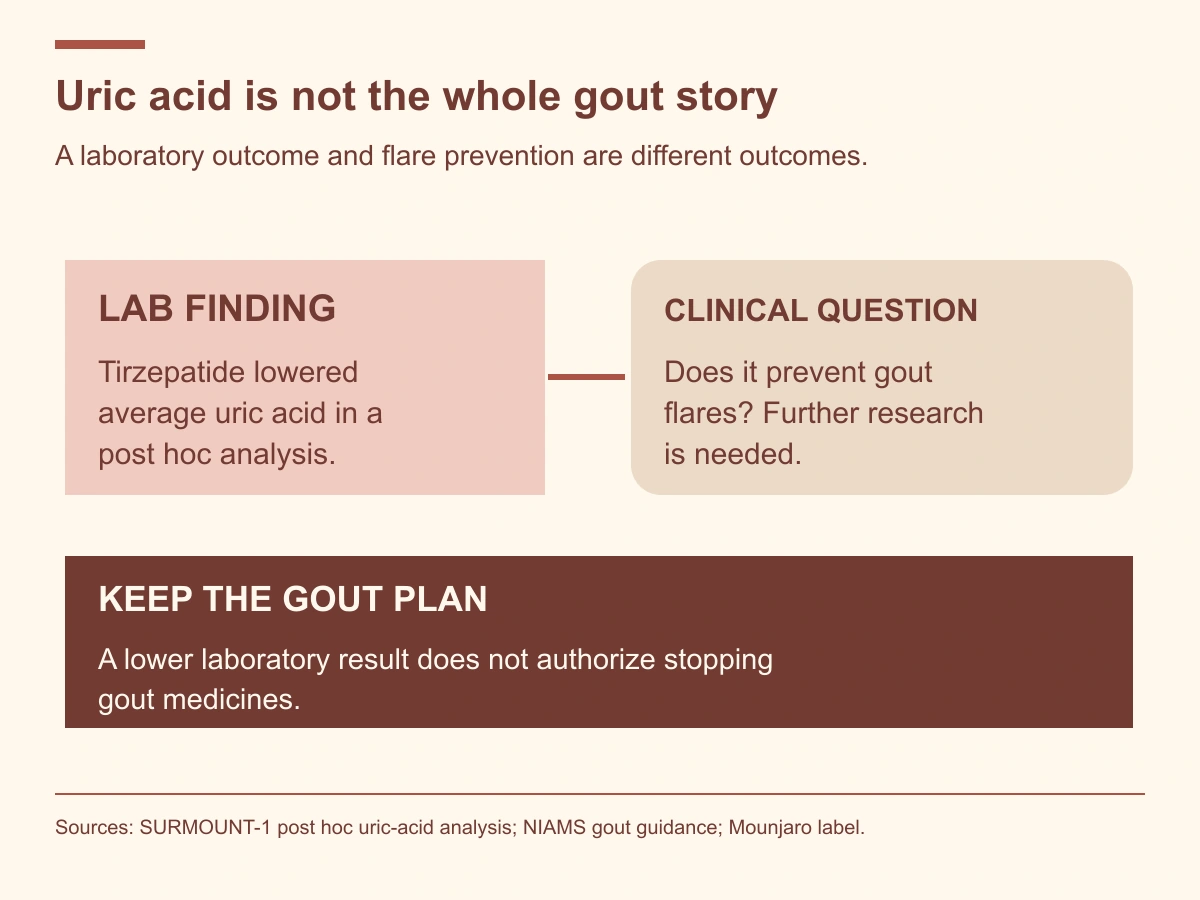
There is also newer research linking tirzepatide with lower blood uric acid. That finding is encouraging for research, but it does not make Mounjaro an approved gout medicine or a replacement for an existing gout plan. Understanding the difference between a laboratory result, a gout flare, and an approved treatment helps make the next conversation more useful.
What is gout, and how is it diagnosed?
Gout is an inflammatory arthritis associated with urate crystals. When urate builds up over time, crystals can form in and around joints and cause episodes of pain and inflammation. The big toe is a familiar location, but other joints can be affected. A flare may begin suddenly, including overnight. NIAMS gout overview.
An elevated uric acid result does not by itself mean someone has gout. NIAMS notes that many people with high serum urate never develop the condition. Conversely, the assessment of a painful joint requires more context than one laboratory number.
The clinician may review symptoms and medicines, examine the joint, order blood tests, or use joint-fluid testing or imaging when appropriate. Other conditions can resemble gout. Tell the clinician whether this is a first episode or whether previous attacks were formally diagnosed. NIAMS diagnosis guidance.
Does Mounjaro cause gout?
The current adult common-reaction table lists nausea, diarrhea, decreased appetite, vomiting, constipation, indigestion, and abdominal pain. It does not list gout. The label also contains other warnings, including kidney injury associated with dehydration from gastrointestinal reactions. Mounjaro safety information.
A common-reaction table cannot prove that an individual symptom is unrelated to treatment. It also cannot supply a gout risk percentage that was never reported there. If symptoms began after a start or dose change, include that timing in the history without treating it as proof of cause.
Several changes can occur together: a new medicine, a different eating pattern, illness, changes in fluid intake, or a change to another prescription. The clinical review should consider the full sequence. Our Mounjaro medication-interaction guide explains why the rest of the medication list matters.
What did the tirzepatide–uric acid analysis show?
A post hoc analysis of SURMOUNT-1 examined serum uric acid in a trial involving 2,539 adults with obesity, or overweight plus a weight-related complication. Participants had been randomized to tirzepatide or placebo for 72 weeks. “Post hoc” means the investigators analyzed this question using data from the existing trial. Primary analysis abstract.
The reported average uric acid changes at week 72 were −0.69, −0.92, and −0.95 mg/dL in the 5, 10, and 15 mg tirzepatide groups, compared with −0.18 mg/dL with placebo. The investigators’ mediation analysis suggested that weight reduction explained much of the uric acid reduction.
Those are study-group results, not a target for choosing a prescription. The analysis does not establish the dose a person with gout should receive, show that every participant avoided flares, or demonstrate that an existing urate-lowering medicine can be discontinued. Its authors called for further investigation of the possible role in people with gout and obesity.
The original treatment trial and this laboratory analysis are also different from a trial designed specifically to test prevention of gout attacks. A lower average uric acid result can justify another research question without answering all the treatment questions that follow.
Keep the three questions separate
| Question | What the evidence can tell you | What still needs assessment |
|---|---|---|
| Is this painful joint gout? | Gout has recognizable patterns and diagnostic tests | Your examination and possible alternative causes |
| Can tirzepatide change uric acid? | The SURMOUNT-1 analysis found average reductions | Your actual level and the clinical importance of its change |
| Can Mounjaro replace gout treatment? | Its current label does not approve it for gout | A separate gout-management plan with the treating clinician |
| Did a recent dose change cause this episode? | Timing is useful information | The full history, other medicines, illness, and test results |
Our Ozempic and gout article addresses a different active ingredient. It should not be used to transfer tirzepatide study results onto semaglutide or the other way around.

What if nausea or vomiting changes your fluid intake?
The Mounjaro label warns about acute kidney injury due to volume depletion, often in the setting of nausea, vomiting, or diarrhea. Report persistent symptoms, difficulty retaining fluids, reduced urination, or significant dizziness. These concerns need attention whether or not a painful joint is ultimately diagnosed as gout. Mounjaro volume-depletion warning.
Fluid advice should account for kidney or heart disease and any existing fluid restriction. Do not respond by forcing a generic amount of water or changing a diuretic yourself. Tell the treating team how much you can comfortably drink and whether illness has affected food, fluid, and medicine intake.
The tirzepatide nausea and reflux guide helps organize digestive-symptom details. Persistent vomiting is not a desirable way to accelerate weight loss, and a painful joint should not distract from dehydration or another acute problem.
Which other medicines should be discussed?
Bring prescriptions, over-the-counter products, vitamins, and supplements. NIAMS identifies several medicines that can raise gout risk, including diuretics, low-dose aspirin, high-dose niacin, and cyclosporine. Their presence on the list is a reason for a clinician to review the overall plan; it is not an instruction to stop them. NIAMS risk factors.
Also identify anything taken for the joint pain. Anti-inflammatory drugs, colchicine, and corticosteroids have different roles and precautions. The appropriate choice depends on the person’s diagnosis, kidney function, other illnesses, and other medicines. Reusing someone else’s prescription or an old course without review can create a separate problem.
Our ibuprofen, alcohol, and tirzepatide guide covers related pain-relief questions. The pharmacist can check the exact products while the clinician evaluates whether the joint needs examination and which treatment is suitable.
Flare relief and long-term urate control have different jobs
Treating the pain and inflammation of an active flare is one goal. Lowering urate over time to prevent future problems is another. NIAMS describes both approaches and notes that recurrent flares or tophi may require medicines to manage urate; lifestyle changes alone may be insufficient. NIAMS treatment guidance.
Feeling better between attacks does not necessarily mean the underlying problem has resolved. Do not stop a urate-lowering medicine because a joint is comfortable or because you have started losing weight. Ask which measures will determine whether the long-term plan needs adjustment.
A follow-up visit can address attack frequency, adherence, laboratory monitoring, and side effects. Bring the name and schedule of both flare and preventive medicines so the team can tell which is being used for which purpose.
How does weight management fit?
NIAMS includes achieving a healthier weight among measures that may lower urate and reduce flares in people with overweight or obesity. It also discusses limiting sugar-sweetened drinks and alcohol and considering a balanced eating pattern such as DASH. These are parts of a broader plan, not proof that a particular medication will cure gout. Living with gout.
Avoid turning this into an overly restrictive diet that is difficult to nourish yourself on, particularly if appetite has already fallen. Our balanced-meal guide and tirzepatide protein and muscle guide provide related planning questions.
CoreAge Rx’s tirzepatide page describes offered compounded care. Compounded tirzepatide is not FDA-approved Mounjaro or Zepbound, and the branded trial evidence does not establish equivalence for a compounded preparation. It should not be represented as an approved gout treatment. FDA compounding explanation.

When should a painful joint receive prompt care?
A first episode of sudden severe joint pain should be assessed rather than labeled as gout at home. A hot, swollen joint with worsening pain, fever, chills, or feeling generally unwell can require urgent help because joint infection is another possibility. Follow local urgent-care or emergency guidance. NHS gout guidance.
Do not wait for the next scheduled medication visit if symptoms are severe. Note when the pain started, which joint is affected, whether you can bear weight or use it, and any fever or injury. A familiar history of gout does not make every future episode identical.
Frequently asked questions
Can I take Mounjaro if I have gout?
Gout is not listed as a contraindication in the current label. Suitability still depends on the full medical history, the reason for treatment, kidney health, and the medication plan. Tell the prescriber about diagnosed gout and all its treatments.
Will lower uric acid guarantee fewer attacks?
The tirzepatide analysis does not provide that guarantee. A laboratory change and a clinical flare outcome are different measures. Continue the gout plan unless the treating clinician changes it.
Should I stop Mounjaro because my toe hurts?
Contact the treating team and have concerning symptoms assessed. Timing alone cannot determine the cause or the correct prescription change. If other urgent symptoms are present, seek care promptly rather than waiting for a routine message.
What should I bring to the appointment?
Bring the medication list, recent dose-change dates, prior gout history, available uric acid results, and a concise account of the joint symptoms, eating, drinking, and illness. Those details help the clinician distinguish a new joint problem from the longer-term gout plan.
Educational information for adults; individual treatment decisions require a qualified clinician. Sources reviewed October 5, 2026. Original AI-generated article images depict fictional people and objects, not patient outcomes. Other editorial images are illustrative. Graphics summarize the cited sources.