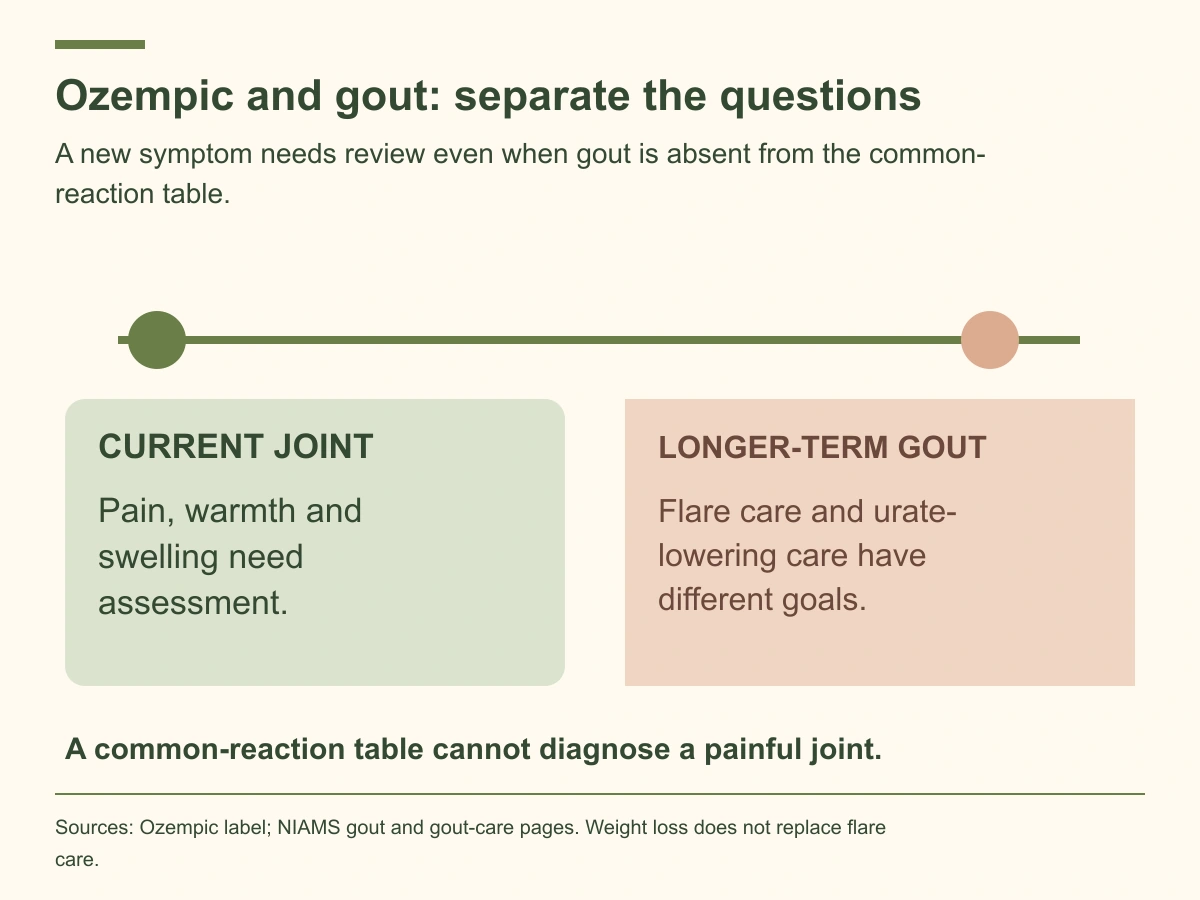
Gout is not listed among the common adverse reactions in Ozempic’s main common-reaction table, but that does not prove a new painful joint is unrelated to treatment or harmless. A sudden red, hot, swollen joint needs clinical assessment. Gout has its own causes, diagnosis, and treatment, and Ozempic should not be used as an improvised treatment for a gout flare. Ozempic prescribing information, NIAMS gout overview
If joint symptoms start after a medication change, report the timing and the full medicine list. The useful question is what is causing the symptoms and what care is needed—not whether a side-effect list can rule out every possible association.
What is gout?
Gout is a form of inflammatory arthritis involving urate crystals in or around a joint. Urate comes from the breakdown of purines, substances found in body tissues and foods. Too much production or too little removal can lead to a buildup. Many people with high blood urate do not develop gout, so a blood result alone does not explain every joint symptom. NIAMS causes of gout
A flare often begins suddenly, sometimes at night. The big toe is a common first location, although other joints can be involved. Pain, swelling, redness, and warmth are typical descriptions. Symptoms may improve between flares even though the underlying condition still needs management.
Some conditions can resemble gout. NIAMS explains that evaluation may include a medical history, examination, blood testing, joint-fluid assessment, or imaging, depending on the situation. Do not diagnose a new episode from a photograph or from someone else’s experience. NIAMS gout diagnosis and treatment
Does Ozempic cause gout?
The reviewed Ozempic common-reaction table primarily lists digestive symptoms, including nausea, vomiting, diarrhea, abdominal pain, and constipation. Gout is not an entry in that table. The table describes reported common reactions in a particular trial pool; it is not a complete test of whether every possible symptom can occur in every person. Ozempic adverse-reaction section
Accordingly, two absolute claims are not justified by the table: that Ozempic is a proven cause of your flare, or that a flare cannot possibly have any connection with changes occurring during treatment. A clinician needs the chronology, gout history, other medicines, health conditions, and symptoms to assess the event.
For broader context, see Ozempic side effects. Distinguishing a documented label warning from an unconfirmed causal explanation makes it easier to seek the right care.
Why the full health history matters
Gout commonly occurs alongside conditions such as obesity, diabetes, high blood pressure, chronic kidney disease, and kidney stones. The fact that a person has diabetes treatment and gout at the same time does not establish which condition or medicine caused the other. NIAMS gout overview
Tell the clinician about previous flares, prior urate testing, kidney disease, and the medicines used to prevent or treat gout. Also describe recent illness, injury, alcohol intake, and changes in food patterns. NIAMS identifies foods, alcohol, some medicines, physical trauma, and illnesses among possible flare triggers.
If menopause is also part of your history, see menopause, joint pain, and HRT questions. That context does not determine the cause of a new hot or swollen joint.
Do not turn this list into a self-blame checklist. It supports a medical review. A flare can require treatment even when you have followed your care plan, and a lifestyle change alone may not address the underlying urate problem.
What if nausea or vomiting changes how you eat and drink?
Ozempic can cause gastrointestinal symptoms, and its label warns about kidney injury associated with volume depletion from nausea, vomiting, or diarrhea. If these symptoms affect your ability to drink or take other medicines, report them promptly. Ozempic dehydration-related kidney warning
That warning is clinically relevant during a gout review because kidney history and medicine tolerance matter. It does not, by itself, prove that dehydration caused a particular flare. Avoid presenting a possible explanation as a diagnosis.
If you have a prescribed fluid limit for heart or kidney care, ask for a plan that fits it. General advice to drink more is not a substitute for individualized instructions. Likewise, do not deliberately reduce intake to make the scale move faster while you are unwell.
For fluid-related symptoms, read Ozempic and water retention and Wegovy and water retention. Swelling around one joint, generalized edema, and dehydration are distinct questions even when the same person is concerned about all three.

Which medicines should be reviewed?
NIAMS lists medicines that can increase gout risk, including diuretics, low-dose aspirin, high amounts of niacin, and cyclosporine. If you take one of these, tell the clinician; do not stop an important prescription on your own. The risk-benefit decision depends on why it was prescribed. NIAMS gout risk factors
Also include gout medicines, diabetes medicines, nonprescription pain relievers, and supplements. The appropriate medicine for a flare depends on your health and other prescriptions. A remedy that helped a friend may be unsuitable for someone with kidney disease, bleeding risk, or another condition.
If an antidepressant is part of the regimen, mention it before adding an NSAID. Lexapro and Zoloft labels warn about increased bleeding risk with NSAIDs and certain other medicines. The Ozempic with Lexapro or Zoloft guide explains why reviewing the complete list matters beyond the original two-drug question.
Flare treatment and urate management have different goals
NIAMS describes treatment for a flare using clinician-selected anti-inflammatory medicines, colchicine, or corticosteroids. It separately describes medicines that lower urate to address the underlying condition and help prevent future problems. These are different jobs within a treatment plan. NIAMS gout treatment information
An episode improving does not automatically mean a long-term preventive prescription is unnecessary. Ask which medicine is intended for immediate pain and which is intended for ongoing urate control. Request instructions about what to do if you miss a dose or cannot keep medicine down.
| Care question | What it is trying to establish | Useful information to bring |
|---|---|---|
| Is this gout or another cause? | Diagnosis of the current joint problem | Onset, location, warmth, redness, fever, prior episodes |
| How should this flare be treated? | A suitable short-term treatment | Kidney history and all medicines |
| Do I need urate-lowering treatment? | Longer-term prevention strategy | Flare frequency, tophi, testing, prior response |
| Has Ozempic affected intake or medicine tolerance? | A separate treatment-review issue | Digestive symptoms and dose-change dates |
| Which changes are appropriate for me? | A sustainable follow-up plan | Existing dietary, activity, and fluid instructions |
The table is a preparation tool, not a way to select a gout prescription at home. Follow the clinician’s actual plan rather than combining several possible treatments yourself.
Can losing weight help gout over time?
Readers asking about a different incretin medicine can review Mounjaro and gout for the distinction between exploratory uric-acid findings and evidence that actually measures gout flares. A laboratory change does not replace a gout treatment plan.
NIAMS says that, for people with overweight or obesity, weight reduction through a reduced-calorie eating pattern and increased activity can help lower urate and reduce flares. It also explains that lifestyle changes alone are not sufficient for some people with frequent flares or tophi; prescribed urate-lowering medicines remain central in those situations. NIAMS living-with-gout guidance
This is a longer-term health discussion. It is not evidence that Ozempic is an approved gout treatment or that a particular number of pounds guarantees a flare will stop. Do not postpone flare care while waiting for weight loss.
Use the weight-loss percentage guide to describe progress consistently. The weight-loss timeline guide explains why an arithmetic estimate should not become a deadline for symptom relief or a reason to tolerate significant adverse effects.
Ask how activity should change during a painful flare and when to resume usual movement. NIAMS includes rest, elevation, and ice among ways to reduce flare symptoms, alongside the prescribed treatment plan. Avoid exercising through severe joint pain to meet a weight goal.
When should a painful joint be assessed promptly?
A new hot, red, swollen joint deserves prompt clinical review, especially if the diagnosis has not been established, pain is severe, or you also feel ill. Tell the office about fever, injury, difficulty using the limb, and rapidly worsening symptoms. Do not wait for a routine Ozempic refill visit to discuss a new acute problem.
Seek emergency care for a serious allergic reaction, breathing difficulty, fainting, or another emergency symptom. Ozempic’s serious warnings also include persistent severe abdominal pain and dehydration-related kidney problems; report those separately from joint pain. Ozempic warnings
If you already have a written gout-flare plan, follow it and contact the clinician when the episode differs from your usual pattern or does not respond as expected. “I have had gout before” should not become a reason to overlook a changed symptom pattern.

Prepare for the appointment
Write a short account with the first symptom date, affected joint, severity, visible changes, and prior episodes. Add recent Ozempic changes, other prescriptions, missed medicines, illness, and digestive symptoms. If photographs show a change over time, ask whether the office wants them.
Ask whether testing is needed, who will follow results, and whether your preventive plan should change. Clarify what should happen before the next scheduled Ozempic dose if the current illness is affecting intake. Do not use a dosing chart as an automatic answer to an illness-related question.
Frequently asked questions
Is gout a common Ozempic side effect?
Gout is not listed in the reviewed main common-reaction table. That is a limited statement about the table, not a diagnosis or a guarantee that every joint symptom is unrelated. Ozempic adverse-reaction information
Should I stop Ozempic because my toe hurts?
Report the symptom and ask for clinical assessment and a specific medication plan. Severe or urgent symptoms need timely care. Do not make an unsupervised treatment change from a guessed diagnosis.
Can I stop gout medicine once I start losing weight?
Ask the gout clinician. Weight management does not automatically replace urate-lowering treatment, especially when flares are frequent or tophi are present. NIAMS gout care
Where can I learn about semaglutide care?
The CoreAge Rx semaglutide information page provides a starting point for treatment questions. It does not diagnose gout, treat a flare, or establish equivalence to Ozempic.
Educational information for adults; individual treatment decisions require a qualified clinician. Sources reviewed October 4, 2026. Original AI-generated article images depict fictional people and objects, not patient outcomes. Other editorial images are illustrative. Graphics summarize the cited sources.