New swelling or a rapid increase on the scale while taking Ozempic deserves a closer description. Fluid collecting in tissues, abdominal bloating, constipation, and a longer-term change in body fat are different things. The scale alone cannot tell you which one is happening or whether the medicine is responsible.
Water retention is not listed among the common Ozempic injection reactions in the reviewed U.S. label. That does not rule out a medication-related problem, an uncommon reaction, or another condition requiring care. The important next step is to describe where swelling occurs, how quickly it appeared, and whether breathing, urine output, or other symptoms changed. Ozempic injection prescribing information.
What does water retention actually mean?
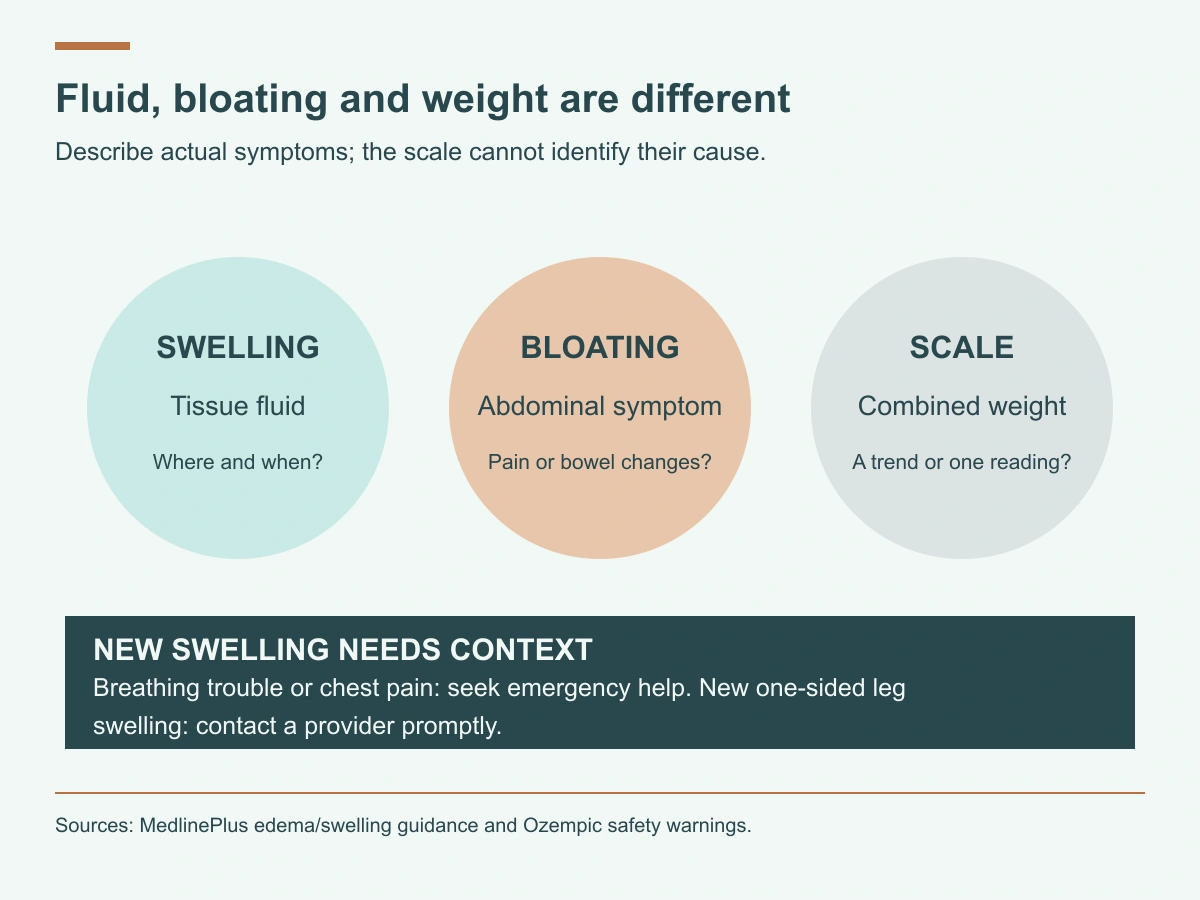
Edema means swelling caused by fluid accumulating in body tissues. It can affect a limited area or be more widespread. MedlinePlus describes several possible causes, including circulation problems, heart, kidney, or liver disease, some medicines, pregnancy, and prolonged standing or sitting. MedlinePlus edema overview.
This is different from a full abdomen after a meal, gas, or bowel contents contributing to scale weight. People sometimes use “water weight” for any short-term change, but that phrase can blur symptoms that need different responses. Notice whether your ankles, hands, face, or another area are actually swollen.
Our guide to water weight versus fat loss explains why a daily scale number includes more than fat. It also discusses why new swelling and rapid unexplained gain should be assessed rather than dismissed as ordinary measurement noise.
Which swelling symptoms need urgent care?
Seek emergency help for swelling with shortness of breath or chest pain. MedlinePlus advises contacting a provider right away for new or worsening swelling in one leg, a swollen area that is red or warm, fever, worsening swelling with known heart or kidney disease, and certain pregnancy-related changes. MedlinePlus foot, leg, and ankle swelling.
Ozempic’s label also warns about serious hypersensitivity reactions, including angioedema and anaphylaxis. Rapid swelling of the lips, tongue, face, or throat, especially with trouble breathing or swallowing, should be treated as an urgent possible allergic reaction rather than routine water retention. Ozempic hypersensitivity warning.
If you already have a heart-failure, kidney-disease, or pregnancy monitoring plan, follow the action instructions supplied by your team. A general article cannot replace the specific change thresholds or emergency contacts in that plan.
What does the Ozempic label support?
The label’s common-reaction list centers on digestive symptoms: nausea, vomiting, diarrhea, abdominal pain, and constipation. It does not provide a common-event rate for water retention. It would therefore be inaccurate to give a percentage for “Ozempic edema” based on that table or transfer a rate from another medicine. Ozempic label.
Two warnings are especially relevant when people describe a fluid problem. The label addresses acute kidney injury associated with volume depletion, often following vomiting or diarrhea, and serious allergic reactions that can include swelling. These are different clinical situations. Neither should be reduced to a generic explanation that the body is temporarily “holding water.”
| What changed? | Questions to bring to the clinician | Why the distinction matters |
|---|---|---|
| Both ankles look swollen | When did it begin, what changes it, and what other conditions or medicines are present? | Tissue-fluid causes need consideration. |
| One leg is newly swollen | Is it painful, red, warm, or associated with other symptoms? | A new one-sided pattern needs prompt advice. |
| The abdomen feels full or distended | Are there bowel changes, pain, vomiting, or trouble passing gas? | Bloating and digestive symptoms are not automatically edema. |
| The scale rose without visible swelling | Were measurement conditions, food, bowel contents, or other factors different? | One reading cannot identify fat or fluid change. |
| Urine output fell during vomiting | How much fluid can you keep down, and how ill do you feel? | Volume depletion and kidney assessment may be relevant. |
These are history prompts, not diagnoses. Several patterns can overlap, and a familiar explanation should not be used to ignore a new warning sign.
Can you be swollen and still have a dehydration concern?
The amount of fluid in tissues is not the same as a simple measure of whether you have enough circulating fluid. An individual fluid problem can be more complicated than “drink more” or “drink less.” The treatment depends on the underlying condition and the clinical assessment.
Ozempic’s kidney warning describes events associated with digestive reactions leading to dehydration. If vomiting, diarrhea, or very low intake occurs with reduced urine output, contact the care team promptly. Explain the duration and whether you can keep liquids down. Kidney-function monitoring may be appropriate when reactions could cause volume depletion. Ozempic volume-depletion warning.
Do not use a fixed drinking target from a social-media post to override a prescribed fluid limit. Our water and drink guide explains why individual needs and restrictions matter. If you are unwell, the GLP-1 sick-day discussion can help you prepare questions for the clinician.
What other medicines can affect swelling?
MedlinePlus identifies several medicine groups that can contribute to leg swelling, including some blood-pressure medicines, NSAIDs, steroids, certain antidepressants, and hormones such as estrogen and testosterone. This is a reason to review the complete list, rather than focus only on the most recently discussed injection. MedlinePlus medicine-related swelling.
Mention prescriptions, nonprescription pain relievers, supplements, and changes in hormonal treatment. Give the actual names and timing. The clinician can consider whether the pattern fits a medicine effect, another condition, or more than one contributor.
Do not stop a prescribed medicine or change a hormone dose independently because it appears in a general list. If HRT is part of your history, our menopause hormone-therapy guide explains questions for a broader review. That link does not establish that HRT caused the swelling or that changing it will solve the problem.

Why timing matters without proving causation
Record whether the swelling began before or after Ozempic started, followed a dose change, or appeared after travel, illness, or a change in another prescription. Notice whether it is present on waking, becomes more apparent later in the day, or improves when a clinician-approved measure is used.
These details can help identify a pattern, but they do not replace examination or testing. A symptom occurring after a weekly injection may be related, coincidental, or influenced by several changes at once. Repeatedly checking the scale cannot resolve that uncertainty on its own.
Do not conduct your own stop-and-restart experiment to test the cause. A prescribing team can decide how to investigate the concern while considering diabetes control and the risks of changing treatment. Our Ozempic dosage guide keeps schedule questions tied to the actual prescription and presentation.
Can constipation or bloating explain a scale increase?
Constipation is a common labeled Ozempic reaction, and digestive contents can affect the scale. A feeling of abdominal fullness may therefore prompt questions about bowel frequency, stool consistency, meals, and dose changes. However, these observations do not identify every cause of abdominal swelling. Ozempic label.
If abdominal symptoms are severe, persistent, worsening, or accompanied by vomiting or other warning signs, seek assessment. Do not automatically add laxatives, restrict food, or assume that an increasing abdomen is benign gas. Our GLP-1 constipation guide explains why symptom context matters before choosing a product.
For mild, familiar symptoms that have already been assessed, a clinician may help review the eating pattern, bowel routine, and treatment tolerance. That is a different situation from new visible edema or a concerning painful abdominal episode.
How might swelling be evaluated?
MedlinePlus describes an assessment using the medical history and physical examination, including attention to the heart, lungs, abdomen, and affected limbs. Depending on the findings, tests can include blood chemistry, urine testing, an ECG, imaging, or an ultrasound of leg veins. Not every person needs every test. MedlinePlus evaluation of swelling.
The clinical question determines the investigation. One-sided leg swelling, swelling during pregnancy, and a gradual bilateral ankle pattern have different implications. Tell the provider about other symptoms and established diagnoses so the evaluation can address the situation you actually have.
Ask what the team is trying to rule in or out, when results will be available, and what should happen if symptoms worsen before then. A clear follow-up plan is more useful than choosing a treatment solely because a website lists it under “water retention.”
Why not use a diuretic or detox tea on your own?
A diuretic is a medicine that increases urine output. It may be prescribed for particular causes of fluid accumulation, but it is not a universal treatment for a temporary scale increase. MedlinePlus notes that cause-directed care may include diuretics and that these medicines can have side effects. MedlinePlus swelling care.
Using one without appropriate assessment can complicate a situation involving vomiting, poor intake, kidney disease, or another medicine. A laxative tea has a different purpose and cannot diagnose or correct the cause of edema. Sweating or dehydration to lower the scale also does not establish fat loss.
Likewise, do not impose a very low-calorie diet because shoes or rings feel tighter. Address the symptom first. Food and fluid plans should fit the medical context, rather than be used as an improvised way to remove an unexplained increase.

A practical record to bring to the care team
Write down where swelling occurs, whether it affects one or both sides, when it started, and whether pain, redness, warmth, fever, breathing symptoms, or reduced urine output are present. Include recent travel, prolonged sitting, illness, and medication changes.
If your team has asked you to record weight, use the measurement conditions and action thresholds they provided. A photograph may help show a change over time if you can take one easily, but it does not measure circulation, kidney function, or the cause. Do not delay urgent care to build a detailed log.
Frequently asked questions
Does Ozempic routinely cause water retention?
It is not listed among the common injection reactions reviewed here. That does not rule out an uncommon or individual problem. New swelling should be described and assessed, with attention to other medicines, conditions, and warning signs.
Does a higher scale reading mean the medicine stopped working?
One reading cannot determine the treatment’s effect. Body water, bowel contents, and measurement conditions can contribute. Visible swelling or a rapid unexplained change needs clinical attention rather than an automatic dose increase or stricter diet.
Should I drink extra water to flush out swelling?
There is no universal flushing plan. Fluid advice depends on the cause and any heart or kidney restrictions. Seek guidance, especially if swelling occurs with vomiting, low urine output, or difficulty breathing.
Would switching to tirzepatide remove the problem?
That cannot be promised before the cause is understood. If you are comparing CoreAge services after assessment, review the semaglutide and tirzepatide pages with a provider. Confirm the actual formulation, treatment goal, and follow-up plan; a switch is not a substitute for investigating new edema.
Educational information for adults; individual treatment decisions require a qualified clinician. Sources reviewed October 2, 2026. Original AI-generated article images depict fictional people and objects, not patient outcomes. Other editorial images are illustrative. Graphics summarize the cited sources.