
Zepbound studies report fatigue, but the label does not provide a fixed number of days after which it resolves. If you are feeling unusually tired, the timing, severity, effect on daily life, and accompanying symptoms matter more than a promised “adjustment period.” Persistent or substantial fatigue deserves a review of the whole situation.
Tell your clinician when it began, whether it followed a dose change, and whether you are also eating less, vomiting, having diarrhea, feeling dizzy, or sleeping poorly. Do not assume tiredness means the medicine is working or that an energy supplement is the solution.
What do Zepbound trials report about fatigue?
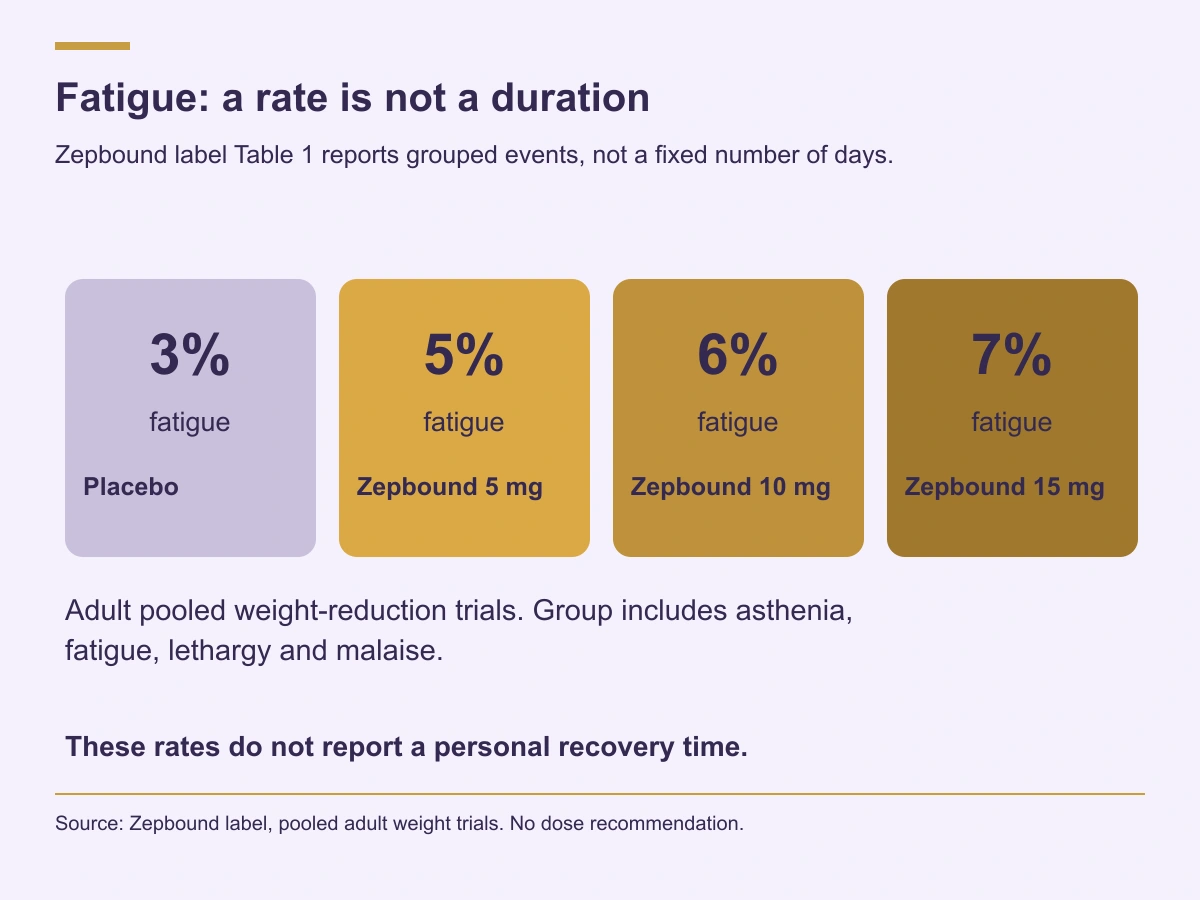
In the label’s pooled adult weight-reduction trials, the fatigue category was reported by 3% of placebo participants and 5%, 6%, and 7% of participants assigned to Zepbound 5 mg, 10 mg, and 15 mg, respectively. The category includes asthenia, fatigue, lethargy, and malaise. Zepbound prescribing information
Those are group-level trial rates. They do not specify how many days each episode lasted, the reason for every report, or whether an individual person’s current tiredness is due to the medicine.
| Trial group | Participants in the label’s table | Grouped fatigue reports |
|---|---|---|
| Placebo | 958 | 3% |
| Zepbound 5 mg | 630 | 5% |
| Zepbound 10 mg | 948 | 6% |
| Zepbound 15 mg | 941 | 7% |
The table describes the studied adult weight-reduction setting. It is not a dosing recommendation or a forecast that moving between doses will change your energy by a particular amount.
How long does Zepbound fatigue last?
The sources reviewed here do not establish a universal duration. A statement such as “fatigue always passes in two weeks” goes beyond what the table reports.
The label does describe a time pattern for nausea, vomiting, and diarrhea: many reports occurred during escalation and decreased over time. That finding concerns gastrointestinal events. It should not be repackaged as a fatigue-recovery timetable. Zepbound prescribing information
Instead of waiting for a fixed deadline, discuss how tired you are and whether the pattern is improving or worsening. Being a little less energetic for part of a day is different from repeatedly being unable to work, drive safely, prepare food, or perform usual activities.
Our first month on tirzepatide guide explains why early treatment tracking includes symptoms and function rather than a single expected weight or energy result.
Is it ordinary tiredness, sleepiness, or weakness?
Try to describe the experience in concrete terms. “I want to sleep,” “my legs feel weak,” and “I cannot keep up with usual tasks” may lead to different questions. You do not need to select a medical label before seeking advice.
Note when it happens: all day, after an injection, when standing, after poor sleep, or alongside gastrointestinal symptoms. Also record whether it is new or a continuation of a problem that existed before treatment.
This history helps the care team avoid attributing everything to Zepbound. The trial category groups several descriptions; your personal symptom still needs its own assessment. If you feel too sleepy or faint to drive or use machinery safely, avoid doing so and get appropriate advice.
Could eating less be part of the picture?
Reduced appetite can make meal planning harder. If you are regularly missing meals or struggling to eat a variety of foods, tell the clinician or dietitian. A very small intake should not automatically be celebrated as treatment success when it leaves you unable to function well.
Describe what a typical day now looks like. Are meals smaller but still regular, or have nausea and food aversion left you eating almost nothing? Those are different situations. A list of foods you can tolerate can help the care team create a workable plan.
Our GLP-1 meal guide and tirzepatide protein and muscle guide cover meal and function questions. They do not prescribe one calorie or protein target for everyone, and an organ capsule is not a substitute for addressing poor intake.

What about dehydration and gastrointestinal symptoms?
Zepbound labeling warns about kidney injury associated with volume depletion, often when nausea, vomiting, or diarrhea leads to dehydration. It also includes low blood pressure in the adverse-reaction table. These issues can be relevant when fatigue occurs alongside difficulty drinking, lightheadedness, or ongoing gastrointestinal symptoms. Zepbound prescribing information
Do not diagnose dehydration from fatigue alone. Report the accompanying symptoms and how much your usual drinking and eating have changed. A clinician may need to assess your fluid status, kidney function, or other concerns.
Avoid adding large amounts of water, salt, or electrolyte products without considering your health conditions and any prescribed fluid restrictions. Persistent vomiting, inability to keep fluids down, or fainting deserves medical assessment rather than repeated attempts to “push through.”
The tirzepatide nausea and reflux guide provides related symptom questions. If you also take blood-pressure medicines, mention the full regimen rather than assuming only the injection matters.
Could low glucose be involved?
The Zepbound label discusses hypoglycemia, with particular attention to use with insulin or medicines such as sulfonylureas. It also reports hypoglycemia in adults without type 2 diabetes. Fatigue alone does not prove low glucose, but the possibility deserves attention when it fits your symptoms and treatment. Zepbound prescribing information
If you have a glucose-monitoring or low-glucose treatment plan, follow that plan and seek help when it indicates. Ask the care team whether medication changes or additional monitoring are needed; do not adjust insulin or other prescriptions on your own.
Bring readings and symptom timing if available. “I feel exhausted” is important, but “I feel weak and shaky before lunch, and here are the readings” gives the clinician more information. Our Mounjaro low-blood-sugar guide covers a related tirzepatide question with its own product context.
Sleep, other medicines, and preexisting conditions
Tell your clinician about poor sleep, known sleep apnea, recent illness, and medicines that changed around the same time. These are relevant parts of the history even if fatigue began after Zepbound.
Do not assume a weight change immediately resolves an existing sleep problem. Our tirzepatide and sleep-apnea guide explains the specific Zepbound evidence and why sleep-care decisions still need follow-up.
Likewise, a symptom such as tiredness is not enough to diagnose low testosterone or a vitamin deficiency. The appropriate evaluation depends on your history and examination. Adding several supplements makes it harder to tell what changed and may introduce additional safety questions.
What to record before contacting the clinician
Choose one or two daily activities as concrete examples. You might note whether you could make breakfast, walk your usual route, or complete a normal work shift. This makes a change easier to discuss than assigning a vague score to “energy.” Avoid pushing through an activity that feels unsafe simply to complete the record.
Include what was already happening before treatment. If poor sleep or fatigue predates the prescription, that history remains relevant even if symptoms have worsened. The clinician can then distinguish a new problem from a change in an existing one rather than starting with an assumed cause.
Keep the record brief enough to use. Include the current dose, injection dates, recent dose changes, when tiredness occurs, and what you can no longer do comfortably. Add gastrointestinal symptoms, intake changes, sleep information, other medicines, and relevant home readings.
Ask whether you should be assessed before the next planned increase. Escalation is a prescribed treatment decision; being tired is not a reason to advance faster or to make an unsupervised dose reduction.
Our Zepbound side-effect guide places fatigue alongside other safety questions. The tirzepatide questions guide offers a broader framework for follow-up and treatment goals.

When is tiredness an urgent concern?
Seek urgent help for severe or rapidly worsening symptoms, fainting, confusion, inability to stay awake normally, or inability to keep fluids down. Breathing trouble or a severe allergic reaction requires immediate medical help. Concerning abdominal pain or other serious symptoms should not be dismissed because fatigue is also present.
The important distinction is the whole symptom pattern and its severity. A fatigue percentage in a trial does not make a serious current illness safe to wait out.
Common questions about Zepbound fatigue
Is fatigue a sign that the dose is strong enough?
No. It is not a measure of treatment effectiveness. Review the intended outcomes, tolerability, and daily function with your clinician rather than using a side effect as a target.
Will a lower dose always fix it?
That cannot be promised. The cause may involve several factors, and trial group rates do not predict your response to a dose change. Ask your prescriber to review the situation before changing treatment.
Should I use caffeine or an energy injection?
Do not use an energy product to bypass evaluation of substantial fatigue. It may not address poor intake, dehydration, glucose problems, sleep issues, or another cause. Ask what needs assessment before adding another product.
Is fatigue different with semaglutide?
Different products have different study populations and safety information. Our semaglutide tiredness guide covers that related question. Do not assume switching ingredients guarantees more energy.
Where can I discuss the treatment plan?
Contact your prescriber, especially when fatigue is persistent or limits normal activities. The CoreAge Rx tirzepatide page provides treatment information for that discussion, without promising a fixed fatigue timeline or recommending a supplement to offset it.
Educational information for adults; individual treatment decisions require a qualified clinician. Sources reviewed October 3, 2026. Original AI-generated article images depict fictional people and objects, not patient outcomes. Other editorial images are illustrative. Graphics summarize the cited sources.