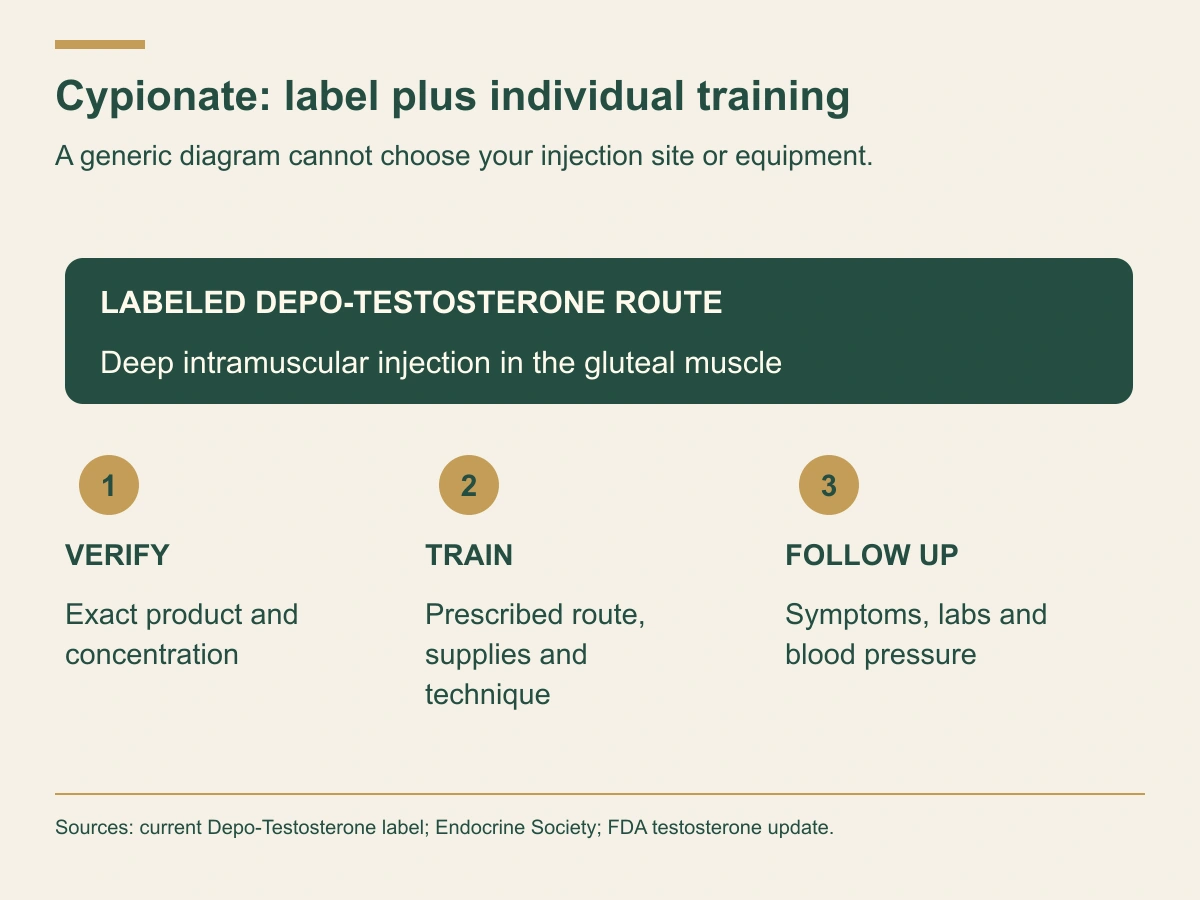
The current U.S. Depo-Testosterone label directs testosterone cypionate to be given by deep intramuscular injection in the gluteal muscle. That means the product’s labeled route is into muscle in the buttock region. It does not provide a reason to choose a site, needle, or technique from a generic online diagram. Your training must match the exact product and prescription. Manufacturer prescribing information.
People searching for a cypionate injection site often encounter instructions for other testosterone products, different routes, or a clinician’s individualized off-label plan. Those instructions may look similar while describing different treatment. Before the next injection, confirm the medicine, route, concentration, prescribed amount, supplies, and person responsible for teaching you.
Start with the vial and prescription together
Read the full name on the pharmacy label and manufacturer packaging. “Testosterone” alone does not identify the ester, formulation, or route. Cypionate and enanthate are different esters, and a gel, vial, or autoinjector comes with its own directions. Our cypionate versus enanthate comparison explains those distinctions.
The Depo-Testosterone label lists both 100 mg/mL and 200 mg/mL strengths. These are concentrations: the amount of medicine in each milliliter of liquid. They are not interchangeable instructions to draw the same volume. A refill that looks familiar still deserves a label check. Depo-Testosterone formulation information.
If the pharmacy directions and the plan you remember do not agree, contact the pharmacy and prescriber before using the product. Keep both labels available so the team can identify the discrepancy. Do not choose whichever set of instructions seems easier to follow.
What does the labeled injection site tell you?
The label’s deep-gluteal intramuscular instruction identifies the intended tissue and region for that product. It also states that the medicine should not be given intravenously. It does not establish the exact safe location on a particular person’s body or teach the complete administration procedure. Manufacturer route instructions.
The person providing training should demonstrate how the prescribed region is identified, which sites to avoid, and how your supplies fit the intended route. Reach, dexterity, vision, body build, and whether someone else will help can affect the practical plan.
Do not assume that a diagram for a vaccine, insulin, or a GLP-1 medicine applies to testosterone cypionate. These products can differ in tissue target, formulation, volume, and equipment. A familiar-looking syringe is not evidence that the instructions are interchangeable.
Why do some people mention the thigh or a subcutaneous route?
A clinician may use a product outside a particular label’s instructions in an individualized treatment plan. If your prescribed site or route differs from the manufacturer directions, ask the prescriber to explain the choice and provide written instructions and training for that exact plan.
A social-media account describing someone else’s thigh or under-the-skin injection does not establish that you should switch. Changing the route can also change the equipment, technique, and monitoring discussion. Do not convert a muscle-injection prescription into a subcutaneous prescription yourself.
Our TRT injections and gel guide addresses formulation tradeoffs. A discussion about discomfort or difficulty reaching a site may lead to renewed training, help with administration, or a different treatment option. It does not need to end with improvising an unfamiliar injection.
What should an injection-training visit cover?
Use the checklist below to identify gaps before you leave the visit. It is a preparation tool, not a needle-placement tutorial.
| Training topic | Question to have answered |
|---|---|
| Product identity | Is this the exact formulation and concentration on my prescription? |
| Route and location | What route and region were prescribed, and how will I identify an appropriate site? |
| Measuring the amount | Do the written amount, volume, and supplied syringe agree? |
| Supplies and handling | Which equipment is appropriate, and how should it be used and discarded? |
| A problem during administration | What should I do if delivery is uncertain or the equipment fails? |
| Follow-up | Who reviews symptoms, laboratory results, blood pressure, and refills? |
Ask to demonstrate your understanding while the trainer observes, using the teaching method they provide. Being able to repeat the steps back is more useful than leaving with an unfamiliar diagram. If you need a caregiver’s help, include that person in the training rather than relaying instructions secondhand.

Is one injection site best for testosterone results?
A site cannot compensate for an incorrect diagnosis, unsuitable regimen, or missed follow-up. The treatment goal is an appropriate testosterone-replacement plan for a confirmed clinical need, with monitoring for benefit and adverse effects. Choosing a region because someone says it “absorbs better” is not a substitute for that plan.
The Endocrine Society recommends diagnosing hypogonadism in men with compatible symptoms and consistently low testosterone concentrations, confirming the result with repeat morning fasting testing and evaluating the cause. Fatigue or a single low result does not answer all of those questions. Endocrine Society guideline summary.
Our low-testosterone symptoms and testing guide explains the diagnostic conversation. Once treatment starts, report both improvement and persistent problems. A prescriber may need to examine several factors before changing a formulation or schedule.
What if an injection hurts or leaves a lump?
The cypionate label lists pain and inflammation at the intramuscular injection site among reported reactions. The presence of a listed reaction does not prove that every painful or swollen area is routine. Its severity, progression, timing, and associated symptoms matter. Manufacturer adverse-reaction information.
Tell the care team if pain is significant, repeatedly interferes with treatment, or is accompanied by spreading redness, warmth, drainage, fever, or worsening swelling. Seek urgent assessment for a severe or rapidly worsening problem. A photograph may help the clinician understand a skin change, but a photo alone may not establish its cause.
Sudden breathing difficulty, facial or throat swelling, collapse, or chest pain requires emergency help. A painful swollen leg with new shortness of breath also needs urgent evaluation; testosterone labels include venous-clot warnings. Do not explain a serious whole-body symptom away as an injection-site issue.
What if you are unsure the full dose went in?
Record what happened, including the product, time, prescribed amount, device, and what you observed. Contact the prescriber or pharmacist for instructions. Do not automatically repeat a full dose or try to estimate a replacement amount from a drop on the skin.
Avoid changing the next scheduled amount to “balance out” an uncertain injection. Your team needs to decide what can be established about the event and what follow-up is appropriate. Ask during training how to reach help outside routine office hours.
The same principle applies to a damaged vial, unclear label, unexpected appearance, or supply mismatch. The dispensing pharmacy should assess the actual product. Do not heat, dilute, mix, or transfer it according to an unrelated online tip.
Monitoring matters after technique becomes familiar
A comfortable injection does not show that the full treatment plan is appropriate. Follow-up considers symptoms, testosterone measurements timed to the prescribed regimen, blood counts, blood pressure, and other individual risks. The cypionate label calls for periodic hemoglobin and hematocrit checks during long-term androgen treatment. Manufacturer monitoring information.
In February 2025, FDA announced class-wide testosterone labeling changes that included blood-pressure warnings and removal of cardiovascular boxed-warning language following review of TRAVERSE. This did not remove the need to assess cardiovascular health or monitor blood pressure. FDA testosterone labeling update.
Our TRT monitoring guide and TRT blood-pressure discussion explain what to bring to follow-up. Tell the team about swelling, persistent headaches, changes in urination, new sleep symptoms, or other concerns instead of waiting until a refill is due.

Fertility and sleep symptoms belong in the plan
Discuss near-term fertility goals before starting or continuing testosterone. Exogenous testosterone can suppress the hormonal signals involved in sperm production. The Endocrine Society recommends against starting therapy in men planning fertility in the near term and in several other specified situations, including untreated severe obstructive sleep apnea. Guideline summary.
These issues do not disappear when the route changes. A different ester or injection location should not be presented as a method to preserve fertility. Our TRT and fertility guide can help prepare the discussion with a qualified clinician.
For service information, CoreAge Rx’s TRT page describes planned compounded care and is currently marked coming soon. Confirm availability, the actual formulation, administration training, and ongoing testing with the service. Compounded medicines are not FDA approved; a manufacturer label for an approved product does not establish equivalence for a compounded preparation. FDA compounding explanation.
Frequently asked questions
Can I use an insulin-injection diagram for testosterone cypionate?
No. The diagram may describe a different route and technique. Ask for instructions matching the exact cypionate product and the prescription, including any deliberately chosen off-label plan.
Does a 200 mg/mL vial mean my dose is 200 mg?
No. It states concentration. Your prescribed drug amount and the corresponding liquid volume are separate instructions that must match the supplied syringe and label. Have the pharmacist confirm them rather than copying a previous marking.
Can I change sites because the previous injection was uncomfortable?
Ask the care team to review the reaction and technique. Do not move to a different route or unfamiliar region without appropriate instructions. Worsening pain or other concerning symptoms may need assessment first.
Should I change the schedule when I feel tired before the next injection?
Report the pattern and the timing of symptoms and tests. Fatigue can have several contributors, and the clinician should review the regimen and broader health context. An extra injection is not a safe way to test whether testosterone is the cause.
Educational information for adults; individual treatment decisions require a qualified clinician. Sources reviewed October 5, 2026. Original AI-generated article images depict fictional people and objects, not patient outcomes. Other editorial images are illustrative. Graphics summarize the cited sources.