Skipping dinner can create an earlier eating window, but research does not establish dinner as the best meal for everyone to skip. The useful question is whether a schedule lets you eat enough, manage your medicines safely, sleep well, and sustain the routine. An earlier final meal is one option; a smaller evening meal or less late-night grazing may fit your life better.
Time-restricted eating means keeping food and calorie-containing drinks within a daily window. It does not specify the quality or amount of food inside that window. Removing dinner while leaving the rest of the day unchanged can have a very different effect from moving a balanced dinner earlier. The studies below help explain that distinction.
What does “skipping dinner” actually change?
Write down the time of the first and last calorie-containing food or drink on a typical day. Include a morning latte, an evening snack, and drinks consumed after a meal. Someone who skips a 7 p.m. dinner but snacks until 10 p.m. has not necessarily created an earlier eating window.
Another person may eat breakfast, lunch, and an early afternoon meal. That pattern can resemble an early time-restricted eating study even though it still contains three meals. Meal names are less informative than the actual schedule, nutrition, and reason for making the change.
A fasting schedule also differs from the instructions for a blood test or procedure. Those instructions come from the relevant healthcare team and may restrict drinks or medication timing differently. Our water and fasting guide explains why these situations need separate answers.
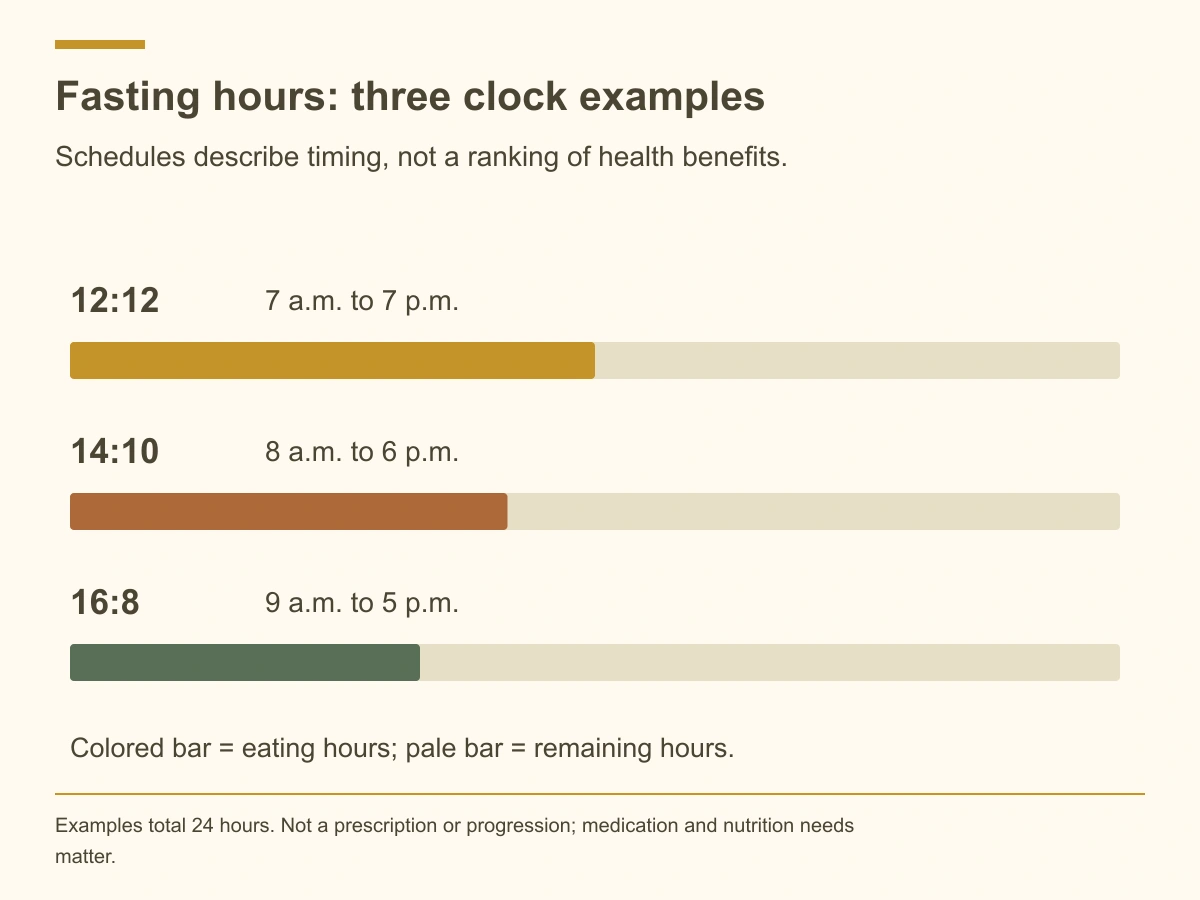
What do 12:12, 14:10, and 16:8 mean?
In common time-restricted-eating notation, the first number describes hours without calorie intake and the second describes the eating window within a 24-hour day. These labels describe a schedule; they do not establish its health benefit, calorie intake, or suitability for you.
| Schedule name | Illustrative eating window | Remaining interval |
|---|---|---|
| 12:12 | 7 a.m. to 7 p.m. | 12 hours until 7 a.m. the next day |
| 14:10 | 8 a.m. to 6 p.m. | 14 hours until 8 a.m. the next day |
| 16:8 | 9 a.m. to 5 p.m. | 16 hours until 9 a.m. the next day |
These are clock examples, not a recommended progression. Moving from one row to another is not automatically an improvement. Each window can also be placed at different times; a 16:8 schedule does not necessarily mean skipping dinner or breakfast.
Count from the first food or calorie-containing drink to the last. A late coffee with milk, a shake, or a bedtime snack changes the actual window even if you still call the plan 16:8. Our water and fasting guide discusses beverage questions and why medical fasting is separate.
Are 18:6, one meal a day, and 5:2 the same thing?
They describe different approaches. An 18:6 schedule leaves a six-hour daily eating window. “One meal a day” describes meal frequency and may leave little time for adequate intake. The term 5:2 is commonly used for a pattern with reduced intake on two days of a week; it is not a daily clock calculation like 14:10.
Naming an approach does not endorse it. The two time-restricted-eating trials discussed below did not establish that the shortest possible window is best or that one-meal-a-day and 5:2 plans produce the same outcomes. Match a study’s actual design to the claim being made. Early-window trial, early, late and self-selected window trial
Which hours should a beginner choose?
First record the schedule you already follow and identify the problem you want to solve. If the issue is unplanned late snacking, a consistent meal routine may address it without a long fast. If the issue is inadequate breakfast followed by intense evening hunger, delaying food further may be unhelpful.
Consider whether the proposed hours leave room for adequate meals, medication instructions, exercise, sleep, and time with other people. Our balanced-meal guide can help with meal structure; it does not require a fasting schedule.
What if you work nights or rotating shifts?
Write the window using actual clock times and include your sleep period. A plan designed around a conventional workday may not translate neatly to an overnight shift. The early-window trial below is not a personalized study of your work pattern.
Discuss the schedule with a clinician if diabetes medicines, pregnancy, an eating-disorder history, or difficulty maintaining nutrition is relevant. In particular, insulin and sulfonylureas can make missed meals a low-glucose concern. NIDDK hypoglycemia guidance
When should the schedule be reconsidered?
A window that repeatedly leaves you weak, unable to take medicines as directed, or struggling to eat enough deserves review. Treat suspected low glucose according to your care plan; do not preserve a fast at the expense of treatment. Fasting hours are one optional organizational tool, not a target that overrides symptoms or nutrition.
What did trials of earlier eating find?
A 2022 randomized trial enrolled 90 adults with obesity. Both groups received weight-loss treatment, including energy restriction. One group ate between 7 a.m. and 3 p.m.; the comparison group ate over a window of at least 12 hours. At 14 weeks, the earlier-window group lost an average of 2.3 kg more weight. However, the between-group difference in the primary body-fat analysis was not statistically significant. Original randomized trial.
That finding supports further interest in earlier eating. It does not establish that removing dinner alone produces the same result, that the difference represents only fat, or that everyone should stop eating at 3 p.m. The participants received counseling, and the study excluded people with diabetes or severe or unstable chronic medical conditions.
A separate 2025 trial randomized 197 adults with overweight or obesity to early, late, or self-selected eight-hour windows, or usual care based on Mediterranean-diet education, for 12 weeks. Its primary outcome was visceral fat measured by MRI. The trial did not find a significant extra reduction in visceral fat with the time-restricted schedules compared with usual care, or a significant difference among the three windows. Primary trial abstract.
Together, these trials show why “earlier is always better” is too broad a conclusion. Studies use different participants, comparison groups, and outcomes. A result about body weight cannot automatically answer a question about visceral fat, long-term maintenance, or a particular person’s glucose safety.
Compare schedules by what they require
The examples below are discussion options, not prescribed fasting windows. None is a proven universal winner.
| Approach | Potential practical advantage | Question to resolve |
|---|---|---|
| Move dinner earlier | Keeps an evening meal while changing the last eating time | Can work and family schedules accommodate it? |
| Eat the final meal in the afternoon | Creates a longer overnight gap | Can you meet nutrition needs before the window closes? |
| Keep dinner and start eating later | May suit shared evening meals | Does it interfere with medicines, morning activity, or concentration? |
| Keep regular meals and reduce unplanned evening grazing | Changes a specific habit without a rigid fast | Is the later eating driven by habit, hunger, or insufficient earlier meals? |
Our balanced-meal guide and meal preparation for busy schedules can help with the food and planning questions. A timetable is easier to evaluate when you know what you will actually eat.
Does skipping dinner guarantee a calorie deficit?
No. The total eating pattern can change in either direction. A person might consume less overall, eat a larger lunch, add snacks, or become very hungry the following morning. A clock cannot measure those changes or determine whether nutrition needs are being met.
For example, removing a substantial dinner and replacing it with several calorie-containing drinks is a different change from moving the same dinner to an earlier time. Neither example tells us the eventual weight outcome without knowing the rest of the routine. Consider the foods, drinks, portions, and consistency together.
NIDDK recommends an eating pattern that can be maintained over time alongside appropriate physical activity. Its guidance includes a variety of vegetables, fruits, whole grains, protein foods, and other nutrient sources. An eating window should leave room for that variety. NIDDK eating and activity guidance.

What if you take insulin or another diabetes medicine?
Discuss the proposed schedule with the diabetes team before fasting. NIDDK identifies skipped or delayed meals and fasting as possible contributors to low glucose, particularly with insulin or medicines that increase insulin release. Changing when you eat can change the safety of an otherwise familiar medication routine. NIDDK hypoglycemia guidance.
The plan should identify which medicines are affected, whether monitoring needs to change, what to do with a low reading, and whom to contact. Do not independently omit insulin or reduce tablets to make a fasting window possible. A clinician needs to consider the actual medicines and your health history.
A fast should never take priority over treating low glucose according to your care plan. Someone who cannot safely swallow, loses consciousness, or needs help because of severe hypoglycemia requires urgent assistance. Discuss an emergency plan with the treating team before experimenting with meal timing.
What if a GLP-1 medicine already reduces appetite?
Less appetite does not mean that a longer fasting window is automatically helpful. If semaglutide or tirzepatide already makes eating difficult, removing another meal may make adequate intake harder. Report persistent nausea, vomiting, weakness, or trouble meeting food and fluid needs.
The semaglutide protein and muscle guide explains nutrition and function questions during treatment. The semaglutide nausea guide addresses meal tolerance and symptoms that need assessment. These are more useful starting points than treating difficulty eating as evidence that a stricter fast is working.
Medication eligibility is a separate decision from whether a fasting schedule feels convenient. CoreAge Rx’s semaglutide care page describes an offered compounded program. Compounded medicines are not FDA approved, and an eating-window study does not establish the safety or effectiveness of that preparation. FDA compounding explanation.
Can skipping dinner affect sleep, exercise, or family life?
Use these as practical measures of fit. If hunger repeatedly prevents sleep, a schedule may need revision. If your exercise occurs late in the day, discuss how to support food intake and recovery. If dinner is your reliable opportunity to eat a varied meal with family, removing it may create a problem that an earlier or smaller meal would avoid.
Our sleep and weight-management guide explains why sleep deserves attention in its own right. Weight planning should not require ignoring persistent fatigue or choosing a schedule that is incompatible with work and caregiving.
For shift workers, a trial organized around daytime waking may not translate neatly to overnight work. Record actual sleep and work hours and discuss the schedule with a clinician or dietitian. Avoid calling a daytime meal “dinner” and assuming that its name makes a study directly applicable.
A useful way to evaluate the idea
Start by defining the problem you want to solve. Perhaps you regularly snack after a satisfying dinner, eat very late because lunch is unreliable, or want a simpler routine. Each calls for a different adjustment. Skipping dinner is only one possible response.
Before changing the schedule, review medicines, health conditions, pregnancy or breastfeeding, and any history of restrictive or disordered eating with a qualified professional when relevant. The adult trials discussed here do not provide a personal fasting prescription for those situations.
Agree on meaningful observations: energy, concentration, hunger, meal adequacy, sleep, and glucose when monitoring is prescribed. If weight tracking is useful for you, interpret a trend under comparable conditions. Our water-weight and fat-loss guide explains why a lower reading after a skipped meal does not prove a particular amount of fat was lost.

Frequently asked questions
Is it better to skip breakfast or dinner?
There is no single answer supported for every adult. Earlier eating has shown benefits in some studies, while another randomized comparison found no significant advantage among eating windows for its primary visceral-fat outcome. Choose a medically appropriate schedule that supports adequate food intake and daily life.
Can I still eat dinner and practice time-restricted eating?
Yes. A time window can include dinner, and an earlier final meal can still be a full meal. The actual first and last eating times matter more than whether the meal is called dinner.
Does feeling very hungry mean the fast is burning more fat?
Hunger is not a measurement of fat loss or a reason to override symptoms. Review the whole pattern, including whether earlier meals were adequate. Dizziness, persistent weakness, or glucose concerns deserve attention rather than a longer fast.
What if I cannot keep the same schedule every day?
Use that information to choose a more realistic approach. A routine can be revised around work, sleep, medication needs, and family meals. The aim is a useful pattern you can maintain, with professional support when needed, rather than completing an arbitrary number of fasting hours.
Sources checked for this update
Fasting Trial source; Fasting Late source; Hypoglycemia source.
Educational information for adults; individual treatment decisions require a qualified clinician. Sources reviewed October 6, 2026. Original AI-generated article images depict fictional people and objects, not patient outcomes. Other editorial images are illustrative. Graphics summarize the cited sources.