
Kojic acid is used in some topical products for unwanted pigmentation, including combination treatments for melasma. Its evidence should be read at the level of the studied preparation rather than extended to every soap, serum, or prescription cream that contains the ingredient. The diagnosis and the skin’s tolerance remain central to the decision.
If you are considering a product such as Spot On, ask what kojic acid contributes alongside the other ingredients and how the whole formula will be used. A multi-ingredient label can provide a rationale for treatment without proving that the finished product will produce a particular result for every person.
What kojic acid is intended to address
Kojic acid is discussed in pigment care because of its effects on processes involved in melanin production. Melanin is the pigment that contributes to natural skin color. The treatment goal should be a defined unwanted patch or mark, not a broad promise to make all skin lighter.
The AAD’s melasma treatment guidance includes kojic acid among options a dermatologist may consider. The choice depends on the condition and the person, including the ability to tolerate the preparation.
A dark spot still needs identification before treatment. A new or changing lesion should not be presumed to be melasma or post-acne pigment simply because a kojic-acid product is marketed for uneven tone.
What a clinical study can tell you
A 2013 study compared kojic acid alone with combinations involving hydroquinone and a corticosteroid in eighty patients with melasma. Over twelve weeks, the kojic-acid-plus-hydroquinone group had the greatest improvement among the studied groups. This was a small, single-center study with particular preparations and methods.
That result supports interest in selected combinations. It does not establish that every kojic-acid product has the same effect or that you should add a steroid or hydroquinone yourself. The study did not test every cream sold under a similar ingredient description.
Combination studies also require careful attribution. If several actives are used together, the result cannot automatically be credited to one ingredient. A comparison designed to isolate an added component answers a different question from an uncontrolled before-and-after photograph.
Product type changes the comparison
Kojic acid may appear in wash-off products, leave-on cosmetics, and prescription combinations. Those preparations have different contact times, concentrations, and accompanying ingredients. A short-contact cleanser is not equivalent to a leave-on cream used under medical guidance.
Read the exact ingredient list and instructions. Some products use related ingredient names or derivatives, which should not automatically be treated as identical to the substance in a study. If the form or strength is unclear, ask the manufacturer or pharmacy.
| Detail | Why it matters |
|---|---|
| Ingredient identity | A related name may describe a different compound. |
| Concentration | It helps define the preparation, but does not alone predict benefit. |
| Wash-off or leave-on | Exposure differs substantially. |
| Other actives | They can influence both results and irritation. |
| Studied formula | Ingredient evidence is not automatically finished-product evidence. |
Match the ingredient to the diagnosis
Melasma, post-inflammatory hyperpigmentation, and discrete sun-related spots have different patterns and management needs. A flat mark after acne also differs from a red mark or an indented scar. Pigment-focused ingredients do not address every feature left behind by a breakout.
Ask the clinician to identify the condition and the intended treatment area. If the concern includes ongoing acne, controlling new inflammation may be part of preventing new marks. If it involves a changing lesion, assessment takes priority over cosmetic treatment.
The hyperpigmentation overview and comparison of common pigment concerns explain these distinctions. A precise goal makes the evidence discussion more useful.
Kojic acid can still irritate
An ingredient’s origin or a product’s brightening description does not guarantee tolerance. Irritation and contact allergy are relevant considerations with topical products, including kojic-acid preparations. The complete formula may contain additional ingredients that matter to your skin.
Tell the clinician about prior reactions, eczema, rosacea, and known allergies. If you have reacted to a particular brightening product, bring the full ingredient list rather than assuming kojic acid was definitely the cause.
Stop a newly introduced product that causes persistent burning, an itchy spreading rash, significant swelling, or blistering and seek advice. Severe facial swelling or breathing difficulty requires urgent medical care. Do not treat a reaction as evidence that pigment is being removed.

Avoid adding several brightening steps at once
A common temptation is to combine a kojic-acid product with an acid toner, retinoid, vitamin C serum, and another dark-spot cream. That can create a routine whose total irritation is more important than any one ingredient’s theoretical benefit.
Review all products together and ask which ones have a clear additional role. A combination prescription may already include ingredients duplicated by separate serums. More layers do not guarantee a faster or more even result.
The dark-spot irritation guide explains how to build a useful timeline if symptoms develop. Keeping optional products stable during an introduction can make the response easier to interpret.
Where Spot On fits
Spot On lists hydroquinone, kojic acid, and niacinamide. The public ingredient summary does not disclose individual concentrations. Confirm the dispensed strengths and full formulation with the pharmacy when reviewing the prescription.
This combination should not be described as the same preparation used in a particular kojic-acid trial unless the match has been established. It also should not be called a corticosteroid-containing triple combination, because a corticosteroid is not among its listed actives.
Ask which areas to treat and for how long, especially because hydroquinone introduces a defined treatment-window discussion. The Spot On guide and hydroquinone duration article explain those questions in more detail.
Sun protection has a separate role
The AAD’s melasma self-care guidance recommends appropriate sun protection and tinted sunscreen containing iron oxide when visible light is relevant. Choose a labeled broad-spectrum SPF 30 or higher and follow its directions, with shade and protective clothing.
Kojic acid is not a sunscreen. A cream’s brightening or antioxidant language does not establish ultraviolet protection. Do not mix the treatment with sunscreen to create a single application step.
If the layers pill or the sunscreen feels uncomfortable, review the practical problem with the provider. A manageable protection step is more useful than a theoretically ideal product that is routinely skipped.
Track a defined area and a defined outcome
Before starting, record the pigment concern and take comparable, unfiltered photographs if useful. Keep lighting, distance, and skin preparation similar. Note new acne, irritation, or other changes that could create additional marks.
Assess the original pigment separately from overall radiance or surface smoothness. A cream can change the finish of the skin without demonstrating meaningful fading of the target patch. Conversely, a gradual change may be easier to see in a consistent record than in daily mirror checks.
At follow-up, discuss whether the result is meaningful and whether the routine is tolerable. Do not increase the amount or add stronger products because one photograph seems unchanged.
Questions for the consultation
- What condition is causing the pigmentation?
- Why is kojic acid being considered for this particular concern?
- What is the exact ingredient form and strength in the supplied product?
- Which result comes from evidence on the ingredient, and which from evidence on the finished formula?
- Does another product in my routine duplicate the same role?
- What should I do if the skin becomes irritated or the color changes unexpectedly?
- When will we review the treatment and any maintenance plan?
Include pregnancy, breastfeeding, other prescriptions, and recent procedures in the discussion. Suitability cannot be inferred from the fact that kojic acid is found in many cosmetic products.
Keep the conclusion proportional to the evidence
Keep the full product name in your notes so later comparisons do not accidentally combine results from different formulations.
Kojic acid has a place in the discussion of selected pigment treatments, including combinations studied for melasma. The evidence does not justify assuming every product works equally well or that a more complicated routine will be better.
For Spot On, use the exact prescription and a defined treatment plan. Understanding the diagnosis, formula, and review point gives you a more useful basis for judging the cream than an isolated ingredient claim.
Explore Spot On™
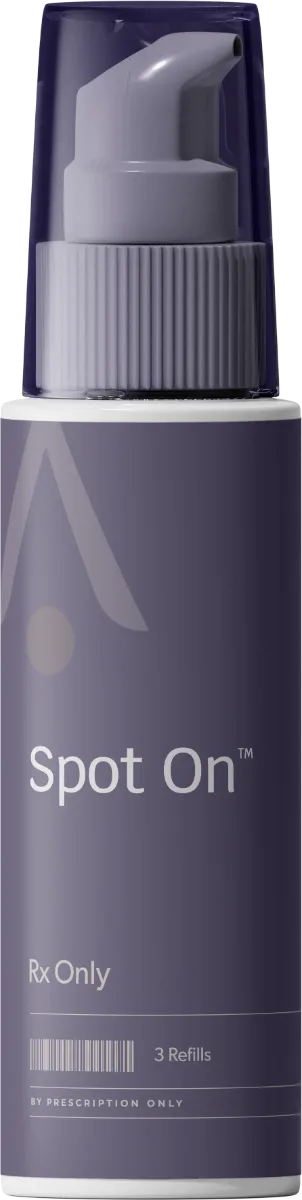
Spot On lists hydroquinone, kojic acid, and niacinamide. Confirm the dispensed strengths, treatment area, and planned treatment duration with your provider. A new or changing dark spot should be assessed before cosmetic treatment. Review the current Spot On™ page and bring your existing skin-care products to the provider discussion.
Related reading
- Hyperpigmentation Treatment: Dark Spots, Diagnosis, and Daily Care
- Niacinamide for Hyperpigmentation: A Supporting Ingredient
- Prescription Hydroquinone for Dark Spots: What to Discuss
- Spot On Ingredients: Hydroquinone, Kojic Acid, and Niacinamide
- A gentle routine for acne-prone skin
Educational information; your prescription and clinician’s instructions guide individual care. Product details and linked sources checked September 15, 2026. Ingredient research does not establish identical results for a finished compounded formula. Photographs are illustrative and do not show treatment outcomes.