
There is no reliable universal Selank dose that this article can turn into a safe U.S. treatment plan. Online microgram charts, nasal-drop schedules, and peptide cycles often leave out the product, concentration, route, clinical indication, and the quality of the evidence behind them.
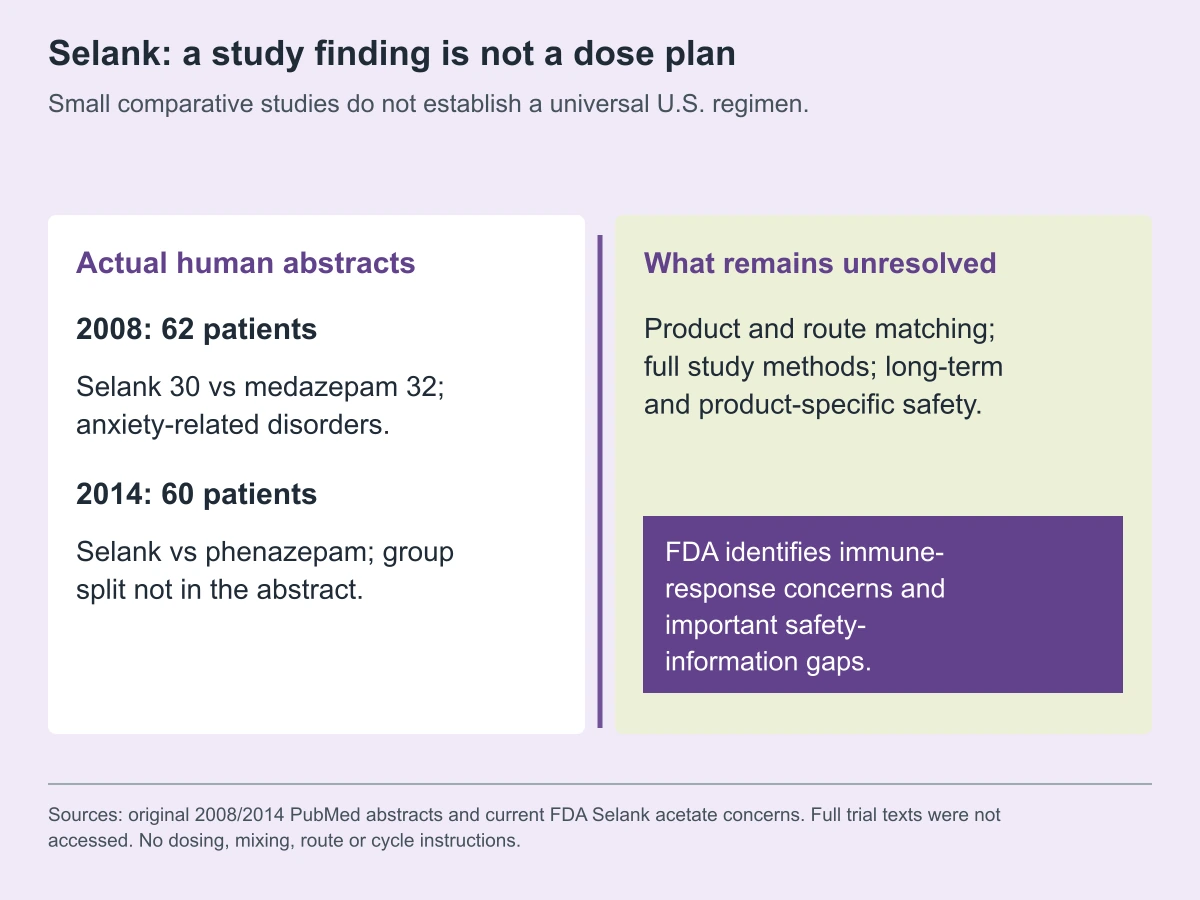
Selank has been studied in people, so saying there is no human research would be inaccurate. However, a few small comparative studies do not establish a broadly applicable regimen or resolve current safety concerns. The FDA identifies important safety-information gaps for compounded Selank acetate and possible immune-response risks for certain routes. FDA peptide safety information
If you arrived here looking for “Selank dosage,” the most useful answer is how to evaluate a dosing claim before acting on it, what the primary research actually shows, and where to seek care for the symptom you want to address.
What is Selank, and why do people search for a dose?
Selank is a peptide discussed in anxiety and cognition research. Peptides are molecules made from amino-acid sequences; sharing that category does not make different peptides interchangeable or prove that each one has the same benefits or risks.
Many dosage searches start with a practical concern: anxiety, poor sleep, brain fog, or difficulty concentrating. Those concerns are real, but a product name is not a diagnosis. Similar symptoms can have different explanations and may need different assessments.
First separate the symptom from the proposed product. What problem are you trying to improve? How long has it been present? What does it prevent you from doing? Have medicines, sleep, illness, or other changes been considered? This creates a clearer clinical conversation than beginning with a dose copied from a forum.
What does the FDA say about Selank acetate?
The FDA’s current public page lists concerns about Selank acetate, also called TP-7, in the context of compounding. It notes possible immunogenicity risks for certain routes, related to peptide aggregation and impurities, and says important information about human safety issues is lacking.
Immunogenicity means the potential to provoke an immune response. That is a safety question; it should not be translated into a claim that every user will have an allergic reaction, or that a route omitted from a marketing page must be safe.
The FDA concern also does not mean that researchers have never studied Selank in humans. Missing adequate safety information and the existence of a small human study can both be true. A study may address limited outcomes without resolving product-quality, long-term, or route-specific questions.
Keep approval and compounding separate. The FDA explains that compounded drugs are not FDA-approved and are not reviewed before marketing in the same way as approved finished products. A pharmacy’s ability to prepare a product is not itself an efficacy trial or an FDA-approved Selank regimen. FDA compounding information
This article does not make a blanket legal determination about a particular supplier or prescription. It explains why a universal consumer dosing chart would imply more certainty than the reviewed evidence supports.
What human research was actually reviewed?
We reviewed the original PubMed abstract records for two comparative studies. Their full journal texts were not available in the reviewed records, which limits how much can be concluded about methods, adverse events, and treatment details.
| Primary study | What the abstract reports | Important limit |
|---|---|---|
| 2008 study in generalized anxiety disorder and neurasthenia | 62 patients: 30 receiving Selank and 32 receiving medazepam; authors reported similar anxiety effects | The abstract does not provide a complete regimen, blinding details, or a full safety analysis |
| 2014 anxiety-disorder comparison | 60 patients; Selank compared with phenazepam; authors reported anxiety and other symptom changes | The abstract does not give a group breakdown or establish a universal dose, long-term safety, or broad wellness benefit |
Sources: 2008 original study record and 2014 original study record. Reported findings deserve accurate description, but preliminary comparisons are not proof that today’s online product will match the studied material or perform the same way.
The studies also involved particular clinical populations. A result in diagnosed anxiety-related disorders should not automatically become a claim about healthy adults’ focus, workplace performance, fat loss, or “optimization.” Those are different questions requiring matching evidence.
Why can’t a study dose simply become your dose?
Even a correctly quoted research protocol belongs to a specific study. Before translating it into care, important details would include the studied formulation, route, concentration, eligibility criteria, monitoring, comparator, and adverse-event reporting.
A dose is only one of those details. Copying it without the others can create the appearance of a complete plan where none exists. An abstract that reports improved symptoms may not provide enough information to evaluate the protocol at all.
Study duration is another limit. Short-term observation cannot establish that repeated long cycles are safe, that benefit persists indefinitely, or that there is an appropriate schedule for people with different conditions and medicines.
This is why the article does not provide nasal-drop counts, injection instructions, reconstitution amounts, or cycles. The useful decision is whether the evidence and product can support the proposed treatment—not whether a precise-looking number can be found online.
Milligrams, micrograms, and concentration are different questions
A mass amount, a liquid volume, and a device marking are not the same thing. “Micrograms” describes an amount of substance. “Milliliters” describes a volume. Drops or spray actuations depend on the device and preparation.
An online instruction that gives only a number of drops cannot establish the amount delivered by a different bottle. Likewise, a vial’s total content does not tell you what is in one measured volume without concentration information.
Understanding this distinction helps you recognize incomplete claims. It does not make an experimental product suitable for home dosing. If a label or instruction is unclear, a qualified prescriber and dispensing pharmacist should resolve it before use rather than asking you to perform an improvised conversion.
Our NAD+ injection label guide discusses amount, volume, and markings in another product context. It is a label-literacy resource, not a Selank protocol; directions cannot be transferred between substances.

Is intranasal Selank automatically safer than an injection?
No reliable conclusion follows just from choosing a route that sounds less invasive. The route changes how a product is delivered and which evidence is relevant; it does not erase formulation, impurity, stability, or safety questions.
A claim about nasal delivery should be supported by human evidence for the actual nasal product and the outcome being promised. Research on a different route or a different peptide cannot fill that gap by itself.
Similarly, “reaches the brain” and “improves a clinical symptom safely” are different claims. Showing a laboratory pathway or discussing a delivery theory does not establish a beneficial clinical result in a person.
Our NAD+ nasal delivery evidence article shows how to distinguish a delivery claim from human benefit. Its conclusions should not be transferred to Selank; it provides an example of the questions to ask.
Does a certificate of analysis prove a product works?
No. An analytical document can address particular testing questions, depending on its methods and authenticity. It cannot by itself establish clinical effectiveness, long-term safety, or that the product is appropriate for your symptoms.
Ask what was tested, by whom, when, and whether the document applies to the actual lot. A purity percentage on an unrelated document is not the same as independently verified identity, strength, sterility when needed, stability, or clinical evidence.
Also ask who is responsible for clinical follow-up. A sales page that gives dosing instructions while offering no meaningful way to assess symptoms, interactions, or adverse events leaves major questions unanswered.
“Research use only” is not a patient-care plan. Avoid treating a marketing disclaimer as reassurance that an experimental product can be safely used without qualified oversight.
What is a more evidence-based starting point for anxiety?
If anxiety persists or interferes with work, relationships, sleep, or everyday tasks, seek an assessment. A clinician can evaluate the pattern, other health considerations, and the treatments that fit your needs.
NIMH describes psychotherapy, medication, or both as treatment options for generalized anxiety disorder. Cognitive behavioral therapy is a well-studied form of treatment. The choice should reflect the person’s situation and preferences, rather than an internet ranking of products. NIMH anxiety information
You do not need to diagnose yourself before asking for help. Bring examples of the problem and what you have already tried. Tell the clinician about supplements, peptides, alcohol, and other products as well as prescriptions.
If you are in immediate danger or thinking of harming yourself, obtain urgent help. In the U.S., call or text 988 for crisis support; call emergency services for a life-threatening situation. A new supplement or peptide search should not delay that care.
What about fatigue, brain fog, or sleep instead of anxiety?
Describe the symptom you actually have. A forum’s anxiety protocol may not address fatigue, a sleep disorder, medication effects, or concentration problems with another cause.
Our NAD+ fatigue article explains why an energy-related marketing claim is not a complete evaluation. Our sleep and weight-management guide covers the broader role of sleep habits and clinical concerns.
If you are comparing peptide categories, the Sermorelin guide and Sermorelin versus other peptides article address a different hormone-related evidence base. Neither establishes Sermorelin as an anxiety treatment or a substitute for Selank.
These links are ways to understand distinct subjects, not a recommendation to combine products. Different ingredients, routes, and goals need separate assessment.
Questions to ask before considering a Selank claim
- Which exact symptom or diagnosis is the proposed treatment meant to address?
- Which original human study supports that claim, and does it match the product and route?
- What is known about adverse events, long-term use, and interactions in people like me?
- How do the current FDA concerns apply to this preparation?
- What alternatives have stronger evidence for my situation?
- Who will monitor outcomes and respond if something goes wrong?
Ask for answers that are specific enough to evaluate. A reference to “clinical research” without the paper, population, outcome, and limitations does not let you assess the claim.

Frequently asked questions
Is there an FDA-approved compounded Selank dose?
Compounded medicines are not FDA-approved. A number quoted from a study or supplier does not establish an FDA-approved regimen for a compounded product.
Does limited evidence mean Selank definitely does not work?
No. It means the available evidence cannot support every claim or resolve the relevant uncertainties. That is different from proving no possible effect.
Can I use another person’s dosing schedule?
Another person’s experience does not establish your diagnosis, formulation, suitability, or safe regimen. Do not turn a testimonial into instructions.
Does CoreAge Rx offer Selank?
This article does not describe Selank as a CoreAge Rx offering. The NAD+ product guide and Sermorelin product guide concern their own products and evidence; they are not Selank pages.
What to remember before using a dosing chart
A precise number can still rest on incomplete evidence. Keep the actual product, route, indication, quality, safety information, and follow-up in the same conversation. For symptoms such as anxiety or persistent brain fog, start with an appropriate assessment and options supported by evidence that matches your situation.
Educational information for adults; individual treatment decisions require a qualified clinician. Sources reviewed October 1, 2026. Original AI-generated article images depict fictional people and objects, not patient outcomes. Other editorial images are illustrative. Graphics summarize the cited sources.