
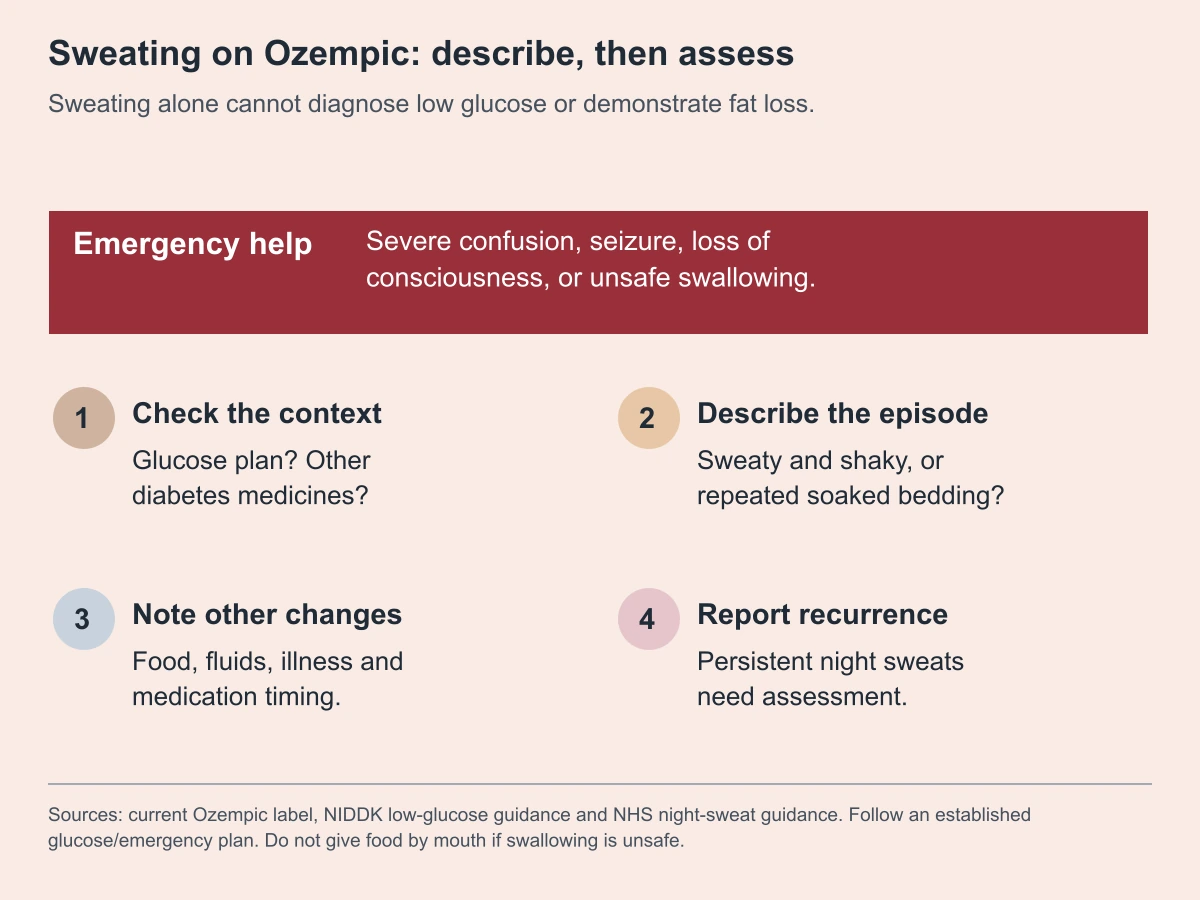
New sweating while taking Ozempic deserves a closer look, but sweating alone cannot show that Ozempic caused it or that your blood sugar is low. It also does not mean the medicine is burning fat.
Sweating is not among the most common adverse reactions in the current Ozempic prescribing information. However, low blood glucose can cause sweating, and the label warns that hypoglycemia risk increases when Ozempic is used with insulin or certain medicines that stimulate insulin release. Ozempic prescribing information
The most useful next step depends on the symptoms that accompany the sweating, your other medicines, and whether the problem is an isolated episode or a recurring change.
When sweating needs urgent attention
Seek emergency help for severe confusion, a seizure, loss of consciousness, or an inability to respond normally. Do not wait to decide whether Ozempic is responsible. Severe low glucose is one possible concern, and a general article cannot distinguish it from other emergencies.
If someone cannot safely swallow, do not give food or drink by mouth. Use a prescribed emergency plan, including glucagon if applicable and someone knows how to use it, while obtaining emergency help. NIDDK low-blood-glucose guidance
For less severe symptoms, follow your established glucose-checking and low-glucose plan if you have one. Do not drive or continue a risky activity while feeling shaky, confused, faint, or otherwise unwell. If symptoms are new and you do not have a plan, contact a clinician promptly for guidance.
These steps are about responding to the situation. They do not diagnose every episode of sweating as hypoglycemia or provide permission to change a prescription on your own.
Is sweating a common Ozempic side effect?
The label’s common-reaction list emphasizes digestive symptoms such as nausea, vomiting, diarrhea, abdominal pain, and constipation. A symptom absent from that list is not necessarily impossible, unrelated, or harmless.
Adverse-reaction tables answer a limited question about events reported in specific study populations. They cannot determine the cause of a new symptom in one person. Other medicines, illnesses, changes in food intake, activity, room temperature, and other circumstances may be relevant.
It is reasonable to report sweating that began after starting treatment or changing a dose. Describe the timing accurately without assuming that the sequence proves causation. The clinician can decide whether the medicine, a related change, or another condition needs attention.
Our Ozempic side-effect guide covers the wider safety picture. Our semaglutide formulation guide explains why a brand-name injection, a tablet, and a compounded preparation should be identified separately.
Could sweating be low blood sugar?
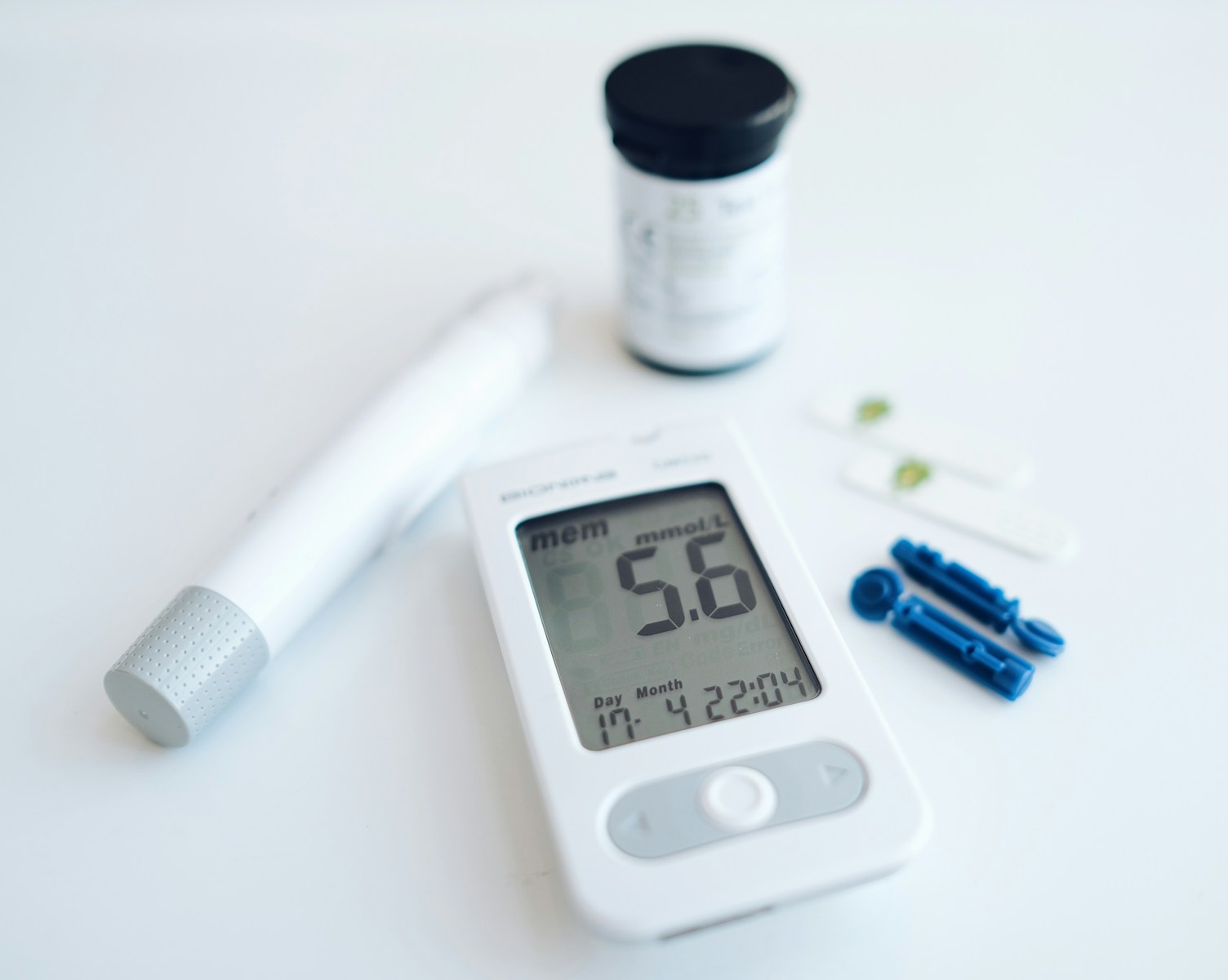
Yes, sweating can occur with low glucose. NIDDK also describes symptoms such as shakiness, hunger, dizziness, headache, and confusion. The combination, your glucose reading when available, and your treatment plan are more informative than sweat alone.
This matters particularly if your medication list includes insulin or a sulfonylurea. Ozempic’s label specifically warns about greater hypoglycemia risk with insulin or insulin secretagogues. A clinician may need to review the combined regimen, but that review is not the same as a do-it-yourself dose change.
Also mention whether nausea, vomiting, or low appetite has changed how much you eat. A person who has been eating differently while taking other glucose-lowering medicines needs a specific conversation about their plan.
If you monitor glucose, record the reading and symptoms according to your existing instructions. Do not delay urgent help because a device is unavailable or because you want a perfect log. A general website cannot select your glucose target or replace a sick-day plan.
What details help distinguish different episodes?
Try to describe the event rather than label it immediately. “I woke with soaked clothes twice this week” and “I became sweaty and shaky before lunch” suggest different questions.
| Pattern you notice | Details worth reporting | What it cannot prove |
|---|---|---|
| Sweating with shakiness, hunger, or confusion | Glucose reading if available, last meal, insulin or other diabetes medicines | That every episode is definitely low glucose |
| Sweating during heat or activity | Environment, activity, symptoms beyond expected sweating | That extra sweating measures fat loss |
| Repeated drenching night sweats | Room temperature, frequency, fever, cough, weight changes | That the medication is the only possible cause |
| New sweating after a medication change | Exact product, date, dose change, other medicines | That timing alone establishes causation |
The table is a way to organize a conversation, not a diagnostic test. Persistent or worsening symptoms may deserve care even when they do not match one of these examples.
What if you wake up sweating at night?
An overheated room or heavy bedding differs from repeatedly soaking clothes or sheets despite a cool room. The NHS recommends assessment for concerning recurring night sweats, particularly with other symptoms such as fever, cough, or unexplained weight loss. NHS night-sweat guidance
Possible explanations include menopause, anxiety, some medicines, low glucose, and alcohol-related circumstances. That list does not identify the cause in your case. It shows why an automatic “Ozempic side effect” answer may miss something worth evaluating.
For someone in perimenopause or menopause, describing hot flashes, cycle changes, and sleep disruption can help the clinician assess the pattern. Our HRT, hot-flashes, and sleep article explains a related treatment discussion. It does not establish that hormone therapy is appropriate for unexplained sweating.
Likewise, sweating should not become a shortcut to choosing another hormone product. Our menopause hormone-therapy guide covers individualized decisions rather than a single-symptom diagnosis.
Can nausea, diarrhea, or dehydration be part of the picture?
Tell the prescribing team if sweating occurs alongside persistent digestive symptoms or difficulty eating and drinking. Ozempic’s label warns about kidney injury associated with volume depletion, particularly with fluid loss from nausea, vomiting, or diarrhea.
Someone with ongoing vomiting, dizziness, weakness, or very little urine has a different concern from someone who feels well but sweats more on a hot walk. Do not treat both situations with the same fixed water or electrolyte instruction.
Fluid advice may need to account for kidney disease, heart disease, or an existing restriction. Ask for a plan suited to the actual situation. Our semaglutide nausea and vomiting guide explains why symptoms that interrupt intake deserve follow-up.
Sweating and urination can also be confusing when both change. Our Ozempic and Mounjaro urination article distinguishes many bathroom trips from unusually large volumes and from reduced urine during illness.
Does sweating mean Ozempic is working?
No. Sweat is not a measurement of medication effectiveness, fat oxidation, or the amount of body fat lost. A workout, a warm room, a spicy meal, or illness can produce sweating without answering a weight-management question.
Treatment progress needs to be assessed against the reason the medicine was prescribed. Glucose management, weight trajectory, tolerability, daily function, and other relevant outcomes may all belong in follow-up. Which measures matter depends on your plan.
Our water weight versus fat-loss article explains why a short-term scale change is not enough to identify fat loss. Our semaglutide plateau guide offers more useful questions about progress than whether you sweat after a dose.
An unpleasant symptom is not proof of a stronger effect. You do not need to endure unexplained sweating to show that treatment is worthwhile.
If the prescription is Wegovy, our guide to sweating during Wegovy treatment uses that product’s current injection and tablet labeling. Shared semaglutide does not make every brand’s trial population, rate or administration instructions interchangeable.
Should you skip a dose, move the injection, or switch products?
Do not choose a prescription change based only on a symptom article. Contact the prescribing team for instructions about the next dose when symptoms are concerning. If urgent symptoms are present, seek urgent care rather than waiting for a routine reply.
Switching the injection from the abdomen to the thigh is not an established treatment for sweating. The Ozempic injection-site guide explains approved regions and rotation, which is a separate topic from diagnosing a new symptom.
Similarly, moving to a different GLP-1 brand does not automatically solve an unexplained problem. A product comparison should include approved uses, medical history, other medicines, the actual formulation, and follow-up. Our Mounjaro versus Ozempic article discusses those broader differences.
If you use a compounded preparation, provide the full pharmacy label and ingredients rather than calling every semaglutide product Ozempic. FDA explains that compounded drugs do not undergo the same premarket approval review as approved finished medicines. FDA compounding explanation
What to record before a follow-up conversation
A brief record can make the discussion easier when symptoms are mild and you are otherwise well:
- The exact product, the prescribed schedule, and the date of any recent change.
- When sweating occurs: after a meal, during activity, overnight, or at another time.
- Whether it is new, recurring, increasing, or interfering with sleep and daily tasks.
- Shakiness, hunger, confusion, dizziness, fever, cough, pain, or digestive symptoms.
- Glucose readings if monitoring is already part of your care.
- Changes in meals, fluid intake, alcohol, or other prescription and nonprescription products.
Do not wait to finish a record if you feel seriously unwell. Its purpose is to help the clinician assess the pattern, rather than to rule out an emergency at home.
It can also help to separate what you observed from what you suspect. “The symptoms began three days after the change” is an observation. “The medication definitely caused them” is a conclusion that may need more information.

Frequently asked questions
Can Ozempic cause night sweats without low glucose?
A general article cannot determine the cause of an episode. Recurrent night sweats warrant consideration of several explanations; sweating alone does not establish low glucose or a direct medication effect.
What if my glucose reading is normal?
Report the reading with the timing and symptoms. One value does not explain every cause of sweating, and persistent symptoms may still need assessment. Follow your monitoring instructions rather than repeatedly testing without a plan.
Should I eat more sugar whenever I sweat?
Use your established low-glucose plan when appropriate. Automatically treating all sweating as hypoglycemia can obscure other causes. Severe confusion or unsafe swallowing needs emergency help, not food by mouth.
Can I compare semaglutide and tirzepatide treatment options?
Yes, with the prescribing team. The CoreAge Rx semaglutide and tirzepatide pages can help organize product questions. An unexplained symptom should be evaluated as part of that discussion, rather than used to select a new treatment on its own.
The most useful takeaway
Describe the sweating, check associated symptoms and your existing glucose plan, and obtain the right level of care. Bring recurring changes to the prescribing team. The goal is to understand what is happening and keep treatment appropriate—not to use sweat as a sign of fat loss or ignore it because it is absent from a common-side-effect list.
Educational information for adults; individual treatment decisions require a qualified clinician. Sources reviewed October 1, 2026. Original AI-generated article images depict fictional people and objects, not patient outcomes. Other editorial images are illustrative. Graphics summarize the cited sources.