Frequent urination is not among the most common adverse reactions listed for Ozempic or Mounjaro. Neither is prescribed as a diuretic, and neither lowers glucose through the kidney glucose-excretion mechanism used by SGLT2 medicines. Still, a new urinary change while taking either product deserves attention rather than an automatic dismissal.
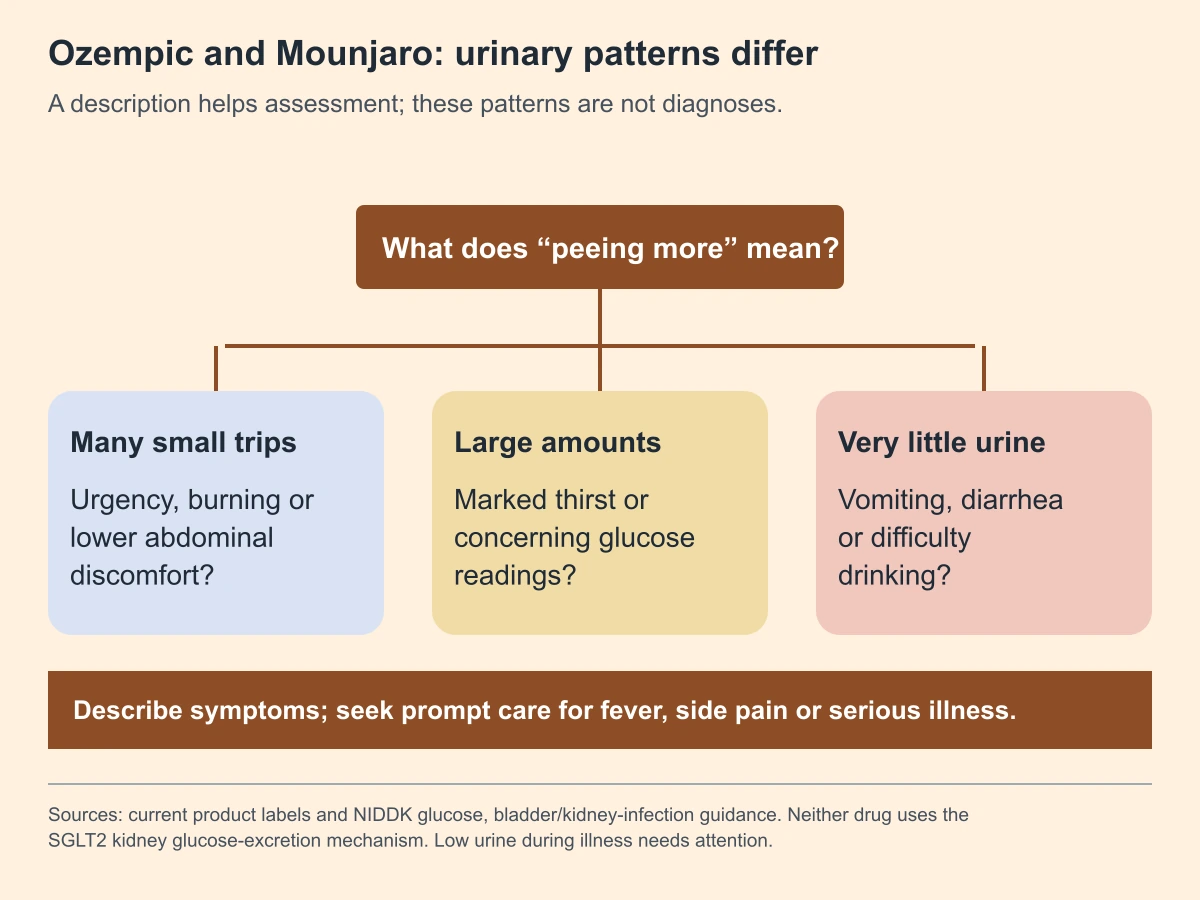
The important distinction is what changed: many trips with small amounts, unusually large volumes with thirst, burning or urgency, or very little urine while vomiting. Those patterns suggest different questions. The medicine is part of the history, but it is not a diagnosis.
This expanded guide covers both Ozempic and Mounjaro, with related Wegovy and compounded-product questions, warning signs, and useful details to bring to your care team.
When should you seek care promptly?
Seek prompt care for painful or frequent urination with fever or chills, back or side pain, nausea, or vomiting. Those symptoms can occur with a kidney infection, which can become serious. NIDDK kidney-infection guidance
Also obtain urgent assessment if you are seriously unwell, confused, fainting, unable to keep fluids down, or passing very little urine during ongoing vomiting or diarrhea. Current Ozempic and Mounjaro labels warn about kidney injury associated with fluid loss.
Do not delay care to see whether changing the injection site fixes the problem. Do not use leftover antibiotics or another person’s medicine based on a symptom list. A clinician needs to assess the actual situation.
Do Ozempic and Mounjaro work by making you urinate glucose?
No. Ozempic contains semaglutide, a GLP-1 receptor agonist. Mounjaro contains tirzepatide, which acts at GIP and GLP-1 receptors. Their glucose-related actions differ from medicines that deliberately reduce the kidney’s reabsorption of glucose.
SGLT2 inhibitors are a separate class. NIDDK explains their kidney glucose-excretion mechanism in its discovery overview. That established mechanism is the point of the comparison here; the older article is not being used as a current prescribing guide. NIDDK SGLT2 mechanism overview
People may take more than one type of diabetes medicine, so review the entire medication list. A tablet used alongside an injection may matter to the urinary pattern. Blood-pressure medicines or other products can also be relevant, which is why naming only the weekly injection may leave the discussion incomplete.
Our how Mounjaro works article explains the GIP and GLP-1 context. Our Mounjaro versus Ozempic comparison addresses product differences beyond a shared bathroom symptom.
Is frequent urination a common side effect?
The current Ozempic label’s common-reaction list focuses on digestive symptoms, including nausea, vomiting, diarrhea, abdominal pain, and constipation. Mounjaro’s common-reaction table likewise emphasizes digestive symptoms and decreased appetite. Frequent urination is not included in those common lists.
That observation has limits. It does not prove that no person can experience a urinary change, that a new symptom is safe, or that the medicine cannot be involved indirectly. A common-adverse-reaction table is not a complete diagnostic guide.
Report a clear change, particularly if it persists, worsens, interrupts sleep, or comes with other symptoms. Your clinician may consider glucose, urine symptoms, fluid intake, other medicines, or kidney function depending on the circumstances.
For broader coverage, see the Ozempic side-effect guide and Mounjaro side-effect guide. Product-specific risks should not be inferred from a forum’s statement that both medicines are “the same kind of shot.”
Frequency, large volumes, and low urine output are different
“Peeing more” can describe several things. Use the clearest description you can:
| What you notice | Questions worth clarifying | Why the distinction helps |
|---|---|---|
| Many trips, with small amounts | Urgency? Burning? Lower abdominal discomfort? | Frequency is not necessarily a large total volume |
| Large amounts, with marked thirst | Glucose readings if available? Recent medicine or intake changes? | High glucose can be one explanation to assess |
| Waking at night to urinate | When and how much do you drink? Other symptoms? | Timing adds context without explaining the cause on its own |
| Little urine during vomiting or diarrhea | Can you drink? Dizziness or weakness? | Fluid loss and kidney concerns need attention |
The table organizes observations. It cannot tell you whether you have an infection, high glucose, dehydration, or another condition.
An approximate description is enough to begin the conversation. Do not undertake complicated home volume measurements or delay care unless the clinician has asked for a particular record.
Can high blood sugar cause more urination?
Yes. NIDDK includes increased urination and thirst among diabetes symptoms. Glucose problems are one reason a clinician may ask about those symptoms, but symptoms alone do not diagnose diabetes or show whether treatment is working. NIDDK diabetes symptom guidance
If monitoring is already part of your plan, report the readings with their timing. Mention missed medicines, illness, difficulty eating or drinking, and changes in the medication list. Follow your existing instructions for concerning readings and sick days.
Do not assume that taking a glucose-lowering medicine makes high glucose impossible. Conversely, do not assume that every additional bathroom trip means the treatment has failed. The pattern and appropriate testing matter more than either assumption.
Our Mounjaro low-blood-sugar article addresses a different glucose problem. Low glucose and high glucose should not be treated as interchangeable explanations for every new symptom.
Our guide to Ozempic, Mounjaro and urinary-infection questions distinguishes burning and urgency from frequency or low urine output, and explains testing, diabetes-related context and symptoms that need prompt care.
Could it be a bladder infection?
Burning during urination, urgency, frequent trips, lower abdominal discomfort, or cloudy, bloody, or strongly smelling urine can be signs of a bladder infection. Contact a clinician for assessment rather than labeling the pattern a routine injection effect. NIDDK bladder-infection guidance
Fever or chills, back or side pain, and nausea or vomiting can signal a more concerning situation, including a kidney infection. Seek care promptly for that combination. An infection and a medication-associated problem are not mutually exclusive.
Mention the medication, but allow the clinician to consider other causes. A prescription change alone may not address an infection, and the appropriate treatment cannot be chosen from a website checklist.

What if you are dehydrated but going to the bathroom less?
That is an important distinction. Ongoing nausea, vomiting, or diarrhea can cause fluid loss, and the product labels warn about acute kidney injury associated with volume depletion. Very little urine during illness is different from feeling well and making an extra trip after a larger drink.
Tell the care team if you cannot maintain intake, feel dizzy or weak, or have persistent digestive symptoms. Do not keep escalating a medication or forcing food and drink without reviewing the situation.
Avoid a universal instruction to drink a large fixed amount of water. Kidney disease, heart disease, fluid restrictions, and the severity of losses can change what is appropriate. Ask for a plan that matches the circumstances.
Our semaglutide nausea and vomiting article, GLP-1 nausea-duration guide, and tirzepatide nausea and reflux article explain when symptoms that disrupt intake need more attention.
Does drinking more explain the change?
It might contribute, but it should not become an automatic explanation. Note whether you have recently increased water, coffee, tea, or other drinks and when you drink them. Then consider thirst, urgency, burning, pain, illness, and other medicines.
A larger evening drink can be relevant to a night-time pattern, yet persistent new nocturnal bathroom trips can still deserve assessment. The purpose of noting fluid timing is to give context, not to dismiss symptoms.
Do not deliberately restrict fluids to test whether the problem disappears. If you are already losing fluid through vomiting or diarrhea, that experiment can create additional risk. A clinician can advise whether any change in timing or amount is suitable.
Our decaf tea and caffeine article explains why drink ingredients and serving sizes also need a closer look.
What about Wegovy, Zepbound, and compounded products?
Wegovy also contains semaglutide, while Zepbound contains tirzepatide. The brands have different labeled uses and product instructions. Frequent urination is not among their listed most common adverse reactions either, but a new symptom still needs to be described and assessed. Wegovy label and Zepbound label
Do not transfer every direction from Ozempic to Wegovy or from Mounjaro to Zepbound. The exact formulation and device remain important. Our Zepbound versus Mounjaro article explains why a shared ingredient is only part of the comparison.
For a compounded product, bring the dispensing label, ingredients, concentration, and actual prescription. The FDA explains that compounded medicines are not FDA-approved and do not receive the same premarket review as approved finished products. FDA compounding information
Our semaglutide questions guide and tirzepatide questions guide can help you separate a brand, an ingredient, a route, and a particular preparation.
What should you record for the clinician?
A short record is useful when symptoms are mild and you are otherwise well. Include:
- When the change began and any medicine starts or dose changes around that time.
- Many small trips versus larger amounts, and whether urgency or burning occurs.
- Thirst, pain, fever, digestive symptoms, or difficulty drinking.
- Night-time episodes and changes in the amount or timing of drinks.
- Glucose readings if already part of your care.
- All prescription, nonprescription, and supplement products.
The clinician may choose urine testing, glucose assessment, kidney-function tests, or other evaluation based on the history. This article cannot select those tests or tell you whether the next injection should be taken, delayed, or changed.
Do not postpone care for warning signs to complete a log. A clear description of what is happening now is more important than several days of perfect data.
Does more urination mean more fat loss?
No. Bathroom frequency is not a measure of fat loss or medication effectiveness. Short-term scale changes can reflect fluid balance and other factors. Weight loss accompanied by illness or dehydration is a reason to assess the situation, not a result to pursue.
The water weight versus fat-loss guide explains why the scale cannot identify the cause of a change on its own. Follow-up should consider the reason for treatment, glucose where relevant, tolerability, and daily function alongside weight.

Frequently asked questions
Should I change the injection site?
Changing from abdomen to thigh is not an established treatment for urinary symptoms. The Ozempic site guide and Mounjaro site guide address approved regions and rotation, which is a separate issue.
Should I stop drinking water at night?
Discuss the pattern and any existing fluid instructions with your care team. Do not restrict fluids to treat an unexplained symptom, especially during ongoing losses or illness.
Can I ask about this before starting treatment?
Yes. When comparing CoreAge Rx semaglutide care and tirzepatide care, ask how symptoms are reviewed between visits and when in-person assessment is recommended. Good follow-up needs to address health changes, not just the scale.
The next useful step
Describe the urinary change precisely, check for associated symptoms, and contact the appropriate care team. Bring the full medication list. Ozempic or Mounjaro may be part of the context, but neither the brand name nor the number of bathroom trips can establish the cause.
Educational information for adults; individual treatment decisions require a qualified clinician. Sources reviewed October 1, 2026. Original AI-generated article images depict fictional people and objects, not patient outcomes. Other editorial images are illustrative. Graphics summarize the cited sources.