
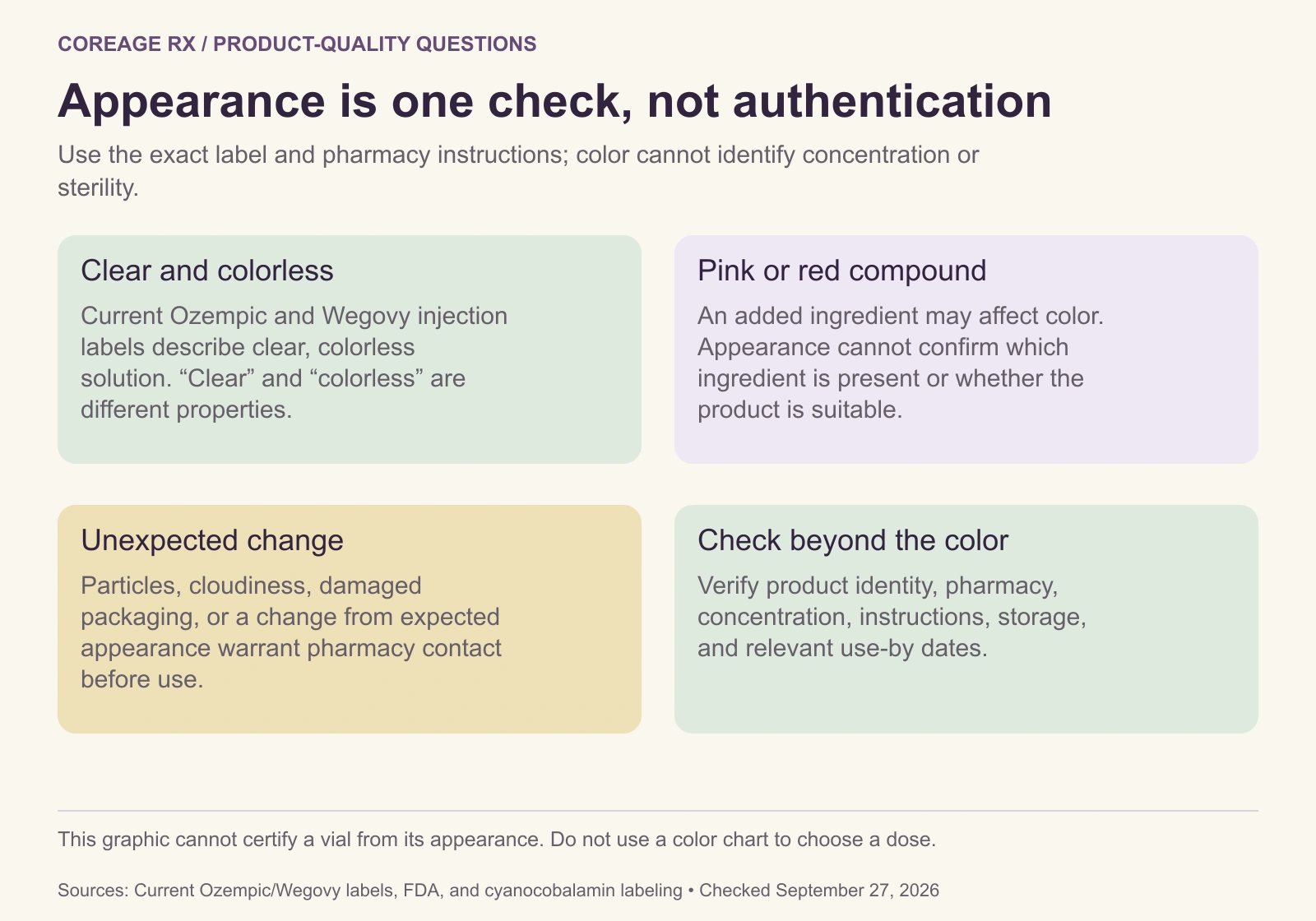
U.S. Ozempic and Wegovy injection labeling describes a clear, colorless solution. A red or pink compounded preparation may contain an added ingredient, such as a form of vitamin B12, but its color cannot tell you exactly what it contains, how concentrated it is, or whether it is safe to inject.
The useful next step is to identify the actual prescription and ask the dispensing pharmacy to confirm its expected appearance. Do not treat a photograph, a social-media comparison, or the color of your previous refill as a substitute for that check. If the appearance is unexpected, clarify the product before using it.
What color should Ozempic or Wegovy be?
The current U.S. instructions for Ozempic and Wegovy injections specify a clear, colorless solution. Their instructions also require checking the medicine before use. A solution that does not meet the product’s appearance instructions should not be used. Sources: Ozempic prescribing information and Wegovy prescribing information.
These statements apply to the labeled injections, not to every preparation that a website calls semaglutide. A tablet, an approved injection, and a compounded vial are different products with different instructions. Even an approved brand may have more than one device presentation, so check the instructions supplied with yours.
If you have an Ozempic pen, the Ozempic pen guide explains how the total contents, prescribed dose, storage limits, and refill timing fit together. Color does not replace any of those details.
Why might compounded semaglutide look red or pink?
Some compounders add other ingredients to semaglutide. The FDA specifically identifies additions including cyanocobalamin, which is vitamin B12, and pyridoxine, which is vitamin B6. Those names describe different substances. A pharmacy should identify the ingredients in the actual preparation, rather than asking you to recognize them by appearance. FDA information about compounded semaglutide
One manufacturer’s cyanocobalamin injection label describes its product as a clear, dark-red solution. That helps explain why a B12-containing preparation might have a red or pink appearance. It does not establish that every red vial contains B12 or that a particular compounded mixture is correctly made. Cyanocobalamin product labeling
Color can also look different under different lighting, against a colored background, or through a photograph. None of those observations measures the ingredients. If a previous refill was colorless and the new one is pink, ask whether the formulation changed and request the current label and written instructions.
Clear and colorless mean different things
A liquid can be transparent and still have a color. “Clear” describes the absence of visible cloudiness; “colorless” describes the absence of a visible hue. This distinction is useful when explaining what you see to the pharmacist.
For example, saying “the liquid is transparent but pink” communicates something different from “the liquid is cloudy with floating material.” Neither description establishes sterility or potency. It simply helps the dispensing team understand the concern and decide what information or replacement is needed.
| What you notice | What it can tell you | What it cannot establish |
|---|---|---|
| A clear, colorless solution | It may match a particular product’s appearance instructions. | That the identity, concentration, storage, and sterility are correct. |
| A red or pink compounded solution | An added ingredient could affect appearance. | Which ingredient is present or whether the mixture is appropriate. |
| New cloudiness, particles, or an unexpected color change | The product needs clarification before use. | The cause of the change or whether it can be corrected at home. |
| A different-looking refill | The formulation, packaging, or something else may have changed. | That the old dose instructions still apply. |
Use the table to organize a question, not to approve a vial for injection.
Does added B12 make semaglutide work better?
A vitamin’s familiar name does not establish the benefits of combining it with a prescription medicine. The FDA states that the safety and effectiveness of combining semaglutide with other added ingredients have not been established. This includes the additions discussed in its dosing-error alert. FDA compounded-semaglutide alert
Treating a confirmed vitamin deficiency is a separate clinical question from claiming that a mixture produces more weight loss, prevents nausea, or improves energy for everyone. Ask what the additional ingredient is intended to address and what evidence supports the proposed combination for your situation.
Our supplements while taking a GLP-1 medicine guide explains why nutrition needs and marketing claims should be evaluated separately. More ingredients do not automatically make a prescription more effective or easier to tolerate.

Can color show the strength or the correct dose?
No. You cannot determine a semaglutide concentration from how dark a solution looks. The prescribed amount, concentration, liquid volume, and syringe markings must be understood from the current prescription and dispensing instructions.
This matters especially after a refill. Two vials can look similar while having different concentrations. Conversely, an appearance change does not tell you how to alter the dose. Reusing an old conversion chart without checking the new preparation can create an error.
The FDA has received reports of serious dosing errors involving compounded semaglutide, including confusion among milligrams, milliliters, and syringe units. Ask the pharmacist to explain the intended measurement using the actual syringe you were supplied, and repeat the instructions back to confirm your understanding. FDA dosing-error information
The semaglutide dosage and measurement guide explains the terminology. It should help you ask a clearer question, not create a new prescription from the color or size of a vial.
What if there are particles, cloudiness, or a change after shipping?
Do not inject a product with an unexplained change in appearance. Keep the packaging and contact the dispensing pharmacy. Describe whether the concern was present on arrival, developed after storage, or appeared after the container was first used.
The FDA has specifically raised concerns about injectable GLP-1 deliveries arriving warm or with inadequate refrigeration and recommends not using affected deliveries. Putting a questionable shipment into the refrigerator afterward does not establish that its quality is acceptable. FDA GLP-1 product-quality concerns
That shipping concern is different from a labeled product’s permitted room-temperature storage during use. Approved products have specific limits that depend on the presentation. Our semaglutide storage and travel guide explains why the product name, device, temperatures, and time all matter.
Do not try to filter out particles, add liquid, heat the medicine, or transfer it to another container to make it look normal. Ask whether the pharmacy needs photographs, the lot number, or the original packaging, and obtain clear replacement or disposal instructions.
What should you have ready when contacting the pharmacy?
A short, specific message is more useful than asking whether all pink semaglutide is safe. Gather:
- The medicine name and all ingredients shown on the label.
- The concentration, prescription directions, and type of supplied syringe or device.
- The dispensing pharmacy’s name, prescription number, lot number if present, and relevant dates.
- When the shipment arrived, how it was stored, and when the vial was first opened.
- A plain description of the concern, including whether the appearance changed.
Keep personal information private when sharing photographs. Send them through the pharmacy’s appropriate channel rather than posting an identifiable prescription online. The pharmacy may need more information than an image provides.
For compounded GLP-1 multidose vials, the FDA currently recommends discarding the vial within 28 days after first use, even if medicine remains or the compounder’s instructions permit longer. This does not replace the distinct instructions for an approved pen or single-dose device. FDA multidose-vial guidance

Can a label or a photo prove that the product is authentic?
Neither is sufficient on its own. The FDA has identified fraudulent compounded GLP-1 products with nonexistent pharmacy names or the names of legitimate pharmacies that did not make the products. A convincing label therefore should not end the verification process when something seems wrong. FDA information about fraudulent compounded products
Use the pharmacy’s independently verified contact details if you are unsure who dispensed the medicine. The FDA’s state pharmacy-license resource can help you find the appropriate board. Ask the pharmacy to confirm that the prescription and product came from it.
These are general product-quality checks; they do not establish that a particular service or pharmacy has supplied a faulty product. The compounded GLP-1 guide explains the broader difference between compounding and FDA approval.
What if you already used it?
Contact the prescribing or dispensing team with the product details and any symptoms. Do not take an extra dose to compensate for uncertainty about the first one. Trouble breathing, swelling of the face or throat, or severe persistent abdominal pain needs urgent medical attention rather than waiting for a routine product inquiry.
If reviewing CoreAge Rx semaglutide care, ask how pharmacy questions, unexpected appearance, delivery concerns, and suspected dosing errors are handled. A useful service should make it possible to identify the preparation and obtain instructions for the prescription you actually receive.
Confirm the exact product, expected appearance, prescription, handling, and source with the dispensing team. Those details provide a useful basis for deciding what to do with the medicine in your possession.
Educational information for adults; individual treatment decisions require a qualified clinician. Sources checked September 27, 2026. Original AI-generated article illustrations depict fictional people and objects, not patient outcomes. Other editorial images are illustrative. Graphics summarize the cited sources.