Hiccups that appear while you are taking Mounjaro deserve context, but their timing alone does not prove the medicine caused them. Hiccups are not listed in the current prescribing information as a common adverse reaction. Mounjaro does have documented digestive effects, including delayed stomach emptying, indigestion, belching, and reflux, which are useful details to discuss if the symptoms occur together. Mounjaro prescribing information
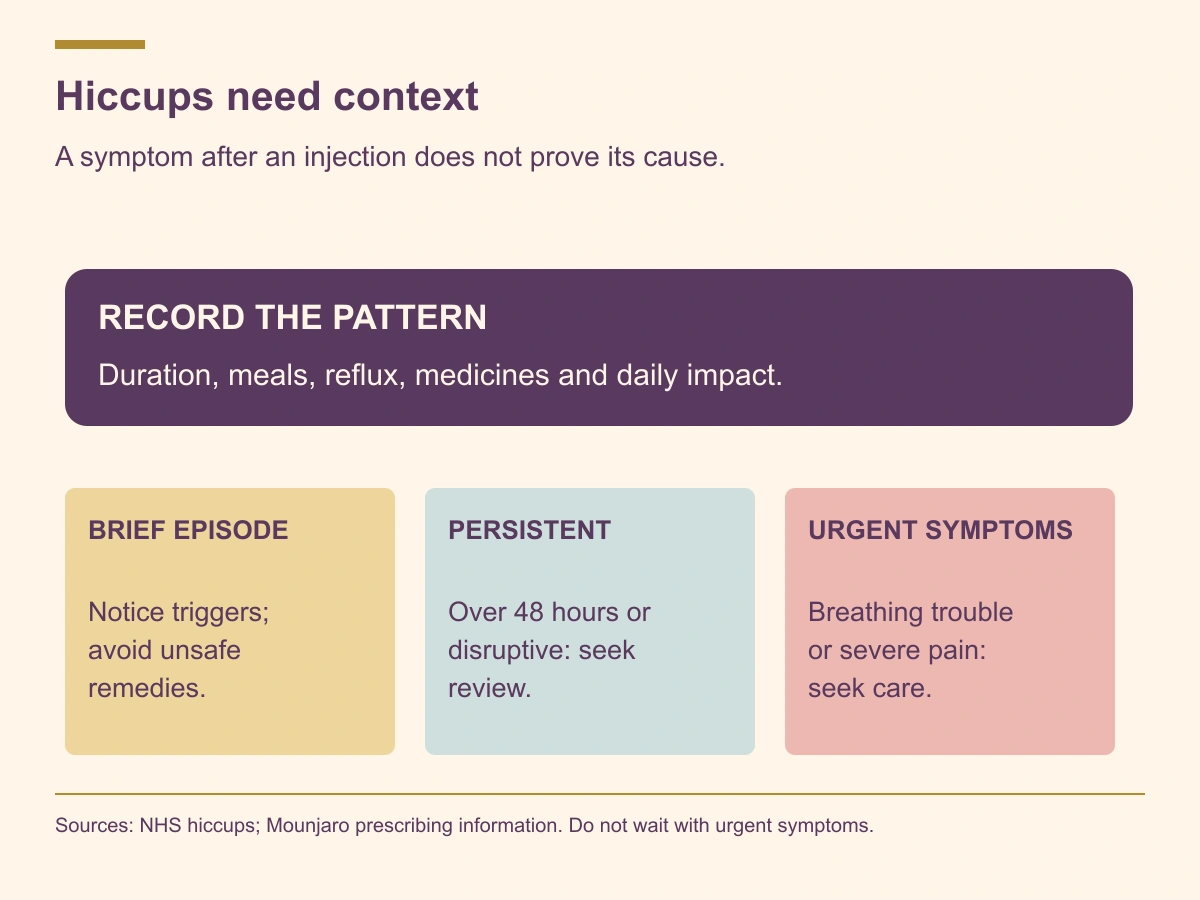
Most short episodes pass. Hiccups lasting longer than 48 hours, or recurring often enough to affect everyday life, should be assessed. Do not wait for that threshold if you also have breathing difficulty, severe pain, confusion, or another urgent symptom. NHS hiccup guidance
Does Mounjaro cause hiccups?
The label does not provide a hiccup incidence rate or establish hiccups as a common treatment effect. That is a more precise statement than saying the medicine can never be involved. A symptom can be absent from a common-adverse-reaction table and still need investigation in a particular person.
Online reports cannot establish how often this happens. People who post may have other medicines, different illnesses, recent dose changes, or digestive symptoms that are not fully described. A collection of experiences can raise a question, but it does not provide the denominator or comparison group needed to calculate risk.
Mounjaro contains tirzepatide. Its current U.S. indications concern type 2 diabetes and specified cardiovascular risk reduction in eligible adults with type 2 diabetes. The article concerns adults using the medicine under clinical supervision; it is not a reason to start treatment or use it for a symptom it is not intended to treat. Our Mounjaro side-effect guide covers the better-established effects and warnings.
Digestive symptoms are relevant, but they are not proof
Mounjaro delays the movement of food out of the stomach. Its label describes the delay as greatest after the first dose and diminishing over time. Indigestion, belching, abdominal bloating, and gastroesophageal reflux were reported in clinical trials. These observations can help a clinician ask useful questions about hiccups around meals. They do not establish a direct causal chain for every episode. Mounjaro gastric-emptying and adverse-reaction information
For example, hiccups accompanied by a sour taste or a burning sensation after a meal create a different clinical picture from isolated hiccups without digestive symptoms. Repeated vomiting, pronounced fullness, or difficulty eating also changes the assessment. Describe those features rather than simply reporting “a stomach side effect.”
Do not diagnose yourself with gastroparesis because you have hiccups or because a medicine slows stomach emptying. A diagnosis requires an appropriate evaluation. Likewise, a brief episode is not proof of bowel obstruction, pancreatitis, or another severe complication. The severity and accompanying symptoms determine how urgently you need care.
Record the pattern that will help the clinician
A short record is more useful than trying several remedies and then guessing which one helped. Write down when the hiccups began, how long the episode lasted, and whether it stopped completely between episodes. Include whether you could sleep, eat, drink, and speak comfortably.
Add the date of your injection and any recent prescribed dose change. Record meals and other symptoms without assuming the last food you ate was the cause. If the pattern repeats, the sequence may help the clinician decide what to review next.
| Detail to record | Why it helps the review |
|---|---|
| Start and stop time | Distinguishes a short episode from persistent or repeated symptoms |
| Relationship to meals and lying down | Helps assess a possible digestive pattern |
| Heartburn, sour taste, bloating, nausea, or vomiting | Identifies associated symptoms rather than treating hiccups in isolation |
| Injection date and recent dose changes | Provides medication context without proving causation |
| Other prescriptions, supplements, and recent illness | Helps the clinician consider alternative explanations |
| Effect on eating, drinking, sleep, and breathing | Shows how much the symptom is disrupting daily function |
You do not need an elaborate spreadsheet. A few dated notes on your phone can be enough. If symptoms are severe, seek care first; a complete log is not a prerequisite for contacting the team.

What can you try during a brief, mild episode?
The NHS notes that eating, drinking, and stress can be associated with hiccups, and that no simple remedy works for everyone. If you notice a consistent trigger, avoid repeating it while the episode settles. Eating hurriedly or repeatedly consuming a drink that seems to trigger symptoms is worth reconsidering. NHS hiccup information
Give yourself time to eat and avoid forcing a large meal through discomfort. If you can swallow normally, a few ordinary sips of water may be comfortable. There is no need to use a large volume, an awkward drinking position, or a challenge that makes you cough or feel faint.
Avoid breathing into a bag, prolonged breath-holding, startling someone, or attempting a swallowing trick when breathing or swallowing is already difficult. These are not substitutes for assessment. Do not start a prescription hiccup medicine borrowed from someone else, and do not add several over-the-counter treatments without checking your medication list.
If reflux symptoms accompany the hiccups, discuss those symptoms directly. NIDDK describes meal timing and individual trigger review as possible parts of reflux management. For nighttime reflux, avoiding meals for at least three hours before lying down may help some people. That advice is about reflux symptoms, not a proven Mounjaro-hiccup treatment. NIDDK reflux guidance
When should you contact the prescribing team?
Arrange a medical review if hiccups last more than 48 hours or recur frequently and affect your life. Contact the team sooner if you are struggling to sleep, eat, or stay hydrated, or if symptoms are worsening. The clinician may review medicines and look for another underlying cause. NHS advice on persistent hiccups
Persistent vomiting or diarrhea deserves particular attention during Mounjaro treatment. The prescribing information warns that fluid loss from digestive adverse effects can contribute to kidney injury. Tell the team if you cannot keep fluids down, are urinating much less, or feel faint. A hiccup remedy does not address dehydration. Mounjaro warnings
If you are due to increase the dose and symptoms have not settled, contact the prescriber before making the change. Describe the current problem and ask whether the planned schedule remains appropriate. Do not turn a symptom question into an experiment with extra injections or smaller improvised doses; the Mounjaro dose-splitting guide explains that distinction.
Symptoms that need urgent attention
Seek urgent assessment for severe or persistent abdominal pain, especially when accompanied by vomiting or pain extending to the back. The Mounjaro label includes a pancreatitis warning and instructs patients to stop the medicine and contact their healthcare provider if pancreatitis is suspected. Severe abdominal symptoms should not be treated as routine hiccups. Mounjaro safety information
Call emergency services for breathing difficulty, swelling of the face or throat, collapse, or severe confusion. Chest pain or pressure with significant shortness of breath also needs emergency assessment. Do not wait for hiccups to have lasted 48 hours when those symptoms are present.
If you use insulin or a sulfonylurea and also feel shaky, sweaty, weak, or confused, consider your low-glucose plan. Hiccups themselves do not diagnose hypoglycemia. Check glucose when possible and follow your established instructions. Severe symptoms or inability to swallow safely require emergency help. NIDDK low blood glucose guidance
The Mounjaro sweating and night-sweat guide explains why sweating needs its own assessment rather than being folded into one nonspecific medication complaint.

Should you stop or switch Mounjaro?
A brief episode without warning signs does not establish that you need to stop treatment. Persistent or disruptive symptoms deserve a discussion with the prescriber, who can consider the benefits of treatment, the full symptom pattern, other medicines, and appropriate investigation.
Do not stop and restart repeatedly to test the relationship yourself. Changes can affect glucose management and make it harder to interpret the pattern. If the team decides to pause, change, or resume treatment, get specific instructions for your situation, including what to do about other diabetes medicines.
The Mounjaro medication-interaction guide can help you prepare a complete list for that review. If you are exploring a different care service, CoreAge Rx tirzepatide information is a starting point for questions about assessment and follow-up, not a promise that changing services or preparations will prevent hiccups.
Frequently asked questions
Are hiccups a sign that Mounjaro is working?
No. Hiccups are not a treatment-response measure. Clinical progress is assessed using the goals and monitoring plan agreed with your clinician, not the presence of an uncomfortable symptom.
Do hiccups mean the dose is too high?
They do not establish that on their own. A recent dose change is useful information, particularly if nausea, reflux, or vomiting also increased. The prescriber should assess the whole pattern before changing the plan.
How long should a Mounjaro-related episode last?
There is no established Mounjaro-specific duration for hiccups. Use the general guidance for persistent or disruptive hiccups, and seek earlier care when other symptoms are concerning.
Can I take an antacid?
An antacid is not a universal hiccup treatment. If you have heartburn or reflux, ask a pharmacist or clinician what is suitable with your conditions and medicines. Recurrent symptoms may require a broader review than an occasional over-the-counter product.
What should I say when I call?
Try a concise description: when the hiccups started, whether they are continuous, your latest injection and dose change, associated symptoms, and whether you can eat, drink, and sleep. Ask what to do before the next scheduled dose and when you should seek urgent care if the situation changes.
Educational information for adults; individual treatment decisions require a qualified clinician. Sources reviewed October 5, 2026. Original AI-generated article images depict fictional people and objects, not patient outcomes. Other editorial images are illustrative. Graphics summarize the cited sources.