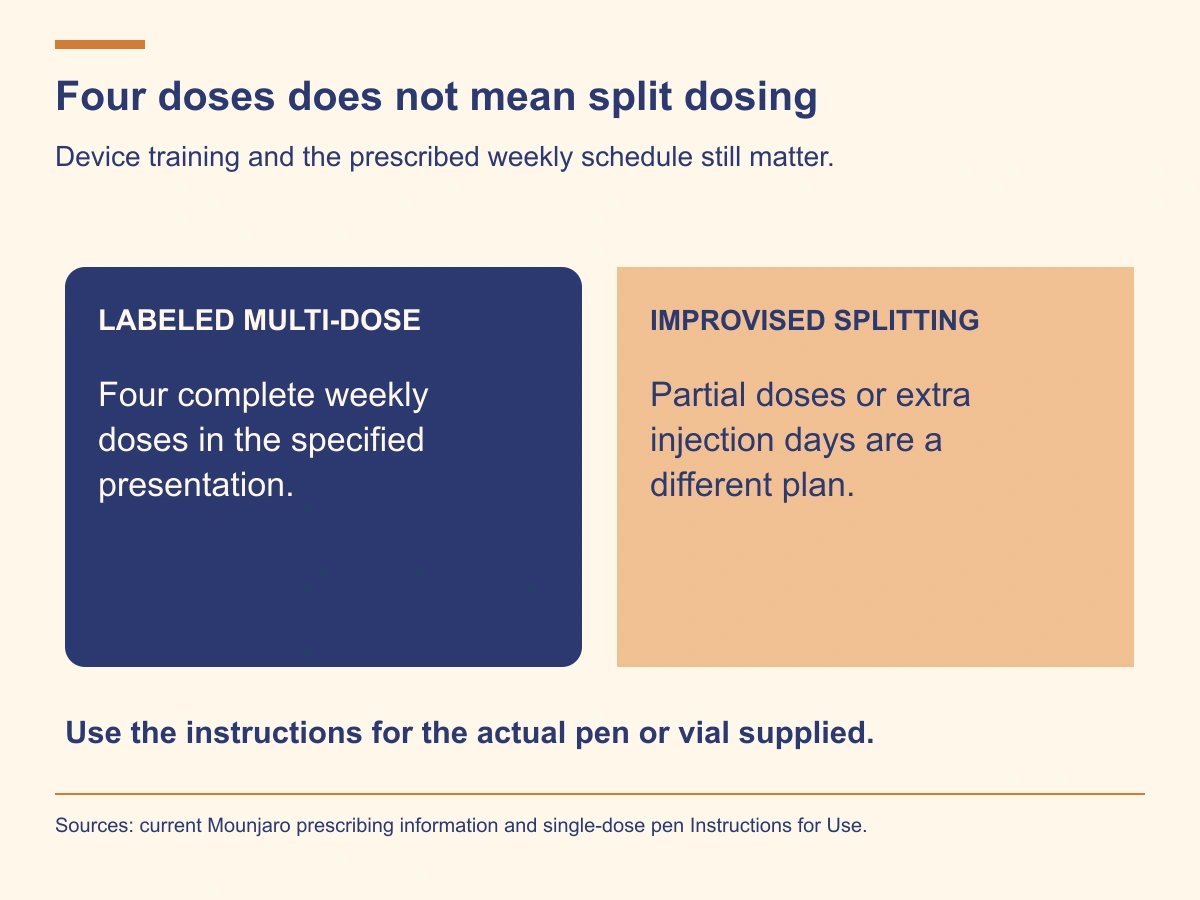
Mounjaro’s labeled schedule is once weekly, using the prescribed dose and the instructions for the presentation you received. Dividing a weekly dose into smaller injections, counting pen clicks, or extracting medicine from a device is not the same as following the labeled regimen. If cost, side effects, or an incomplete injection is prompting the question, discuss that specific problem with the prescriber or pharmacist before changing anything.
A multi-dose presentation can create understandable confusion: some Mounjaro containers hold four weekly doses. That does not mean each prescribed dose has been validated for further subdivision. This guide separates the packaging, scheduling, and symptom questions so you can get a clear answer for your actual prescription.
What do you mean by splitting a dose?
People use the phrase for several different ideas. They may mean using part of a stronger product, taking half the weekly amount on two different days, combining smaller doses, or saving residual medicine for later. Those are different changes, and none should be inferred from a calculator or a social-media demonstration.
Tell the pharmacist which problem you are trying to solve. “The prescribed amount causes vomiting,” “I cannot afford the next refill,” and “I do not know whether the pen finished” require different responses. A discussion about the underlying problem is more useful than requesting a partial-dose conversion in isolation.
Our Mounjaro dosage chart explains the labeled strengths and schedule. Use it to understand the prescription, while relying on your own care team for treatment changes.
First identify the presentation
The current U.S. label includes four presentations. Each has its own administration and handling instructions. The manufacturer directs clinicians to provide training for the prescribed presentation and to provide appropriate training when it changes. Mounjaro prescribing information.
| Presentation | What the package is designed to provide |
|---|---|
| Single-dose prefilled pen | One prescribed injection from a prefilled device |
| Single-dose vial | One dose with the appropriate syringe and needle training |
| Multi-dose vial | Four labeled doses with its own handling and discard instructions |
| Single-patient-use KwikPen | Four weekly doses for one patient, with presentation-specific training |
The label distinguishes 0.5 mL single-dose presentations from 0.6 mL doses in multi-dose presentations. This is a reason to identify the package, not a conversion chart for creating another regimen. A volume remembered from an earlier vial may be wrong for the new product.
Why a single-dose pen is not a partial-dose tool
The manufacturer’s single-dose pen instructions describe a complete injection sequence and the device’s completion signs. They do not provide a validated method for stopping halfway through, measuring what remains, or using a fraction later. Single-dose pen instructions.
A sound, a visible drop, or an estimated hold time cannot reliably tell you how many milligrams entered the body. Interrupting the process and then trying to calculate the remainder can create uncertainty about both the first and the next injection.
Do not dismantle a pen or withdraw its contents to improvise a smaller dose. Ask the prescriber about a suitable prescribed strength or another appropriate treatment plan. The injection-site and device guide explains how presentation and completion questions differ from where you inject.
Four doses in a container does not mean unlimited division
A manufacturer’s multi-dose vial or KwikPen contains a defined number of labeled doses. “Multi-dose” describes how that container is intended to be used; it does not establish that any smaller amount can be measured, stored, or administered safely.
Likewise, leftover liquid is not proof that another complete dose is available. The label gives specific discard limits for multi-dose presentations, including disposal after four weekly doses even if medicine remains. Handling, first-use dates, and temperature exposure also matter.
The U.S. KwikPen instructions explicitly say not to count clicks when selecting the dose and not to transfer medicine from the pen into a syringe. They also distinguish priming before each weekly injection from delivering the prescribed dose. Mounjaro KwikPen instructions.
Use the matching Instructions for Use and the supplies identified by the pharmacist. Do not substitute a click chart from another country or another device. A familiar product name does not make every presentation’s mechanism and instructions identical.
Why the milligram total is not the whole schedule
Two smaller injections on different days can add up arithmetically to the same milligram total as one weekly injection. That arithmetic does not establish the same treatment effect or safety profile. Timing changes the pattern of exposure, and the labeled regimen is once weekly.
The Mounjaro label reports an elimination half-life of approximately five days. That helps explain why medicine remains in the body between scheduled doses; it is not a basis for inventing a twice-weekly schedule. Symptoms later in the week do not independently establish that the dose should be divided or moved closer together.
If hunger or glucose readings seem to change across the week, bring a useful record to the clinician. The tirzepatide plateau guide discusses treatment stage, administration, nutrition, and other factors without treating every fluctuation as a dosing failure.

Side effects need assessment before a dosing experiment
Nausea, diarrhea, vomiting, constipation, indigestion, reduced appetite, and abdominal pain are among the recognized Mounjaro adverse effects. The current label recommends a starting regimen and gradual escalation intended to reduce gastrointestinal reactions. Whether treatment should stay at the current dose, change, or stop is an individual clinical decision.
Do not assume smaller, more frequent injections will solve persistent symptoms. Severe or persistent abdominal pain, repeated vomiting, inability to maintain fluids, or markedly reduced urination needs prompt assessment. Trouble breathing, swelling of the face or throat, or collapse requires emergency help.
Our Mounjaro side-effects guide and kidney-disease article explain why symptoms and dehydration change the review. Waiting for the next routine appointment may be inappropriate when symptoms are severe.
What if cost is the reason?
Tell the prescriber and pharmacy before the supply runs out. Ask about the actual insurance decision, authorization requirements, eligible savings, and clinically appropriate alternatives. A more expensive strength divided at home is not an established cost-saving plan just because the arithmetic looks attractive.
Compare total care costs as well as the medication quote. If a service offers a different preparation, confirm exactly what it is and who dispenses it. Do not assume that an offer for “tirzepatide” means FDA-approved Mounjaro or that a branded savings card will apply.
The Mounjaro cost guide and Mounjaro alternatives guide provide questions for those conversations. Keep affordability and treatment suitability connected rather than solving the financial problem through unreviewed device manipulation.
What if you miss a dose?
The current label says a missed Mounjaro dose may be administered within four days, or 96 hours. If more than four days have passed, skip the missed dose and resume on the regularly scheduled day. When changing the weekly administration day, there must be at least three days, or 72 hours, between doses. Labeled schedule.
Those instructions are not permission to establish a recurring split-dose regimen. They address a missed dose or a change in the usual weekly day. Do not combine the maximum delay and minimum interval into a new routine without clinical direction.
For a prolonged interruption, an uncertain previous dose, or a prescription that differs from the label, contact the prescriber. The usual missed-dose rule does not by itself answer every restarting question.
What if the injection may have been incomplete?
Identify the presentation and describe exactly what happened. For the single-dose pen, the manufacturer’s instructions use the visible gray plunger as a completion sign and direct users with uncertainty to contact Lilly for further instructions. Other presentations need their own instructions.
Do not automatically inject again. If some or all of the medicine was delivered, a replacement injection could provide more than prescribed. Keep the box and lot details and store the device safely if the manufacturer or pharmacist needs information about it.
A small drop of blood or liquid on the skin is addressed in the single-dose pen instructions and does not alone quantify a missing dose. A bruise also cannot tell you how much medicine was absorbed. Discuss the device observation and any symptoms separately.
Compounded tirzepatide has different instructions
A compounded vial may have a different concentration, ingredient combination, measuring device, and beyond-use date. Its instructions cannot be reconstructed from a Mounjaro pen diagram or a generic syringe-units chart.
FDA has received reports of dosing errors and adverse events involving unapproved GLP-1 preparations. It emphasizes that compounded drugs are not FDA-approved and should be used only when a patient’s medical needs cannot be met by an approved drug. FDA concerns.
If you review CoreAge Rx tirzepatide information, ask the team for the exact preparation, prescribed milligrams, pharmacy instructions, and training. The compounded tirzepatide comparison explains why branded and compounded products should remain distinct.

Questions to settle before the next injection
Bring the box or clear label information and ask the care team to confirm the product, presentation, prescribed dose, weekly schedule, and supplies. Explain whether the concern is tolerability, cost, missed treatment, or delivery uncertainty. Include other medicines, especially insulin, sulfonylureas, and oral drugs that require close monitoring.
Request a written plan for the specific problem, including who to contact if it recurs. If a presentation changes at the pharmacy, ask for the new instructions and training before using it. Understanding the sequence is more dependable than relying on the appearance of a similar device.
Frequently asked questions
Can I count clicks to make a smaller Mounjaro dose?
Do not use an online click count as a substitute for the prescribed dose and matching device instructions. A click chart does not establish dose accuracy, safety, or an appropriate regimen for your presentation.
Can I use leftover liquid as another weekly dose?
The label’s discard instructions still apply, including disposal of multi-dose presentations after four weekly doses even if liquid remains. Leftover volume is not an instruction to create an extra dose.
Does splitting prevent nausea?
The reviewed label does not establish an improvised split-dose regimen as a treatment for nausea. Persistent symptoms need a review of the prescription, hydration, nutrition, and other possible causes.
Can I change from Mounjaro to Zepbound using the same instructions?
Confirm the actual prescription and presentation with the clinician and pharmacist. The products share tirzepatide but have different indications and product instructions. Our Zepbound dose-splitting guide addresses that product separately.
Educational information for adults; individual treatment decisions require a qualified clinician. Sources reviewed October 5, 2026. Original AI-generated article images depict fictional people and objects, not patient outcomes. Other editorial images are illustrative. Graphics summarize the cited sources.