There is no single Mounjaro price that every Walgreens customer pays. Your amount depends on the exact prescription, insurance benefit, deductible, pharmacy location, and eligibility for a particular savings offer. A price displayed online is useful only when you know which product and payment route it describes.
This guide explains how to compare a Walgreens quote, what the current Lilly savings terms actually say, and how to plan beyond the first fill. Prices and program terms were reviewed October 5, 2026; a pharmacy must confirm the amount for your prescription when it is processed.
First identify what you are pricing
Mounjaro contains tirzepatide. Its current U.S. label includes improving blood glucose in adults and children aged 10 and older with type 2 diabetes, and reducing specified major cardiovascular events in adults with type 2 diabetes at high risk. It is not FDA-approved specifically for weight loss. Zepbound also contains tirzepatide but has different labeled indications. Mounjaro prescribing information.
Those distinctions affect both prescribing and payment. A manufacturer offer requiring an approved use cannot be assumed to apply to every off-label prescription. Our Zepbound versus Mounjaro guide explains why a shared ingredient does not make the products interchangeable for coverage.
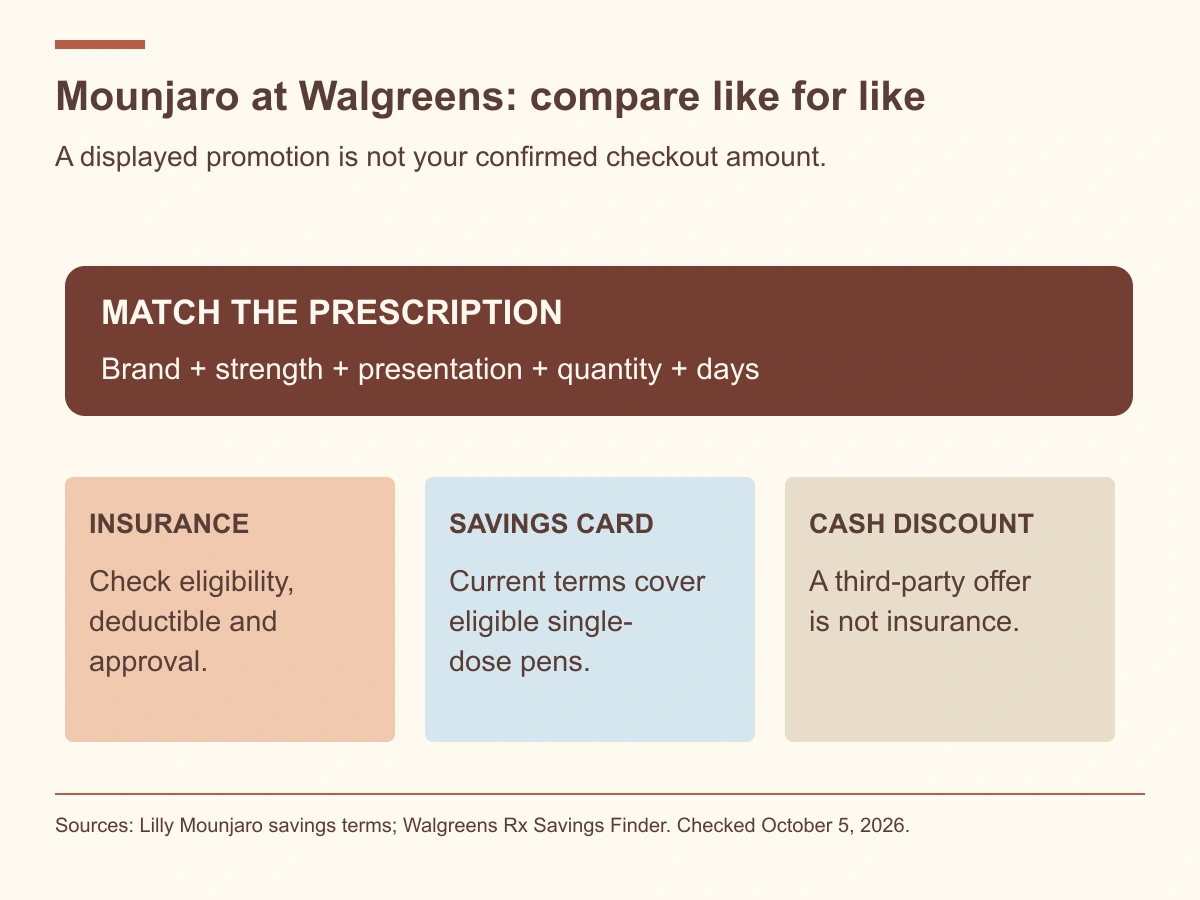
Also confirm the presentation. The current Mounjaro label includes single-dose pens, single-dose vials, multi-dose vials, and a single-patient-use KwikPen. A quote for four single-dose pens is not automatically a quote for another presentation. The savings program reviewed below specifically covers eligible single-dose pens.
A useful quote includes more than a dollar amount
Ask Walgreens to identify the medicine, strength, form, quantity, and days’ supply. Then ask which payment route produced the amount. If you are comparing two pharmacies or two websites, keep these details the same.
For example, a 28-day supply and an 84-day supply have different quantities. Dividing a larger fill’s total by three may help budgeting, but it does not mean you can purchase each month separately at the same price. Your prescription, insurer, pharmacy, and savings program may impose quantity limits.
Keep a dated note of the quote and whether availability was confirmed. A price estimate is not a reservation, an insurance authorization, or a promise that a future refill will cost the same. Our broader Mounjaro cost guide provides context for comparing insurance and cash routes.
What Lilly’s current $25 offer means
Lilly’s reviewed terms say eligible patients with commercial drug insurance that covers Mounjaro may pay as little as $25 for a one-, two-, or three-month fill of Mounjaro single-dose pens. The program defines those supplies as up to four pens for 28 days, eight for 56 days, and twelve for 84 days. Lilly savings terms.
The offer has savings caps: up to $150 for a one-month fill, $300 for two months, or $450 for three months, with a maximum annual savings of $1,950 and up to 13 prescription fills per calendar year. The reviewed card expires December 31, 2026, subject to Lilly’s ability to change or end the program.
“As little as” matters. If the patient responsibility exceeds what the card can offset, the final amount can be higher. Eligibility also requires an approved use consistent with labeling, age 18 or older, and U.S. or Puerto Rico residency, among the full terms. A prescription alone does not establish card eligibility.
What if commercial insurance does not cover Mounjaro?
The same reviewed program describes a separate route for eligible people who have commercial drug insurance but no Mounjaro coverage: as low as $499 for a one-month supply of single-dose pens. The listed savings cap is up to $647 monthly and $8,411 annually, with up to 13 fills per calendar year and the December 31, 2026 expiration, subject to change.
This is not the same as an uninsured offer. Someone with no commercial drug insurance should not assume they qualify for this category. The approved-use requirement and other eligibility rules still apply.
Have the pharmacy determine how the prescription and card process under your actual circumstances. Do not change the reported diagnosis or insurance information to fit an advertisement. If you are comparing alternative care, the Mounjaro alternatives article can help frame a clinical discussion rather than treating price alone as a reason to substitute medication.
Government coverage and other exclusions matter
Lilly’s terms exclude people enrolled in government-funded healthcare programs, including Medicare, Medicaid, TRICARE, VA, and other listed programs. The commercial savings card is not a Medicare or Medicaid benefit. The terms also address alternate funding programs, and they do not allow the card to be combined with another Mounjaro coupon or discount program.
An insurer may still cover an appropriate Mounjaro prescription through its own benefit rules. Ask the plan about formulary status, prior authorization, deductible, and preferred pharmacies. A manufacturer-card rejection and an insurance-coverage denial are different events with potentially different explanations.
Avoid sending sensitive insurance information to an unfamiliar coupon site merely because it displays a low number. Use the pharmacy and the manufacturer’s official resources to resolve eligibility and card-processing questions.

How Walgreens Rx Savings Finder fits
Walgreens describes Rx Savings Finder as a tool for locating third-party prescription discount cards. These cards are not insurance. Its terms say prices vary with the discount card, drug, and participating Walgreens location, and may change at any time. Drug-specific exclusions come from the card vendor. Walgreens Rx Savings Finder.
The tool can provide a useful comparison with your insurance amount, but an online result does not settle every claim question. Confirm the selected medicine, presentation, and quantity, then have the pharmacy check whether the coupon can be used for the actual fill.
Do not add the apparent savings from multiple offers together. A manufacturer card, an insurance claim, and a third-party cash-discount card follow different rules. Ask the pharmacy to compare eligible routes separately and explain how a cash purchase affects your insurance spending records.
Compare the payment routes side by side
| Route | What to confirm before relying on it |
|---|---|
| Insurance benefit | Coverage, authorization, deductible, coinsurance, network, and quantity |
| Eligible Lilly card with commercial coverage | Approved use, card terms, savings caps, and final processed amount |
| Eligible Lilly card without Mounjaro coverage | Commercial insurance is still required; other eligibility rules apply |
| Third-party discount card | Exact product, participating pharmacy, vendor exclusions, and current cash price |
| Cash without a card | Actual pharmacy amount for the prescription and days’ supply |
A lower payment today is not always the complete financial answer. For an ongoing treatment, consider the next refill, annual caps, changes in insurance, and what happens when a temporary program ends. The GLP-1 insurance guide explains the benefit terms that often cause confusion.
A short script for the pharmacy call
You can ask: “I have a prescription for this Mounjaro strength and presentation. Can you confirm the quantity, days’ supply, and price after my insurance is processed? Is authorization missing? If I am eligible for the manufacturer’s card, what would the final amount be?”
If you want a cash comparison, ask separately about the current price with an eligible Rx Savings Finder card. Give the pharmacy the actual coupon information rather than only quoting a search-engine snippet. Ask whether the product is in stock, needs ordering, or requires a prescription clarification.
If the fill is rejected, request the reason and the next step. It may be something the prescriber must address, such as authorization documentation, or something the insurer must clarify. Repeatedly downloading coupons will not resolve an excluded benefit or an incompatible product.
Plan for refills and presentation changes
Confirm how early you should request a refill and which office handles authorization renewal. Ask whether your current quantity and pharmacy remain eligible under the plan. A change in coverage, deductible, strength, presentation, or savings terms can change the next amount even when the medicine’s name is unchanged.
Do not stretch a supply by splitting doses, extracting leftover medicine, or borrowing someone else’s prescription. Bring affordability concerns to the care team before running out so they can discuss appropriate options. The Mounjaro dosage guide explains the prescribed schedule, and the injection-site and device guide explains why training must match the presentation.
When treatment has been interrupted, ask the prescriber about restarting. A lower price is not a reason to resume an old regimen without considering the length of the interruption and previous tolerability.

Keep branded and compounded quotes separate
An online service advertising tirzepatide may be describing compounded treatment rather than Mounjaro. Check the exact preparation, pharmacy, clinical fees, supplies, and follow-up. Do not label the service’s price as a Walgreens Mounjaro price.
FDA states that compounded drugs are not FDA-approved and highlights dosing, quality, and other concerns with unapproved GLP-1 products. Compounded preparation may be considered when a patient’s medical needs cannot be met by an approved drug; it does not inherit the branded product’s approval or savings-card eligibility. FDA information.
For CoreAge Rx tirzepatide information, ask about the assessment, exact preparation, dispensing pharmacy, and ongoing care. Our guide to choosing a compounding pharmacy provides additional questions.
Frequently asked questions
Is Mounjaro always $25 at Walgreens?
No. The manufacturer’s “as little as” offer has eligibility conditions and savings caps. The pharmacy must confirm the final processed amount for an eligible prescription. Insurance coverage alone does not guarantee that amount.
Does the $499 category mean no insurance is needed?
No. The reviewed terms require commercial drug insurance that does not cover Mounjaro, along with the program’s other criteria. It should not be advertised as an unconditional uninsured price.
Can I use a discount card and the Lilly card together?
Do not assume they can be stacked. Lilly’s reviewed terms prohibit combining its card with other Mounjaro discount offers. Ask the pharmacy to compare eligible payment routes separately.
What is the most useful first step?
Identify the exact prescription, then ask Walgreens for a dated quote using your actual benefit information. Confirm eligibility and availability before paying or transferring. That produces a more useful answer than treating a national price estimate as your checkout total.
Educational information for adults; individual treatment decisions require a qualified clinician. Sources reviewed October 5, 2026. Original AI-generated article images depict fictional people and objects, not patient outcomes. Other editorial images are illustrative. Graphics summarize the cited sources.