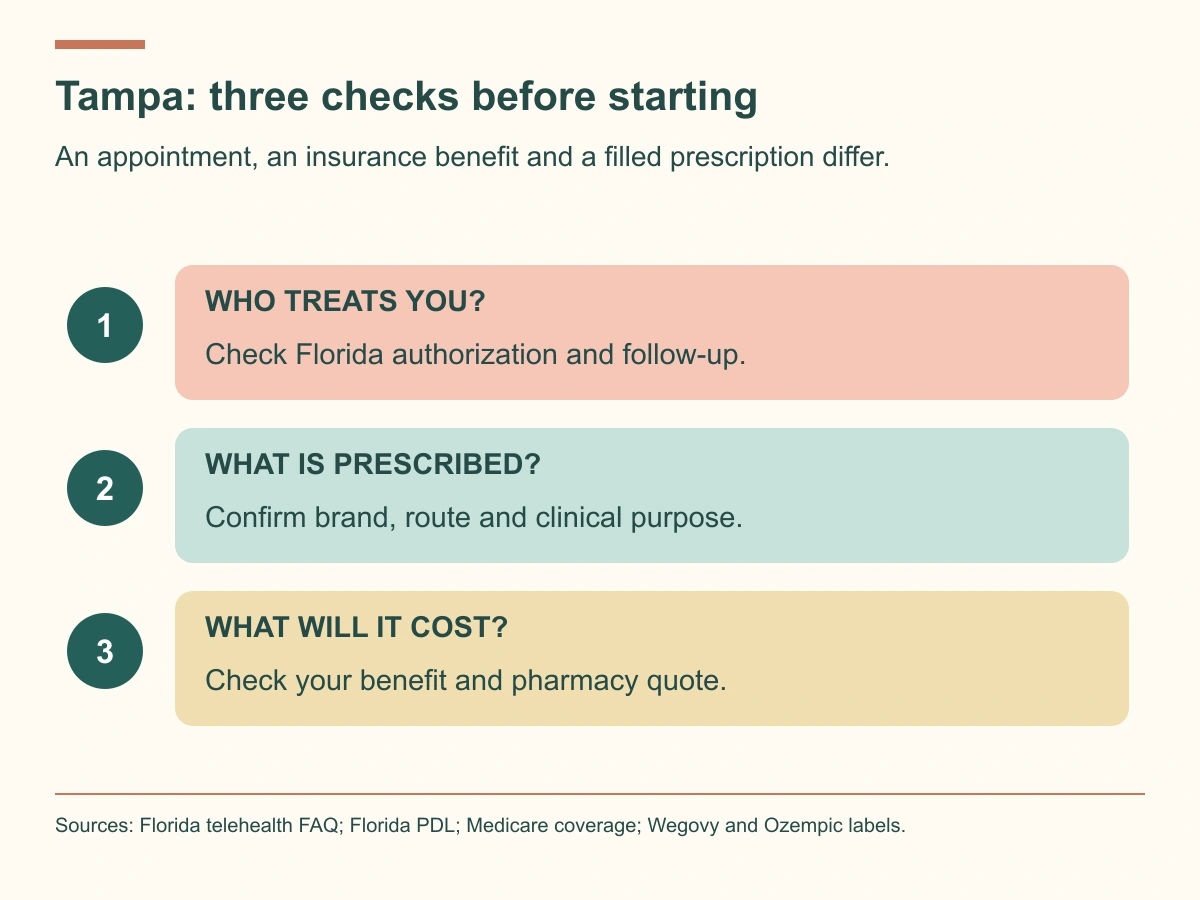
Finding Wegovy or Ozempic care in Tampa involves three separate decisions: whether a treatment fits your health needs, whether the professional is authorized to treat you in Florida, and whether your insurance and pharmacy can support the prescription. A local advertisement or a booked video visit cannot answer all three.
Wegovy and Ozempic both contain semaglutide, but they are different prescription products with different labeled uses and instructions. This guide explains how to check the clinician, prepare for assessment, and get useful coverage and pharmacy answers without relying on a list of supposedly “best” Tampa clinics.
Start with the product and the treatment goal
A request for “a semaglutide shot” leaves important details unresolved. Wegovy has weight-management indications for appropriate patients, along with other product-specific indications. Ozempic’s indications center on type 2 diabetes and specified cardiovascular or kidney outcomes in eligible adults. Ozempic is not FDA-approved specifically for weight loss. The exact formulation also matters: current U.S. semaglutide labeling includes both injection and tablet products. Wegovy prescribing information. Ozempic prescribing information.
Ask the clinician which exact medicine, route, and treatment purpose they are considering. Do not assume that a diabetes prescription, a weight-management prescription, and a compounded preparation have the same insurance requirements. Nor does an online questionnaire establish that you should receive a particular medicine.
Our guide to getting a Wegovy prescription explains the assessment conversation. The oral semaglutide and injection comparison can help you prepare formulation questions before comparing prices.
Verify the professional treating you in Florida
Ask for the treating professional’s full name, profession, and Florida license or applicable registration number. A business name, customer-service representative, or medical director’s photograph does not identify the person responsible for your care.
Florida allows appropriately authorized professionals to provide telehealth. A full Florida professional license is one route. Florida also has an out-of-state telehealth registration pathway for qualifying professionals licensed elsewhere. The Department of Health explains that this registration permits telehealth for Florida residents and visitors; it does not authorize the registrant to open a Florida office or provide in-person care in the state. A full Florida license does not require a separate out-of-state telehealth registration. Florida telehealth FAQ.
Use the state’s healthcare-provider verification system. For the out-of-state route, the Department’s FAQ explains how to select the relevant telehealth profession or board category. Match the record to the professional’s actual name and profession. A registration is not a general endorsement of a company’s service or evidence that a drug is suitable for you.
Your physical location matters during a video visit
Tell the service where you will physically be when the appointment occurs. Someone who normally lives in Tampa may be in another state while traveling, and a visitor may be in Florida temporarily. The Florida guidance expressly discusses residents and visitors and notes that care outside Florida requires attention to the rules where the patient is located.
Ask what happens if the clinician needs an examination, testing, or local evaluation. A practical remote service should be able to explain how you obtain those services and how results reach the treating clinician. Convenient scheduling is useful only when the follow-up arrangements fit the care you need.
The online weight-loss prescription guide provides broader questions about clinician identity, pharmacies, and continuity of care.
Prepare information that changes the clinical decision
Bring an accurate medication list, including insulin, diabetes tablets, nonprescription products, and supplements. Mention previous weight-management treatment, why it stopped, digestive symptoms, pregnancy or pregnancy plans, and relevant thyroid-cancer history. Personal or family history of medullary thyroid carcinoma and MEN2 are specific contraindication issues in the semaglutide labels; they should not be confused with every thyroid condition.
The clinician may also need information about kidney health, gallbladder or pancreatic disease, diabetic eye disease, planned anesthesia, and your ability to maintain food and fluids. The point is to support an individual assessment. A blog cannot decide eligibility by counting symptoms or applying a single number.
If you are changing services, request a transfer of relevant records. An old prescription or a photograph of a box may help identify the product, but it is not a complete treatment history. Ask how interruptions and previous adverse effects will be assessed before treatment resumes.

Ask your insurer about the exact benefit
Coverage depends on the plan, prescription, clinical indication, and current rules. A pharmacy rejection does not necessarily mean the medicine is never covered; it may reflect missing authorization, an excluded benefit, quantity limits, an out-of-network pharmacy, or information that needs correction.
| Question | Why the answer matters |
|---|---|
| Is this exact product covered for the prescribed indication? | A diabetes benefit does not establish weight-management coverage |
| Is prior authorization required? | The clinician may need to submit supporting records |
| Are there preferred alternatives or other requirements? | These can affect the appropriate next step |
| Which pharmacies and quantities are allowed? | A different location or days’ supply can change the claim |
| What is my current deductible or coinsurance? | Coverage does not guarantee a low payment |
| What happens at renewal? | An initial approval may have ongoing requirements |
Keep the date, reference number, and explanation from the conversation. Our GLP-1 insurance guide explains these terms and why approval and affordability are separate questions.
Florida Medicaid requires its own check
The Florida Medicaid preferred drug list effective October 1, 2026 lists several Ozempic presentations under incretin-mimetic antihyperglycemic medicines and marks them for clinical prior authorization. A listing establishes that the product appears in that document; it does not establish that every person qualifies or that every indication is covered. Florida Medicaid preferred drug list.
Ask the member-services and prescribing teams to check the current requirements for your actual program, product, and diagnosis. Do not infer a complete Wegovy coverage rule from an absent search result in a long drug list. The applicable authorization criteria and benefit documents are necessary for an individual answer.
Our Florida Zepbound insurance article explains the same distinction between a drug-list entry and a benefit decision, while keeping Zepbound’s indications separate from semaglutide.
Medicare has more than one relevant pathway
Older statements that Medicare never provides access to weight-management GLP-1 medicines can miss current program changes. Medicare’s public information describes a temporary GLP-1 Bridge program beginning July 1, 2026, with a $50 monthly copayment for eligible people with Part D coverage and specified clinical criteria. Its listed products include Wegovy, subject to the program’s requirements. This is separate from ordinary Part D coverage for other eligible indications. Medicare weight-loss drug coverage.
That description is not an approval for every beneficiary, and Ozempic is not one of the Bridge products listed on the reviewed page. Ask the prescriber and Medicare which pathway applies. Confirm the exact medicine, eligibility, authorization, and payment before filling; do not substitute a manufacturer commercial-insurance coupon for a Medicare benefit.
Get a pharmacy quote that you can use
Once a prescription is available, ask the pharmacy to confirm the product, strength, presentation, quantity, and payment route. Verify whether the quoted amount is after insurance, under an eligible manufacturer offer, or through a separate cash discount. An advertised introductory price can differ from the next refill.
Ask about current availability and when the pharmacy expects to fill your prescription. Neither a website listing nor this article verifies stock at a Tampa location. If the pharmacy suggests a different presentation, the prescriber may need to review the prescription and you may need new administration training.
For further preparation, read Wegovy pharmacy and self-pay questions and Ozempic pharmacy quote questions. Those guides explain price comparison methods; they do not supply a guaranteed local checkout price.

Compare the complete care arrangement
Request a written explanation of what the service charges separately: assessment, ongoing visits, membership, laboratory work, medication, supplies, and delivery. Ask whether payment guarantees only a consultation and what happens if no prescription is appropriate. Clarify renewal, cancellation, and refund terms before enrolling.
If a service offers compounded semaglutide, identify it as such. FDA explains that compounded drugs are not FDA-approved and are not reviewed for safety, effectiveness, and quality before marketing in the same way as approved drugs. Compounding can serve patients whose medical needs cannot be met by an approved product; it should not be described as automatically interchangeable with Wegovy or Ozempic. FDA compounded GLP-1 concerns.
CoreAge Rx semaglutide information can support questions about its assessment-based service. Ask the team to confirm the preparation, dispensing pharmacy, availability where you are located, and clinical follow-up.
Frequently asked questions
Does a Tampa address make a clinic the best option?
An address alone cannot establish clinical quality, prescribing suitability, insurance participation, or follow-up. Verify the treating professional and evaluate the actual care arrangements. A local office may be useful when you need in-person assessment, but its location does not promise medication availability.
Can I use an out-of-state online clinician?
Possibly, if the professional is appropriately authorized for the care and your location. Florida has an out-of-state telehealth registration route for qualifying professionals. Check the actual record and profession instead of assuming that every out-of-state license is sufficient.
Does a prescription mean insurance will pay?
No. Prescribing and benefit approval are different decisions. Ask for the reason for any denial, the applicable appeal or review route, and the records needed. Florida’s consumer health-insurance guidance provides a starting point for understanding insurance questions.
What should I do before booking?
Identify the treating professional, ask which products the service actually evaluates, and obtain its written fees and follow-up policy. Bring your medication and treatment history to the assessment. Those steps make the first appointment more useful than starting with a promised price or a request for a particular dose.
Educational information for adults; individual treatment decisions require a qualified clinician. Sources reviewed October 5, 2026. Original AI-generated article images depict fictional people and objects, not patient outcomes. Other editorial images are illustrative. Graphics summarize the cited sources.