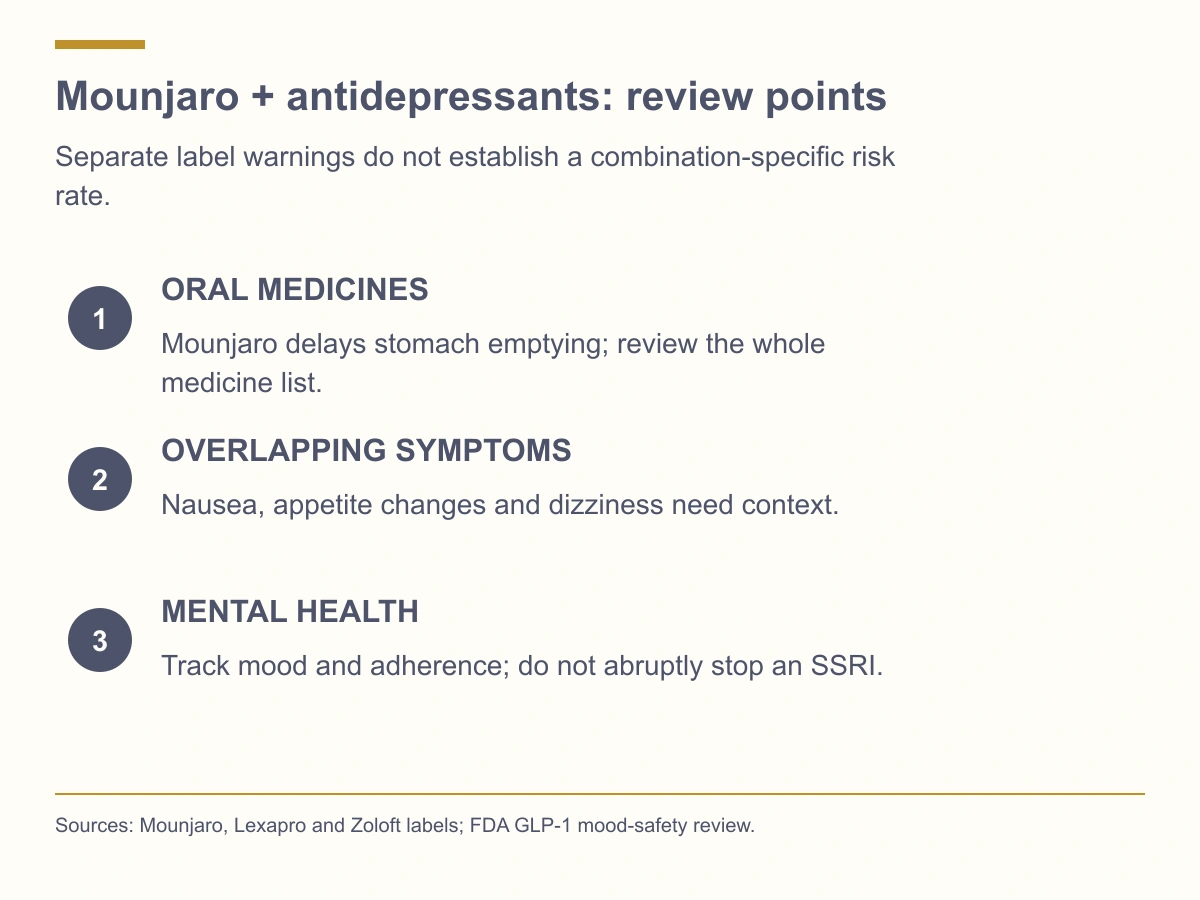
Mounjaro and antidepressants such as Lexapro or Zoloft may be part of the same person’s treatment, but the combination deserves an individualized medication review. Mounjaro delays stomach emptying and can affect the absorption of oral medicines. The antidepressants also have their own side effects, interactions, and instructions for stopping or changing treatment.
The useful question is not simply whether two names appear together in an interaction checker. It is whether your full medicine list, symptoms, mental-health history, diabetes treatment, and ability to eat and drink support a workable plan. Do not stop an antidepressant abruptly because you are starting Mounjaro.
What are these medicines doing?
Mounjaro contains tirzepatide, a medicine that acts at GIP and GLP-1 receptors and is used for type 2 diabetes under its prescribing information. Lexapro contains escitalopram, and Zoloft contains sertraline. Both are selective serotonin reuptake inhibitors, or SSRIs, with their own approved psychiatric indications. Their purposes and dosing schedules are different. Mounjaro label; Lexapro label; Zoloft label.
Zepbound also contains tirzepatide, but brand-specific indications and instructions matter. A discussion of Mounjaro should not assume that every reader is being treated for the same condition or has the same benefit coverage. For a broader introduction, see our tirzepatide questions guide.
Having depression or anxiety does not, by itself, answer whether a particular diabetes medicine is suitable. The prescriber needs the clinical context, including how well the psychiatric condition is controlled and whether other medicines contribute additional concerns.
Does Mounjaro make Lexapro or Zoloft stop working?
The available labeling does not establish a universal loss of antidepressant effect or a predictable percentage change for either combination. Mounjaro’s oral-medication warning is broader: delayed gastric emptying has the potential to affect absorption, so caution and appropriate monitoring are needed. Mounjaro section 7.2.
That statement should not be translated into “all pills stop working” or “the combination is risk-free.” The label specifically highlights medicines whose effectiveness depends on threshold concentrations and those with a narrow therapeutic index. A pharmacist can consider your actual antidepressant formulation and other oral treatments rather than applying an identical rule to every tablet.
If mood or anxiety symptoms change, tell the treating team. Possible explanations include the underlying condition, missed doses, difficulty keeping medicine down, a recent antidepressant change, sleep disruption, or other health issues. The timing can be informative, but timing alone does not prove an absorption problem.
Should you take the antidepressant several hours away from the injection?
There is no universal spacing interval in the Mounjaro label that guarantees normal antidepressant absorption. Mounjaro is a weekly injection, and its effect on gastric emptying is not a brief event that can automatically be avoided by moving one tablet to the next hour.
Ask the pharmacist to reconcile the instructions for each prescribed product. Keep following the established antidepressant schedule unless the treating clinician changes it. If you miss or vomit a dose, get product-specific advice rather than automatically repeating the tablet.
This also differs from the instructions for some oral semaglutide products, which have their own requirements around food, water, and other oral medicines. Our Wegovy, Ozempic, and SSRI guide discusses those formulation differences. An oral semaglutide timing rule should not be imported into a Mounjaro injection schedule.
Which symptoms can overlap?
Nausea, digestive discomfort, and appetite changes can occur with more than one medicine. Zoloft’s common adverse-reaction information includes nausea, diarrhea, decreased appetite, and other symptoms. Lexapro also has gastrointestinal and other adverse effects. Mounjaro’s common adult reactions include nausea, diarrhea, decreased appetite, vomiting, constipation, indigestion, and abdominal pain. Current prescribing information; Zoloft adverse reactions; Lexapro adverse reactions.
| What you notice | Useful information for the care team |
|---|---|
| Nausea after a treatment change | Which medicine changed, when symptoms began, and whether food or fluids stay down |
| Reduced appetite | Whether you are still eating adequately and whether weight change was intended |
| Dizziness or weakness | Fluid intake, vomiting or diarrhea, other medicines, and any glucose readings available under your care plan |
| Worsening mood or anxiety | Missed doses, sleep, recent psychiatric treatment changes, and the pattern of symptoms |
| Sexual difficulties | When they started, the specific problem, and how it affects you |
This table organizes a conversation; it does not identify the cause. Two labels mentioning nausea does not tell us the rate or severity of nausea in people taking both medicines together.
Why vomiting, diarrhea, and low intake need attention
Mounjaro labeling warns about acute kidney injury associated with volume depletion, often following gastrointestinal symptoms that lead to dehydration. Contact the prescriber if vomiting or diarrhea persists or intake becomes inadequate. A dose-escalation visit is also an opportunity to discuss symptoms before another change is made. Mounjaro kidney and gastrointestinal warnings.
Both Lexapro and Zoloft labels also warn about hyponatremia, meaning low blood sodium. Their labeling identifies older adults, people taking diuretics, and people who are volume-depleted as potentially more vulnerable. This does not prove that adding Mounjaro causes a specific interaction rate. It is a clinical reason to review overlapping circumstances when someone is unwell. Lexapro sodium warning; Zoloft sodium warning.
Do not try to diagnose or correct an electrolyte problem by drinking extreme amounts of water or taking salt or potassium supplements. New confusion, fainting, seizures, or severe weakness needs urgent medical assessment. Laboratory testing and treatment depend on what is actually happening.
For related dietary questions, read tirzepatide nausea and reflux and very-low-energy intake during weight treatment.
What about low blood glucose?
Mounjaro can increase hypoglycemia risk when used with insulin or an insulin secretagogue such as a sulfonylurea. The diabetes team may need to review those medicines and the monitoring plan. Do not change insulin or another prescribed dose on your own. Mounjaro hypoglycemia warning.
Symptoms such as sweating, shakiness, palpitations, or feeling unusually anxious should not automatically be labeled as anxiety when low glucose is possible. Follow your existing glucose-checking and treatment plan, and seek help if symptoms are severe or do not resolve as expected.
This is one reason a complete medicine list is more useful than considering only Mounjaro and an SSRI. Our Ozempic, metformin, and glipizide guide explains the general distinction between diabetes medicines with different roles; it is not a conversion guide for Mounjaro.
Does the combination cause serotonin syndrome?
SSRI labels warn about serotonin syndrome, particularly with other medicines that increase serotonergic activity. Examples and contraindications are listed in the antidepressant’s own prescribing information. Tirzepatide’s GIP/GLP-1 action should not be relabeled as an SSRI-like action simply because the medicines are taken together. Lexapro warnings; Zoloft warnings.
A full interaction review is still necessary. Other prescriptions, over-the-counter products, and supplements may change the risk assessment. Tell the pharmacist about everything you use, including occasional pain medicines and herbal products.
Marked agitation or confusion together with fever, tremor, muscle rigidity, or other severe new symptoms requires urgent assessment. An online article cannot determine whether those symptoms represent serotonin syndrome, another drug reaction, infection, or another emergency.
What has the FDA said about GLP-1 medicines and suicidal thoughts?
In its January 13, 2026 communication, FDA reported that its comprehensive review did not identify an increased risk of suicidal ideation or behavior with GLP-1 receptor agonist medicines. It requested removal of that warning from the weight-management products that included it: Saxenda, Wegovy, and Zepbound. The communication also noted that diabetes-product labeling did not contain the same warning. FDA safety review.
That finding should not be used to dismiss new mental-health symptoms. Continue the care and monitoring recommended for the underlying condition and the antidepressant itself. Tell a healthcare professional about worsening depression, unusual behavior, or suicidal thoughts.
If you may act on thoughts of self-harm or cannot stay safe, obtain emergency help. In the United States, calling or texting 988 connects you with crisis support. You do not need to decide which medicine, if any, is responsible before seeking help.
Can weight changes tell you which medicine is responsible?
Not reliably on their own. Weight and appetite can change for many reasons, including treatment, mood, sleep, illness, and changes in eating patterns. A timeline helps the clinician evaluate possibilities, but it does not isolate one cause.
Avoid treating a psychiatric medicine as expendable because you are concerned about weight. The potential benefits of maintaining mental-health stability belong in the same discussion as metabolic goals. A clinician may consider several strategies, but an abrupt medication stop can create additional problems.
Both Lexapro and Zoloft labeling recommend gradual dose reduction rather than abrupt discontinuation whenever possible. The exact plan should come from the psychiatric prescriber. Lexapro discontinuation guidance; Zoloft discontinuation guidance.

What should you track before follow-up?
A short record is usually more useful than constant monitoring without a clear purpose. Note the dates of medication starts or changes, symptoms that interfere with daily life, missed doses, vomiting, and any difficulty maintaining meals and fluids. Follow the glucose-monitoring schedule you were given rather than inventing a new one.
Also note changes in sleep, anxiety, mood, or sexual function that matter to you. If discussing sexual symptoms feels awkward, a written note can help start the conversation. Our low-libido guide for women distinguishes desire, comfort, arousal, and medication-related questions.
Ask which clinician is coordinating the combined plan and whom to contact between visits. Having one clear route for urgent questions can prevent conflicting instructions from separate offices.
Questions for the pharmacist and both prescribers
- Have you reviewed my complete prescription, supplement, and over-the-counter list?
- Does any oral medicine need extra monitoring with delayed stomach emptying?
- What should I do if I vomit after a tablet or repeatedly miss doses?
- Which symptoms call for same-day advice or emergency care?
- Does my diabetes plan need review if I am eating less?
- When will we assess mood, tolerability, and the treatment’s intended benefits?
If you are exploring CoreAge Rx treatment, use the tirzepatide product information as a starting point for a clinical discussion. Confirm the exact preparation and indication, and make sure the prescribing team knows about your antidepressant. A product page cannot replace review of the full treatment plan.
Educational information for adults; individual treatment decisions require a qualified clinician. Sources reviewed October 6, 2026. Original AI-generated article images depict fictional people and objects, not patient outcomes. Other editorial images are illustrative. Graphics summarize the cited sources.