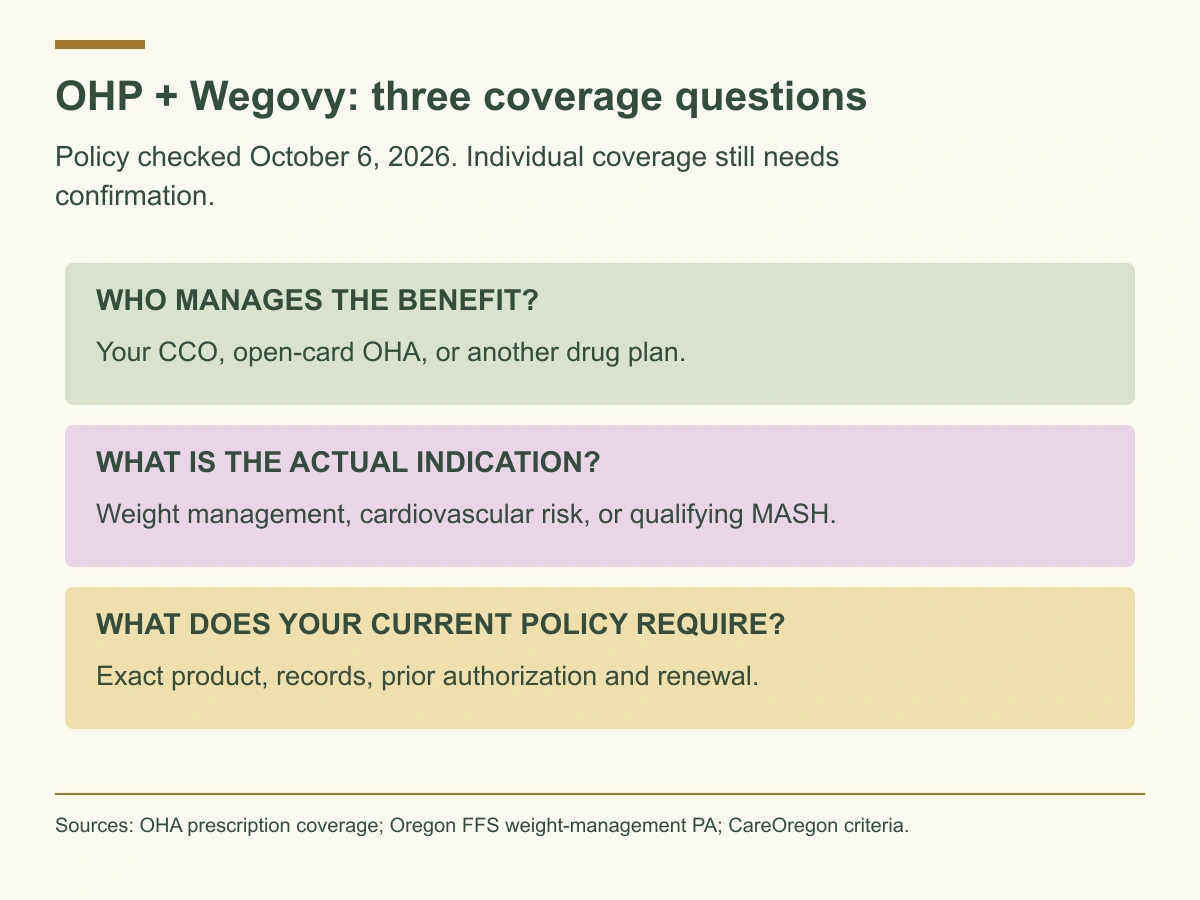
Oregon Health Plan coverage for Wegovy depends on who manages your prescription benefit, the reason it is prescribed, the exact formulation, and the applicable authorization rules. The current Oregon fee-for-service policy does not cover medication for adult weight management alone, but it includes review pathways for certain other indications and separate provisions for eligible younger members. A coordinated care organization may have different requirements.
This guide reviews official policy available on October 6, 2026. It cannot determine your individual benefit or guarantee that a pharmacy claim will be paid. The most useful next step is to identify your actual plan and ask it to review the precise prescription and diagnosis.
Start with the organization that pays for your prescriptions
OHP is not one uniform pharmacy policy for every member. Oregon Health Authority explains that a coordinated care organization, or CCO, generally covers its members’ medical prescriptions, while OHA covers behavioral-health prescriptions. For open-card, or fee-for-service, members, OHA manages prescription coverage. People with Medicare may also have a Part D plan responsible for most prescriptions. OHA prescription coverage guidance.
Look at your current coverage information before relying on a formulary found through a search engine. Ask the number on your member card which organization handles the medication in question. Tell the pharmacy about all of your coverage, including Medicare or other insurance.
A useful opening question is: “Who should my prescriber contact about authorization for this exact Wegovy prescription?” That establishes the right destination before time is spent gathering records for a policy that does not apply to you.
What does the current fee-for-service policy say?
The Oregon FFS weight-management prior-authorization document linked from the state’s searchable drug list distinguishes weight management alone from other evidence-supported uses. Its current implementation history lists March 1, 2026. It states that adult weight-management use without another qualifying indication is not currently covered under that policy. Oregon FFS weight-management criteria.
The policy identifies established cardiovascular disease and qualifying metabolic dysfunction-associated steatohepatitis, or MASH, among semaglutide review pathways. MASH is a liver condition; it is not established simply by having excess weight or a mildly abnormal liver test. The policy has specific documentation and fibrosis-stage requirements.
It also directs requests for Ozempic, Rybelsus, or Mounjaro for type 2 diabetes to separate diabetes criteria. That direction should not be read as saying that any semaglutide brand is automatically covered whenever a person has diabetes.
| Situation | What to clarify |
|---|---|
| Adult weight management alone | Whether the request falls under a noncovered indication in the applicable policy |
| Established cardiovascular disease | The exact diagnosis, product, records, and authorization criteria |
| MASH with qualifying fibrosis | Required diagnostic evidence, specialist involvement, and formulation |
| Type 2 diabetes treatment | The diabetes-specific product and policy rather than a general Wegovy assumption |
| An eligible younger member | Whether a separate EPSDT review pathway applies |
This table is an orientation to the policy, not a complete eligibility test. The underlying document contains additional steps that the prescriber and plan must apply.
Does a high BMI mean Wegovy will be approved?
No. Clinical eligibility for a medication and insurance coverage are different decisions. A person can meet a drug’s prescribing criteria while their plan still requires another indication, documentation, or a different authorization pathway.
The FFS document includes BMI criteria in parts of its review, but it also evaluates the indication and other requirements. Reading one qualifying number in isolation can create a misleading impression of coverage. A BMI threshold is not a substitute for the rest of the policy. FFS approval criteria.
Likewise, do not assume that a diagnosis should be changed to fit a coverage rule. The request needs to reflect your actual health history and the clinician’s findings. If records are incomplete, the appropriate step is to supply accurate documentation, not to select a more convenient diagnosis.
Why cardiovascular and liver indications need separate questions
Wegovy has formulation-specific prescribing information, and coverage policies can distinguish those formulations and uses. The current FFS table includes semaglutide tablets or injection for the cardiovascular pathway and injection for qualifying MASH. The prescriber should check the current label and the payer’s exact requirements together. Oregon indication table; Wegovy prescribing information.
For cardiovascular review, ask which established disease records are needed. A general desire to prevent future heart disease is not necessarily the same as documented cardiovascular disease under a policy. For MASH, ask what diagnostic evidence and fibrosis assessment the plan requires and whether a specialist must be involved.
These distinctions matter because coverage is tied to a clinical purpose. They also help prevent confusion between related medicines. Our oral semaglutide and injection guide explains why route and product identity belong at the start of the discussion.
What if you are enrolled in a CCO?
OHA states that a CCO’s prescription policies can differ from its own, while still needing to follow applicable Prioritized List coverage. Use your CCO’s member handbook, covered-drug list, and current criteria. The state FFS document is valuable background, but it does not replace your CCO’s decision. OHA member guidance.
CareOregon provides an example of why checking the actual policy matters. Its prior-authorization index says documents were revised October 1, 2026, while the linked Wegovy/Zepbound guideline itself shows an effective date of July 1, 2026. That guideline has distinct sections for pediatric weight management, noncirrhotic MASH, secondary cardiovascular prevention, and Zepbound for obstructive sleep apnea. CareOregon policy index; linked guideline.
The index date and a document’s effective date are different pieces of information. Neither turns the policy into a guarantee of benefits. CareOregon explicitly states that its medical policies do not determine a member’s benefits and that eligibility is considered before those guidelines are applied.
This example should not be copied onto another CCO. Ask your own plan for the applicable document, its effective date, and any requirements specific to your benefit.

How should younger members be handled?
The FFS criteria include case-by-case review for members eligible for the Early and Periodic Screening, Diagnostic and Treatment program, or EPSDT. This is one reason an adult coverage summary should not be treated as a complete answer for every younger member. FFS EPSDT provisions.
The CareOregon example has its own pediatric section covering ages 12 through 20, with detailed requirements. That age range is a feature of that specific policy section; it should not be generalized into a universal promise of coverage or prescribing eligibility. CareOregon Wegovy criteria.
Families should ask the treating team and plan which review pathway applies to the member’s age and circumstances. Medication, nutritional care, and growth-related considerations require a pediatric assessment. This article does not provide a pediatric treatment plan.
What does “prior authorization” actually mean?
Prior authorization is a request for a plan to review a proposed treatment against its requirements before payment. It can involve chart notes, diagnosis details, previous treatment, relevant test results, and the exact prescription. A prescription being sent to a pharmacy does not necessarily mean authorization is complete.
The Oregon searchable database also distinguishes preferred status from clinical authorization rules. A preferred drug can still have clinical criteria, and a drug appearing in the database is not proof that every indication is funded. Oregon FFS database explanation; weight-management class listing.
Our GLP-1 insurance coverage guide explains the wider process. When checking a request, ask whether it was received, whether information is missing, and whether the decision concerns a benefit exclusion or medical criteria. Those are different problems with different possible next steps.
What records should you gather?
Let the prescriber and plan identify the necessary records. A useful starting packet may include your member information, the exact medicine and formulation, the treatment indication, and any records the plan specifically requests. Avoid sending unrelated private information to a seller or a generic online form.
For an ongoing prescription, keep the previous approval letter and authorization dates. For a new request, ask which office is responsible for submission and how you will hear about the result. If multiple clinicians are involved, confirm who is coordinating the documentation.
A short call record can prevent repeated work: note the date, the organization, the question, and the answer or reference number. This is especially useful when a pharmacy and plan appear to be giving different explanations for an unfilled prescription.
What happens if the request is denied?
Read the written decision and ask the plan to explain the reason and the available review or appeal process. Follow the deadline and instructions in that specific notice. This guide does not provide a universal appeal deadline because the applicable process depends on the decision and coverage arrangement.
If required information was missing, ask whether the prescriber can submit it. If the decision concerns a noncovered indication, additional notes may not resolve that underlying benefit issue. Ask the treating clinician about other clinically appropriate options while the coverage question is being clarified.
Do not assume that buying a similarly named product privately will be equivalent. Compounded preparations are not FDA-approved and should not be represented as FDA-approved generics of Wegovy. FDA compounding questions and answers.

Does approval last indefinitely?
Usually, an authorization has a defined period and may require renewal. The current FFS weight-management document lists initial authorization for up to six months and renewal for up to 12 months, with different requirements for different indications. These maximum periods do not establish the duration of an individual member’s approval. FFS authorization and renewal criteria.
Ask when the next review is due and what records will be needed. Do not wait until the final available dose to discover that a renewal request has not been started. If treatment is interrupted, ask your prescriber about restarting; do not automatically resume an old dose after a long gap. Our missed semaglutide and restart guide explains why the product and length of the interruption matter.
A practical coverage call checklist
Before calling, have your current member card and the prescription details available. Then ask:
- Which organization manages this prescription benefit?
- Is this exact formulation reviewed for my actual diagnosis?
- Which current authorization policy applies, and where can I read it?
- What must my clinician submit, and where should it be sent?
- Which participating pharmacy can process the prescription?
- If approved, when does authorization end and what is required for renewal?
- If denied, how do I obtain the written reason and review instructions?
For clinical background, see how to get a Wegovy prescription and our semaglutide questions guide. If you are considering CoreAge Rx, review its semaglutide treatment information directly with the provider; this article does not verify OHP participation, billing, or coverage for a CoreAge Rx service.
Educational information for adults; individual treatment decisions require a qualified clinician. Sources reviewed October 6, 2026. Original AI-generated article images depict fictional people and objects, not patient outcomes. Other editorial images are illustrative. Graphics summarize the cited sources.