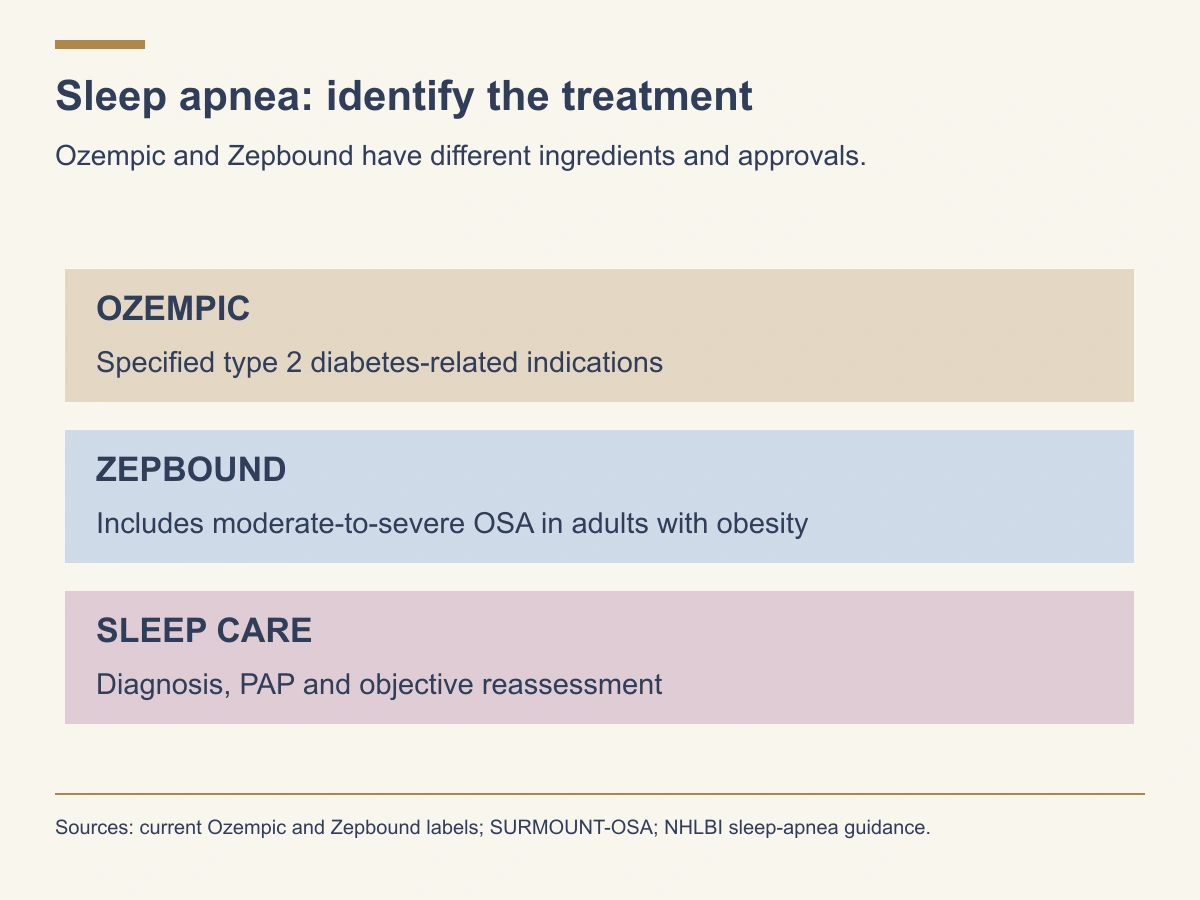
Ozempic is not FDA approved to treat sleep apnea. Its current U.S. indications concern specified type 2 diabetes, cardiovascular, and kidney outcomes. Zepbound, which contains the different medicine tirzepatide, has an indication for moderate-to-severe obstructive sleep apnea in adults with obesity. These products and their evidence should not be treated as interchangeable. Ozempic label, Zepbound label.
Weight management may be part of sleep-apnea care, but improvement in weight or snoring does not by itself show that apnea has resolved. If you have diagnosed sleep apnea, discuss treatment changes with the sleep-care team. If you have symptoms without a diagnosis, the next step is assessment rather than selecting a medication from a search result.
What is obstructive sleep apnea?
Obstructive sleep apnea, or OSA, happens when the upper airway becomes blocked repeatedly during sleep. Breathing can become reduced or stop for periods, interrupting sleep and oxygen delivery. Obesity is one risk factor, but airway anatomy and other factors can also contribute. NHLBI sleep-apnea overview.
Central sleep apnea is different: the brain does not send the signals needed to maintain breathing. A treatment claim for obstructive sleep apnea should not be transferred automatically to central apnea or to every kind of poor sleep.
Symptoms that deserve discussion include loud snoring, witnessed pauses, gasping during sleep, and excessive daytime sleepiness. A clinician may recommend a sleep study. Snoring alone cannot tell you the type or severity, and the absence of a partner’s report does not rule out a problem.
Why is weight part of the discussion?
Excess body weight can contribute to upper-airway obstruction, so a weight-management plan can be relevant for some people with OSA. However, people of different body sizes can have sleep apnea, and weight change does not capture all the factors that affect breathing during sleep.
NHLBI includes a healthy weight, physical activity, and healthy sleep habits among treatment measures. It also describes devices and other therapies that address the airway more directly. The appropriate combination depends on the person’s diagnosis and circumstances. NHLBI treatment overview.
Our sleep and weight-management guide explains the broader relationship. The goal is coordinated care for both issues, with the sleep outcome assessed directly rather than inferred only from the scale.
What can Ozempic evidence tell us?
Ozempic contains semaglutide. Its label identifies use in adults with type 2 diabetes for glucose control and specified cardiovascular and kidney risk reduction. A person may have both an appropriate Ozempic indication and OSA, but that does not turn the prescription into an approved apnea treatment. Current Ozempic indications.
Weight can change during semaglutide treatment. Still, a weight result alone cannot establish a particular reduction in apnea events, the ability to stop PAP, or the response in someone with central apnea. Those are separate outcomes that need appropriate evidence and clinical evaluation.
If you already take Ozempic, tell the sleep clinician and the prescribing clinician about both treatment plans. Ask which health goals each treatment addresses and how progress will be measured. Do not switch or combine medicines simply because another brand appears in a sleep-apnea headline.
How does Zepbound differ?
The current Zepbound label includes treatment of moderate-to-severe OSA in adults with obesity, alongside a reduced-calorie diet and increased physical activity. Its active ingredient is tirzepatide, not semaglutide. The label also says coadministration with another tirzepatide-containing product or a GLP-1 receptor agonist is not recommended. Zepbound indications and limitations.
That indication does not apply automatically to every person who snores, every adult with sleep apnea, or every product described as tirzepatide. The type and severity of apnea, obesity, contraindications, and broader health context remain relevant.
Our tirzepatide and sleep-apnea guide gives a fuller explanation of the branded evidence. Product selection should involve the prescribing and sleep-care teams rather than an assumption that any weight-management injection has the same approval.
| Treatment or product | What it addresses | Question to clarify |
|---|---|---|
| Ozempic | Its specified type 2 diabetes-related indications | What is the separate plan for diagnosed apnea? |
| Zepbound | Includes moderate-to-severe OSA in adults with obesity | Do the diagnosis and individual clinical circumstances fit? |
| PAP therapy | Uses air pressure to help keep the airway open during sleep | Is the device comfortable, effective, and appropriately adjusted? |
| Compounded semaglutide or tirzepatide | A specific compounded preparation, without FDA approval | What is the actual product and reason for considering it? |

What did the SURMOUNT-OSA trials measure?
Two randomized, placebo-controlled phase 3 trials studied adults with moderate-to-severe OSA and obesity for 52 weeks. One enrolled people not receiving PAP at baseline; the other enrolled people using PAP. Participants received tirzepatide at the maximum tolerated trial dose or placebo. Primary SURMOUNT-OSA publication.
The primary outcome was change in the apnea–hypopnea index, or AHI: the number of apnea and hypopnea events per hour of sleep. In the first trial, the average change was −25.3 events per hour with tirzepatide versus −5.3 with placebo. In the second, it was −29.3 versus −5.5. Baseline average AHI was about 50 events per hour in each trial.
These results describe group averages in specific trial populations. They do not mean that everyone became free of apnea or that a person should choose a trial dose without titration and monitoring. Gastrointestinal adverse events were the most commonly reported with tirzepatide, and the trials were funded by Eli Lilly.
The evidence concerns tirzepatide and the studied participants. It does not establish the same AHI changes for Ozempic, a compounded preparation, mild apnea, or central apnea.
Can you stop CPAP after losing weight?
Do not decide from weight, snoring, or perceived sleep quality alone. Ask the sleep-care clinician whether reassessment or repeat testing is appropriate and whether device settings or treatment need to change. A quieter night is not a measurement of breathing events or oxygen levels.
PAP and weight-management treatment can address different parts of the same condition. In the SURMOUNT-OSA PAP trial, participants had been using PAP and intended to continue it during the trial. That design should not be retold as a general instruction to abandon PAP when a prescription starts. Trial design.
If PAP is uncomfortable, report the specific problem. Mask fit, dryness, pressure intolerance, or other symptoms may require adjustments or discussion of alternatives. NHLBI describes oral devices and selected procedures as additional options for appropriate patients. NHLBI treatment options.
How soon should sleep improve?
There is no reliable personal timetable from a medicine name alone. The trials measured outcomes over many months, and an average week-52 result cannot promise improvement after a first dose or a particular number of pounds lost.
Track the symptoms that matter in daily life, such as sleepiness, morning function, and the ability to use prescribed therapy. Let the sleep team interpret device information and determine when objective reassessment is useful. If sleepiness makes driving or safety-sensitive work unsafe, seek prompt advice and avoid those activities while impaired.
Our tirzepatide first-month guide explains why early treatment is a period of assessment and adjustment. It should not be treated as a substitute for ongoing sleep-apnea treatment while waiting for a weight response.
What else belongs in the medication review?
Bring all medicines and supplements, the exact GLP-1 product, recent dose changes, and current digestive symptoms. Tell the team about diabetes treatments, kidney concerns, pregnancy plans, and any upcoming procedure. These details can affect medication selection and follow-up.
For Ozempic, the label warns that delayed stomach emptying matters during general anesthesia or deep sedation. It instructs patients to tell procedural teams about use. Our semaglutide and anesthesia guide explains the need for a coordinated plan. A sleep-apnea diagnosis should also be shared with procedural clinicians.
If you receive testosterone, make sure both teams know. The TRT and sleep-apnea guide addresses that separate treatment question. Persistent tiredness should not automatically be attributed to low testosterone, poor motivation, or a medicine without reviewing sleep and other causes.

How do you compare access and treatment options?
Start with the clinical indication, then check coverage for the actual product and plan. An insurer may require documentation of a diagnosis or other criteria, and coverage for one indication does not establish coverage for another. The GLP-1 insurance guide explains questions for the insurer and prescribing office.
CoreAge Rx’s tirzepatide page describes offered compounded care. Compounded tirzepatide is not FDA-approved Zepbound, and the sleep-apnea indication and trial results should not be presented as approval or equivalence for the compounded product. FDA compounding explanation.
Before changing treatment, clarify who will follow the sleep condition, who will manage medication, how symptoms will be reported, and what testing will guide future decisions. A coordinated plan is more useful than a promise that a single product will solve every part of the problem.
Frequently asked questions
Is Ozempic approved for snoring?
No. Its current label does not include snoring or sleep-apnea treatment. Snoring with pauses, gasping, or daytime sleepiness deserves evaluation for its cause.
Are Ozempic and Zepbound the same medicine?
No. Ozempic contains semaglutide; Zepbound contains tirzepatide. Their labels, indications, dosing plans, and evidence differ. Do not combine or substitute them independently.
Does a lower AHI mean sleep apnea is cured?
A lower number may represent meaningful improvement, but its interpretation depends on the remaining severity, symptoms, oxygen findings, and overall assessment. A trial average cannot establish an individual’s need for continued treatment.
What is the best first step if I suspect apnea?
Tell a healthcare professional about snoring, witnessed pauses, gasping, sleepiness, and relevant medical history. Ask whether a sleep study is appropriate. Medication selection comes after the condition and treatment needs are understood.
Educational information for adults; individual treatment decisions require a qualified clinician. Sources reviewed October 5, 2026. Original AI-generated article images depict fictional people and objects, not patient outcomes. Other editorial images are illustrative. Graphics summarize the cited sources.
Research behind this topic
- Tirzepatide and Sleep Apnea: Inside the SURMOUNT-OSA Trials. Go inside the two SURMOUNT-OSA trials, including the AHI changes and the supervised PAP-assessment protocol. Improvement does not automatically mean CPAP can be stopped.