
There is no universal syringe-unit conversion for 1.7 mg of semaglutide. Milligrams describe the amount of drug; milliliters describe liquid volume; syringe units describe a particular measuring scale. To connect them, the exact preparation’s concentration and the supplied syringe must be known. Another person’s unit number cannot establish your dose.
If the prescription, dispensing label, and instructions do not clearly match, contact the dispensing pharmacist and prescribing clinician before an injection. An online conversion chart cannot verify the contents of your bottle, your prescribed dose, or the scale of your measuring device.
What mg, mL, concentration, and units mean
The terms are related but describe different things. Confusing them can produce a much larger amount than intended, especially when instructions change between refills or a patient receives an unfamiliar syringe.
| Term | What it describes | Why it matters |
|---|---|---|
| mg, or milligrams | Mass of active drug | A prescribed amount of semaglutide is commonly expressed this way |
| mL, or milliliters | Volume of liquid | The same liquid volume can contain different drug amounts |
| mg/mL | Concentration: drug amount per volume | It connects the mass and volume for the exact preparation |
| Syringe units | Marks on a particular calibrated scale | They do not independently identify milligrams of semaglutide |
| Total bottle content | Drug or volume in the entire container | It is not automatically the amount for one injection |
The FDA’s compounded semaglutide dosing-error alert describes confusion among milligrams, milliliters, and units, as well as varying concentrations. The general relationship is that prescribed drug mass and the actual concentration determine liquid volume; the correct measuring device must then match that volume. This explanation is not a verified calculation for your prescription.
Our semaglutide dosage guide discusses product-specific schedules. A schedule identifies prescribed drug amounts and timing, while a syringe measurement is a separate preparation-specific question. Do not assume a schedule supplies a universal units chart.
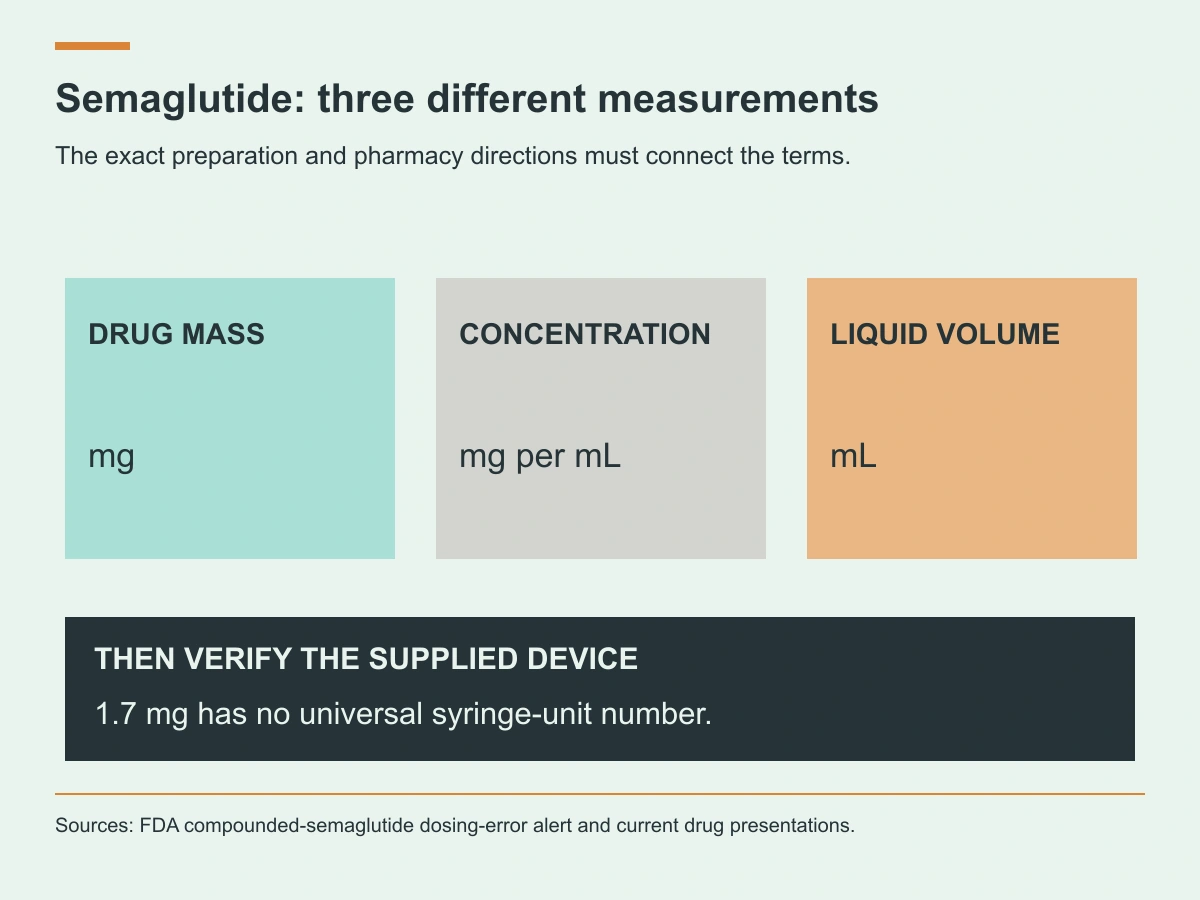
Why 1.7 mg has no universal answer in units
The number 1.7 mg tells you a mass of semaglutide. It does not tell you how much liquid contains that mass unless the concentration is known. It also does not identify whether you have an approved device designed to deliver a fixed amount, or a compounded preparation requiring pharmacy-specific instructions.
The current Wegovy label identifies particular 1.7 mg single-dose presentations with their own volume and instructions. That labeled product information does not establish how to draw from a different vial. A brand’s device specification is not a general conversion for every preparation sharing the active ingredient.
Likewise, “1 mg,” “0.25 mg,” or “0.5 mg” alone cannot establish a syringe number for an unidentified bottle. The dispensing pharmacist needs the actual concentration, prescribed amount, device, and directions. A vial with a similar-looking name may have a different concentration or total content.
Do not extract medicine from a branded pen to create a homemade conversion, count clicks as a substitute for its instructions, or repeat an injection because the liquid amount looked small. Approved devices have presentation-specific directions. See our Ozempic device guide and Wegovy injection guide.
What FDA’s reported errors show
FDA’s July 2024 alert describes patients drawing more than the prescribed amount from multidose compounded semaglutide vials. In reported cases, some administered five to 20 times the intended dose. Reports included severe digestive symptoms, dehydration, fainting, and cases requiring medical attention or hospitalization.
The alert also describes errors by health care professionals when converting an intended dose between measurements. These examples show why written directions and appropriate syringe selection matter. They are not templates to reuse, and the amounts in a reported error do not establish another person’s concentration or prescription. FDA dosing-error alert.
The reports cannot tell you the probability of an error for every user or prove that every compounded preparation has the same problem. They do establish a practical concern: a small intended volume, a large syringe, unclear units, or a miscalculation can create serious confusion.
FDA recommends appropriate syringe selection and counseling on measuring the intended amount. Ask for instruction with the exact supplied device rather than accepting a general video for a different syringe. If a staff member changes the directions, request a clear written reconciliation from the pharmacist or prescribing clinician.
What to check before using a compounded preparation
Keep the actual dispensing label, prescription directions, and supplied device together. Ask the pharmacy to explain each field and resolve any mismatch. A photo of a label can help the care team identify the preparation, but a general article cannot authenticate the product.
Useful details include:
- The active ingredient and any other ingredients.
- The drug concentration with its complete units.
- The prescribed drug amount and schedule.
- The corresponding volume and device-specific measurement provided by the pharmacy.
- The identity and contact information of the dispensing pharmacy.
- The total content, storage information, and relevant discard instructions.
The semaglutide vial guide explains why total bottle content and one dose are different. Do not calculate from a statement such as “5 mg vial” without knowing the actual preparation and pharmacy directions. A total drug mass does not, by itself, tell you how much liquid to add or inject.
If directions are incomplete, damaged, contradictory, or supplied only in a customer chat message, ask for corrected written information. Do not rely on how many doses someone says the bottle “usually” contains. That claim may omit concentration, intended dose, or the safe time for use after opening.

A refill can require new instructions
Do not assume a new bottle has the same concentration as the previous one. The prescribed drug amount may stay the same while the liquid volume changes, or the treatment plan may change. The pharmacy must explain the instructions for the preparation actually dispensed.
An old unit number saved on a phone can be misleading if the new concentration or measuring device differs. Compare the current directions with the previous ones and ask about any change. Do this before preparing a dose rather than after an unexpected amount has been drawn.
For approved medicines, a change in presentation also requires the correct Instructions for Use. The current Wegovy label specifically emphasizes training for the prescribed device and new training when presentation changes. A single-dose pen, single-dose syringe, and multidose pen do not all use the same steps.
Our semaglutide ingredients guide discusses formulation differences. Added ingredients do not prove improved results or make one preparation equivalent to another. FDA’s current guidance also distinguishes semaglutide salt forms from the active ingredient used in approved products. FDA GLP-1 concerns.
When the dose is uncertain or may have been wrong
If you are uncertain before injecting, pause and contact the dispensing pharmacist or prescriber. If an injection may already have been incorrect, seek prompt professional advice rather than waiting for symptoms or trying to compensate with a later dose. Provide the exact preparation, concentration, intended amount, amount used if known, and time of administration.
For significant symptoms such as severe or persistent abdominal pain, repeated vomiting, fainting, inability to keep fluids down, or confusion, seek urgent medical assessment. A clinician or poison center can advise on the appropriate response. Do not induce vomiting, take another medicine to counteract the injection, or create a new schedule from an online comment.
Semaglutide has a long duration in the body, so an initially mild or absent symptom does not establish that an uncertain dose was harmless. FDA notes that observation and treatment after an overdose may need to be prolonged. FDA dosing-error alert.
Our semaglutide nausea and vomiting guide explains symptom reporting. It does not replace overdose assessment. A suspected measurement error and ordinary mild nausea are different situations; tell the care team explicitly when an error may have occurred.
Storage and sterility are separate from correct arithmetic
Even a verified measurement does not resolve whether a preparation was stored correctly or is suitable to use. FDA’s current guidance recommends discarding multidose compounded GLP-1 vials within 28 days of first use, even if medication remains or a compounder permits a longer period. It also advises a new sterile needle and syringe for each dose. Current FDA guidance.
Ask about the pharmacy’s other date and storage requirements as well; a shorter applicable limit should not be ignored. A printed date on an unopened preparation and a limit after first use answer different questions. Do not stretch a bottle based solely on the amount of liquid left.
The storage and travel guide covers temperature concerns. FDA advises against using injectable GLP-1 products that arrive warm or with insufficient refrigeration. Contact the pharmacy about an unexpected shipment rather than deciding from appearance that the drug is fine.

Ask about the care plan, not only the measurement
If you are exploring treatment, the CoreAge Rx semaglutide page provides service information. Confirm the exact preparation, clinical suitability, pharmacy, training, recurring charges, and follow-up. A service description is not an individualized prescription or a dose conversion.
Approved and compounded preparations are distinct. FDA says compounded drugs are not FDA-approved and should meet a medical need that an available approved medicine cannot meet. Compounding questions and answers. Ask why the proposed preparation is appropriate and what options exist if written instructions remain unclear.
Frequently asked questions
How many units are 1.7 mg of semaglutide?
There is no universal number. The exact concentration, prescribed preparation, and measuring device are needed. Ask the dispensing pharmacist for instructions that clearly connect the prescribed drug amount with the supplied device.
Are 50 units or 20 units the same number of milligrams for everyone?
No. A syringe number does not independently identify drug mass. Different concentrations can place different amounts of semaglutide in the same liquid volume. Do not reuse another person’s number or an old refill instruction without verification.
Can I convert 1 mg or 0.25 mg using a generic chart?
A generic chart cannot verify your current concentration, product, device, or prescription. Use the actual pharmacy’s written directions and resolve discrepancies with the pharmacist and prescriber before injecting.
Does a 5 mg vial mean a 5 mg injection?
No. Total content and one prescribed dose are different. The label and directions must explain the actual preparation and intended amount. Do not infer dilution or injection instructions from total mass.
What if the directions say 5 units but I used 50?
Treat a possible error as a reason for prompt professional or poison-center advice. Provide the exact preparation and details rather than assuming its significance from the numbers alone. Serious symptoms require urgent assessment; do not wait for a routine refill response.
Educational information for adults; individual treatment decisions require a qualified clinician. Sources reviewed October 2, 2026. Original AI-generated article images depict fictional people and objects, not patient outcomes. Other editorial images are illustrative. Graphics summarize the cited sources.