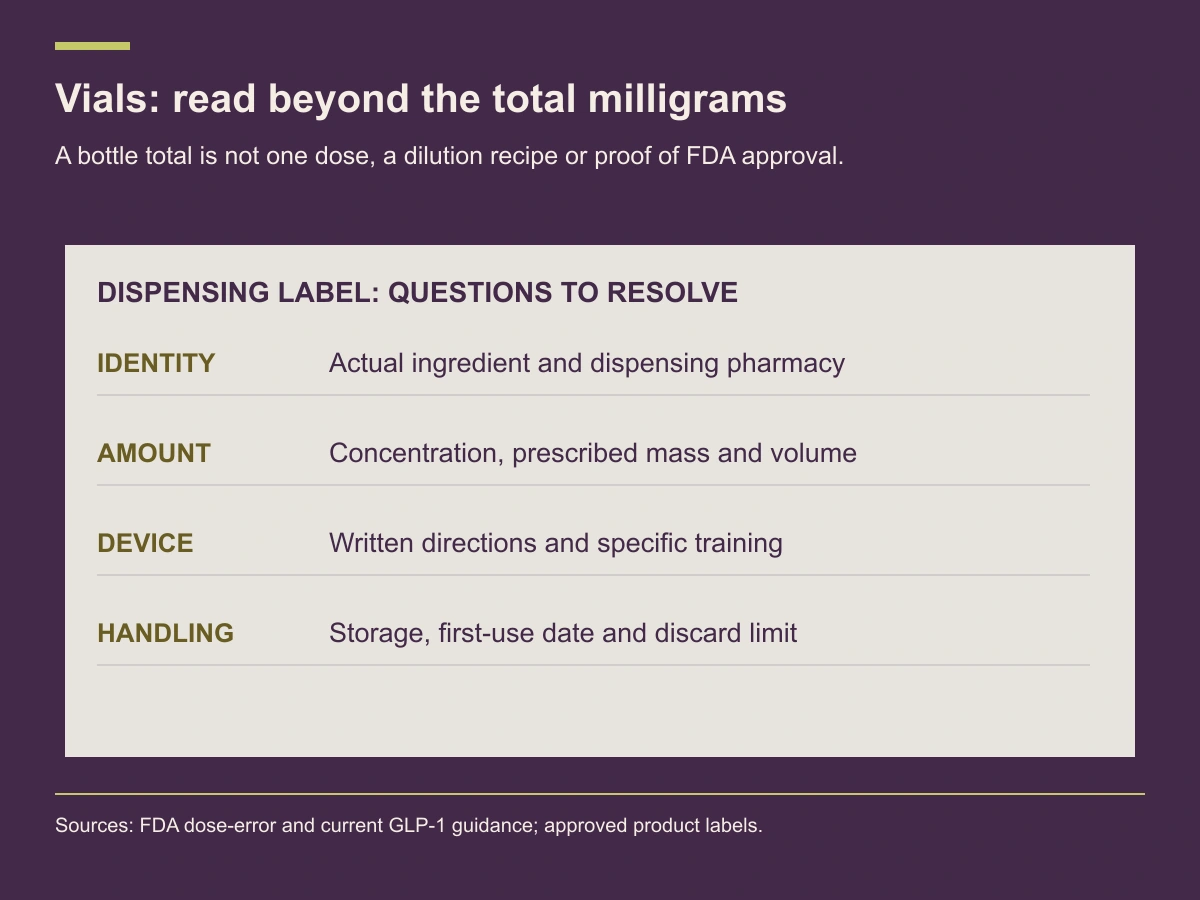
Before using a semaglutide vial, identify the exact preparation, dispensing pharmacy, concentration, prescribed amount, measuring device, and storage instructions. A bottle’s total milligrams do not automatically describe one injection. A familiar-looking container does not establish that its contents are FDA-approved, authentic, or prepared the same way as your previous refill.
If directions are incomplete or contradictory, contact the pharmacist and prescribing clinician before an injection. This guide explains useful label questions and current FDA concerns; it does not provide a dilution recipe, a personal syringe conversion, or instructions for mixing a powder purchased online.
Is semaglutide in a vial approved Ozempic or Wegovy?
The current Ozempic label identifies specific multidose pens and single-dose prefilled syringes. The current Wegovy label identifies specific pens, syringes, and daily tablets. A compounded semaglutide vial is not FDA-approved Ozempic or Wegovy merely because it contains, or claims to contain, the same active ingredient.
FDA distinguishes compounded medicines from approved brands and approved generics. Compounded drugs do not undergo FDA review for safety, effectiveness, and quality before marketing. The agency says they should meet a medical need that an available approved medicine cannot meet. FDA compounding questions and answers.
Ask the clinician to explain the exact product and why it is being considered. Then ask the dispensing pharmacist to explain the preparation and directions. Brand instructions should not be copied onto an unrelated compound, and a compounded product’s vial instructions should not be used to modify a branded device.
Our semaglutide and Ozempic comparison provides background. The semaglutide ingredients guide explains why active ingredient, formulation, and added ingredients are different questions.
Total content, concentration, and one dose are different
One container can hold multiple prescribed amounts. The total drug content is not automatically the intended injection, and it does not reveal liquid volume without the concentration and preparation details. Likewise, a stated total liquid volume does not independently identify drug mass.
| Label or instruction field | What it helps identify | What it cannot establish alone |
|---|---|---|
| Active ingredient | What the preparation is described as containing | Authenticity, approval, or individual suitability |
| Total milligrams | Drug amount described for the container | One dose or how much liquid to add |
| Concentration in mg/mL | Drug amount per liquid volume | Your prescribed schedule |
| Prescribed amount and directions | The intended treatment instruction | That another bottle has the same concentration |
| Device-specific measurement | How the supplied device is to be used under pharmacy instruction | A universal conversion for all semaglutide |
| Storage and date information | Handling and applicable time limits | That visible leftover liquid remains suitable |
Our mg, mL, and units guide explains the relationships. A syringe scale alone does not establish semaglutide mass. Ask the pharmacy to provide complete written directions that match the actual concentration and supplied device.
Do not calculate the intended number of injections from a promotional statement such as “one vial lasts months.” Treatment can change, and the preparation has storage and discard limits. The amount left is not the only factor determining whether it can still be used.
What to ask the dispensing pharmacy
Confirm the pharmacy’s full identity and contact details. Ask which active ingredient is used, what any additional ingredients are, the complete concentration, prescribed drug amount, corresponding volume, and exact device. Request training appropriate to that preparation and measuring device.
FDA’s current GLP-1 guidance warns about false pharmacy information on some products. If the label names a pharmacy that says it did not prepare the medicine, do not resolve the discrepancy by trusting the platform’s reassurance alone. Contact the prescribing team and the actual pharmacy directly.
Also ask what to do about a damaged shipment, uncertain temperature exposure, a label mismatch, an unclear measurement, or a possible error. Identify a pharmacist and clinical response pathway before you need one. A customer-service representative may need to route questions rather than answer them clinically.
Keep the label, written directions, and packaging available for follow-up. Avoid sharing personal prescription images publicly while seeking advice. The care team needs the actual preparation details; strangers in a forum cannot authenticate the bottle or authorize a dose.
Why “5 mg powder” does not supply a mixing recipe
A statement of powder mass does not specify an appropriate diluent, concentration, preparation process, sterility, stability, or personal prescription. The same is true for a container described as 3 mg. Adding a guessed amount of water does not resolve those questions.
Do not buy a product labeled for research and turn it into an injection based on online instructions. FDA urges consumers not to purchase products falsely marketed for research or not for human consumption, which may be of unknown quality and harmful. Current FDA guidance.
If a licensed pharmacy dispenses a preparation that requires any preparation step, obtain its specific written instructions and clarification from the pharmacist. Do not assume every powder product is identical or that every compound is dispensed as a liquid. This article cannot verify a particular preparation or supply a do-it-yourself process.
Semaglutide sodium and semaglutide acetate are also not interchangeable names for the active ingredient used in approved products. FDA identifies those salt forms as different active ingredients and says it is unaware of a lawful basis for their use in compounding. A name resemblance does not prove equivalent properties.

Current FDA advice for multidose-vial use
FDA’s current guidance recommends that consumers discard multidose compounded GLP-1 vials within 28 days after first use, even if medication remains. It specifically says not to continue beyond 28 days even when compounder instructions permit longer use. FDA concerns with multidose vials.
Ask about other applicable pharmacy date and storage instructions too. An unopened preparation’s beyond-use date and a limit after first use are different. A shorter applicable limit or another reason the preparation is unsuitable should not be ignored because 28 days have not passed.
FDA also advises a new sterile needle and syringe for every dose. Reusing supplies can contaminate the medication. Do not stretch a vial by reusing equipment, combining leftovers, or treating a longer advertised supply as a reason to disregard the current advice.
Record the first-use date so it can be discussed with the pharmacist. If written instructions conflict with this FDA recommendation, ask the pharmacy and prescriber to resolve the discrepancy. The safe-use question is not answered simply by confirming that some liquid remains.
Shipping, storage, and appearance questions
FDA has received complaints of compounded GLP-1 products arriving warm or with inadequate ice packs. It advises patients not to use injectable GLP-1 medicine that arrives warm or with insufficient refrigeration, because quality may be affected. Current FDA storage guidance.
Contact the dispensing pharmacy with the delivery details and follow its assessment of the actual preparation. Do not borrow an approved pen’s storage allowance for a compounded vial. Temperature, time, whether the preparation has been opened, and its specific stability information matter.
Our semaglutide storage and travel guide explains the questions to ask. The semaglutide color guide explains why appearance alone cannot establish potency, sterility, or authenticity. A clear liquid is not proof that an unexpected shipment is suitable.
If there are particles, damage, an unexpected color, or missing directions, contact the pharmacist before use. Do not warm, freeze, dilute, filter, or alter a preparation to try to restore it. A visual check cannot replace a pharmacy’s product-specific assessment.
Dosing errors can be serious
FDA’s July 2024 dosing-error alert reports compounded semaglutide vial errors involving confusion among drug mass, volume, and syringe units. Some patients administered five to 20 times the intended amount; some reports involved medical attention or hospitalization.
A change in concentration, an unfamiliar syringe, unclear directions, or a conversion mistake can matter even when the intended prescription sounds familiar. FDA encourages appropriate syringe selection and instruction. Confirm each refill rather than assuming an old unit number still applies.
If a dose may already have been wrong, contact a clinician or poison center promptly with the label, intended amount, actual amount if known, and time of administration. Do not wait for symptoms before seeking advice or try to compensate by inventing a later schedule. Serious symptoms require urgent assessment.
Repeated vomiting, severe or persistent abdominal pain, fainting, confusion, or inability to keep fluids down should not be managed through a routine shipping inquiry. The semaglutide nausea and vomiting guide explains symptom reporting, but a suspected dosing error needs its own assessment.
Refills, gaps, and treatment fit
Before another fill, review symptoms, adequate intake, treatment response, and any interruption with the prescribing team. A refill is not simply a request for another container. A changed product or device may require new training, while a gap can require a product-specific restart decision.
Our missed semaglutide doses and restart guide explains why the exact product and interruption matter. The first-month guide helps readers track the information needed for follow-up. Neither authorizes an escalation or a vial conversion.
For people exploring services, the CoreAge Rx semaglutide page introduces information to discuss with the team. Confirm the prescribed preparation, clinical suitability, dispensing pharmacy, continuing cost, and support arrangements. The service page does not establish a personal prescription or make a compounded product an approved brand.
Frequently asked questions
Is every semaglutide vial fake?
No. A licensed pharmacy may compound for an appropriate medical need under applicable requirements. However, compounds are not FDA-approved, and a container or label alone does not authenticate the product. Verify the actual preparation and dispensing source.
How much water goes into a 5 mg or 3 mg vial?
Total mass alone does not determine an appropriate preparation process. Obtain the dispensing pharmacist’s specific written instructions for a prescribed preparation. Do not create an injection from a research product or an online dilution chart.
How many doses are in my vial?
That requires the actual content, concentration, prescription, and applicable use limits. A marketing estimate is not enough. Current FDA advice for multidose compounded GLP-1 vials also limits use after first opening, even when liquid remains.
Can I keep using it for longer because the pharmacy printed a later date?
FDA’s current guidance says to discard multidose compounded GLP-1 vials within 28 days of first use, even if compounder directions allow longer. Ask the pharmacist to reconcile the instructions and observe any shorter applicable limit.
Can I use the same units as my last refill?
Confirm the current concentration, prescribed amount, supplied device, and written directions first. An old number can be wrong for a changed preparation. Resolve mismatches before injecting rather than guessing from how similar the bottles look.
Educational information for adults; individual treatment decisions require a qualified clinician. Sources reviewed October 2, 2026. Original AI-generated article images depict fictional people and objects, not patient outcomes. Other editorial images are illustrative. Graphics summarize the cited sources.