
Amoxicillin may be prescribed for an appropriate bacterial infection in someone taking Mounjaro, but the decision needs the actual prescription, allergy history, kidney function, symptoms and other medicines. The reviewed labels do not provide a universal amoxicillin-and-Mounjaro dose-spacing plan or a rule to hold Mounjaro for every antibiotic course.
Tell the clinician prescribing the antibiotic that you take Mounjaro, and ask the pharmacist to review the complete medication list. Do not independently skip the antibiotic, change its dose or stop and restart Mounjaro because of a generic online combination answer.
Why this is more than a yes-or-no interaction question
An interaction check is one part of the review. The reason for the antibiotic, the person’s medical history and what is happening during the illness also matter.
Mounjaro contains tirzepatide and is given as a weekly injection. Amoxicillin is a penicillin-class antibacterial medicine with product-specific indications and dosing. The current identified amoxicillin label, updated July 30, 2026, describes treatment of susceptible bacterial infections and includes allergy, gastrointestinal and renal precautions.
The current Mounjaro label describes the medicine’s effects and warnings, including delayed gastric emptying and the potential to affect absorption of oral medicines. These facts explain why the full situation needs review; they do not create an automatic prohibition against every oral antibiotic.
This is a practical inference from the two labels, not evidence of a dedicated clinical trial showing that every amoxicillin formulation and illness is safe with Mounjaro.
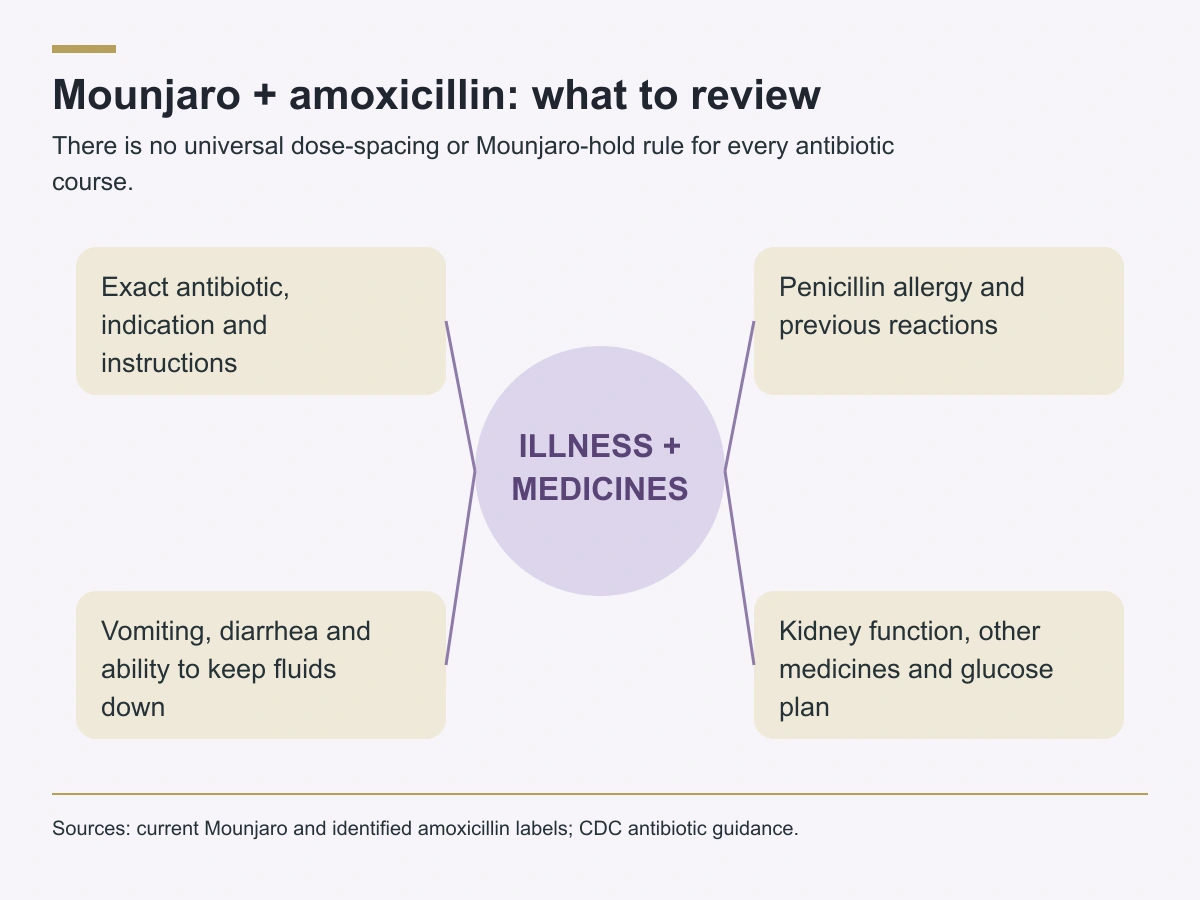
What to give the prescriber or pharmacist
Have the antibiotic name, strength, dosage form, directions and intended duration available. Check whether it is amoxicillin alone or amoxicillin combined with clavulanate; those are different prescriptions with their own information.
Also give the Mounjaro dose, date of your last injection, any recent increase, and the reason it was prescribed. Mention previous problems with penicillins or related antibiotics, kidney disease, pregnancy or pregnancy planning, and other relevant diagnoses.
Include prescription medicines, nonprescription pain or cold remedies, contraception and supplements. The amoxicillin label includes interactions involving medicines such as probenecid, oral anticoagulants and allopurinol. A review of only Mounjaro and the antibiotic can miss another relevant medicine.
| Information to provide | Why it helps the review |
|---|---|
| Exact antibiotic and instructions | Identifies the product, purpose and prescribed course |
| Penicillin or other drug-allergy history | Helps assess potentially serious hypersensitivity risk |
| Kidney function or known kidney disease | Can affect the appropriate antibiotic regimen |
| Mounjaro dose and recent changes | Helps interpret the symptom timeline and treatment plan |
| Vomiting, diarrhea and fluid intake | Identifies current tolerance and hydration concerns |
| Other medicines and supplements | Allows review beyond the two products in the headline |
Mounjaro and absorption of oral medicines
Mounjaro delays gastric emptying. Its prescribing information says that this can affect absorption of orally administered medicines and calls for caution and monitoring in relevant circumstances, including medicines dependent on particular concentrations or with a narrow therapeutic range.
That warning does not supply a standard number of hours to separate an antibiotic capsule from a weekly injection. Because the effect is not simply the two products touching in the stomach, an invented two-hour spacing rule is not an established solution.
Ask the pharmacist whether your exact antibiotic directions need any clarification in your circumstances. If you cannot keep oral doses down, have severe symptoms or are concerned the infection is not improving, contact the treating clinician. Do not independently increase the antibiotic or take extra doses to compensate for an assumed absorption problem.
Our Mounjaro dosage guide explains the product’s labeled schedule. It does not establish a new antibiotic-timing protocol.
Nausea and diarrhea can have more than one explanation
The identified amoxicillin label lists diarrhea, rash, vomiting and nausea among common reported adverse reactions. Mounjaro also has gastrointestinal effects. An infection, food changes or other medicines may contribute to how you feel.
The timing can help the clinician distinguish possibilities. Record when the illness started, when the antibiotic began, whether the Mounjaro dose changed, and when symptoms appeared. Include how often vomiting or diarrhea occurs and whether you can keep fluids and the prescribed antibiotic down.
Do not assume that every new symptom is a routine Mounjaro effect. An antibiotic-related reaction or another illness may need a different response.
Our tirzepatide nausea and reflux guide offers questions for reviewing recurring symptoms. The GLP-1 flu-like symptoms guide also explains why feeling unwell should be assessed by the actual symptoms rather than by a catch-all label.

Symptoms that need prompt or urgent care
Difficulty breathing, swelling of the face or throat, collapse or other signs of a serious allergic reaction require emergency care. The amoxicillin label warns about potentially fatal hypersensitivity reactions and directs discontinuation if an allergic reaction occurs, with appropriate treatment.
A new rash should be reported promptly. Blistering, peeling, spreading lesions, fever or involvement of the mouth or eyes should not be treated as a simple irritation to watch indefinitely. The label includes severe skin-reaction warnings.
Significant or persistent diarrhea during or after an antibiotic course also needs medical advice. The label describes Clostridioides difficile-associated diarrhea and notes that it can occur after treatment, including more than two months later. Bloody stools, severe abdominal pain, fever or dehydration concerns make assessment particularly important.
If you have persistent vomiting, cannot keep fluids down, have severe abdominal pain or feel markedly worse, seek prompt care. A medication-timing adjustment from a blog is not an appropriate response to a possible serious reaction or significant illness.
Kidney function and the antibiotic prescription
Amoxicillin is substantially cleared through the kidneys. The current label includes adjustments for severe renal impairment and specifies that some doses are unsuitable in that setting.
This article does not reproduce an antibiotic dosing schedule for your infection. The appropriate dose depends on the diagnosis, product, kidney function and other clinical details. A familiar strength from a previous prescription may be inappropriate now.
If you have known kidney disease or a recent change in kidney tests, tell the treating clinician and pharmacist. Also report substantial vomiting, diarrhea or poor fluid intake. Mounjaro’s label includes kidney-injury concerns associated with volume depletion, so ongoing symptoms deserve attention rather than a routine reassurance that the two products are compatible.
Should you pause Mounjaro while taking amoxicillin?
There is no universal hold-for-the-antibiotic rule in the reviewed labels. The prescribing team may need to make an individualized decision based on illness severity, intake, symptoms and the broader treatment plan.
Ask specifically what to do with the next scheduled injection if you are unwell. If Mounjaro is prescribed for diabetes, ask about your glucose-monitoring and other diabetes-medicine instructions during the illness too. Do not independently stop several treatments because one is a weekly injection.
If a dose is missed or treatment is interrupted, get a clear plan for resuming. A long gap and poor tolerance can make the next step different from an ordinary late dose. Do not double the injection or restart at a changed dose without advice.
For broader context, our GLP-1 dosage chart keeps product-specific schedules separate. It does not provide an illness-based hold or restart prescription.
Birth control: distinguish the warnings
Mounjaro’s label advises people using oral hormonal contraception to switch to a nonoral method or add a barrier method for four weeks after starting Mounjaro and for four weeks after each dose escalation. Those are tirzepatide-specific precautions, not a window that automatically starts with every antibiotic course.
Antibiotic advice is a separate issue. The identified amoxicillin package information includes an oral-contraception warning, while the CDC’s 2024 U.S. Medical Eligibility Criteria states that most broad-spectrum antibiotics do not affect the effectiveness of combined pills, patches or rings. Rifampin and rifabutin have separate guidance.
Bring your exact contraceptive method and prescription to the pharmacist or clinician to reconcile the applicable instructions. Vomiting, diarrhea, missed contraceptive doses and a recent Mounjaro start or increase may also require product-specific advice. Do not conclude either that every antibiotic makes contraception fail or that Mounjaro’s own precautions can be ignored.

Follow the prescribed antibiotic course
The CDC’s antibiotic guidance explains that antibiotics treat certain bacterial infections, not viral colds or flu. Use them exactly as prescribed, and do not share doses or use leftovers from an earlier illness.
If a side effect, vomiting or another problem prevents you from following the prescription, contact the treating clinician for instructions. Do not improvise a different course length or compensate with extra doses.
Keep a written list of questions: What improvement is expected? When should I call if I am not improving? What should I do if I vomit after a dose? What is the plan for my next Mounjaro injection if I remain unwell? Clear answers are more useful than a general “no interaction” message.
For treatment questions beyond the illness, see our tirzepatide versus semaglutide guide and tirzepatide product information. They explain a separate discussion about clinical suitability and formulation, rather than antibiotic prescribing.
Frequently asked questions
Can I take amoxicillin on injection day?
The reviewed labels do not establish a universal injection-day prohibition or a standard spacing interval. Follow the actual prescriptions and have the pharmacist review the combination and your current symptoms.
Should I skip antibiotics because Mounjaro slows digestion?
Do not independently skip treatment. Delayed gastric emptying is a reason to review oral medicines, not a reason to abandon a prescribed course. Contact the clinician if you cannot keep doses down or have concerns about response.
Does diarrhea mean Mounjaro is causing it?
Not necessarily. The antibiotic, illness and other factors may contribute. Persistent or severe diarrhea during or after antibiotics needs assessment, including consideration of the label’s C. difficile warning.
Can I use leftover amoxicillin for a new infection?
Do not self-treat with leftovers. The current illness may not require an antibiotic, and the product, dose or duration may be inappropriate. Follow a clinician’s assessment and prescription.
What should I ask before the next injection?
Explain the infection, antibiotic course, recent Mounjaro changes, food and fluid intake, gastrointestinal symptoms and glucose concerns. Ask for an explicit plan for the scheduled dose and for resuming if treatment is interrupted.
Educational information for adults; individual treatment decisions require a qualified clinician. Sources reviewed October 2, 2026. Original AI-generated article images depict fictional people and objects, not patient outcomes. Other editorial images are illustrative. Graphics summarize the cited sources.