Comparing weight-loss percentages from separate trials can be misleading. Different participants, follow-up periods, doses, and analysis methods can make two numbers look more directly comparable than they really are. SURMOUNT-5 addressed that problem by randomly assigning people within one trial to tirzepatide or semaglutide.
Tirzepatide produced a larger average weight reduction at 72 weeks. The useful next step is to understand what that result means, who it applies to, and which treatment questions the trial did not answer.
What question did SURMOUNT-5 ask?
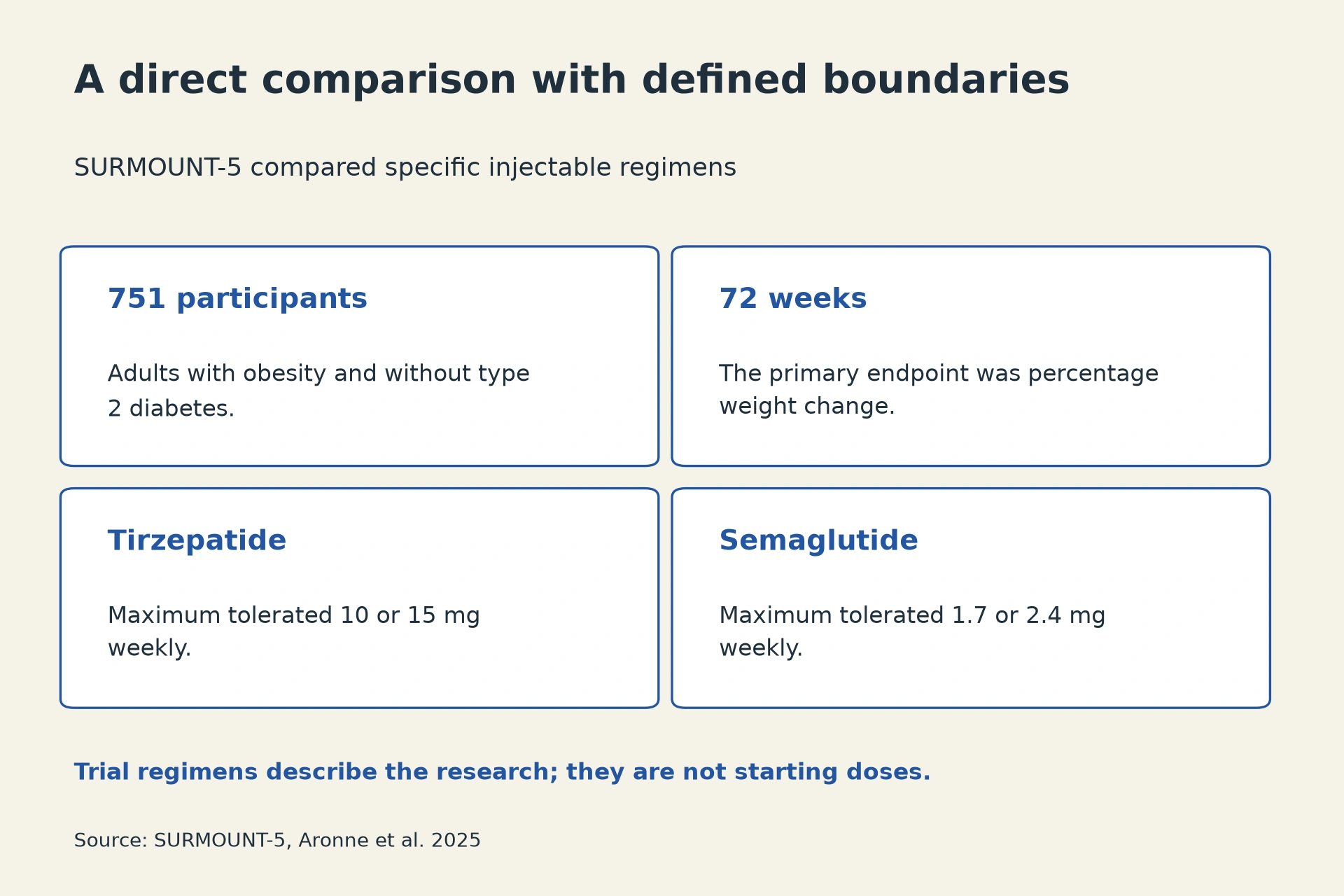
The phase 3b trial asked whether tirzepatide reduced body weight more than semaglutide in adults with obesity who did not have type 2 diabetes. Researchers assigned participants in a 1:1 ratio to the two treatments and followed them for 72 weeks. The primary endpoint was percentage change in body weight from baseline. Original SURMOUNT-5 paper.
The comparison used maximum tolerated weekly subcutaneous doses: tirzepatide 10 or 15 mg, and semaglutide 1.7 or 2.4 mg. These are descriptions of the research regimens, not starting-dose advice or a conversion chart. Participants reached treatment doses within a supervised trial; the paper does not justify jumping directly to them.
The study was open-label, meaning treatment assignment was known. Randomization still helps create comparable groups, but lack of blinding is relevant to expectations and behavior. Body weight is an objective measurement, yet adherence, eating behavior, and treatment persistence can still be influenced by knowing which medication one receives. Eli Lilly funded the study.
For a broader introduction to the medicines, our tirzepatide versus semaglutide guide explains how evidence fits with treatment access, tolerability, and individual needs.
How much weight did participants lose?
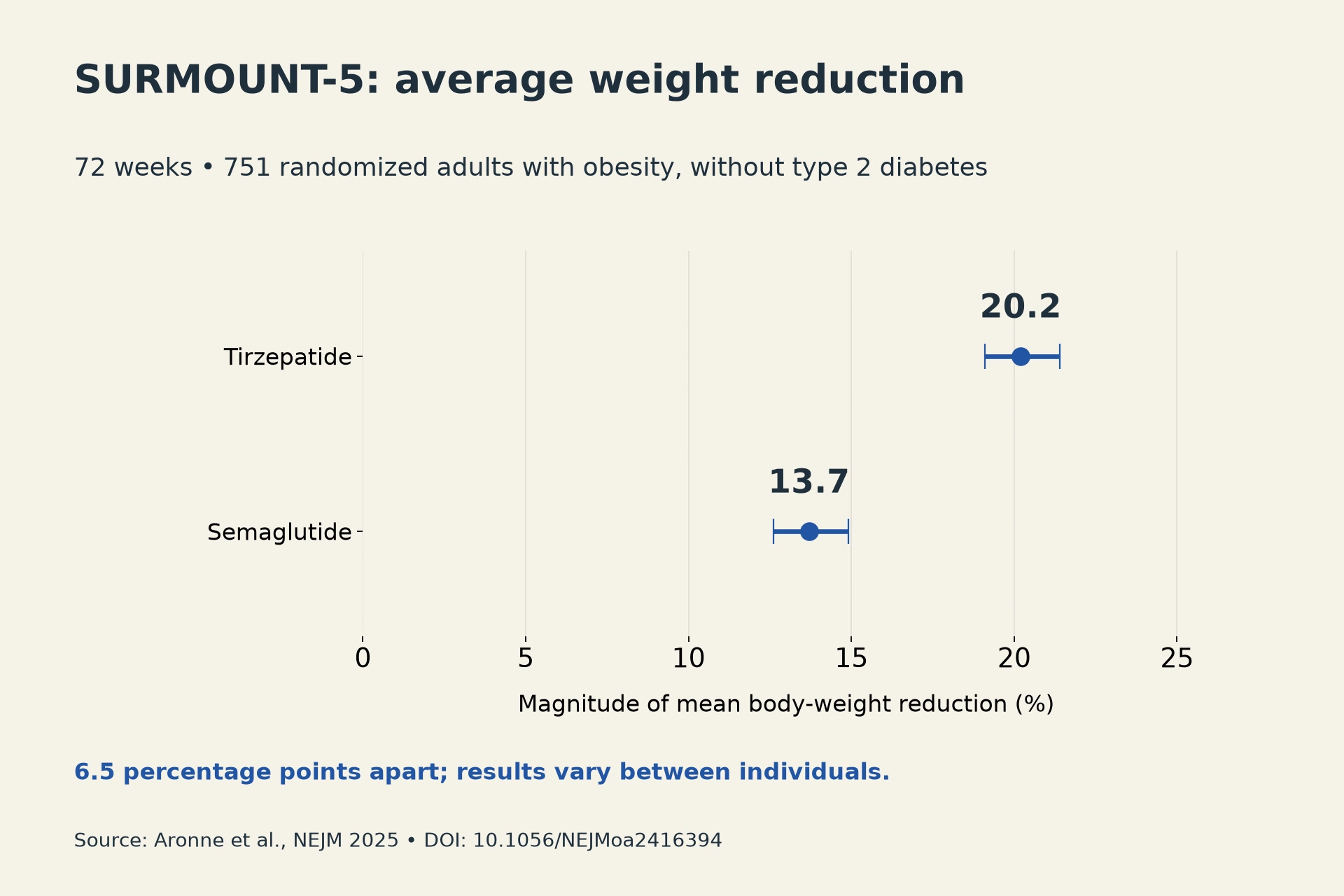
At week 72, the reported least-squares mean weight change was −20.2% with tirzepatide, with a 95% confidence interval of −21.4% to −19.1%. With semaglutide, it was −13.7%, with a confidence interval of −14.9% to −12.6%. The difference favored tirzepatide and was statistically significant. Study results.
“Least-squares mean” indicates a model-based estimate used in the analysis. It should not be described as the outcome achieved by every participant. Likewise, a confidence interval describes uncertainty around a group estimate; it is not the range of results a future patient can expect.
The difference between 20.2 and 13.7 is 6.5 percentage points. That wording matters. Saying “6.5% more weight loss” can leave readers unsure whether the comparison is an absolute difference or a relative calculation. Using the reported group percentages and naming their difference avoids that ambiguity.
A simple example makes the percentages easier to interpret
Imagine a starting weight of 100 kilograms purely to illustrate the arithmetic. A 20.2% reduction would equal 20.2 kilograms, while a 13.7% reduction would equal 13.7 kilograms. The numerical difference would be 6.5 kilograms at that particular starting weight.
This is not a trial participant’s result or a personal forecast. Someone starting at another weight would have different kilogram changes for the same percentages. More importantly, actual responses vary because treatment duration, tolerability, adherence, medical conditions, and other circumstances differ.
A percentage also does not tell us which tissues were lost. Body weight combines fat, lean tissue, water, and other compartments. Our GLP-1 lean-mass evidence review explains why a larger drop on the scale does not automatically establish better muscle preservation or strength.
What happened to waist circumference?
SURMOUNT-5 also measured waist circumference. The average change was −18.4 cm with tirzepatide and −13.0 cm with semaglutide, a difference of 5.4 cm between the reported estimates. Participants assigned to tirzepatide were also more likely to meet the trial’s weight-loss thresholds of at least 10%, 15%, 20%, and 25%. Original report.
Waist circumference is relevant to body size and central adiposity, but it is not a direct measurement of every fat depot. A smaller waist does not, by itself, demonstrate a particular reduction in liver fibrosis, cardiovascular events, or future diabetes. Those outcomes need their own trials and definitions.
That is why our reviews of semaglutide and heart health, tirzepatide and diabetes prevention, and MASH liver studies examine separate research programs. A treatment decision can involve more than the largest average weight change.
How is this different from SURPASS-2?
SURPASS-2 was an earlier direct comparison in people with type 2 diabetes. It randomized 1,879 participants and compared tirzepatide 5, 10, or 15 mg with semaglutide 1 mg over 40 weeks. Its primary endpoint was change in glycated hemoglobin, or HbA1c, rather than percentage weight loss. SURPASS-2 paper.
Tirzepatide improved HbA1c more at each tested dose and also produced greater weight reduction. However, the semaglutide dose, population, follow-up, and main question differed from SURMOUNT-5. Treating the two reports as interchangeable can create the false impression that every comparison used the same obesity-dose regimen.
| Feature | SURMOUNT-5 | SURPASS-2 |
|---|---|---|
| Main population | Adults with obesity, without type 2 diabetes | Adults with type 2 diabetes |
| Randomized participants | 751 | 1,879 |
| Duration | 72 weeks | 40 weeks |
| Semaglutide regimen | Maximum tolerated 1.7 or 2.4 mg weekly | 1 mg weekly |
| Primary outcome | Percentage change in body weight | Change in HbA1c |
The studies complement each other, but their results should stay attached to their own designs. Neither provides a universal dose-equivalence rule for switching medicines.
What did the safety results show?
In SURMOUNT-5, the most common adverse events in both groups were gastrointestinal. Most were mild or moderate and occurred primarily during dose escalation. That pattern is useful for setting expectations, but “most” does not mean everyone tolerated treatment easily. SURMOUNT-5 safety summary.
A person can achieve substantial weight loss and still find side effects unacceptable. Conversely, someone whose weight reduction is below the trial average may experience meaningful improvement and prefer to continue a well-tolerated regimen. The right assessment includes nutrition, hydration, daily function, symptoms, and whether treatment remains appropriate.
The published abstract does not provide a complete individualized risk comparison. It also cannot rule out rare events or settle safety over decades. A clinician should review the current prescribing information for the exact product and consider medical history, other medicines, pregnancy plans, and relevant contraindications.
Our semaglutide questions guide and tirzepatide questions guide offer practical starting points for that conversation.
Does this mean someone should switch to tirzepatide?
The result provides a reason to discuss options, not an automatic instruction to switch. A useful consultation starts with the reason for considering a change: insufficient response, side effects, treatment access, another medical condition, or a change in goals.
Bring the current product name, prescribed dose, time on treatment, weight trend, side effects, and relevant health outcomes. A short period at an introductory dose is different from a sustained trial at a tolerated maintenance regimen. The study’s week-72 group average cannot decide whether an individual has received an adequate trial of treatment.
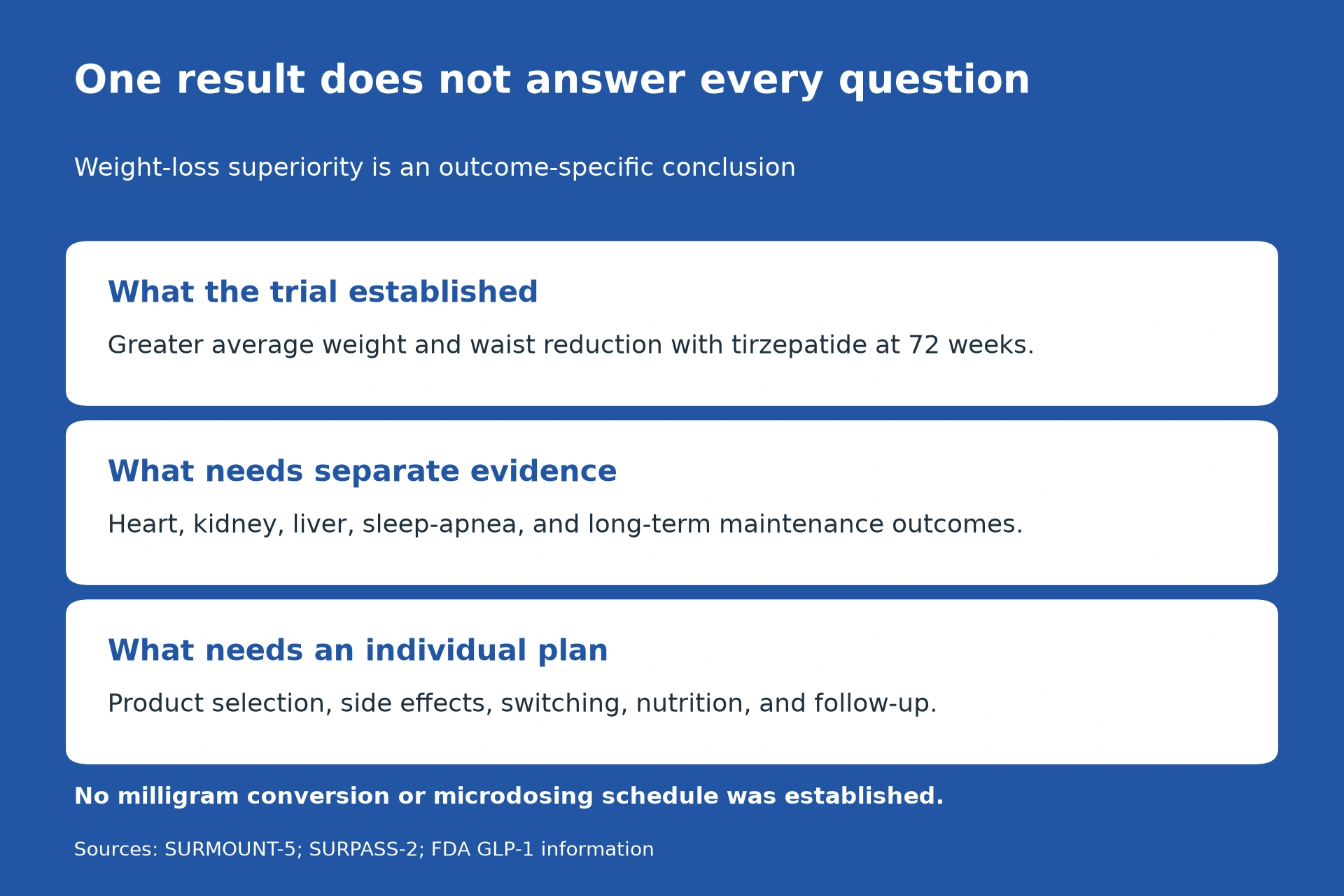
Switching also raises questions about timing, titration, and follow-up. SURMOUNT-5 was not a switching study and did not establish a conversion formula. Do not combine semaglutide and tirzepatide or improvise a transition based on their milligram amounts. Different molecules and dosing schedules cannot be matched by arithmetic alone.
Do the findings apply to compounded or microdose products?
SURMOUNT-5 evaluated specified study medications and regimens. Its numbers should not be presented as verified outcomes for every compounded preparation, oral product, or nonstandard microdosing schedule.
The FDA explains that compounded GLP-1 drugs are not FDA-approved and do not undergo the same premarket review for safety, effectiveness, and quality as approved drugs. The agency also describes concerns involving dosing errors and unapproved products. FDA information on unapproved GLP-1 drugs.
The CoreAge Rx semaglutide information page and tirzepatide information page can support a discussion of the actual product offered. Ask about its formulation, dispensing pharmacy, regulatory status, instructions, and follow-up. Linking to a product does not establish that it is identical to the product or regimen tested in this trial.
What about maintenance after losing weight?
A 72-week comparison does not answer what happens indefinitely, what occurs after stopping, or whether a lower intermittent schedule maintains the same effect. These are separate questions.
Our review of GLP-1 withdrawal studies examines STEP 4, SURMOUNT-4, and the STEP 1 extension. It explains why regain percentages have different reference weights and why those studies do not establish a proven tapering strategy.
Before starting or changing treatment, it is reasonable to ask how progress will be reassessed, how nutrition and activity fit into care, and what the plan would be if access or tolerability changes. A useful long-term plan should not depend on assuming that an average trial result will continue automatically.
Watch: broader obesity-treatment context
This Mayo Clinic video discusses medication and metabolic surgery as obesity-treatment options. It is general clinical context, not a presentation of SURMOUNT-5 or evidence that everyone needs combined treatment. The direct comparison results are in the original paper linked above.
Common questions about the head-to-head trial
Did semaglutide fail in SURMOUNT-5?
No. The semaglutide group had a substantial average weight reduction. Tirzepatide produced a larger reduction under the study conditions. A comparative advantage for one treatment does not mean the other had no effect.
Is the 6.5-point difference the same as losing 6.5 kilograms?
Only in an arithmetic example with a 100-kilogram starting weight. Percentage changes scale with starting weight, and real individual outcomes vary. The article’s kilogram example is illustrative rather than predictive.
Can I expect the trial average if I follow the same dose?
No study average guarantees an individual outcome. The trial also involved selection criteria, monitoring, and a defined duration. Tolerating a dose does not make a person identical to the average participant.
Did the trial prove which medicine is best for heart or kidney disease?
No. The primary endpoint was body-weight change. Cardiovascular, kidney, liver, sleep-apnea, and other outcomes require the relevant condition-specific evidence and current product labeling.
What is the most useful takeaway?
SURMOUNT-5 strengthens the evidence that tirzepatide produces greater average weight reduction than the tested semaglutide regimen in adults with obesity without diabetes. Use that finding alongside the person’s health needs, tolerability, product details, and maintenance plan.
Original papers and supporting sources
The references distinguish full research papers, published abstracts, and official guidance. This educational narrative review is not a systematic review or an individual treatment recommendation. Sources were checked in October 2026.
- Aronne LJ et al. Tirzepatide as Compared with Semaglutide for the Treatment of Obesity. (2025). Published abstract reviewed. DOI: 10.1056/nejmoa2416394.
- Frías JP et al. Tirzepatide versus Semaglutide Once Weekly in Patients with Type 2 Diabetes. (2021). Published abstract reviewed. DOI: 10.1056/nejmoa2107519.
- FDA. Concerns with unapproved GLP-1 drugs used for weight loss. FDA safety information.