Ozempic injection has an approximately one-week half-life, and its prescribing information says semaglutide remains in circulation for about five weeks after the last dose. Those numbers describe how the medicine leaves the body; they do not guarantee when appetite changes, nausea, blood sugar effects, or other symptoms will end. Planned pregnancy has a separate instruction: discontinue Ozempic at least two months beforehand, with a clinician’s plan for ongoing care.
If you are thinking about stopping, have missed doses, or feel unwell, the reason matters as much as the calendar. A refill problem, persistent vomiting, and a planned pregnancy require different conversations. Counting weeks cannot replace those decisions.
What does a one-week half-life mean?
A half-life is the approximate time it takes for the amount or concentration of a medicine to decrease by half during the elimination phase. The Ozempic injection label gives semaglutide an elimination half-life of approximately one week.
This is not the same as “the medicine is gone after seven days.” In a simplified model, half remains after one half-life, one quarter after two, and one eighth after three. Each additional week halves what remains; it does not subtract the same fixed amount each time.
A medicine can therefore continue to be present after the next weekly injection would have been due. That is one reason weekly dosing and a prolonged period after the last dose are compatible facts. It is also why a missed injection is not equivalent to the body instantly returning to its pretreatment state.
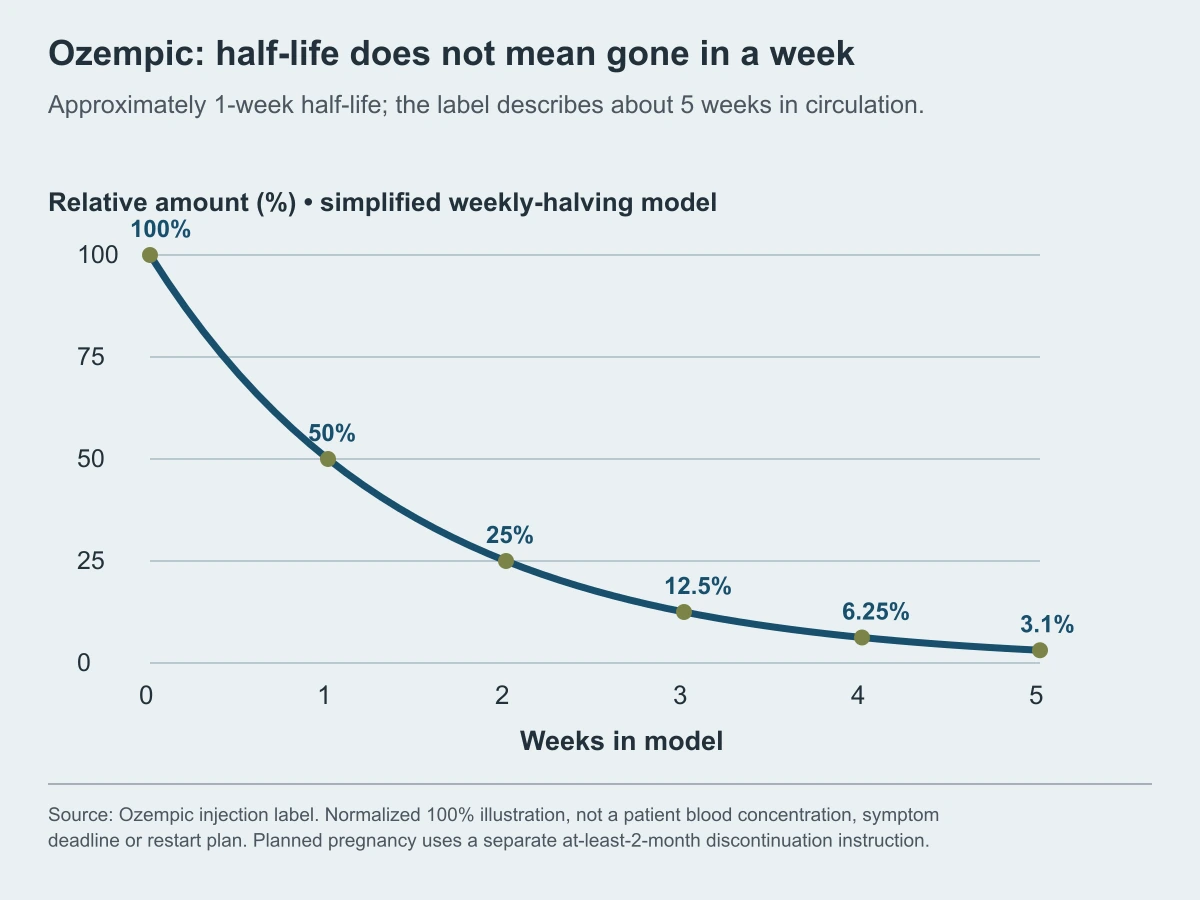
An illustration of gradual elimination
The table below starts with an arbitrary 100% at the beginning of elimination and assumes an exact one-week half-life. It is mathematical illustration, not a measurement of a patient’s blood concentration or of the injected dose still in the body.
| Illustrative time | Relative amount in a simplified model |
|---|---|
| Starting point | 100% |
| One week | 50% |
| Two weeks | 25% |
| Three weeks | 12.5% |
| Four weeks | 6.25% |
| Five weeks | About 3.1% |
The model leaves a small remainder after five weeks. The label’s statement that semaglutide remains in circulation for about five weeks is an approximate pharmacokinetic description, rather than a claim of complete elimination at midnight on a particular day.
Actual concentrations also depend on factors such as previous dosing and the amount present when treatment stops. A graph normalized to 100% cannot tell you the number of milligrams in your blood, whether a symptom is caused by semaglutide, or when you can safely start another medicine.
Why can the medicine stay after the weekly dose is due?
Ozempic is designed for once-weekly use. With repeated dosing, a new dose is given while some medicine from earlier doses remains. The label describes steady-state exposure after several weeks of regular treatment; steady state means a repeating balance of dosing and elimination, rather than the first dose suddenly becoming fully effective on a specific day.
After the final dose, that existing exposure decreases over time. Your body is not starting from an empty system, and the last injection does not become the only relevant dose in the history. This matters when people try to calculate clearance from a single syringe amount without considering regular treatment.
For practical initiation questions, our first month on semaglutide guide explains what to record and discuss. The semaglutide questions guide covers treatment decisions beyond pharmacokinetics.
When will appetite return after stopping?
There is no label-supported day when hunger must return for everyone. Drug exposure, appetite, meal routines, blood glucose, and body weight are related but different measurements. An individual may notice changes before or after another person with the same prescription.
A useful record focuses on patterns that affect daily life: hunger between meals, the ability to eat adequate meals, intrusive food thoughts, and any difficulty following a nutrition plan. It does not require checking hunger every hour or deciding that a brief craving proves the medicine is gone.
Our food noise guide distinguishes hunger, cravings, and persistent food thoughts. If stopping treatment changes those patterns, discuss what nutrition support and clinical follow-up will help. A long-term plan is more useful than waiting for one exact “washout day.”
Weight management also continues beyond drug elimination. NIDDK’s guidance on successful weight-loss programs emphasizes ongoing eating, activity, support, and maintenance strategies. A prescription ending does not by itself create a replacement plan for those needs.
How long will nausea or diarrhea last?
The half-life cannot predict the duration of an individual symptom. Nausea and diarrhea can be associated with Ozempic, but infections, food intolerance, other medicines, and digestive conditions can cause similar symptoms. Persistent symptoms after the last dose still need an assessment; attributing everything to a five-week clearance window can delay useful care.
The Ozempic diarrhea guide explains the symptom history and warning signs to describe. Our GLP-1 constipation guide covers hard or difficult stools and the need to distinguish ordinary constipation from more concerning symptoms.
Get prompt medical advice for repeated vomiting, inability to keep fluids down, very little urine, fainting, or severe or persistent abdominal pain. The Ozempic label includes pancreatitis and volume-depletion kidney injury warnings. Blood or black stools, severe pain, and dehydration also warrant assessment under NIDDK diarrhea guidance.
Do not wait for the medicine to “leave the system” before seeking care for an urgent symptom. Stopping a dose does not establish the cause or guarantee that a serious condition will resolve without treatment.

Can you flush Ozempic out faster?
There is no home flushing method established by the label. Semaglutide is broken down through metabolic processes; elimination is not simply a matter of increasing urine output until an injection is removed.
The label describes metabolism through changes to the peptide and fatty-acid portions of the molecule. Drug-related material is excreted through urine and feces, with only a small portion excreted unchanged in urine. That information does not support using extra water, laxatives, sauna sessions, or a cleanse to speed an individual washout.
Appropriate hydration may matter when you are ill, but excessive fluid intake is not a drug-removal treatment. People with kidney or heart conditions may have specific fluid advice. Use the plan appropriate to your health rather than a universal number of bottles.
NCCIH’s review of detoxes and cleanses discusses the limited evidence and potential harms of these approaches. Our pooping and weight guide also explains why passing stool is not a method for deliberately burning body fat or clearing a prescription.
Why does planned pregnancy require two months?
The Ozempic prescribing information instructs discontinuation at least two months before a planned pregnancy because of the long washout period. That is a distinct instruction from the approximately five-week circulation statement. Do not shorten the pregnancy planning interval based on a half-life calculator.
Bring pregnancy plans to the clinician managing diabetes and any other relevant care. If Ozempic is part of your glucose-management treatment, stopping requires a plan to keep blood glucose managed during the transition. Pregnancy planning involves both medication exposure and the health condition being treated.
If pregnancy occurs unexpectedly, contact your clinician promptly for advice about the actual prescription and ongoing care. This article cannot determine the outcome of an exposure or provide an individual replacement treatment.
Our semaglutide and pregnancy guide provides additional questions for that appointment. The calendar should support a planned clinical transition, rather than becoming a reason to make unsupervised changes.
Does kidney disease change the answer?
The label reports no clinically relevant change in semaglutide pharmacokinetics with renal impairment. That pharmacokinetic finding does not mean kidney-related care is irrelevant during treatment.
Vomiting or diarrhea can cause volume depletion, and the label warns about acute kidney injury in that setting. Kidney health may also affect your nutrition, fluid advice, and other medicines. A clinician needs the whole picture, especially if you are eating less, drinking poorly, or noticing reduced urination.
Do not interpret “no clinically relevant pharmacokinetic effect” as clearance to ignore dehydration. Similarly, an internet half-life table cannot determine whether a new kidney-related symptom is benign.
Can you take Ozempic every other week because it lasts in the body?
The labeled injection schedule is once weekly. Residual semaglutide exposure and an approximately one-week half-life do not authorize extending it to every other week. A different interval changes exposure and is not established by a clearance calculation. Discuss cost, tolerance, an interruption or a treatment change with the prescriber rather than stretching doses independently.
What if you missed doses or want to restart?
A missed-dose instruction and a restart after a longer interruption are different situations. The exact prescription, time since the last dose, previous tolerance, glucose needs, and reason for interruption can influence what your clinician recommends.
Do not assume that residual medicine lets you repeat a dose early, or that five weeks passing automatically makes the previous dose appropriate again. An online article cannot tell you how to retitrate after an interruption. Contact the prescriber or pharmacist with the actual date and dose history.
If you are uncertain whether an injection was delivered, use the device instructions and professional guidance rather than repeating it because you did not feel an immediate effect. The Ozempic pen guide discusses why strength, total pen contents, and a prescribed dose are separate numbers.
Tell your care team about insulin or a sulfonylurea, since changing treatment may alter glucose patterns and low-glucose risk. Do not independently adjust those medicines to match a theoretical decay curve.
Is switching to another medicine just a washout calculation?
No. The medicine being started has its own approved uses, dose schedule, interactions, and risks. Semaglutide and tirzepatide are different ingredients; their milligram doses do not have a simple conversion.
Our Zepbound half-life guide explains tirzepatide’s separate pharmacokinetic information. It should not be substituted for the Ozempic numbers. Different semaglutide brands and oral formulations also have presentation-specific instructions, so an injection graph is not an oral-to-injection dosing chart.
If cost or access is prompting a change, use the Ozempic cost guide and GLP-1 insurance guide to describe the problem accurately. A pharmacist may be able to clarify the actual prescription or payment route before a preventable interruption occurs.
CoreAge Rx’s semaglutide treatment information is a separate way to explore a clinical assessment. Ask about the precise preparation, follow-up, and costs. A compounded preparation is not FDA-approved, and evidence for Ozempic’s labeled product does not validate every semaglutide mixture or device; see FDA’s concerns about unapproved GLP-1 products.

Questions to bring to a stopping discussion
A short preparation list helps the clinician make the calendar meaningful:
- The exact product, route, strength, and date of the last dose.
- Whether you are stopping for symptoms, pregnancy planning, cost, access, or another reason.
- How well you can eat and drink, and whether pain or vomiting is present.
- Other glucose-lowering medicines and recent glucose patterns.
- What ongoing nutrition, activity, and weight or diabetes follow-up will replace the current plan.
- Who to contact if symptoms persist or a refill becomes available.
The balanced meals guide can help maintain a practical eating routine during a transition. Supplements cannot replace a treatment plan. For example, Strong Suit creatine concerns muscle-support supplementation, not semaglutide clearance; ask about suitability separately if you are considering it.
Frequently asked questions
Is Ozempic gone after one week?
No. One week is approximately one half-life, meaning about half remains in a simplified elimination model. The label says semaglutide is present in circulation for about five weeks after the last dose.
Is it completely gone at five weeks?
The label describes an approximate circulation period. A simplified weekly-halving model still has a small remainder at five weeks. Neither statement guarantees an individual concentration of zero or a precise symptom endpoint.
Can symptoms last after I stop?
They can continue, and they may also have another cause. Seek assessment for persistent or concerning symptoms instead of waiting for a calculator’s end date. Urgent symptoms need prompt care regardless of the last dose date.
Can extra water or a bowel movement clear it?
Those actions are not established ways to accelerate semaglutide elimination. Hydration and bowel care should address your actual health needs, rather than act as a prescription cleanse.
Can I plan pregnancy once five weeks have passed?
The labeled instruction is at least two months before planned pregnancy. Use that separate instruction with your clinician, including a plan for the condition Ozempic was treating.
Does this apply to every semaglutide tablet or compounded product?
This article centers on Ozempic injection labeling. Other products have their own instructions, formulations, and evidence. Confirm the exact medicine instead of transferring an injection schedule or dose conversion to another product.
Educational information for adults; individual treatment decisions require a qualified clinician. Sources reviewed October 1, 2026. Original AI-generated article images depict fictional people and objects, not patient outcomes. Other editorial images are illustrative. Graphics summarize the cited sources.