
Zepbound contains tirzepatide, which declines gradually rather than disappearing when the weekly dosing interval ends. The current prescribing information gives an approximate elimination half-life of 5–6 days in people with overweight or obesity and in people with obstructive sleep apnea and obesity. Zepbound prescribing information
Half-life describes a decline in drug amount during elimination. It does not provide a personal date when side effects will end, a safe restart dose, or a universal deadline for surgery or pregnancy planning.
Here is what the number means, what a simplified graphic can show, and why different stopping questions need different answers.
What does a 5–6-day half-life mean?
In a simple elimination model, one half-life leaves half of a starting reference amount. Another half-life leaves half of that remainder. The amount gets progressively smaller; it does not drop from “present” to “gone” in one step.
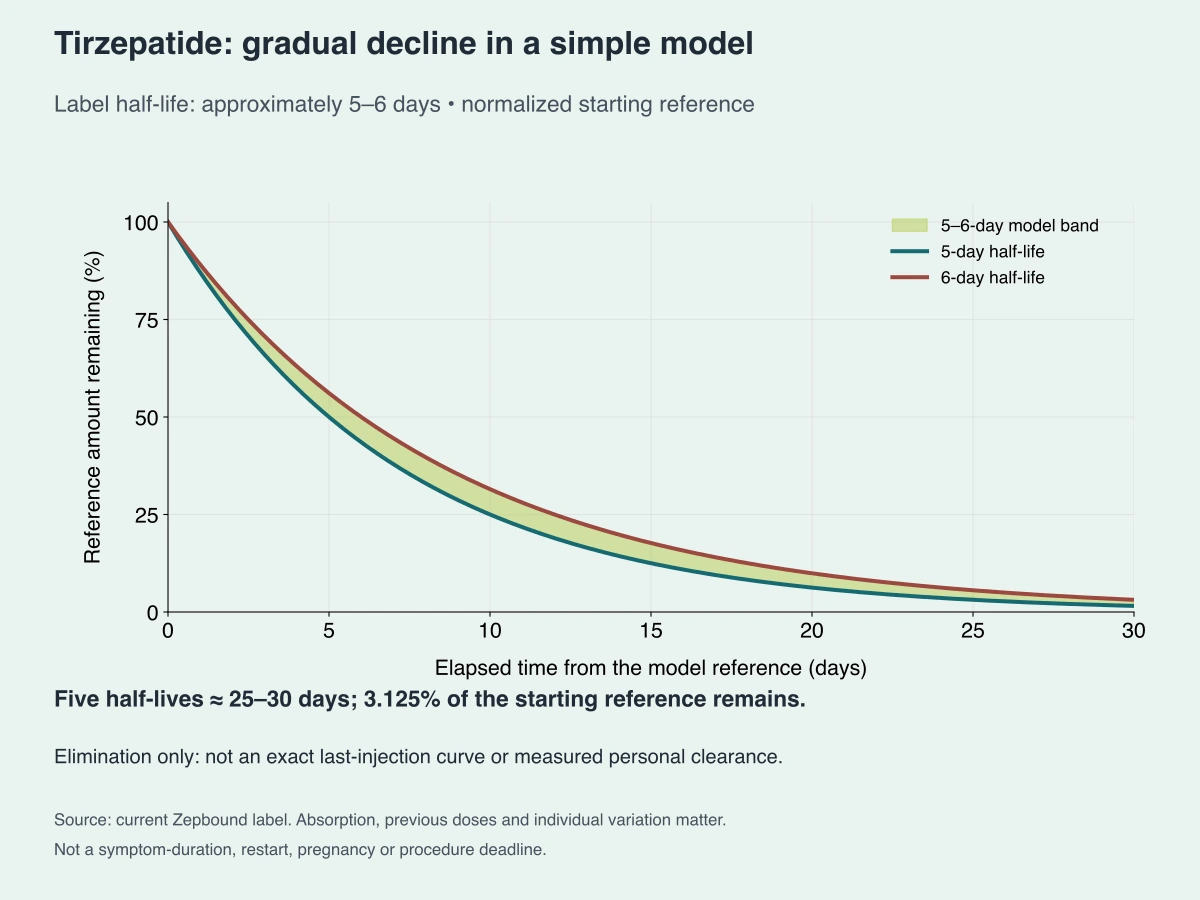
For example, starting at an illustrative 100%, one half-life leaves 50%, two leave 25%, and three leave 12.5%. These percentages describe the arithmetic of a model. They are not measured values for your blood sample or the amount remaining in an injection device.
The label gives an approximate range, so translating each half-life into calendar days also gives a range. A single exact five-day countdown would overstate the precision of the label information.
Do not confuse this with weekly scheduling. A medicine can still be present at the end of a dosing interval. The prescribed schedule reflects the evaluated product and regimen, rather than a requirement that every previous dose disappear first.
How long until most of it has declined?
Using the 5–6-day range in an elimination-only model:
| Number of half-lives | Approximate elapsed time | Reference amount remaining |
|---|---|---|
| 1 | 5–6 days | 50% |
| 2 | 10–12 days | 25% |
| 3 | 15–18 days | 12.5% |
| 4 | 20–24 days | 6.25% |
| 5 | 25–30 days | 3.125% |
Five half-lives represents a reduction of about 97% from the model’s starting reference, rather than exactly zero drug. It is a useful illustration of gradual decline, not a personal clearance test.
The accompanying graphic starts with a normalized reference amount and shows elimination only. It is not the exact concentration curve after your last injection. Absorption, previous doses and accumulation, and individual variation affect an actual course.
MotherToBaby gives a related estimate: in healthy adults, it can take up to 30 days on average for most tirzepatide to be gone. “Most,” “on average,” and the population described are important limits. MotherToBaby tirzepatide fact sheet
Why can’t the graphic identify your clearance date?
The model does not know your treatment history or measure your concentration. It uses the label’s approximate half-life range to explain a concept.
The starting amount in a person who has been taking weekly doses is not necessarily the same as after a first dose. There can also be a period of absorption after an injection. A curve that ignores those features should not be labeled as a measured last-dose curve.
Different clinical questions also use different endpoints. “Most of the amount has declined,” “my nausea has resolved,” “I can restart,” and “my procedure team has a plan” are not interchangeable outcomes.
Use the graphic to understand why effects or concerns may persist beyond a week. Use the care team to decide what the actual clinical situation requires.
Will side effects end after one half-life?
Not necessarily. A symptom’s duration cannot be read directly from a pharmacokinetic number. Symptoms can differ in cause and severity, and some require assessment rather than waiting for drug decline.
Persistent vomiting, inability to drink, very little urine, severe abdominal pain, or a concerning allergic reaction should not be managed by calculating half-lives. Seek the appropriate level of care for the symptom. Our Zepbound side-effect guide provides more context.
Likewise, a headache is not guaranteed to end after five or six days. Our Zepbound headache article explains warning patterns and useful details to report. The tirzepatide nausea and reflux article addresses symptoms that disrupt intake.
If you are considering stopping because of symptoms, tell the prescriber what is happening and ask for instructions. A concentration estimate is not an assessment of the cause.
Can water, exercise, or a detox product flush it out faster?
The evidence reviewed here does not establish a home method to accelerate clinically meaningful tirzepatide clearance. Do not interpret extra urination, sweating, or a scale drop as proof that the medicine has been removed.
The label describes metabolism and elimination; it does not direct patients to force water, use laxatives, or add a detox supplement to end treatment. In fact, fluid loss from persistent digestive symptoms can create its own health concerns.
Our urination article explains why bathroom changes are not a drug-clearance or fat-loss measure. Our water weight versus fat-loss article explains a related scale misconception.
If you need urgent evaluation, bring the product and timing information. Do not spend time attempting a home “flush” before obtaining care.

What happens to appetite or weight after stopping?
The half-life cannot predict the exact day hunger will change or the amount of weight a person will regain. Those are clinical outcomes influenced by more than drug elimination.
The SURMOUNT-4 randomized withdrawal trial offers relevant evidence. Adults with overweight or obesity without diabetes first received tirzepatide during a 36-week lead-in; 670 were then randomized to continue treatment or switch to placebo for 52 weeks. From randomization, the placebo group gained about 14% in weight while the continuing group lost a further 5.5%, on average. Original SURMOUNT-4 trial
Those figures do not mean everyone regained all initial loss or regained it immediately. The comparison followed a selected trial population and protocol. It does support planning for maintenance rather than assuming treatment can end without follow-up.
Our stopping tirzepatide and maintenance guide covers the broader discussion. Meal routines, activity that fits your abilities, ongoing monitoring, affordability, and the reason for stopping can all belong in the plan.
Does half-life tell you when to restart after a gap?
No. A missed weekly dose and a longer interruption are separate situations. The label’s missed-dose directions do not automatically provide the correct restart plan after several missed weeks.
Tell the prescriber the actual product, last dose date, previous dose, how long the gap has been, and why it occurred. Side effects, illness, procedures, or access problems can change the questions that need attention.
Do not use the model’s “amount remaining” percentage to select a dose. It is not a tolerance test or a conversion chart. Our tirzepatide missed-dose and restart article explains why product and gap length matter.
Storage is another separate concern. A bottle that remained in your home during the gap may or may not still be usable depending on its label, dates, and handling. Our Zepbound storage guide covers device-specific questions to verify.
Do you have to stop Zepbound before surgery or sedation?
Do not decide a procedure plan from half-life arithmetic. Tell the surgeon, anesthesia team, and prescriber that you use tirzepatide, including the product, schedule, recent changes, and digestive symptoms.
The currently served multi-society guidance explains that many patients can continue GLP-1 medicines before elective procedures, while higher-risk circumstances may require an individualized plan. It does not support a universal rule that everyone must stop for a week or wait five half-lives. Multi-society procedure guidance
Follow the actual team’s instructions for medication, food, fluids, and the procedure. Do not choose a liquid diet or fasting schedule on your own based on a general article. Ask how the teams will coordinate if guidance differs.
Our GLP-1 surgery and anesthesia article explains the kinds of information to bring. Its broad planning framework does not make semaglutide and tirzepatide clearance estimates interchangeable.
What about pregnancy planning and oral contraception?
Zepbound’s current label says to discontinue when pregnancy is recognized. If you are planning pregnancy, discuss timing with the prescribing and pregnancy-care teams rather than using a modeled day as a personalized clearance deadline.
The label also advises people using oral hormonal contraception to switch to a nonoral method or add a barrier method for four weeks after starting Zepbound and for four weeks after each dose escalation. This is a product-specific instruction about contraceptive reliability, not a statement that everyone clears the drug in four weeks.
Do not transfer a waiting interval quoted for semaglutide to tirzepatide. Identify the actual medicine and seek guidance for the situation. Pregnancy, contraception, symptom resolution, and an elective procedure have different planning needs.

Frequently asked questions
Is Zepbound gone after seven days?
No. The weekly interval is not a complete-clearance interval. The approximate half-life explains why a substantial amount can remain in a simplified model.
Is five half-lives the same as zero?
No. The elimination-only calculation leaves about 3.125% of its starting reference after five half-lives. It is not a guarantee about an individual’s measured concentration.
Is Mounjaro’s ingredient different?
Both brands contain tirzepatide, while labeled uses and product instructions differ. See the Zepbound versus Mounjaro guide for treatment context. Sharing an ingredient does not eliminate the need to identify the actual prescription.
Can I switch to semaglutide once a certain percentage remains?
Do not use a model to schedule a switch. Our switching semaglutide and tirzepatide article explains the need for a clinician-directed plan.
What should I ask before starting care?
When considering CoreAge Rx tirzepatide care or semaglutide care, ask about access interruptions, symptom follow-up, maintenance, and coordination with other clinicians. Planning ahead is more useful than calculating a personal stopping date after a problem develops.
The practical meaning of the number
Tirzepatide declines over weeks, and half-life helps explain that gradual process. It cannot answer every stopping question. Keep symptom care, restart decisions, procedure planning, pregnancy considerations, and maintenance in the appropriate clinical conversation.
Educational information for adults; individual treatment decisions require a qualified clinician. Sources reviewed October 1, 2026. Original AI-generated article images depict fictional people and objects, not patient outcomes. Other editorial images are illustrative. Graphics summarize the cited sources.