
Some Anthem-related plans may cover GLP-1 medicines, but the answer depends on the member’s exact benefits, drug list, prescribed product, and reason for treatment. A CarelonRx formulary entry is a useful starting point, not a guarantee of payment. Check whether the benefit is included, which authorization rules apply, and what your pharmacy claim would cost.
Why there is no single Anthem answer
Anthem members can have different employer, individual, Medicare, or other plan arrangements. The same insurer name does not establish that two members have the same pharmacy benefits. An employer’s choices, plan documents, effective date, and the drug list that applies can all affect the answer.
CarelonRx’s official drug-list page presents several list families and tier versions. These include Focused or Essential, Advanced or National, Guided or National Direct Plus, and Complete or Traditional. The page tells members to verify which list their plan uses with their employer or the Pharmacy Member Services number on the ID card. CarelonRx list selector
Start there rather than using another member’s approval story. Ask for the exact plan and formulary name, current effective date, and the prescription being reviewed. A general article cannot confirm an individual benefit or submit an authorization.
What current dated formularies show
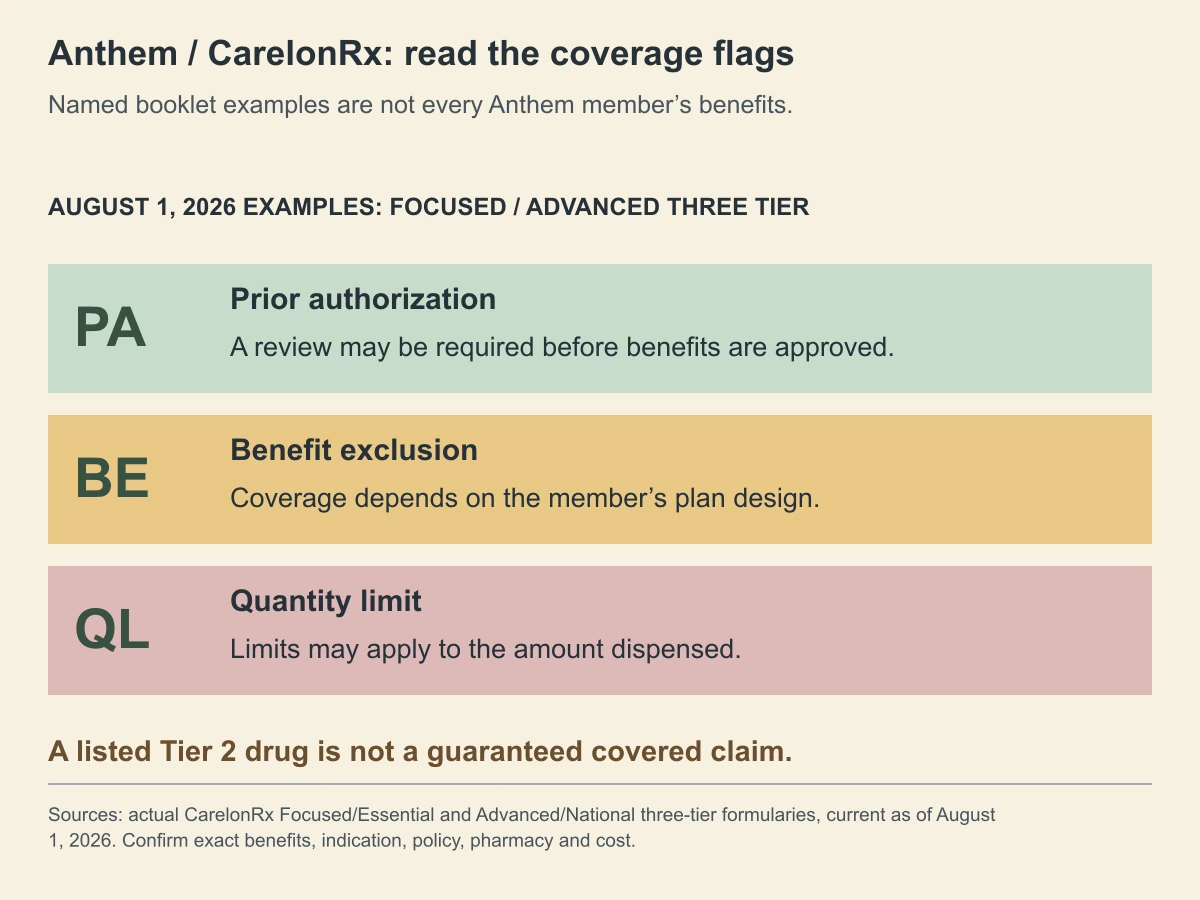
The CarelonRx Focused/Essential Three Tier and Advanced/National Three Tier booklets reviewed for this article are marked current as of August 1, 2026. Both list Wegovy subcutaneous auto-injector and Zepbound subcutaneous auto-injector entries in Tier 2, with PA, BE, and QL notes. These are specific examples, not a nationwide Anthem tier assignment. Focused booklet, Advanced booklet
The notes are essential. The booklets define PA as prior authorization, BE as benefit exclusion depending on the plan’s design, and QL as quantity limits. A Tier 2 entry with a benefit-exclusion flag does not establish that every member has coverage for the medicine.
| Dated example | Listed injectable product | Entry in the reviewed booklet | What still needs checking |
|---|---|---|---|
| Focused/Essential Three Tier, August 1, 2026 | Wegovy auto-injector | Tier 2; PA, BE, QL | Whether the member’s benefit includes it and which review applies |
| Focused/Essential Three Tier, August 1, 2026 | Zepbound auto-injector | Tier 2; PA, BE, QL | Indication, authorization, quantity, and member cost |
| Advanced/National Three Tier, August 1, 2026 | Wegovy auto-injector | Tier 2; PA, BE, QL | Whether this is the correct list and current benefit |
| Advanced/National Three Tier, August 1, 2026 | Zepbound auto-injector | Tier 2; PA, BE, QL | Applicable plan exclusions and claim conditions |
The booklets say lists are updated and tell members to use their account for the most current plan information. The official change document also includes future effective dates, including 2027 changes, despite its 2026 filename. A filename or posting date is not enough to determine when a change applies. Official change document
Benefit coverage and clinical approval are separate
First ask whether the medicine and intended use fall within your benefit. Then ask what clinical review is required. Prior authorization means information may need to be reviewed before benefits are approved; it does not guarantee that an excluded benefit becomes included.
The reviewed formularies explicitly connect benefit exclusions to plan design and direct members to their plan documents and member tools. Clinical documentation alone does not establish that the benefit exists. If a medicine is excluded, ask whether an exception or other review route is available under your specific plan. Focused formulary definitions
Also distinguish a nonformulary product from a plan exclusion, missing authorization, a quantity issue, and a pharmacy-network problem. The remedy can differ. A rejected claim needs its actual reason, not a guess based on the medicine’s popularity.
Which medicine and indication are being reviewed?
“GLP-1” is a category, not a single prescription. Semaglutide and tirzepatide have different named products, presentations, and indications. The current label and the insurer’s criteria for the submitted product both matter.
For example, Wegovy has weight-management and other specified indications, with details differing by presentation. Zepbound has adult chronic-weight-management and a specific obstructive-sleep-apnea indication. Mounjaro’s current label includes type 2 diabetes uses and a cardiovascular-risk indication in certain adults with type 2 diabetes. Ozempic injection has its own label and type 2 diabetes context. Wegovy label, Zepbound label, Mounjaro label, Ozempic injection label
Those distinctions do not authorize changing or inventing a diagnosis to obtain coverage. The submitted information should accurately describe the patient and prescribed treatment. Ask for the applicable criteria rather than copying another product’s requirements.
Our Zepbound versus Mounjaro guide and tirzepatide approval history explain why sharing an active ingredient does not make brands or indications interchangeable.
What information may the prescriber need?
The exact policy determines the submission. Ask the plan or prescriber for the current criteria and required forms for your product and indication. Relevant clinical information may include the diagnosis, treatment history, current prescription, other medicines, and the documented reason for use.
This article does not assign a universal BMI threshold, required prior treatment, continuation target, or authorization duration to all Anthem members. Those details must come from the applicable policy, not from a different insurer’s document or a generic GLP-1 overview.
Anthem’s public clinical-criteria page also describes documents for injectable, infused, or implanted therapies under the medical benefit. That library should not automatically be treated as the complete pharmacy authorization policy for a self-administered prescription. Ask which benefit and policy apply to the claim. Anthem clinical-criteria page

A useful call to member services
Have the ID card, prescription name, presentation, and reason for treatment available. Ask the representative to identify your plan’s pharmacy benefit and current drug list before asking whether “GLP-1s” are covered.
Useful questions include: Is this exact product included for this indication? Does a benefit exclusion apply? Which prior-authorization criteria and form should the prescriber use? Are there quantity limits, a required pharmacy, or another condition? What would the member pay under a current claim estimate?
Record the date, representative’s reference number if provided, and the documents named. A reference number helps organize follow-up; it is not an approval. Ask how to obtain the applicable information in writing or through the member portal.
What if an authorization or claim is denied?
Get the written reason and identify whether the issue concerns benefits, clinical criteria, documentation, product selection, quantity, or pharmacy rules. A denial based on missing information is different from a benefit exclusion. Work with the prescriber and plan on the route that actually applies.
Follow the instructions and deadlines in your own notice and plan documents. Do not use an appeal deadline from a general blog or another member’s plan. Ask whether the clinician needs to provide additional information, whether a formulary exception is available, and how review status can be checked.
There is no guarantee of approval after an appeal or a particular submission. Avoid services that promise a diagnosis workaround or a guaranteed result. The goal is an accurate, complete review of a treatment that is clinically appropriate.
Cost after coverage is confirmed
A formulary tier is not the same as a final dollar amount. Deductibles, copayments, coinsurance, pharmacy-network rules, days supplied, and plan conditions can affect what you pay. Ask for a current estimate for the actual prescription rather than using another person’s reported monthly cost.
Separate the cost of the medicine from any consultation, membership, testing, delivery, or other service. A pharmacy claim does not necessarily cover everything in a weight-management program. Ask each provider what is included and how the charges are handled.
Our Zepbound cost guide and Wegovy Costco cost guide explain other payment questions. Cash offers, insurance claims, and manufacturer assistance have different eligibility and combination rules; confirm the route before comparing prices.
What about Medicare or the GLP-1 Bridge?
Do not transfer a commercial formulary example to a Medicare benefit. Medicare-related coverage questions need the member’s own plan, indication, and the rules of any separate program involved.
CMS describes a Medicare GLP-1 Bridge with specific eligibility, covered-product, and operational rules. That separate program is not automatic coverage for every Medicare beneficiary or every GLP-1 prescription. Ask whether you qualify, what submission is needed, and whether the prescription is handled through the program or the plan. CMS Bridge information, CMS provider information
A medicine prescribed for a particular non-weight-loss indication may involve a different coverage question from a prescription intended solely for weight management. Keep the diagnosis accurate and verify the applicable route rather than assuming that a broad approval announcement answers the benefit question.
Comparing Anthem with other insurers
Our Aetna Ozempic and Wegovy coverage guide and UnitedHealthcare GLP-1 coverage guide show similar categories of questions. Their documents and thresholds cannot establish an Anthem member’s benefit.
If choosing among employer plans, compare the actual benefit documents, exclusions, drug lists, member costs, and how the prescription would be reviewed. A brand name on a broad list is only one part of that comparison. Make sure the documents cover the plan year and option you are considering.

Where CoreAge Rx fits into the decision
If you are considering treatment through CoreAge Rx, review the semaglutide and tirzepatide pages and ask what product, formulation, services, and payment route are included. Do not assume a service price corresponds to an insured Wegovy, Zepbound, Ozempic, or Mounjaro pharmacy claim.
Compounded drugs are not FDA-approved products, and FDA does not review them before marketing in the same way as approved medicines. A benefit for a named approved product does not automatically establish coverage for a compounded formulation or a related clinical service. FDA compounded-drug guidance
The tirzepatide first-month guide and semaglutide questions guide can help you prepare for a clinical conversation. Cost matters, but the treatment decision also needs an assessment of health, suitability, symptoms, and follow-up.
Frequently asked questions
Does Anthem cover Zepbound in 2026?
Some applicable plans may, but the answer is member-specific. The reviewed August 2026 CarelonRx booklets list the injectable product with PA, BE, and QL flags. Confirm the benefit, indication, and current rules under your own plan.
Does Tier 2 mean my prescription is approved?
No. In the cited examples, the entries also carry authorization, benefit-exclusion, and quantity notes. Tier placement does not remove those conditions or establish the final cost.
Is Wegovy covered if weight-loss medicines are excluded?
Ask the plan how the exact product and prescribed indication are handled. An exclusion and any possible exception require the actual benefit documents. Another indication does not justify changing a diagnosis simply to obtain payment.
Can my doctor use Ozempic instead to get coverage?
Product selection must fit the clinical circumstances and accurate indication. Coverage of one brand does not establish that it is an appropriate substitute. Discuss the options with the prescriber and verify their current policies.
Will an employer’s plan use the same CarelonRx list as mine?
Not necessarily. The official page lists different families and tier arrangements. Ask for the exact plan option, benefit, and formulary rather than using the employer or insurer name alone.
What is the fastest useful next step?
Identify your actual plan and prescription, then ask member services for the current benefit status and applicable criteria. Share those documents with the prescriber. That provides a concrete starting point for review without guessing at approval or cost.
Educational information for adults; individual treatment decisions require a qualified clinician. Sources reviewed October 1, 2026. Original AI-generated article images depict fictional people and objects, not patient outcomes. Other editorial images are illustrative. Graphics summarize the cited sources.