Primal Queen is a beef-organ supplement marketed to women. A published Citruslabs study summary describes menstrual-symptom outcomes, but it does not report a weight-loss or body-composition outcome. If your main question is whether it helps you lose weight, distinguish the finished-product evidence from nutrient explanations, testimonials, and claims about other diets.
What is Primal Queen?
The manufacturer describes a freeze-dried beef-organ product containing tissues from liver, heart, kidney, uterus, fallopian tubes, and ovaries. Its marketing emphasizes energy, hormones, and menstrual wellness. Those descriptions identify the product’s positioning; they do not establish that it treats obesity or a diagnosed hormone disorder. Manufacturer product page
A supplement is also different from eating a serving of organ meat. You cannot assign the nutrient content of a food portion to a capsule unless the product’s actual label or relevant testing supports the amount. The same caution applies to claims about diets that contain meat: a diet study is not automatically a study of this capsule.
What does the actual Supplement Facts panel show?
The manufacturer-hosted image reviewed October 1, 2026 lists one capsule as a serving, 60 servings per container, and 337.5 mg of a proprietary blend per serving. The blend lists bovine uterus powder containing fallopian tubes, followed by ovary, liver, kidney, and heart powders. Other ingredients listed are Nu-flow and gelatin for the capsule. Actual Supplement Facts image
The page’s FAQ describes 60 capsules used at two capsules per day as 30 daily servings. That daily-use description is different from the panel’s one-capsule serving and 60 servings per container. The distinction matters when comparing amounts or cost. It is not a reason to choose a dose from this article.
| Label or page detail | What it establishes | What it does not establish |
|---|---|---|
| One capsule per labeled serving | The reference for the Supplement Facts amount | A personalized treatment instruction |
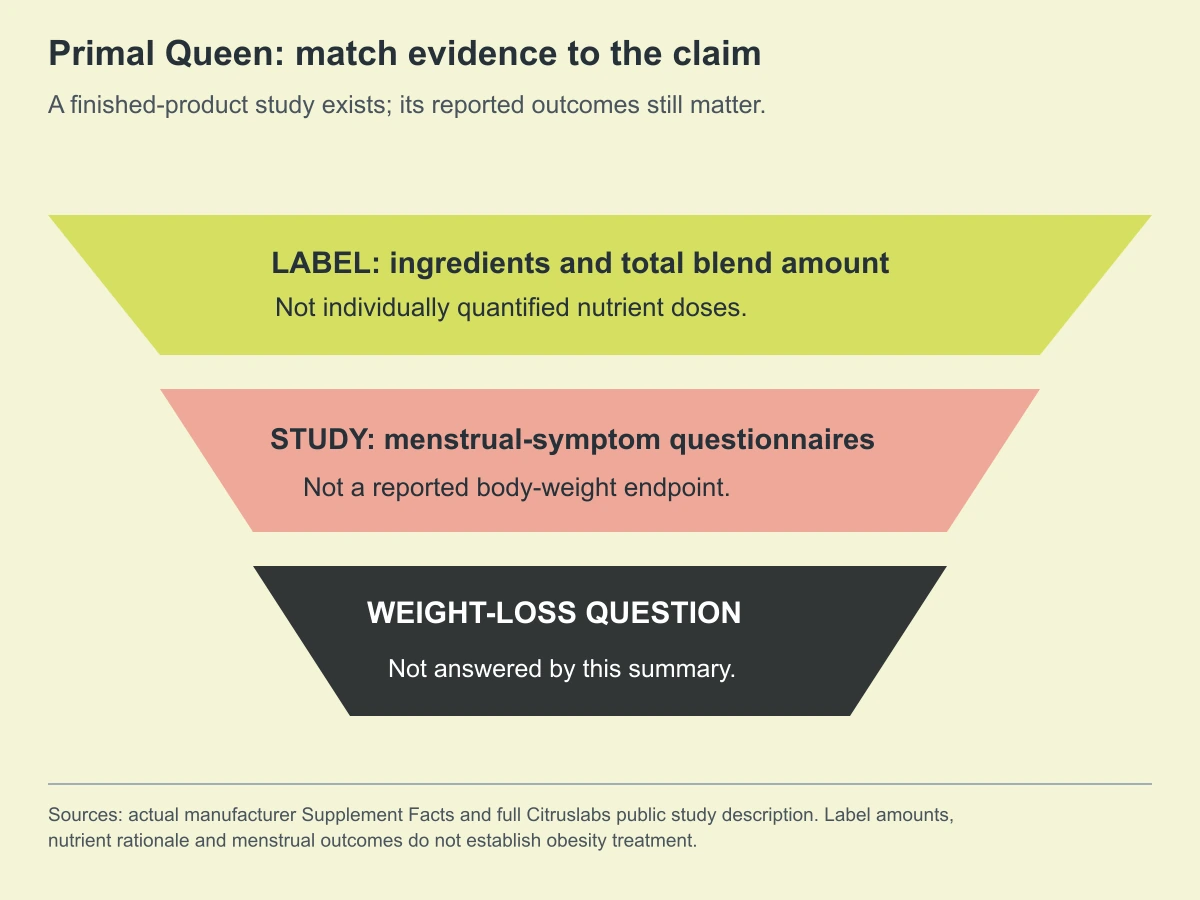
| 337.5 mg proprietary blend per serving | Total blend amount | The amount of each organ or each nutrient |
| Listed bovine organ powders | Ingredients in the blend | Measured hormone or weight-loss effects |
| Nu-flow and gelatin listed | Additional label ingredients | That the capsule consists only of organ tissue |
| FAQ describes two capsules daily | Manufacturer’s daily-use description | Equivalence with a retailer’s different listing or package |
The inspected panel does not individually quantify iron, vitamin B12, vitamin A, or the other nutrients discussed in marketing. Do not infer those quantities from the blend’s total mass. Check the label on your own product because formulations and presentations can change. Manufacturer page, Label image
Does Primal Queen have a human study?
Yes. Citruslabs publishes a finished-product clinical-study description. It describes a virtual randomized, placebo-controlled, triple-blind study involving 100 women aged 18 and older who reported symptoms associated with their menstrual cycle. Participants used the assigned product for three menstrual cycles, approximately twelve weeks, with questionnaire assessments. Citruslabs study description
The summary reports within-group changes in menstrual-cycle satisfaction and symptom severity, including improved symptom parameters by the third cycle. These are relevant to the outcomes studied, but they are not weight-loss results. The page does not report a measured change in body weight, fat mass, waist circumference, or an obesity-treatment endpoint.
Its disclaimer says the work was conducted by Citruslabs on behalf of Primal Queen. That is important context when distinguishing a commissioned study from independent replication. It does not by itself invalidate the findings; it does make transparency about methods and reporting useful.
What are the limits of the public study summary?
The description supplies a study design, population, duration, and selected results. It does not supply a complete peer-reviewed report, a downloadable full statistical analysis, or detailed between-group effect estimates for every outcome. The summary describes the product group improving more than placebo, while presenting the headline percentages as changes within the product group.
An improvement from baseline is not identical to the difference between product and placebo. To judge the size and certainty of that difference, a reader would want the results for both groups, how the outcomes were defined, missing-data handling, and the statistical methods. The public summary alone cannot answer every one of those questions. Study description
The population also matters. The page says pregnant and breastfeeding participants were not included and that the study was not specifically designed for menopause or perimenopause outcomes. Results for menstrual symptoms should not be transferred automatically to pregnancy, menopause, diagnosed hormone deficiency, or weight management.
Does it work for weight loss?
The finished-product study description reviewed here does not establish that result. Nutrient rationale, customer stories, and menstrual-symptom questionnaires answer different questions from a controlled trial measuring weight or body composition.
If someone reports losing weight while using the product, other changes may have occurred too: eating differently, exercising, starting another treatment, experiencing illness, or changing fluid balance. A testimonial generally cannot separate those possibilities or estimate what another person should expect.
You can ask the manufacturer for relevant finished-product human evidence for the exact outcome. The useful questions are what was measured, compared with what, for how long, and in whom. Avoid replacing those questions with a broad conclusion that all organ supplements work or that no finished-product research exists.

Does the nutrient explanation prove the benefit?
For the broader product category, our guide to beef organ supplements and weight-loss evidence explains why organ-powder mass does not quantify individual nutrients and why nutrient roles do not establish weight-loss outcomes.
No. A nutrient can have an established biological role without a particular supplement providing a measured effective amount or improving a specific symptom. The inspected label’s blend mass is not a quantified dose of each vitamin or mineral.
This matters for fatigue and suspected deficiency. If someone has a deficiency, assessment can identify the cause and an appropriate treatment. Taking an organ blend without knowing its relevant nutrient amount is a different approach and should not substitute for that evaluation.
Our NAD+ energy and fatigue guide discusses a related problem: symptoms deserve assessment before they are attributed to a single cellular pathway or marketed ingredient. Our stopping NAD+ and NMN guide also explains why personal experiences and biomarkers are not interchangeable with treatment outcomes.
Hormone claims need careful interpretation
The word “hormones” can cover many different symptoms, diagnoses, and treatments. A questionnaire about perceived menstrual symptoms does not establish that the product corrected a measured hormone deficiency. Including reproductive organ tissue also does not demonstrate a targeted hormone effect in humans.
If you have changes in cycles, heavy bleeding, persistent fatigue, hot flashes, or other concerns, discuss them with a clinician. The appropriate assessment depends on the symptom and your circumstances. An explanation built around “hormone balance” can be too vague to guide that decision.
Our perimenopause symptom and HRT guide and menopause hormone-therapy guide explain the separate clinical questions involved. The estrogen and oral progesterone pages describe prescription options to discuss when appropriate. A supplement study is not evidence that Primal Queen replaces those assessments or therapies.
Safety, other supplements, and your circumstances
Bring the product label and your full medicine and supplement list to a clinician or pharmacist. Include multivitamins, separate iron or vitamin products, other organ supplements, and combination products. The lack of individually listed nutrient amounts makes it difficult to calculate overlap from the panel alone.
NIH’s supplement guidance explains that supplements can interact with medicines and that more is not automatically better. Manufacturing or testing claims also do not establish suitability for every individual. NIH dietary-supplement guidance
The manufacturer advises discussing use during pregnancy with a healthcare provider, and the cited study did not include pregnant or breastfeeding participants. Do not interpret the word “natural,” a grass-fed sourcing claim, or a reassuring testimonial as clinical clearance for those situations. Manufacturer FAQ, Study description
If a new supplement is followed by significant symptoms, seek advice and describe the timing. Severe allergic-type symptoms, difficulty breathing, fainting, or another serious acute reaction need urgent care. A trial’s limited safety summary cannot guarantee that an individual will tolerate the product.
What does third-party testing tell you?
The manufacturer links a laboratory report and makes testing claims. Testing can address particular quality questions depending on what was measured and which batch was tested. It is a separate issue from whether the finished product causes weight loss or treats a symptom.
Ask what the report covers, whether it applies to your batch, and what it does not measure. A contaminant test, ingredient test, or manufacturing credential is not a randomized efficacy trial. Likewise, a registered facility is not the same as FDA approval of a supplement for treating disease. NIH supplement overview
This article’s label comparison is based on the inspected manufacturer image and product page. It does not claim to have independently tested the capsule, verified every batch, or audited the manufacturer’s facilities.

How to decide whether it meets your goal
Write down the outcome you want: weight management, an explanation for fatigue, more comfortable menstrual symptoms, or something else. Then compare that outcome with the evidence actually available. A positive finding for one question cannot automatically answer another.
Consider cost and what you would do if you did not buy the product. A clinical assessment, help with meal planning, or review of existing supplements may address the underlying question more directly. There is no requirement to use an organ supplement to build a useful eating pattern.
The protein breakfast guide and yogurt meal guide offer ordinary food-planning ideas. If your goal is medical weight management, a clinician can review whether treatment is appropriate; the semaglutide and tirzepatide pages describe separate prescription-care options. They should not be chosen simply because a supplement claim was unconvincing.
Frequently asked questions
Does Primal Queen really work?
Specify the outcome. The public study summary describes menstrual-symptom findings in a particular study population. It does not report weight loss or demonstrate treatment of every hormone-related concern. Your circumstances and the limits of the report matter.
How soon should I expect weight loss?
The cited finished-product summary does not establish a weight-loss timeline. The study’s approximately twelve-week duration concerned menstrual-symptom assessments. It should not be converted into a promise about when the scale will change.
Is it a multivitamin or an iron treatment?
The inspected label lists a proprietary organ blend without individual vitamin or mineral quantities. Do not assume it supplies a particular multivitamin panel or a treatment dose for iron deficiency. Ask for assessment when a deficiency is suspected.
Does the one-capsule serving conflict with the daily-use FAQ?
They describe different references. The label lists one capsule and 60 servings; the FAQ describes two capsules per day and 30 daily servings. Keep those definitions separate when comparing amounts, and follow appropriate advice for your own use.
Can it replace HRT?
The reviewed study does not establish that. Its menstrual-symptom outcomes are different from an assessment of menopause treatment or measured hormone deficiency. Discuss those symptoms and options with a qualified clinician.
Is it FDA-approved for weight loss?
No such approval is established by the reviewed materials. Dietary supplements are generally not approved by FDA before marketing in the way medicines are. Clinical testing, a laboratory report, and a manufacturing claim are separate from approval for treating obesity. NIH supplement guidance
Educational information for adults; individual treatment decisions require a qualified clinician. Sources reviewed October 1, 2026. Original AI-generated article images depict fictional people and objects, not patient outcomes. Other editorial images are illustrative. Graphics summarize the cited sources.