
If you are thinking about stopping NMN or an NAD+ product, first identify exactly what you are using and why. NMN capsules, NR capsules, NAD+ injections, IV infusions, and nasal products are different approaches. The human studies reviewed here do not establish one withdrawal syndrome, taper, or symptom timeline that applies across them.
Why people ask “Why did I stop taking NMN?”
That search often reflects a personal decision: the product costs money, the expected benefit is unclear, symptoms changed, or someone wants to reconsider a supplement routine. Another person’s story can suggest useful questions, but it cannot establish what will happen to you.
Selected original human studies help clarify what was assessed, what remains unanswered, and what information can help you discuss a change with a clinician. Keep a personal account separate from those research findings.
You do not need to keep taking a product solely because it is described as supporting healthy aging. Ask whether there was a clear goal, a meaningful outcome, and a reason to continue. If it was prescribed or supervised, involve the prescriber in that review rather than replacing their instructions with a general internet routine.
NAD+, NMN, and NR are different ingredients
NAD+ is a coenzyme involved in cellular processes. NMN, or nicotinamide mononucleotide, and NR, or nicotinamide riboside, are related precursors studied as ways to influence NAD metabolism. Related does not mean identical: the ingredient, formulation, route, and study population affect what evidence applies. Original NMN study, Original NR study
Your body has normal processes for making and recycling NAD-related molecules. A biomarker change during supplementation does not mean all normal NAD production depends on that supplement. It also does not show that a person needs lifelong use to prevent a specific syndrome.
Our NAD+ injections versus NMN and NR guide explains these distinctions. If your product label lists several ingredients, record the full list; effects or symptoms cannot automatically be attributed to NMN alone.
The route changes the question
| What you use | What to identify | Why stopping advice cannot be copied across products |
|---|---|---|
| Oral NMN | Actual ingredient, formulation, other ingredients, and purpose | NMN studies concern specific oral products and populations |
| Oral NR | Ingredient and formulation, including combinations | NR is a different precursor from NMN |
| NAD+ injection or IV | Prescribed product, route, preparation, and supervision | Oral precursor findings do not establish injection effects or safety |
| NAD+ nasal product | Formulation, pump instructions, and reason for use | Another route requires its own evidence and directions |
| A multi-ingredient “NAD booster” | Every active ingredient and its amount | Caffeine, herbs, or other components can create separate questions |
If you are unsure which category applies, bring the bottle, prescription label, or product photos to a clinician or pharmacist. A marketing name such as “NAD support” may not identify the ingredient. Do not infer a dose or route from someone else’s review.
What original NMN studies actually measured
A 2021 randomized study included 25 postmenopausal women with prediabetes who were overweight or obese. Participants completed about ten weeks of oral NMN or placebo. The investigators examined outcomes including muscle insulin sensitivity and body composition. They found a muscle-insulin-sensitivity result without a significant treatment-related change in body weight or fat mass. Original Yoshino study
That is an interesting result in a particular group. It is not proof of general weight loss, a treatment for menopause, or a post-stopping symptom course. The study’s treatment-period findings cannot tell every reader whether fatigue after discontinuing a different product is a withdrawal effect.
A separate 2023 primary abstract describes 11 healthy volunteers receiving oral NMN for twelve weeks and measurements of plasma NMN, NAD+, and post-meal insulin. Individual changes varied. The accessible abstract does not establish a universal post-discontinuation timeline; the full paper was not accessible for this review. Yamane primary abstract
A washout period is not automatically a withdrawal study
Research terminology can be easy to misread. A washout period is part of a study design intended to separate treatments or assessments. Its existence does not establish that the researchers measured a clinical withdrawal syndrome.
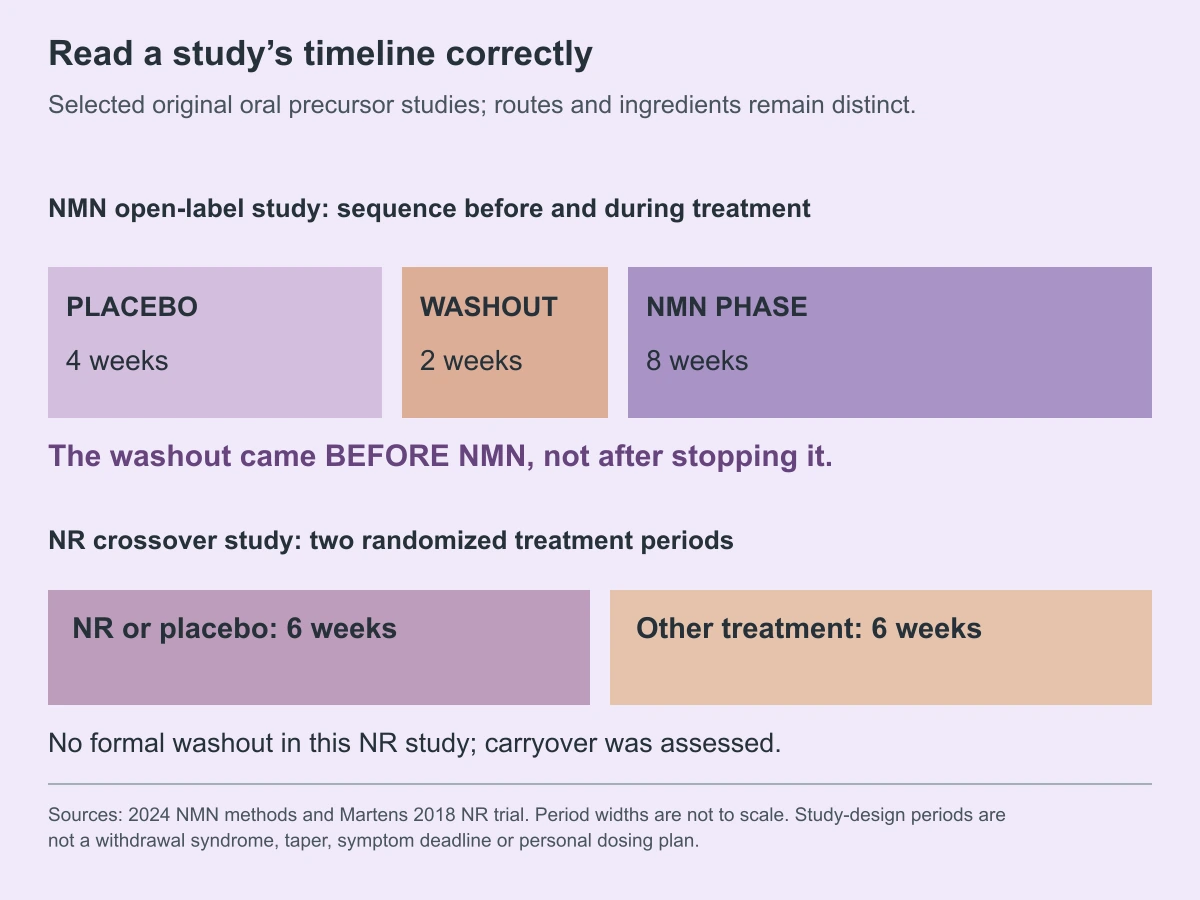
The 2024 open-label study of healthy middle-aged Japanese men used a placebo period followed by a two-week washout before the NMN intervention. Nine participants completed the NMN phase. The washout came before NMN treatment, so it cannot be cited as two weeks of recovery after stopping NMN. The study assessed safety and NAD-related biomarkers during its particular protocol. Original study methods
In the 2018 NR trial, 30 people were randomized and 24 completed a two-by-six-week crossover comparison with placebo. The investigators did not include a formal washout period, and assessed whether carryover affected their findings. That design concerns NR and its measured outcomes; it does not create a taper or a withdrawal timetable for NAD+ injections. Original Martens study

What can happen to biomarkers after a change?
Measurements can change when an intervention changes, but interpretation depends on what was measured and when. Plasma, blood cells, and other tissues are different samples. A change in one measurement does not directly establish how someone feels, whether a disease improved, or whether a symptom is caused by stopping the product.
The studies above used different populations, durations, ingredients, and measurements. They do not supply a single curve showing when every person’s NAD-related level returns to baseline after every product. Avoid treating a manufacturer’s generalized diagram as an individual recovery prediction.
Our NAD+ testing and biomarkers guide discusses these limits. Before paying for testing, ask what clinical decision the result would change and whether the test has a useful interpretation for your situation.
What if you feel tired after stopping?
Record the timing without assuming the cause. Fatigue can arise from changes in sleep, stress, food intake, illness, other medicines, or an underlying condition. A symptom occurring after a product change is relevant information, but sequence alone does not establish withdrawal.
If fatigue persists, interferes with daily life, or is accompanied by other symptoms, arrange a clinical assessment. Bring the product label, when it was started and stopped, what you expected it to do, and any other changes. Restarting a product solely to see whether the fatigue disappears can complicate the picture, especially if there was a possible adverse reaction.
The NAD+ energy and fatigue guide explains why evaluation should come before attributing every symptom to an NAD-related level. For someone also experiencing menstrual or menopause-related symptoms, the menopause hormone-therapy guide covers a different clinical discussion; an NMN trial is not evidence that a supplement replaces hormone assessment or therapy.
Symptoms after a recent injection need their own assessment
Stopping questions should not distract from a reaction after treatment. FDA has reported severe chills, shaking, vomiting, and fatigue following NAD+ injectable drugs, with some cases requiring medical treatment. Its sterile-compounding reminder discusses food-grade ingredients and contamination or endotoxin concerns. FDA safety reminder
This is a product-quality and administration issue, not evidence of withdrawal after stopping oral NMN. It also does not establish that every NAD+ product or route has the same risk. If significant symptoms follow an injection or infusion, contact the treating service promptly and seek urgent care when symptoms are severe.
Keep the product and prescribing information available for the clinical review. Do not independently repeat an injection or change its preparation to test a theory about the reaction. The NAD+ injection side-effect guide explains related reporting and follow-up questions.
Do you need to taper NMN or NAD+?
The studies reviewed here do not establish one required taper that applies to oral NMN, NR, injectable NAD+, and nasal products. They also do not establish that abrupt changes are suitable for every person or multi-ingredient product. A protocol would require relevant evidence and clinical context rather than a guess based on the ingredient name.
If the product is prescribed, discuss the proposed change with the prescriber. If it is an over-the-counter combination, review every ingredient with a pharmacist or clinician, particularly when you also use medicines or have had symptoms. Do not change another prescribed treatment because a supplement routine is changing.
The practical goal is a clear plan: what is being changed, why, what to monitor, and when to seek help. That plan need not involve a complicated schedule unless there is a specific reason for one. A general article cannot supply a personalized discontinuation protocol.
A useful review before continuing or stopping
Write down the original goal in terms you can observe: an activity you wanted to manage, a symptom being evaluated, or another meaningful outcome. Then ask whether the product helped in a way that mattered, whether side effects or cost outweighed that benefit, and whether another explanation or treatment needs consideration.
Review concurrent supplements. Products marketed for energy, sleep, hormones, or metabolism may overlap in ingredients, and changing several together makes interpretation harder. You do not need to add a replacement supplement automatically when removing one.
If you are exploring CoreAge Rx options, read the NAD+ injectable product guide and NAD+ nasal product guide alongside the injectable and nasal product pages. These help identify the actual service and route; they are not evidence that a person should continue, switch, or restart treatment.

What to monitor afterward
A short record of symptoms, sleep, food intake, activity, and other medication changes can support follow-up. Note whether symptoms improve, persist, or worsen and whether everyday function changes. Avoid interpreting every ordinary fluctuation as a supplement effect.
If there was a specific clinical concern, ask how it will be assessed. Biomarkers may or may not be useful for that decision. The NAD+ results timeline guide discusses meaningful outcomes and expectations; it does not provide a guaranteed post-stopping timeline.
Seek timely medical advice for persistent or concerning symptoms. Severe weakness, fainting, chest pain, difficulty breathing, confusion, or another serious acute change should not be managed by an internet supplement experiment.
Frequently asked questions
Will my energy definitely crash when I stop NMN?
The cited human studies do not establish that outcome for every user. If your energy changes, record the pattern and consider other explanations with a clinician. A personal story is not a reliable prediction for your product or circumstances.
Will I gain weight after stopping?
There is no universal weight-regain result established by the reviewed studies. The cited ten-week NMN trial did not show a significant treatment-related body-weight or fat-mass change. Changes in eating, activity, illness, or other treatment can affect weight independently.
Can I switch directly from NMN to an NAD+ injection?
Do not assume that related ingredients make a switch equivalent. The route, product quality, instructions, and evidence differ. Discuss the reason for switching with a qualified prescriber rather than converting an oral supplement amount into an injection amount.
Is a headache after stopping proof of withdrawal?
No. Timing alone cannot identify the cause. Review the full product, caffeine or other ingredients, sleep, hydration, and medicines. Persistent, severe, or unusual headache needs its own assessment.
Does a lower NAD-related test mean I need to restart?
Not by itself. Ask what the sample measures, how the result is interpreted, and what clinical decision it supports. A biomarker is not an automatic diagnosis or a treatment instruction.
Should I copy a “why I stopped” video?
Use it to generate questions, not a personal protocol. Verify the ingredient and route, distinguish experience from research, and make the decision based on your own goals, symptoms, and qualified advice.
Educational information for adults; individual treatment decisions require a qualified clinician. Sources reviewed October 1, 2026. Original AI-generated article images depict fictional people and objects, not patient outcomes. Other editorial images are illustrative. Graphics summarize the cited sources.