Noticing more hair in the shower after starting sermorelin can make you wonder whether the prescription is responsible. Timing is worth reporting, but it does not establish the cause. Hair shedding, gradual thinning, and patchy loss can have different explanations, and the assessment should include your other medicines, recent illness, nutrition, and scalp symptoms.
There is no reliable adult hair-loss percentage to give for the compounded sermorelin preparations discussed here. Historical growth-hormone research also cannot establish that sermorelin prevents thinning or reliably restores hair. A useful next step is to describe the change clearly and have the prescribing team or a dermatologist review it.
What can we actually say about sermorelin and hair loss?
Sermorelin is a growth-hormone-releasing hormone analogue. Stimulating a hormone pathway is different from proving an effect on scalp hair. A laboratory change, an account from one person, or a promotional before-and-after picture cannot establish how often a particular preparation causes hair loss—or whether it treats it.
The FDA’s historical Geref notice describes earlier diagnostic and pediatric growth-hormone-deficiency uses. It does not establish a current approval for adult hair growth, cosmetic anti-aging, or a compounded clinic formulation. The sermorelin overview explains those treatment and evidence distinctions.
The practical answer is therefore measured: hair concerns deserve assessment, and a medicine contribution should remain part of that assessment. Neither “it must be the sermorelin” nor “sermorelin could never contribute” can be concluded from the start date alone.
First describe what has changed
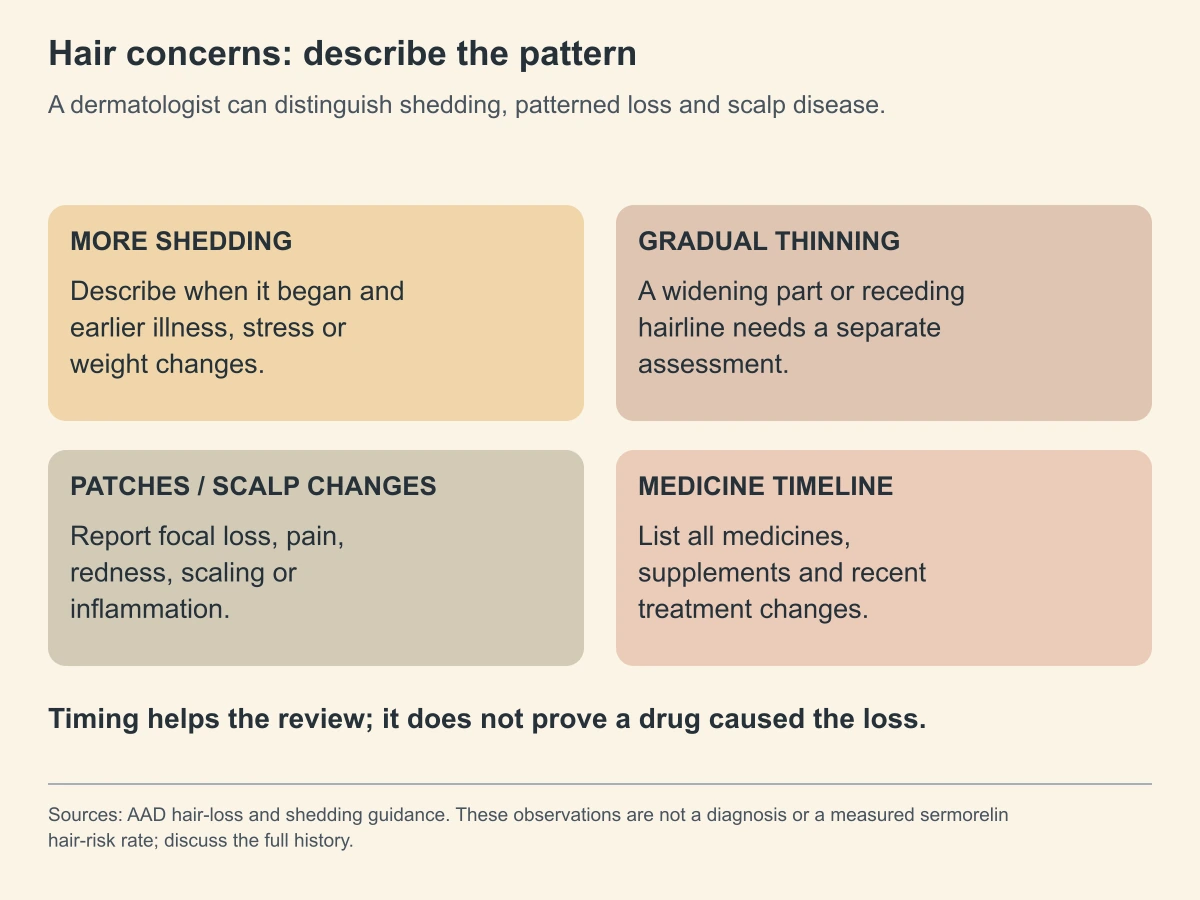
Try to distinguish increased shedding from a changing hairline or a new area of missing hair. You do not need to count every strand or inspect your scalp repeatedly. A few clear observations can make the appointment more productive.
| What you notice | Details worth bringing |
|---|---|
| More hair during washing or brushing | When it began, whether it is continuing, and events in the preceding months |
| A gradually wider part or thinner crown | Previous photographs, family history, and how long the pattern has changed |
| A receding hairline | Earlier changes and other medicines or hormone treatments |
| Distinct patches | Where they appeared and whether eyebrows or other areas are affected |
| Redness, scaling, soreness, or burning | Whether the scalp symptoms preceded the hair change |
| Short broken hairs | Styling practices, chemical treatments, heat, and tight hairstyles |
These are descriptions, rather than diagnoses. The American Academy of Dermatology’s guide to hair-loss causes explains why the pattern matters. More than one cause can be present at the same time.
Why the timeline can be misleading
Excessive shedding can follow a stressful event after a delay. That event might be a significant illness, surgery, childbirth, substantial weight change, or another major disruption. A new prescription may happen to begin during the same period.
The AAD’s shedding guide describes this delayed pattern, often called telogen effluvium. That does not mean every person with increased shedding has it. It means the review should look farther back than the last injection or the week in which you first noticed hair in the drain.
For example, someone might begin sermorelin after several months of reduced eating and rapid weight change. Another person may have recovered from a fever before starting treatment. Those histories raise different questions from a gradual hairline change that began years earlier. Recording the sequence helps the clinician evaluate competing explanations without overlooking the medicine.
Include every medicine and supplement
Bring the actual sermorelin label, the pharmacy name, the prescribed directions, and the dates treatment began or changed. If a preparation contains additional ingredients, those belong in the review too. The word “peptide” does not identify one standardized formula.
Also list prescription medicines, over-the-counter treatments, vitamins, hair supplements, and recently stopped products. Mention changes to testosterone, other hormone therapy, contraception, and any hair-loss treatment. A clinician can decide which details are relevant rather than asking you to choose the suspected culprit first.
The sermorelin side-effect guide covers the broader monitoring conversation. If you think a treatment contributes to hair changes, contact its prescriber before making an independent stop, restart, or replacement plan. A general article cannot determine whether continuing the exact prescription is appropriate for you.
Could eating less or weight change be involved?
Nutrition is worth discussing when appetite, food choices, or body weight have changed substantially. Hair concerns do not prove a nutrient deficiency, but an intake review may reveal a problem that a supplement advertisement would miss.
Describe typical meals, food groups you avoid, difficulty eating enough, and persistent vomiting or bowel symptoms. If weight management treatment is also involved, explain the entire course rather than only the most recent medicine. The protein shake meal guide and weight-management macros guide discuss building nourishing meals without turning one protein number into a complete diet.
A dietitian can help adapt intake to symptoms and preferences. Adding a large collection of hair vitamins without reviewing the cause is a different decision. A supplement can duplicate ingredients already in your routine, and taking more does not necessarily improve hair growth.

Does a thyroid or hormone test explain the problem?
Some medical conditions can affect hair, and a clinician may consider testing based on the history and examination. That does not make a broad hormone panel necessary for every person with shedding.
The reason for a test matters: What condition is being considered? What result would change management? How will the result be interpreted with symptoms, medicines, and earlier measurements? Those questions are more useful than assuming that any value outside a preferred online range explains the hair change.
The sermorelin and IGF-1 testing guide explains why an IGF-1 result is not a simple cosmetic score. A change in that result does not prove that hair follicles are healthier or that a medicine caused thinning. Likewise, a photograph cannot diagnose thyroid disease or testosterone deficiency.
What should a dermatologist assess?
A dermatologist can review the distribution of loss, scalp condition, hair shafts, medical history, and progression. Depending on the findings, the assessment may include selected tests or a closer scalp examination. The appropriate work-up depends on the question being investigated.
Gradual patterned thinning, stress-related shedding, inflammatory scalp disease, and hair breakage can call for different approaches. Starting a treatment intended for one cause may delay identification of another. If several factors appear relevant, the plan can address them together.
Bring a short timeline and any earlier photographs that show the area under similar lighting. Pictures can help document progression, but differences in hairstyle, lighting, wetness, and camera angle can make them misleading. They are supporting information, not proof of a drug effect.
Can sermorelin be used to regrow hair?
The evidence discussed here does not establish sermorelin as a hair-regrowth treatment. Growth-hormone signaling, tissue biology, and a marketed hair claim are different levels of evidence. A plausible mechanism is not enough to promise a visible benefit or select a prescription.
There are treatments for several forms of hair loss, but suitability depends on the diagnosis, medical history, and goals. Ask a dermatologist which options have evidence for the cause identified in your case, what improvement is realistic, and how response will be reviewed.
The sermorelin-versus-HGH comparison also explains why the two therapies cannot be treated as interchangeable. Replacing one hormone-related treatment with another to address hair concerns needs its own clinical rationale.
What should you do while waiting for the appointment?
Keep a concise record of the first noticeable change, recent treatment adjustments, scalp symptoms, and any substantial illness or nutrition changes. Continue ordinary gentle care and mention practices that pull, irritate, or chemically damage the hair. Avoid turning the record into a daily inspection that increases distress.
Contact the care team sooner for rapid progression, distinct new patches, or painful, inflamed, or otherwise changing scalp areas. Those findings need assessment rather than an assumption that they are a routine adjustment to treatment. A general shedding timeline is not permission to ignore them.
If hair concerns affect your confidence or daily life, say so. The impact matters even when the final explanation is common or treatable. Ask when the assessment will occur and how you can contact the team if the pattern changes before then.

Questions for the prescribing team
A focused conversation might include:
- Does the pattern suggest shedding, patterned loss, breakage, or a scalp condition?
- Which events in the previous months could be relevant?
- Should the exact sermorelin preparation or another medicine be reviewed?
- Is the current food intake adequate, and would dietitian support help?
- Which tests, if any, would change the next decision?
- Should a dermatologist assess the scalp?
- What change would justify contacting the team before the planned follow-up?
For service details, see CoreAge Rx’s sermorelin information. A product description does not establish a hair-treatment benefit. Compounded medicines are not FDA-approved; the historical branded evidence discussed here does not establish the same safety or effectiveness for an individual compounded preparation.
Frequently asked questions
Does hair shedding after the first few injections prove sermorelin caused it?
No. The timing is useful to report, but earlier illness, stress, nutrition changes, other medicines, and an existing hair-loss pattern may also matter. Keep the medicine in the review without assuming the cause.
Is there a proven percentage of adults who lose hair on sermorelin?
The sources reviewed here do not provide a reliable rate for current compounded adult preparations. Historical pediatric or diagnostic records cannot supply that missing estimate.
Will stopping sermorelin make my hair return?
That cannot be promised. The result depends on the cause and whether several factors are involved. Discuss the prescription and the hair assessment with the treating team instead of using stopping as an unsupervised diagnostic experiment.
Should I start minoxidil or a hair supplement immediately?
Ask about the diagnosis first. Different causes need different treatment, and the choice may depend on other conditions or medicines. An over-the-counter label or a popular testimonial does not resolve those questions.
Can both shedding and patterned thinning occur?
Yes. A dermatologist may identify more than one process. A temporary increase in shedding does not automatically explain a gradual change in the hairline or part.
How long does recovery take?
There is no sermorelin-specific recovery deadline established here. General shedding guidance describes possible recovery after a stressor resolves, while other causes may require treatment. Ask what outcome and follow-up are appropriate for the diagnosis in your case.
Educational information for adults; individual treatment decisions require a qualified clinician. Sources reviewed October 1, 2026. Original AI-generated article images depict fictional people and objects, not patient outcomes. Other editorial images are illustrative. Graphics summarize the cited sources.