Sermorelin’s presence in the bloodstream and the duration of a hormone response are different questions. Original human research describes rapid elimination of circulating GHRH(1–29), the analogue associated with sermorelin, while measured growth-hormone effects continued beyond that circulation phase.
That does not establish a personal “all clear” time after your prescription. The preparation, route, clinical purpose, symptoms, and other medicines matter. A short circulating lifetime cannot determine when to take another dose, stop treatment, interpret a lab, or expect every effect to end.
What does half-life mean?
Half-life describes the time associated with a reduction to half of a substance’s amount or concentration under the conditions of a pharmacokinetic measurement. It is not the moment the medicine disappears completely, and it is not automatically the duration of its clinical benefit.
Absorption and repeated administration can complicate the picture. A figure measured after an intravenous dose may answer a different question from a subcutaneous preparation or another route. The name of an active ingredient alone does not establish the exposure of every formulation.
The sermorelin overview explains the basic treatment and evidence context. Understanding the time measurement helps avoid turning a research result into instructions for a different prescription.
What did original human research show?
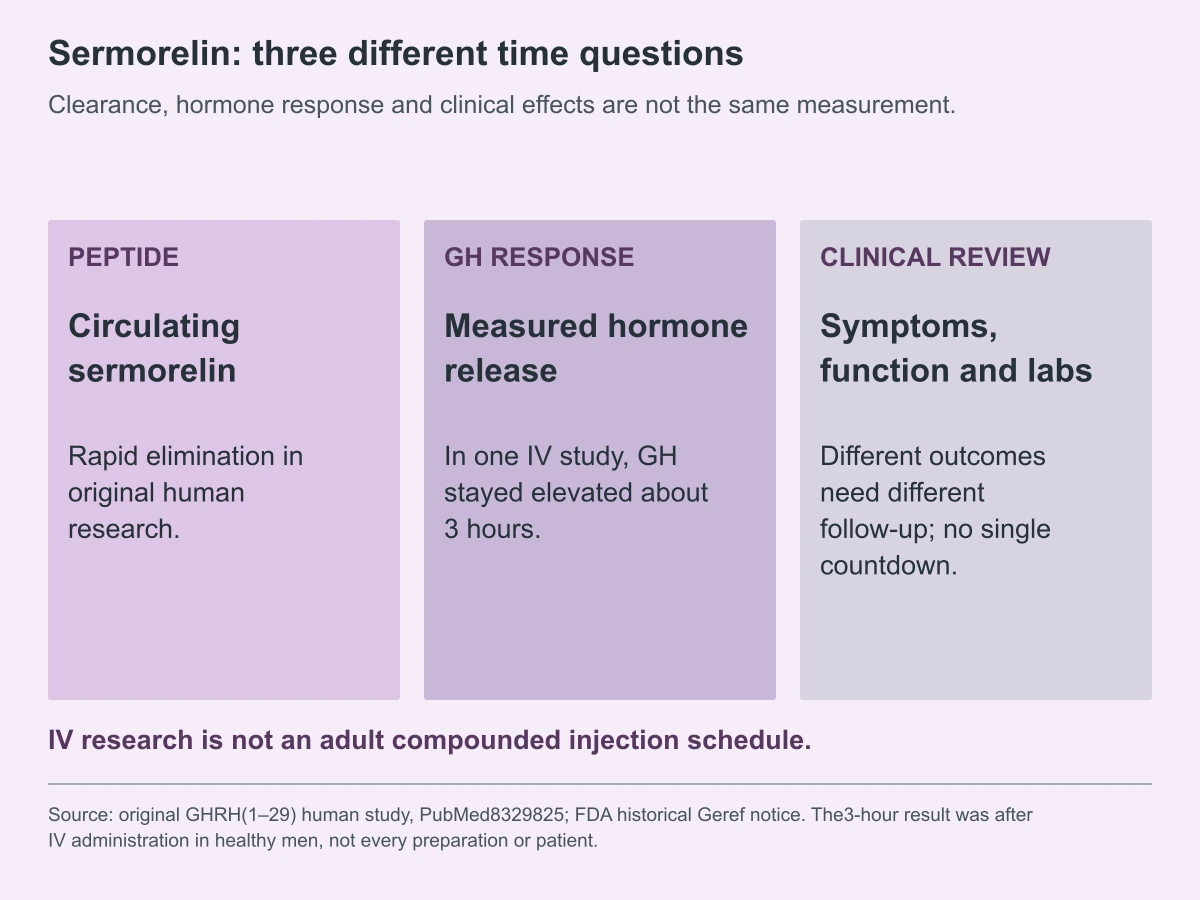
An original 1993 human study evaluated GHRH(1–29)-NH2 given intravenously or intranasally to thirty healthy men aged nineteen to forty-three. Its published abstract reports rapid elimination after intravenous injection, while growth-hormone levels remained elevated for about three hours.
That is a useful demonstration that circulating peptide and hormone response are not the same countdown. It is not a universal three-hour effect for every patient, and it does not describe the clinical results of current compounded subcutaneous adult treatment.
The abstract also reports low absorption through the nasal route. It should not be used to declare a present-day nasal, oral, troche, or injection product equivalent. The exact analogue, route, preparation, study population, and outcome need to match the question.
Why doesn’t this guide give an exact personal clearance time?
A reader may want one number to answer whether the treatment has left their system. The accessible original evidence reviewed here cannot supply that number for an individual’s current compounded preparation.
Historical product summaries and clinic pages often present short half-life estimates. Those estimates need their original measurement context; they should not become a guarantee about every preparation or a rule for stopping, restarting, or combining medicines. The original study abstract supports rapid circulation clearance without providing a validated personal washout plan.
Ask your prescribing team what the timing question is intended to resolve. Managing a symptom, planning a different treatment, interpreting a hormone test, and handling an unused vial are four separate decisions. They may require different information even when the same medicine is involved.
Circulating sermorelin, GH, and IGF-1 are different measures
Sermorelin is intended to stimulate growth-hormone release from the pituitary. A measurement of the administered peptide is therefore different from a measurement of the hormone response it stimulates.
IGF-1 is another part of the growth-hormone-related assessment and has its own interpretation. An IGF-1 result is not a direct reading of how much sermorelin remains in your bloodstream. Its relevance depends on age, symptoms, medical context, and the reason it was obtained.
The sermorelin and IGF-1 testing guide explains those distinctions. A higher laboratory value does not automatically mean a better clinical outcome, and a changed value does not select the next dose by itself.
| Time question | What the question actually concerns |
|---|---|
| How quickly is the administered peptide cleared? | Pharmacokinetics under a particular route and preparation |
| How long does GH rise after administration? | A downstream hormone response under the study conditions |
| When should IGF-1 be checked? | A clinical testing purpose and the treating team’s plan |
| When might symptoms or function change? | Outcomes requiring their own evidence and follow-up |
| When can another treatment begin? | A product-specific interaction and clinical transition decision |
| How long can the vial be used? | Storage, sterility, and pharmacy labeling, rather than blood clearance |
Does a short half-life mean you should inject more often?
No. A pharmacokinetic figure cannot select a dosing interval without the rest of the treatment evidence and prescription context. Taking another dose when you think the previous peptide has cleared can create an unreviewed regimen.
Follow the written prescription for the exact preparation. If the schedule is unclear, contact the pharmacy or prescribing team and ask which directions apply. Do not combine a clinic’s schedule with numbers from a historical study to design your own frequency.
The timing, labels, and storage guide explains why directions for different products should not be merged. A study involving a diagnostic dose or an experimental route is not a routine adult injection protocol.
Does a short half-life mean side effects end quickly?
It does not guarantee that. A symptom can involve a local injection reaction, a downstream effect, another ingredient, an unrelated illness, or another medicine. The symptom’s cause and severity determine the appropriate assessment.
Tell the care team what happened, when it began, and whether it recurs after administration. Include the preparation and any recent changes. The sermorelin side-effect guide covers the broader monitoring conversation.
Breathing difficulty, serious allergic symptoms, or severe and worsening symptoms need prompt appropriate care. Do not wait for a calculated clearance period to decide whether a serious reaction deserves attention.
How long does it take to notice a clinical result?
A laboratory hormone response is different from a change in sleep, strength, body composition, or everyday function. Each outcome needs its own study evidence and measurement approach. A brief peptide exposure cannot establish a promised number of weeks to a visible result.
The sermorelin results guide discusses how to define and review an outcome. The body-composition guide explains why a scale or consumer estimate is not a complete treatment assessment.
Agree on what is being followed, how it will be measured, and what result would justify changing the plan. A clear review point is more useful than waiting for a universal transformation timeline that the evidence does not establish.
What happens if you stop taking sermorelin?
Stopping is a clinical decision that should consider why treatment was started, what benefit was observed, symptoms, other medicines, and the exact preparation. A circulation half-life alone does not establish a taper, withdrawal syndrome, or the timing of every downstream change.
If you are stopping because of a suspected reaction, describe it promptly to the treating team. If the concern is cost, lack of benefit, or difficulty using the product, those are also useful reasons for a structured review.
Ask which symptoms or measurements should be followed and whether another treatment is being considered. Do not substitute HGH, another peptide, or a supplement based on a clearance calculation. The sermorelin-versus-HGH guide explains why those treatments have different evidence and uses.
Does the answer change for a compounded formulation?
The actual label and pharmacy information matter. Compounded preparations can differ in concentration, inactive ingredients, additional substances, route, and directions. Historical data for one product cannot establish the performance of every current preparation.
The FDA’s historical Geref notice describes earlier diagnostic and pediatric uses, discontinuation, and the determination that the products were not withdrawn for safety or effectiveness reasons. That history is not an approval for current adult anti-aging uses or a compounded formulation.
A University of Maryland report prepared for FDA in 2020 provides historical clinical-use context. It is an FDA-funded scoping report, rather than an agency endorsement or a present-day efficacy recommendation for every clinic offering.
Half-life is not the vial’s beyond-use date
A vial’s storage directions and beyond-use date address the preparation outside your body. They can involve stability, handling, and sterility. They are unrelated to how quickly an administered peptide is eliminated from circulation.
Follow the pharmacy’s instructions for the exact formulation, including any directions after opening or reconstitution. Do not transfer a rule from another pharmacy’s vial, from a branded historical product, or from a social-media preparation video.
If the label is unclear or the product was stored outside its stated conditions, ask the dispensing pharmacy before using it. Appearance alone cannot resolve every storage or quality question.

Questions that make a timing conversation useful
Explain what you want the time estimate to help you decide. Useful questions include:
- Are we discussing the administered peptide, GH response, a lab result, or a clinical symptom?
- Which route and preparation did the cited evidence study?
- Does the research actually support my proposed decision?
- What is the plan after a missed dose or a longer gap?
- Should any symptom change be assessed before the next administration?
- If treatment stops, what follow-up is needed?
- Which pharmacy directions apply to storage and the remaining supply?
For service details, see CoreAge Rx’s sermorelin information. Compounded medicines are not FDA-approved. Historical branded evidence and original experimental results do not establish equivalent safety, effectiveness, or instructions for a compounded adult preparation.
Frequently asked questions
Does half-life mean the medicine is completely gone?
No. It describes a reduction under particular measurement conditions. It is not an exact zero point or a universal end to every downstream effect.
Did the three-hour GH result mean sermorelin stayed in the blood for three hours?
No. The original study distinguished rapid IV peptide elimination from the longer measured GH response. The two observations describe different things.
Can a half-life estimate tell me when to take another dose?
No. Use the prescription and pharmacy directions. Frequency cannot be designed from a clearance figure alone.
Can it tell me when to start another peptide?
It cannot establish a safe transition or combination. The actual products, clinical purpose, other medicines, and treatment plan need review.
Will a lab result tell me how much sermorelin remains?
A GH or IGF-1 result is not a direct measurement of the remaining administered peptide. Ask what the test is intended to evaluate.
Is blood clearance the same as storage time?
No. Storage and beyond-use dates concern the product in its container. They need the instructions for that preparation, independently of a bloodstream half-life.
Educational information for adults; individual treatment decisions require a qualified clinician. Sources reviewed October 1, 2026. Original AI-generated article images depict fictional people and objects, not patient outcomes. Other editorial images are illustrative. Graphics summarize the cited sources.