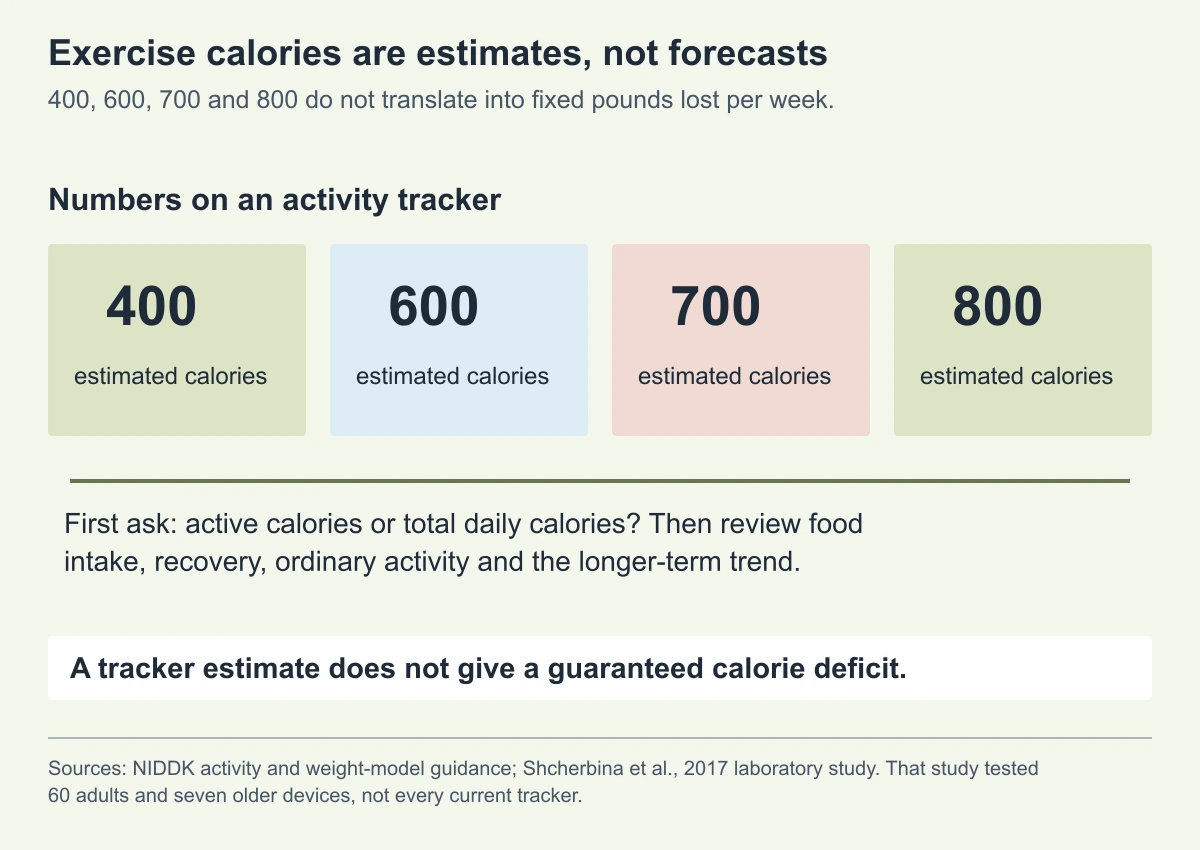
Burning an estimated 400, 600, 700 or 800 calories through activity does not establish how much weight you will lose. First check what the number represents: one workout, active calories throughout the day, or total daily energy expenditure. Weight change depends on the relationship between overall intake and expenditure over time, while the calorie number from a wearable remains an estimate.
There is also no universal daily exercise-calorie goal that everyone needs to reach. An activity routine should suit your health, starting fitness, available time and recovery. NIDDK guidance emphasizes sustainable eating and physical activity, including their health benefits beyond a change on the scale. NIDDK weight-management guidance.
What does “burning calories” mean on your device?
Your body uses energy throughout the day, including while you rest. Exercise is one part of that expenditure. Walking around your home, working, carrying groceries and other ordinary movement also contribute. A display labeled “total calories” may answer a different question from a display summarizing a workout.
Before interpreting a number, open the device’s explanation of its metric. Check the time period, whether resting expenditure is included, and whether the value is for the whole day or a recorded session. Do not add a workout figure to a daily total if the session is already included in that total. Double counting can make an estimated deficit look larger than it is.
| Display or question | What to clarify | Why it matters |
|---|---|---|
| Calories in one workout | Session duration and whether the value includes resting expenditure. | It does not describe the rest of the day. |
| Active calories | The manufacturer’s definition and activities counted. | It is not automatically your total energy requirement. |
| Total daily calories | The full time period and components included. | Compare the appropriate total with intake, recognizing uncertainty. |
| Calories “remaining” in a food app | Whether the app has already adjusted its target for activity. | Adding exercise again can double count an allowance. |
These are questions to check in the actual app, not a claim that every device uses the same definitions. The calorie-intake guide explains the separate question of food intake. Eating 800 calories and recording 800 activity calories are very different situations.
Why an exercise estimate is not the same as a calorie deficit
A deficit describes the difference between intake and expenditure; an activity estimate describes only what its algorithm attempts to measure. Increasing activity may change that relationship, but it does not supply the other half of the calculation.
For example, imagine an app estimates 2,500 total calories expended in a day, including a workout. If the food record estimates 2,400 consumed, the simple difference is 100 calories—not the full workout figure. Both inputs may be inaccurate, and that arithmetic does not predict a fixed amount of fat lost. These numbers are an illustration of the accounting question, not a personal intake recommendation.
Appetite, eating habits and activity outside the workout can also change as a routine changes. Someone may add exercise and then eat differently or spend more of the remaining day resting. The right response is to review the whole pattern, not to conclude that exercise has no value or that a higher burn target must be chased.
NIDDK’s Body Weight Planner research accounts for changing energy expenditure and body weight. Its adult model is more informative than treating one workout number as a permanent daily deficit. It is still a planning tool, not a clinical prescription or a guarantee. NIDDK planner research.
Our guide to net calories and food-log calculations uses a hypothetical example to separate food minus a logged workout from a deficit based on total daily expenditure. It also explains how an app can count the same activity twice.
How accurate are wearable calorie estimates?
Treat the number as an estimate rather than a laboratory measurement. One often-cited 2017 study tested seven then-available wrist-worn devices in 60 adults during laboratory activities. Researchers compared device readings with reference measures, including indirect calorimetry for energy expenditure. Energy estimates performed less well than heart-rate measurements in that study. Shcherbina and colleagues’ original study.
That result has limits. It tested particular older devices, specific activities and a particular group of volunteers. It does not establish the error of your current watch, and it does not mean that every reading today is wrong by one fixed percentage. Firmware, algorithms, fit, personal settings and the activity being measured can differ.
A tracker can still be useful for noticing whether you are moving more consistently or spending more time on an activity. Keep its settings accurate and use its metric consistently. Avoid treating small day-to-day calorie differences as proof of a precise change in your metabolism or body fat. The distinction between a useful trend and an exact measurement is central to interpreting the display.
Is burning 200 exercise calories a day good for weight loss?
A displayed 200-calorie exercise estimate does not establish a 200-calorie deficit or a guaranteed weight-loss result. The device estimate, food intake, other activity, and individual circumstances all affect interpretation. A comfortable repeatable routine can still be worthwhile; CDC allows activity to be accumulated in shorter chunks and recommends aerobic activity plus strength work. Do not increase exercise or reduce food solely to satisfy a watch number. Review the overall routine and progress rather than treating 200 as a universal success threshold. CDC adult physical activity recommendations. About the Body Weight Planner – NIDDK.
Is burning 300 exercise calories a day enough for weight loss?
A displayed 300-calorie exercise estimate is not the same as a measured 300-calorie deficit. Total daily energy use, food intake, the uncertainty of the device and compensation after activity all matter. The number cannot establish a fixed weekly loss or a minimum exercise requirement. Choose activity you can sustain safely and evaluate the broader pattern, including nutrition, strength and physical function.
Is burning 400 calories a day enough?
An estimated 400 activity calories may describe a substantial amount of movement for one person and a different pattern for another. It is not a minimum requirement for weight loss or a guarantee that weight will decrease. The meaning depends on what is counted, your overall intake and whether the activity is sustainable.
If your routine supports health and you recover well, there is no reason to dismiss it because someone online recommends 800. Review duration, consistency, strength work and how you feel. A routine you can keep doing may be more useful than a higher number you reach only by overexerting yourself or abandoning other parts of care.
Is burning 600 calories a day good?
The number alone cannot establish whether the routine is appropriate. Ask whether it refers to exercise or a daily total, whether it comes from an estimate, and what it takes to reach it. Your health conditions, medicines, injury history and starting fitness matter more than the round number.
Do not automatically add 600 calories to a food target or subtract it from an already activity-adjusted app target. If you are unsure how your app handles exercise, clarify that setting. A dietitian or clinician can help review nutrition and activity together rather than turning a display into a rigid eating rule.

Is burning 700 calories a day enough to lose weight?
Seven hundred estimated activity calories do not establish a predictable rate of loss. They may be included in total expenditure, and food intake may change. The body’s energy requirements also change with weight and other circumstances. A few days of readings cannot identify the longer-term balance precisely.
If the scale does not immediately respond, check the observation period and the complete routine before escalating exercise. The water-weight versus fat-loss guide explains why short-term scale movement is not an isolated measure of fat. A plateau question also deserves review of symptoms, medications and the plan you can realistically maintain.
Is burning 800 calories a day good?
There is no universal recommendation to burn 800 calories through exercise every day. For some people, pursuing that estimate could require more activity than they can recover from safely. For others, an app may count ordinary movement toward the number. Without that context, “good” is too vague to be useful.
A higher estimated burn does not automatically mean a better program. Consider fatigue, injury, nutrition, sleep and whether the goal is displacing normal meals or rest. If you have a chronic condition or are starting a new routine, discuss appropriate activity with your healthcare professional. NIDDK advises tailoring activity to health and ability. NIDDK activity guidance.
Why the pounds-per-calorie shortcut breaks down
The familiar approach of dividing a daily deficit by a fixed number of calories per pound assumes a simple, continuing relationship. Hall and colleagues’ adult weight-change model explains why that is inadequate: energy expenditure changes as body weight and composition change. Weight lost can include both fat and lean tissue, and the trajectory is not a straight line indefinitely. Original Lancet model research.
This does not make energy balance irrelevant. It means that a static calculation is not a reliable personal timetable. Combining an uncertain wearable estimate with a simplified conversion adds uncertainty rather than creating an exact forecast.
Avoid tables promising that 400, 600, 700 or 800 exercise calories will produce a particular number of pounds every week. Useful planning considers the starting circumstances, changing requirements and the observed response. An unexpected trend should lead to a review of the assumptions, not an accusation that the person failed an equation.
Build a routine around activity you can repeat
NIDDK’s general guidance for healthy adults includes at least 150 minutes of moderate-intensity aerobic activity each week and muscle-strengthening activity involving the major muscle groups on two or more days. Those are time-and-activity recommendations, not a requirement to hit a daily wearable calorie value. Individual health and ability may require adaptations. NIDDK guidance.
Start with a realistic schedule. Walking, cycling, swimming or another enjoyable activity may fit different preferences and physical limitations. Increase gradually rather than treating a high burn estimate as the first-day target. Some activity is better than none, and a missed session does not erase the value of the routine. NIDDK getting-started advice.
Food and recovery belong in the same discussion. The balanced-meal guide can help organize eating questions. If you use a GLP-1 medicine, the semaglutide protein and muscle guide and tirzepatide protein and muscle guide discuss maintaining nutrition and function when appetite changes.
What to review when the scale is not changing
Bring a representative record of the routine, rather than only the highest-burn workout. Include the app’s metric definition, session frequency, food-record approach, recovery and any new symptoms. Discuss how weight is measured and whether the concern is a brief fluctuation or a longer trend.
Ask whether the plan is meeting nutrition needs and whether activity is appropriate for your health. If you are taking medication, include its exact name and recent changes. Avoid skipping meals, increasing a prescription dose or adding excessive exercise just to make the estimated numbers balance.
For persistent concerns, a clinician can evaluate possible contributors and help choose a manageable next step. The GLP-1 option guide explains medication-selection questions for people considering that route. CoreAge Rx’s semaglutide and tirzepatide pages describe offered compounded care; eligibility requires evaluation, and branded-product approval and study results should not be assumed to apply to those compounded preparations.
The fat-loss timing guide explains why an estimated workout burn does not supply a personal date for a visible body-fat change.
A more useful question than “Did I burn enough?”
Ask whether your routine is safe, repeatable and helping the goals you agreed with your care team. Consider movement, strength, recovery, eating patterns and the weight trend together. A wearable number can be one observation in that conversation. It should not become a verdict on the day or a promise about next week’s body weight.
Educational information for adults; individual treatment decisions require a qualified clinician. Sources reviewed September 30, 2026. Original AI-generated article images depict fictional people and objects, not patient outcomes. Other editorial images are illustrative. Graphics summarize the cited sources.