
Aetna may cover Ozempic or Wegovy under some plans, but the answer depends on your exact benefits, the prescribed product, and the treatment purpose. A public drug list or clinical policy is not a guarantee for every Aetna member. Check your current member formulary, benefit exclusions, prior-authorization requirements, and pharmacy claim separately to find out what you would actually pay.
Ozempic and Wegovy share semaglutide, but they have different approved uses and product instructions. An Ozempic diabetes policy cannot be assumed to approve Wegovy for weight management, and a Wegovy weight-management benefit does not establish Ozempic coverage without the required clinical documentation.
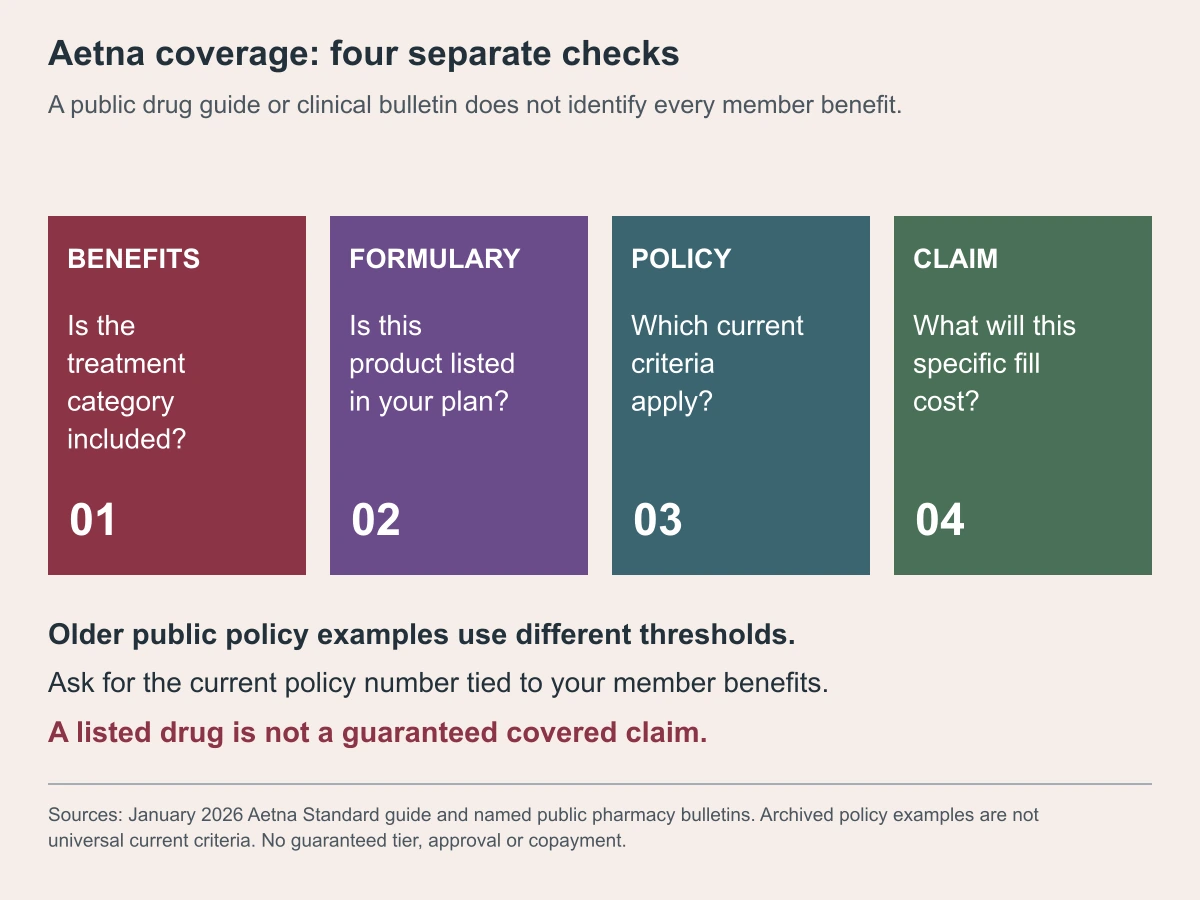
Start with four separate questions
Coverage decisions become easier to understand when you identify what each document answers.
| Question | Document or contact to check | What it does not establish |
|---|---|---|
| Is the treatment category included? | Member benefit description or employer benefits team | That every drug in the category is approved |
| Is the specific drug listed? | Current member-specific formulary | That you meet authorization criteria |
| What clinical documentation is needed? | Applicable current pharmacy policy or authorization form | Your final out-of-pocket price |
| What will this fill cost? | Pharmacy claim and plan cost information | All later fills or future plan years |
The January 2026 Aetna Standard Plan Pharmacy Drug Guide lists Ozempic among diabetes medicines and Wegovy among antiobesity medicines. It also explains that a benefit design may exclude a medicine or category despite its appearance in the guide. The list is not all-inclusive, does not guarantee coverage, and is subject to updates.
That public edition is useful background, rather than your individual October 2026 coverage determination. Aetna administers many benefit designs. Use the formulary linked to your member plan and the current prescription, not simply the first PDF returned by a search.
Does Aetna cover Ozempic for weight loss?
The current Ozempic injection label describes type 2 diabetes uses, including specified cardiovascular and kidney risk reduction indications. Ozempic is not the semaglutide brand labeled for weight management simply because weight can change during treatment.
Aetna’s publicly available Ozempic policy examples focus on documented type 2 diabetes and specified clinical criteria. For example, bulletin 2439-C, dated October 14, 2023, describes different initiation and continuation requirements. Another public diabetes bulletin, 5694-D, dated October 15, 2023, uses a different framework for diagnosis documentation and authorization.
These are archived examples we could verify directly, rather than a claim that either one governs every current member. Their older product summaries also do not replace the current FDA label. Ask Aetna which current policy identifier applies to your prescription and treatment purpose, including any newer kidney-related indication review.
Do not obtain a false diagnosis or choose a drug solely to fit a policy. The Ozempic qualification guide explains the clinical assessment. If the main purpose is weight management, ask the clinician about the appropriate treatment and the plan about its relevant benefit.
Does Aetna cover Wegovy for weight management?
Some plans include a weight-management pharmacy benefit; others exclude it or use particular program criteria. Aetna’s weight-reduction medical bulletin warns that many benefit descriptions exclude obesity-related services and supplies, including weight-reduction medicines. The benefit description therefore matters before a BMI or authorization discussion.
If your plan includes the benefit, a pharmacy policy may require starting measurements, a documented weight-related condition, previous participation in a comprehensive program, or ongoing lifestyle support. Continuation may require treatment-response documentation. The exact requirements and time periods must come from the policy that actually applies to you.
Two publicly available older Aetna examples show why a blanket BMI statement is unreliable:
| Verified public example | Example adult weight-management threshold | Why you need the applicable policy |
|---|---|---|
| Wegovy bulletin 4774-C | BMI at least 30, or at least 27 with a weight-related condition, plus other criteria | It is an older named Wegovy program example |
| Weight-loss bulletin 6450-C, dated August 15, 2024 | BMI at least 35, plus other criteria | It describes a distinct program rather than the same threshold |
The 4774-C example and 6450-C example are illustrative archived documents. They are not a complete list of current criteria for tablets, injections, every approved indication, or all Aetna plans. Ask for the current policy number and effective version rather than treating an internet BMI threshold as a personal approval rule.
What about cardiovascular or other approved indications?
A drug can have more than one approved use, and a plan may handle each purpose differently. The current Wegovy label includes specific cardiovascular and liver-related uses as well as weight management, with route- and population-specific details.
A benefit exclusion for weight loss does not by itself answer every other indication. At the same time, a new FDA-approved use does not guarantee immediate coverage under a particular plan. Ask whether the exact product and indication have a separate review pathway and what clinical documentation is needed.
Describe the actual medical history accurately. A cardiovascular-risk discussion is not permission to infer heart disease from body weight or select a diagnosis to bypass a benefit exclusion. Your clinician must establish the condition and decide whether the treatment is appropriate.
The public archived Wegovy examples include a cardiovascular route with its own criteria. Because those documents are older, they should not be used to define all current indications or to invent criteria for a newer tablet or liver-disease use. The plan can identify the current applicable document.

What does prior authorization mean?
Prior authorization is a plan review of a proposed prescription before it is covered under the relevant rules. It is different from the clinician deciding that treatment is medically appropriate, and different from the pharmacy calculating the final member share.
The prescriber may need to supply diagnosis records, starting measurements, previous treatment information, and other details from the chart. A request that lacks a required record may be handled differently from a request for a benefit that is excluded entirely.
Ask the care team which request was sent, whether it is complete, and whether the plan has responded. If more information is requested, accurate documentation is more useful than changing the diagnosis or sending another vague request.
Our GLP-1 insurance guide explains formulary, benefit, and authorization terms. If you are changing plans, compare the documents for the new member benefits; an approval under an earlier employer or plan may not carry over automatically.
Why can an approved prescription still cost more than expected?
Approval does not set one universal Aetna copayment. A deductible, coinsurance, drug tier, pharmacy network, quantity, or days’ supply can affect the amount for a fill. A public list may not display the member’s exact cost-sharing design.
Ask the pharmacy whether the quote reflects a processed covered claim or an estimate. If the claim rejected, get the specific explanation. A network mismatch, missing authorization, quantity issue, and excluded benefit should not all be described as “Aetna doesn’t cover it.”
Our Ozempic cost guide and Wegovy cost guide help separate medicine charges, care fees, insurance share, and self-pay options. For a warehouse pharmacy, the Costco Wegovy guide explains why nonmember access, member discounts, and insurance are separate routes.
Manufacturer savings may have commercial-insurance eligibility conditions, limits, and government-program exclusions. Do not subtract a headline savings amount from a quoted insurance price unless the pharmacist confirms that the program is valid for the actual claim.
What should you do after a denial?
Read the written reason. Ask whether the issue is missing information, an unmet clinical criterion, a nonpreferred drug, or an excluded benefit. Those distinctions determine whether corrected records, an exception request, an appeal, or a benefits discussion is relevant.
Ask the plan for the instructions, required documents, and deadline that apply to your case. This article does not give a universal appeal period because plan type and process can differ. Your clinician can help explain the medically relevant information without guaranteeing a reversal.
Keep copies of the request, response, and reference numbers. If access is interrupted, tell the prescriber before you run out when possible. A denial should not lead to unsupervised dose splitting, brand substitution, or buying an unverified preparation.
The online prescription guide and FDA’s unapproved GLP-1 warning are useful when evaluating alternatives. A compounded product is not FDA-approved, and a low price does not establish equivalence to Ozempic or Wegovy.
Aetna Medicare and the Medicare GLP-1 Bridge
Commercial coverage and Medicare require separate checks. A qualifying indication may be reviewed through the actual Part D plan. Weight-management access through the CMS Medicare GLP-1 Bridge follows a separate, conditional process outside ordinary Part D coverage and payment.
Aetna’s Bridge information page describes the program as run by CMS, rather than part of Aetna Medicare benefits. Eligible participants pay $50 for a one-month supply of qualifying products under the program. The current program runs from July 1, 2026 through December 31, 2027, subject to its eligibility rules.
That statement is not universal Medicare GLP-1 coverage. The eligible plan types, product presentations, clinical requirements, and purpose must be checked. The Bridge cost does not count toward ordinary Part D deductible or out-of-pocket spending. Use the current CMS materials and your clinician’s assessment to find the correct pathway.
Our Medicare weight-loss medicine guide explains the distinction. Do not apply a commercial Aetna policy or manufacturer commercial savings card to a Medicare question without checking the actual rules.

A useful call checklist
Have your member ID, exact prescription, and treatment purpose available. Ask:
- Is this treatment category included in my benefits?
- Which current formulary applies to my plan and this prescription?
- What current policy number and version apply to the indication?
- Is prior authorization, step therapy, or a quantity limit required?
- Which pharmacy locations are in-network or preferred?
- What would I pay for the specified quantity and days’ supply?
- What response documentation and renewal date would apply after approval?
- If denied, what written reason and review process apply?
For tirzepatide’s weight-management brand, use our separate Aetna Zepbound coverage guide. Its policy questions should not be collapsed into Ozempic or Wegovy simply because all are discussed as GLP-1-based treatment.
CoreAge Rx’s semaglutide information offers a separate clinical-assessment option. Confirm the preparation, costs, and follow-up directly. It does not establish Aetna coverage, branded Ozempic or Wegovy availability, or approval of a particular member’s claim.
If you are comparing a different insurer, our Anthem and CarelonRx GLP-1 coverage guide explains how to read named formulary flags and confirm the member benefit, treatment purpose and pharmacy share. An Aetna example does not establish the rules of an Anthem plan.
Frequently asked questions
Does seeing Ozempic in an Aetna drug guide mean I am covered?
No. The public Standard guide says benefit design may override appearance on the list. Check your member-specific formulary, applicable clinical criteria, and benefit exclusions.
Is a BMI of 30 always enough for Wegovy approval?
No. Different public Aetna examples use different thresholds and additional requirements. The current policy applicable to your benefits is the relevant source, and meeting a BMI criterion alone does not guarantee approval.
Can I use an Ozempic policy for Wegovy?
No. Brand, route, indication, and plan rules must match the prescription. A shared active ingredient does not make their coverage policies interchangeable.
Does authorization guarantee a low copayment?
No. The covered claim can still involve deductible or coinsurance costs. Ask the pharmacy and plan to explain the actual member share for the fill.
Does the Bridge mean Aetna Medicare now covers all weight-loss medicines?
No. The Bridge is a separate CMS program with defined eligibility and qualifying products. It does not convert every Aetna Medicare plan into a universal weight-loss pharmacy benefit.
Educational information for adults; individual treatment decisions require a qualified clinician. Sources reviewed October 1, 2026. Original AI-generated article images depict fictional people and objects, not patient outcomes. Other editorial images are illustrative. Graphics summarize the cited sources.