Dramamine is a brand with several different products, and its motion-sickness labels do not establish a routine treatment for nausea from Ozempic, Wegovy, Mounjaro, or Zepbound. Before taking it, check the active ingredient and ask a pharmacist or prescriber whether that particular product fits your symptoms, other medicines, and health history. “Less Drowsy” still allows drowsiness, including uncertainty about how you will feel the next day.
The useful first question is why you feel nauseated. A queasy stomach after starting treatment deserves a different discussion from repeated vomiting, severe abdominal pain, or symptoms of low blood sugar. Adding an over-the-counter medicine without describing those differences can leave the main problem unaddressed.
Which Dramamine product do you mean?
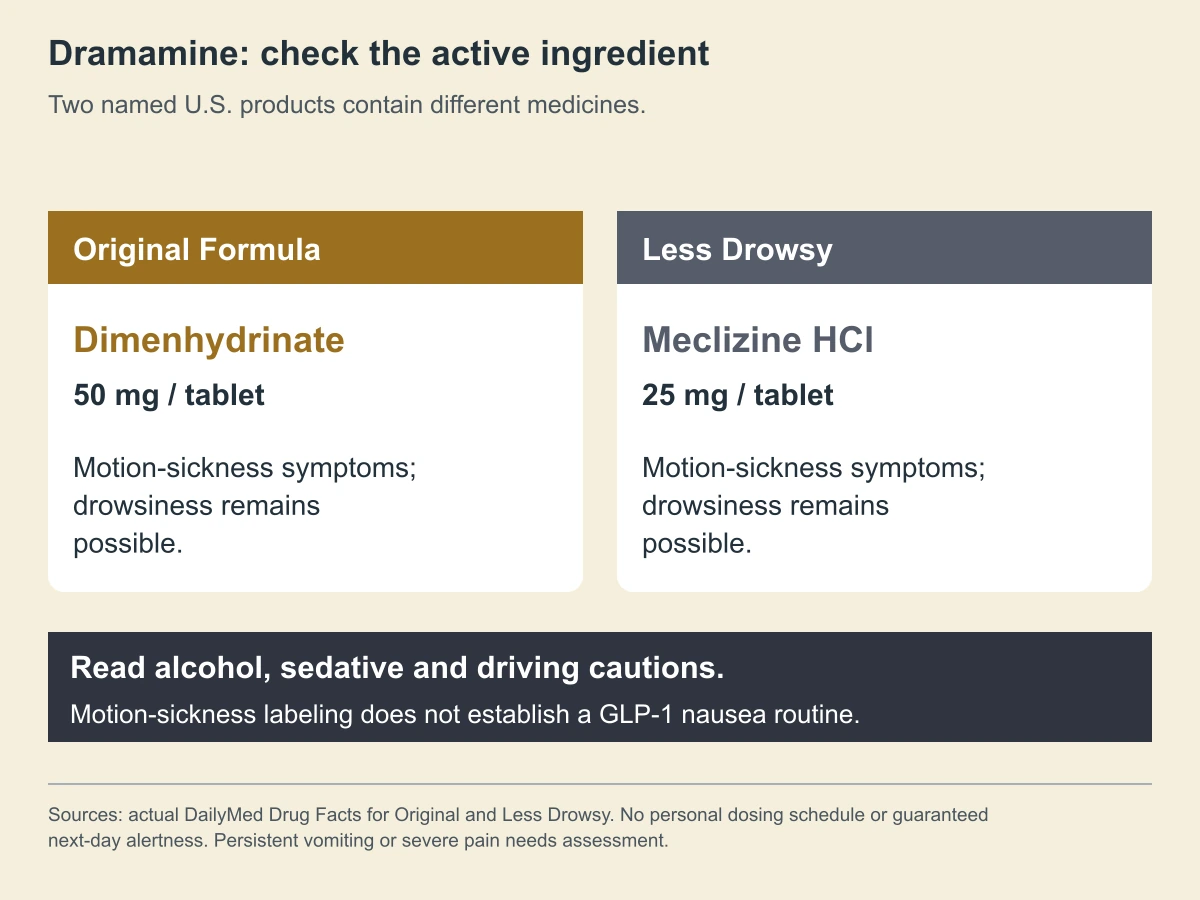
Read the Drug Facts panel on the box you actually have. Product names, tablet colors, and brand recognition are insufficient to identify an ingredient. The following comparison describes two specific U.S. products; chewables, children’s products, and ginger supplements need their own labels.
| Named product | Active ingredient per tablet | Labeled purpose | Drowsiness warning |
|---|---|---|---|
| Dramamine Original Formula | Dimenhydrinate 50 mg | Prevention and treatment of nausea, vomiting, and dizziness associated with motion sickness | Marked drowsiness may occur |
| Dramamine All Day Less Drowsy | Meclizine hydrochloride 25 mg | Prevention and treatment of nausea, vomiting, and dizziness associated with motion sickness | Drowsiness may occur |
These are different medicines, rather than two interchangeable strengths of one medicine. Both labels caution about alcohol, sedatives or tranquilizers, and driving or operating machinery. The current Original Formula label and Less Drowsy label give product-specific warnings and age restrictions.
Products sold as Advanced Herbals from the makers of Dramamine are another category. The manufacturer’s product FAQ describes ginger-based supplements separately. A bottle associated with the Dramamine name does not necessarily contain dimenhydrinate or meclizine. A supplement also needs an interaction review; the word “herbal” cannot answer whether it suits you.
Does Dramamine help GLP-1 nausea?
The OTC labels above address motion sickness. That purpose alone does not establish effectiveness, an appropriate regimen, or suitability for medication-related nausea. Whether a clinician recommends a particular nausea treatment depends on the likely cause, symptom severity, and the rest of your treatment.
Semaglutide and tirzepatide can cause gastrointestinal symptoms. Their labels also describe delayed gastric emptying and important conditions that need assessment. The Ozempic prescribing information and Zepbound prescribing information are more relevant to those medication risks than a travel-sickness package.
Tell your prescriber when symptoms began, whether the dose recently changed, whether you can eat and drink, and whether there is pain, diarrhea, constipation, dizziness, or sweating. “I feel a little queasy after a large meal” and “I have vomited repeatedly and can barely drink” should not lead to the same response.
Our GLP-1 nausea guide and tirzepatide nausea and reflux guide explain the symptom conversation in more detail. Use the medicine-specific guide alongside your actual prescription instructions.
Can Dramamine make you feel sleepy the next day?
It can cause drowsiness, and the labels do not promise that every person will be alert by a particular morning. The “Less Drowsy” name is a comparison in the product name, not a guarantee that you can drive, work at heights, or operate equipment safely after taking it.
Several questions matter before use:
- Is the product dimenhydrinate, meclizine, or something else?
- Are you taking sleep medicines, sedatives, tranquilizers, or another product that causes sleepiness?
- Have you consumed alcohol?
- Did you take more than one medicine with overlapping ingredients?
- Do you have to drive early, supervise children alone, or do safety-sensitive work?
Give the pharmacist the complete list, including OTC sleep aids, cold products, and supplements. Different package names can conceal overlapping effects. Combining two products is not a reliable way to gain more relief without more impairment.
If you feel unusually sleepy, confused, faint, or otherwise unwell, contact a health professional rather than relying on a countdown. In an overdose or severe reaction, get urgent help; the OTC labels direct consumers to medical help or Poison Control for overdose. A routine dosing interval is not a test of fitness to drive.

Which health conditions need a warning check?
Both named labels advise asking a doctor before use with a breathing problem such as emphysema or chronic bronchitis, glaucoma, or trouble urinating related to an enlarged prostate. They also advise a doctor or pharmacist review if you take sedatives or tranquilizers. Pregnancy or breastfeeding requires medical advice before use.
These warnings are worth reading even if you have used a travel medicine years ago. Your prescription list, kidney or digestive health, and other conditions may have changed. A prior uneventful experience does not establish that the same product remains appropriate during a new treatment.
Age instructions also differ. Original Formula says not to give it to children under two unless a doctor directs it; Less Drowsy says not to give it to children under twelve unless directed by a doctor. This article concerns adult questions and does not provide a child’s dosing plan. Use a pediatric clinician and the exact package for a child’s symptoms.
When nausea needs prompt care
Seek prompt assessment for repeated vomiting, inability to keep fluids down, very little urine, fainting, or severe or persistent abdominal pain. Pain that may extend to the back is one reason to contact your clinician urgently because GLP-1 product labels include pancreatitis warnings. Pain, vomiting, or abdominal swelling also needs evaluation rather than an assumption that every episode is an ordinary side effect.
The labels warn about kidney injury associated with volume depletion. Reducing nausea for a few hours would not by itself correct dehydration or establish that a serious cause has resolved. Do not use symptom relief as proof that another dose or a dose increase is appropriate.
People taking insulin or a sulfonylurea should also discuss low blood sugar. Sweating, shakiness, dizziness, weakness, or confusion can overlap with a general feeling of being sick. Follow your existing glucose and emergency plan; a motion-sickness medicine does not treat hypoglycemia. Type 1 diabetes requires additional care because nausea and vomiting can accompany ketosis or diabetic ketoacidosis; see our type 1 diabetes and GLP-1 evidence guide.
What can you review before adding another medicine?
For mild symptoms, a useful discussion starts with meals, fluids, bowel habits, and the dose timeline. Consider whether eating quickly, a very large meal, or lying down soon afterward seems associated with symptoms. Smaller, tolerable meals may be easier for some people, but an inability to eat enough deserves a nutrition and treatment review.
Keep adequate nourishment in view. Appetite suppression does not remove your need for food. Our balanced meal guide offers practical ways to combine foods without requiring a large meal. If you are barely eating, losing strength, or repeatedly skipping meals, tell your care team instead of treating that as success.
Constipation and diarrhea deserve their own assessment. Review constipation on GLP-1 medicines if stools are hard or difficult to pass. For new or persistent loose stools, the Ozempic diarrhea guide helps you describe symptoms and warning signs. These problems can have causes beyond the prescription.
Do not turn a supplement into a nausea treatment. For example, Full House is a fiber-focused supplement, rather than an antiemetic. Fiber products need their own amount, water, swallowing, and medication-timing review, especially if you are already nauseated or constipated. Adding a product during an unresolved digestive problem can complicate the picture.

A short message to send your prescriber
A concrete description is easier to assess than “the injection makes me sick.” You could organize the information this way:
| Detail | What to include |
|---|---|
| Prescription | Exact brand or preparation, strength, and delivery device |
| Timeline | First dose, latest dose, and any recent increase |
| Symptoms | Queasiness, vomiting, pain, reflux, diarrhea, or constipation |
| Intake | Whether you can keep liquids and meals down |
| Other products | Prescription medicines, OTC medicines, supplements, and alcohol |
| Proposed OTC option | Full name and active ingredient from the Dramamine box |
Ask whether the symptoms need evaluation, whether your next planned increase needs review, and what medicine or other measures are appropriate. Do not independently create a preventive routine or change a prescribed dose based on an online article.
For broader treatment education, the semaglutide questions guide and tirzepatide questions guide cover the questions that often arise between visits. CoreAge Rx’s semaglutide treatment information is a separate way to explore a clinical assessment; it does not establish that OTC Dramamine is appropriate for your current symptoms.
Frequently asked questions
Can I take Dramamine before every GLP-1 injection?
The motion-sickness labels do not establish that routine. Repeated nausea should prompt a review of its cause, severity, nutrition, hydration, and the prescribed plan. A pharmacist or prescriber can advise whether a specific product is suitable, rather than assuming a weekly preventive medicine is necessary.
Is Less Drowsy a non-drowsy product?
Its Drug Facts panel explicitly allows drowsiness. Read the active ingredient and warnings, and discuss safety-sensitive activities before use. Feeling well at bedtime does not guarantee alertness the following morning.
Can I take Original and Less Drowsy together?
Do not assume they combine safely because they share a brand. They contain different active medicines with overlapping cautions. Ask a pharmacist to review the exact products and your other medicines before combining nausea treatments.
Can I drink alcohol with it?
Both named labels advise avoiding alcoholic drinks and warn that alcohol can increase adverse effects. Alcohol can also complicate the assessment of dizziness, intake, and other symptoms. Follow the actual label and your clinician’s advice.
What if nausea happens after a dose increase?
Tell your prescriber about the timing, but do not assign the cause from timing alone. A dose increase is relevant information, particularly if you are vomiting, unable to eat, or dehydrated. Ask for guidance before further escalation rather than masking worsening symptoms.
Does no nausea mean the GLP-1 medicine is failing?
No. Side effects are not a required sign of benefit. Treatment response is assessed through the goals and follow-up measures appropriate to your condition, rather than how uncomfortable you feel after a dose.
Should I switch to another GLP-1 because Dramamine makes me sleepy?
That question needs a review of both the original nausea and the added medicine. Another prescription may have different benefits and risks, and switching is not a simple milligram exchange. Bring the symptom record and OTC box to your care team so they can address the whole problem.
Educational information for adults; individual treatment decisions require a qualified clinician. Sources reviewed October 1, 2026. Original AI-generated article images depict fictional people and objects, not patient outcomes. Other editorial images are illustrative. Graphics summarize the cited sources.