
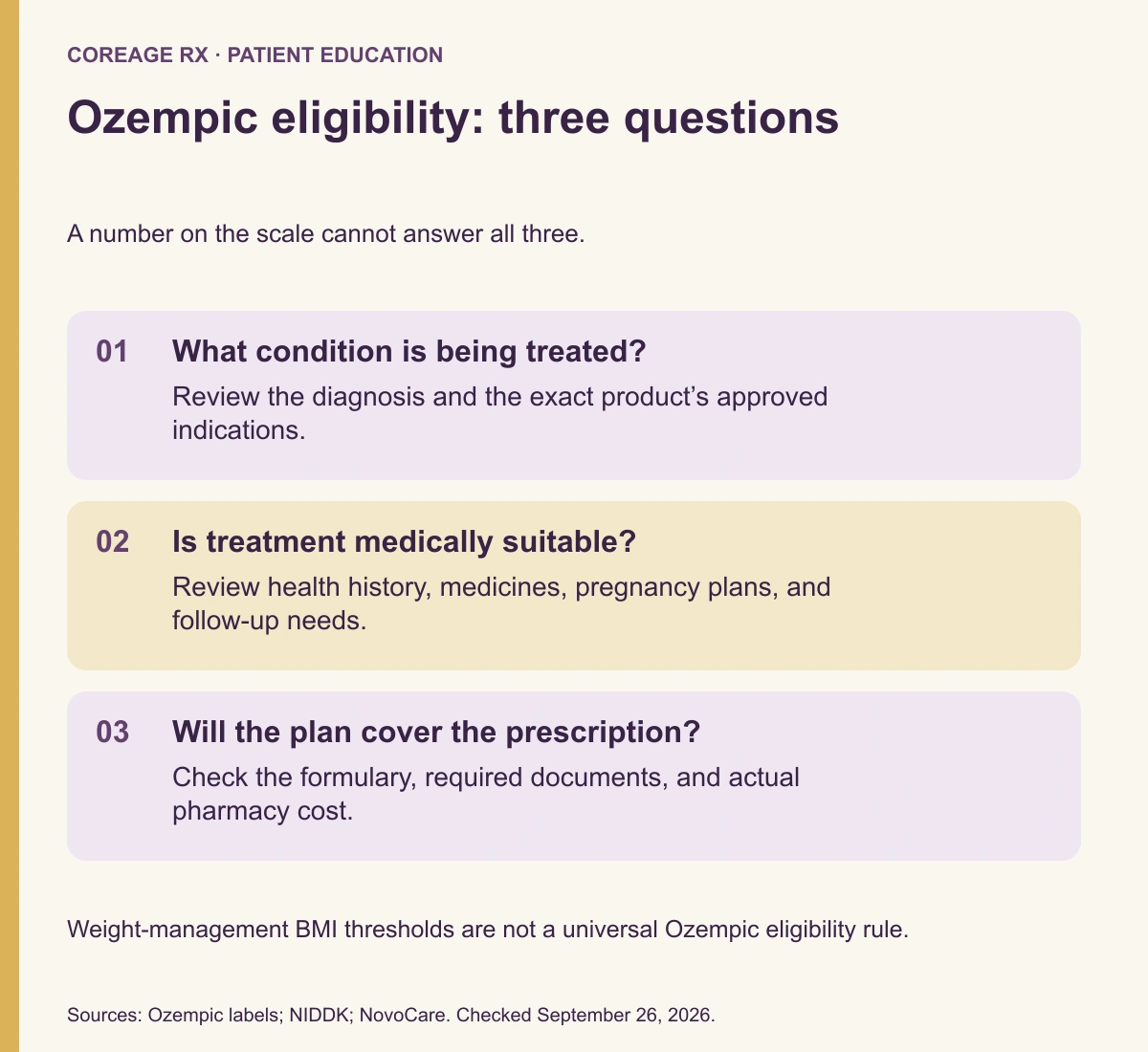
There is no single body weight that automatically qualifies someone for Ozempic. The decision starts with the condition being treated, the specific Ozempic product, medical history, and the prescribing clinician’s assessment. Insurance coverage is a separate decision, with its own documentation and payment rules.
That distinction matters because Ozempic and weight-management medicines often appear in the same conversation. Ozempic contains semaglutide, but a familiar ingredient does not give every semaglutide product the same approved uses. This guide explains the questions to bring to a consultation, rather than providing a checklist that guarantees a prescription.
What is Ozempic approved to treat?
The current U.S. Ozempic injection prescribing information describes use in adults with type 2 diabetes. Its indications include improving blood-sugar control, reducing certain cardiovascular risks in adults with established cardiovascular disease, and reducing specified kidney and cardiovascular outcomes in adults with type 2 diabetes and chronic kidney disease.
The details of those indications matter. For example, having kidney disease alone does not establish eligibility under the injection’s diabetes-and-kidney indication. A clinician considers the whole diagnosis and treatment plan.
Ozempic tablets are also available under separate labeling with formulation-specific instructions and indications. A discussion about a weekly injection should not silently turn into instructions for a daily tablet. Start by identifying the exact prescription. Our oral semaglutide versus injections guide explains why the distinction affects daily use.
Is a BMI of 27 or 30 an Ozempic requirement?
Those numbers usually refer to consideration of medicines approved for chronic weight management in adults. NIDDK describes commonly used thresholds of a BMI of at least 30, or at least 27 with weight-related health problems. They are not a universal Ozempic qualification rule.
Wegovy also contains semaglutide, but it has weight-management indications. Zepbound contains tirzepatide and has different labeled uses. The exact product, formulation, population, and clinical circumstances determine which criteria apply. See the current Wegovy and Zepbound labels.
| Question | What it helps establish |
|---|---|
| Do I have type 2 diabetes? | Whether the Ozempic discussion aligns with its approved diabetes-related uses. |
| Is the main goal chronic weight management? | Whether a weight-management medicine and its specific eligibility criteria should be discussed. |
| Do I have a weight-related health condition? | Whether that condition affects treatment choice and applicable weight-management criteria. |
| Does my insurer cover this product for this diagnosis? | Whether the prescription may be paid for under the plan’s rules. |
Our BMI and waist-measurement guide explains the limits of screening measurements. A BMI value is one piece of a clinical assessment, not a diagnosis of personal health or a measure of effort.
Why a number on the scale cannot answer the question
Weight has to be interpreted in context. Height changes how a given weight relates to BMI, and BMI itself does not describe body composition, symptoms, glucose control, medical history, or the benefits and risks of a particular medicine.
Two adults with the same weight may therefore leave a consultation with different plans. One may need diabetes treatment, another may be assessed for obesity care, and another may need an explanation for a recent weight change before medication is considered.
Avoid trying to change a measurement temporarily to meet a threshold. Accurate information allows the clinician to identify appropriate care and document it correctly. If you are uncertain whether your concern warrants an appointment, our guide to seeking weight-management help is a useful starting point.
What does the clinician usually need to review?
Bring enough information to make the discussion specific:
- Your main health goal and any diagnosed diabetes, cardiovascular, kidney, or other relevant conditions.
- Your current prescription medicines, nonprescription products, and supplements.
- Recent laboratory results or glucose records, if available and relevant.
- Previous medication experiences, including adverse reactions and reasons treatment stopped.
- Digestive symptoms, eye problems, prior pancreatitis or gallbladder problems, and other significant history.
- Pregnancy, breastfeeding, or pregnancy plans.
- Practical needs such as cost, storage, travel, and access to follow-up.
This is not a request to diagnose yourself or order a standard panel of tests online. The clinician decides which records, examination findings, and tests are needed for your situation. An incomplete medicine list can matter as much as a missing weight measurement, particularly when several treatments affect blood sugar.

What could make Ozempic unsuitable?
The injection has a boxed warning about thyroid C-cell tumors observed in rodents; whether it causes these tumors in humans is unknown. It is contraindicated in people with a personal or family history of medullary thyroid carcinoma or MEN2, and in people with a serious hypersensitivity reaction to semaglutide or its ingredients. Source: Ozempic label.
Other circumstances require careful review rather than a simple yes-or-no internet checklist. These include significant gastrointestinal problems, diabetic retinopathy, medicines that can cause low blood sugar, and procedures involving anesthesia or deep sedation. The label does not recommend Ozempic injection in people with severe gastroparesis.
Pregnancy planning should be discussed before treatment. The injection label advises stopping Ozempic at least two months before a planned pregnancy. Do not independently change diabetes treatment without a replacement plan. Our semaglutide and pregnancy article and surgery and anesthesia guide cover questions to raise with the care team.
Can Ozempic be prescribed without type 2 diabetes?
A clinician may sometimes prescribe an approved medicine for an off-label use. That means the proposed use is outside the FDA-approved labeling; it does not create a guarantee that the medicine is appropriate or that insurance will pay for it. NIDDK explains off-label prescribing in its weight-management medication overview.
If your main goal is weight management, ask why a particular product is being considered and whether an approved weight-management option fits your needs. The answer should account for medical suitability, evidence, access, cost, and ongoing care. It should not depend only on which brand name is most recognizable.
For a broader orientation, read what GLP-1 medicines are and our comparison of tirzepatide and semaglutide evidence.
Type 1 diabetes requires a separate specialist discussion. Our GLP-1 medicines and type 1 diabetes guide distinguishes obesity treatment from an approved type 1 glucose-control indication, explains the selected trial populations, and describes why insulin and ketone planning remain essential.
A prescription and insurance approval are different
A clinician can decide that a medicine is clinically appropriate while the insurer applies a coverage exclusion, requests prior authorization, or requires documentation of another treatment. The reverse is also important: an advertised savings offer does not establish clinical eligibility.
The manufacturer’s coverage information directs patients to confirm their own formulary, prior authorization, and step-therapy requirements. A useful insurance call identifies the exact formulation and dose, the diagnosis being considered, and what documents the prescriber must submit.
Ask for the expected pharmacy cost after any deductible, the limits of a savings offer, and what happens when an introductory price ends. Our Ozempic cost guide separates those numbers so that an attractive starting price does not hide the ongoing bill.
Can an online consultation establish eligibility?
An online visit can be a way to obtain a clinical assessment when the service and clinician can appropriately evaluate your needs. Completing a questionnaire or paying a membership fee does not mean that a prescription is guaranteed.
Before enrolling, clarify who provides care, what information is reviewed, how needed tests or in-person examinations are arranged, and how you can contact the prescriber after treatment begins. Ask what happens if the clinician decides the requested medicine is unsuitable.
Also confirm what is actually being offered. CoreAge Rx’s semaglutide information can help you prepare product questions, but compounded semaglutide is not FDA-approved Ozempic or an FDA-approved generic equivalent. FDA distinguishes compounded preparations from approved products in its GLP-1 guidance.

What happens if treatment is prescribed?
Eligibility is the beginning of the care plan. You still need product-specific instructions, a monitoring schedule, a plan for side effects, and a way to assess benefit over time. Increasing a dose is a clinical decision rather than proof that you have become more eligible for treatment.
Our Ozempic injection dosage chart, side-effects guide, and first-month semaglutide guide explain questions that often come next. Read them alongside your own prescription instructions.
Frequently asked questions
Can prediabetes alone qualify me for Ozempic?
Prediabetes is not the same diagnosis as type 2 diabetes. A clinician can discuss diabetes prevention and weight-management options, but prediabetes alone should not be presented as an automatic match to Ozempic’s approved diabetes indication or to an insurer’s criteria.
Do I have to try every diet first?
There is no universal requirement to try every diet. The clinician reviews previous efforts and appropriate treatment options; an insurer may have its own documentation rules. A history of difficulty maintaining weight loss is information for the care plan, not a reason for blame.
Can I use someone else’s prescription to see whether it helps?
No. The product, dose, screening, and instructions are individual. Ozempic pens must never be shared, even if the needle is changed, because of infection risk. Arrange your own assessment.
What should I ask at the end of the appointment?
Ask which condition the proposed medicine addresses, why that product fits, what could change the decision, what it will cost, and when benefit and tolerability will be reviewed. A useful answer should describe a care plan, not simply whether you passed a weight threshold.
Educational information for adults; individual treatment decisions require a qualified clinician. Sources checked September 26, 2026. Original AI-generated article illustrations depict fictional people and objects, not patient outcomes. Other editorial images are illustrative. Graphics summarize the cited sources.