
GLP-1 nausea often becomes less troublesome as treatment continues, but there is no reliable deadline that applies to everyone. A brief episode after a dose is different from nausea that returns during several dose increases. The most useful questions are whether symptoms are improving, whether you can eat and drink, and whether anything suggests a problem that needs assessment.
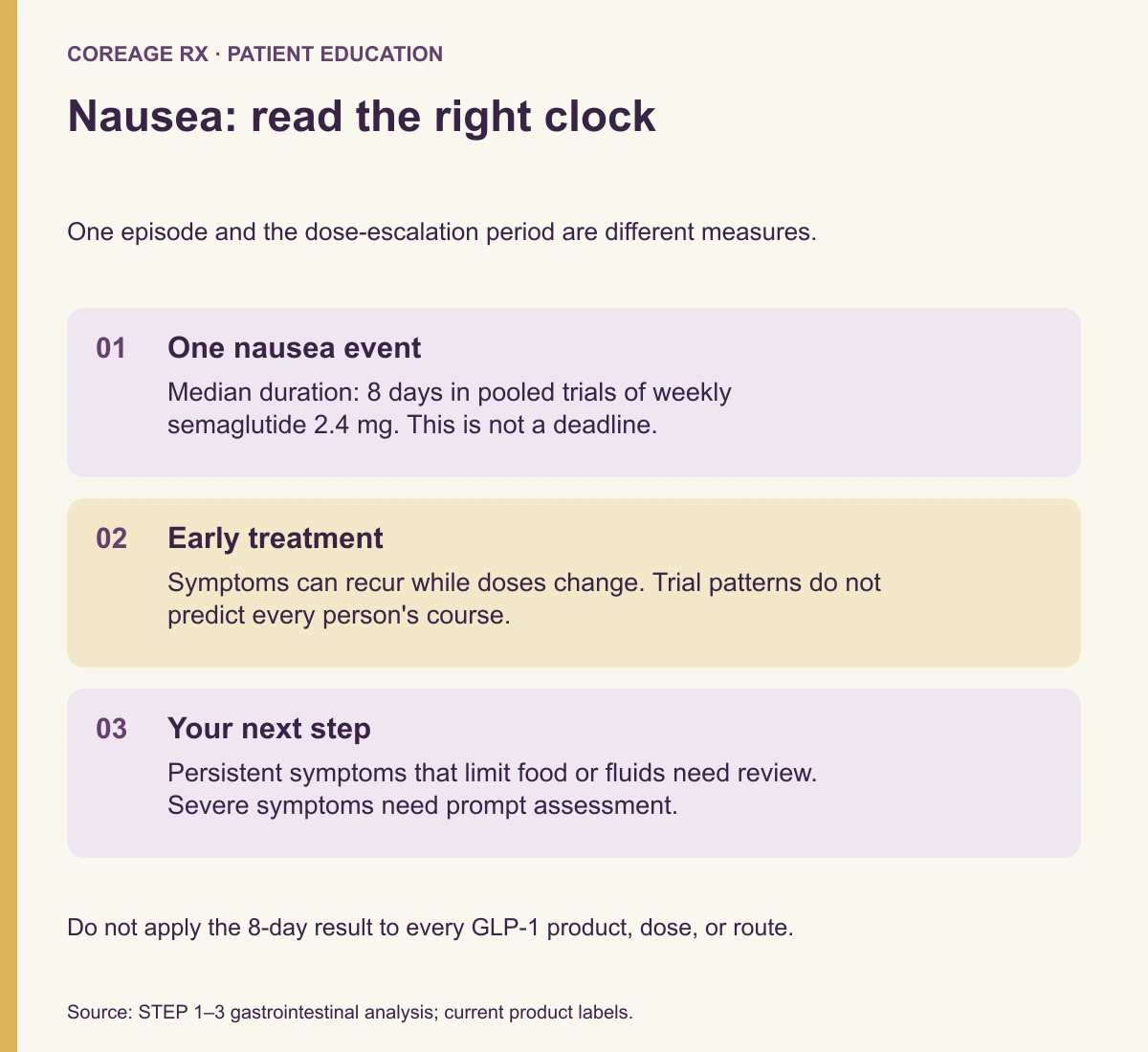
One study of weekly injected semaglutide 2.4 mg found that an individual nausea event lasted a median of eight days. That does not mean everyone feels better on day eight, or that all nausea over an entire course of treatment lasts eight days. It also does not establish the duration for Ozempic, oral semaglutide, tirzepatide, or a compounded preparation. Here is how to interpret the evidence and decide what to discuss with your care team.
Three different meanings of “how long”
People use the same question to describe three different experiences:
| What you are measuring | What it tells you | What it cannot tell you |
|---|---|---|
| One episode of nausea | How long a particular event continues | Whether another episode will happen after a later dose |
| The early treatment period | When symptoms tend to appear while doses change | How many days one person will feel sick |
| Time after stopping a medicine | How long symptoms persist after the last dose | Whether the medicine is the only cause |
This distinction matters when reading online stories. Someone who says nausea lasted “two months” might mean occasional symptoms during several dose changes. Another person may mean daily symptoms that interfered with hydration. Those experiences call for different discussions even though the calendar period sounds similar.
Record the first day of each episode, its severity, whether vomiting occurs, and the relationship to meals and doses. A short description of what you can actually tolerate is more useful than simply recording “nausea: yes.”
What semaglutide research actually measured
A pooled analysis of STEP 1–3 included 2,117 participants assigned to semaglutide 2.4 mg and 1,262 assigned to placebo. These were weight-management trials; STEP 2 included people with type 2 diabetes, while the other two did not. Treatment lasted 68 weeks, with gradual escalation toward the target injection dose.
The median duration of an individual nausea event in the semaglutide group was eight days. Median means the middle of the estimated duration distribution, not a maximum or a promise. Participants could report more than one event. First gastrointestinal events clustered during dose escalation, and nausea became less prevalent later in treatment. Some participants continued to have symptoms. These findings come from the published STEP gastrointestinal analysis.
The same analysis found that gastrointestinal problems led to a dose reduction or temporary treatment interruption in 12.5% of semaglutide-treated participants. Permanent discontinuation because of gastrointestinal effects occurred in 4.3%. Those are different outcomes: adjusting a plan does not automatically mean treatment has failed.
The study does not justify enduring significant symptoms until a particular week. Trial participants had clinical follow-up and could receive changes to their treatment. Our semaglutide nausea and vomiting guide covers practical symptom discussions in more detail.
Does tirzepatide nausea follow the same timetable?
Tirzepatide acts on both GIP and GLP-1 receptors. Its gastrointestinal effects can overlap with those of semaglutide, but semaglutide’s eight-day statistic should not be presented as a tirzepatide result.
A post-hoc analysis of SURMOUNT-1 through SURMOUNT-4 found that gastrointestinal events were generally mild to moderate, occurred mainly during dose escalation, and diminished over time. The studies differed in their populations and design, including whether participants had diabetes and whether they had already completed a treatment lead-in period. They do not establish one duration that predicts every patient’s nausea. See the SURMOUNT tolerability analysis.
Both Mounjaro’s label and Zepbound’s label describe gastrointestinal effects that often occur during escalation. That pattern supports planning follow-up around dose changes. It does not establish that every later episode is harmless or caused by the medicine.
For symptoms that include reflux, fullness, or belching, our tirzepatide nausea and reflux guide can help you describe the pattern clearly.
Why nausea can return after you were feeling better
A dose increase changes medication exposure, so tolerating an earlier dose does not guarantee the next step will feel identical. Other changes can also matter: meal size, a new medicine, an infection, constipation, or a period of reduced fluid intake.
The timing can offer a clue without proving the cause. Symptoms that begin after escalation deserve a discussion about tolerability. Symptoms appearing after months on an unchanged regimen deserve a broader review, especially when accompanied by pain, fever, or persistent vomiting.
Do not turn a published escalation schedule into an obligation to increase while feeling unwell. Prescribers consider response and tolerance, and the exact product label matters. If symptoms are still limiting meals or fluids before the next planned increase, contact the care team first. The semaglutide dosage guide explains why product-specific schedules cannot be combined into one universal chart.

What may help while symptoms are mild
Start with changes that make eating and drinking more manageable. Smaller meals, slower eating, stopping when comfortably full, and choosing foods you tolerate can help. Large, rich meals may be harder to manage during a symptomatic period. The trial discussions include dietary counseling as part of managing gastrointestinal effects; they do not identify a single food that reliably cures nausea.
Sip fluids in amounts you can tolerate. If you have a prescribed fluid restriction because of another condition, ask how to manage hydration within that plan. Repeatedly vomiting fluids is a reason to seek help, not simply to try another beverage.
Avoid turning a few days of nausea into a highly restrictive long-term diet. If you are eating very little, tell the clinician how much you are managing and for how long. A dietitian can help adapt meals while preserving nutrition. Our balanced meals guide offers a starting point for meals that can be adjusted to appetite and tolerance.
Anti-nausea medicines may be appropriate in selected circumstances, but the choice depends on the cause, other prescriptions, and medical history. Ask before combining over-the-counter remedies or using someone else’s prescription.
If you are considering an over-the-counter motion-sickness product, read our Dramamine and GLP-1 nausea guide. The named products contain different ingredients and have drowsiness and interaction warnings; their labels do not establish a routine treatment for GLP-1-related nausea.
When to contact the prescriber instead of waiting
Contact the care team promptly when nausea repeatedly interferes with eating, drinking, work, sleep, or taking other necessary medicines. Also report symptoms that persist without improvement, recur with every dose, or become worse after a recent increase.
There is no evidence-based rule that everyone should wait exactly three, seven, or fourteen days before calling. Severity and function matter more than reaching a calendar threshold. You can contact the team early, even if the symptom is described as common on the label.
Useful information to send includes:
- The exact medicine, formulation, dose, and date of the last dose.
- Any recent dose change, missed dose, or restart.
- When nausea started and whether it is continuous or episodic.
- Vomiting, bowel changes, pain, dizziness, and urine changes.
- What you have eaten, drunk, and tried for relief.
For a vial, include the pharmacy label and prescribed measuring instructions. A misunderstanding about concentration or syringe markings requires a medication review. Do not assume a dosing error will resolve with normal adjustment time.
Symptoms that need urgent assessment
Severe or persistent abdominal pain, particularly pain that may extend to the back, needs prompt medical assessment because product warnings include pancreatitis. Pain with fever or jaundice can suggest a gallbladder problem. Markedly reduced urination, fainting, or an inability to keep fluids down can signal significant dehydration.
Severe abdominal swelling with vomiting or inability to pass stool or gas also needs urgent evaluation. Trouble breathing, throat or facial swelling, collapse, or another severe allergic reaction is an emergency. These warning signs should not be explained away as the usual early nausea. The current Ozempic safety information and Zepbound prescribing information describe the relevant serious risks.
If you use insulin or a sulfonylurea and feel sweaty, shaky, weak, or confused, follow your prescribed low-blood-sugar plan and seek appropriate help. Nausea alone does not distinguish a medication side effect from another problem.

Does nausea mean treatment is working better?
No. Feeling sick is not the target of treatment, and an absence of nausea is not proof that the medicine is ineffective. In the STEP analysis, most of semaglutide’s weight-loss effect was not explained by gastrointestinal adverse events. SURMOUNT analyses likewise found substantial weight reduction among participants who did not report nausea, vomiting, or diarrhea.
These were secondary analyses with limitations, so they should not be used to predict an individual’s response. They do support an important practical point: there is no reason to seek nausea, escalate to produce it, or consider persistent vomiting a sign of success.
Assess treatment through the agreed health goals, tolerability, nutrition, and follow-up. If appetite changes seem modest, our semaglutide plateau guide explains why a single symptom or scale reading is a weak measure of response.
Common duration questions
Will nausea stop as soon as I stop the medicine?
Not necessarily. Effects of a long-acting medicine do not vanish immediately after the last dose, and another cause may be contributing. Do not use an expected drug-clearance timeline to delay care for severe symptoms. Discuss stopping and restarting with the prescriber; a previous dose may not be the right restart dose after an interruption.
Is daily nausea for weeks something I must accept?
No. Even a recognized side effect deserves reassessment when it continues to affect daily life or nutrition. The clinician may review other causes, the dose plan, supportive treatment, or whether another approach fits better.
Where should I start if I am considering treatment?
Ask how symptom questions will be handled between visits and before dose increases. You can review CoreAge Rx’s semaglutide care information and tirzepatide care information, then discuss suitability and the exact prescribed product with a qualified clinician. The goal is a sustainable treatment plan with manageable effects, not a commitment to tolerate an arbitrary number of sick days.
Educational information for adults; individual treatment decisions require a qualified clinician. Sources checked September 27, 2026. Original AI-generated article illustrations depict fictional people and objects, not patient outcomes. Other editorial images are illustrative. Graphics summarize the cited sources.