
UnitedHealthcare coverage for Wegovy and other GLP-1-based medicines depends on the member’s benefits, the exact product, and the condition being treated. Some commercial employers elect a weight-management drug benefit; others do not. Diabetes, cardiovascular, and liver-related policies can follow different criteria. A public policy describes a review program, rather than guaranteeing coverage or one copayment for every UnitedHealthcare member.
The most useful starting point is your member benefit document and current formulary. Once those are identified, ask which policy and indication apply to the prescription. “Does UnitedHealthcare cover GLP-1?” is too broad to answer the final pharmacy cost.
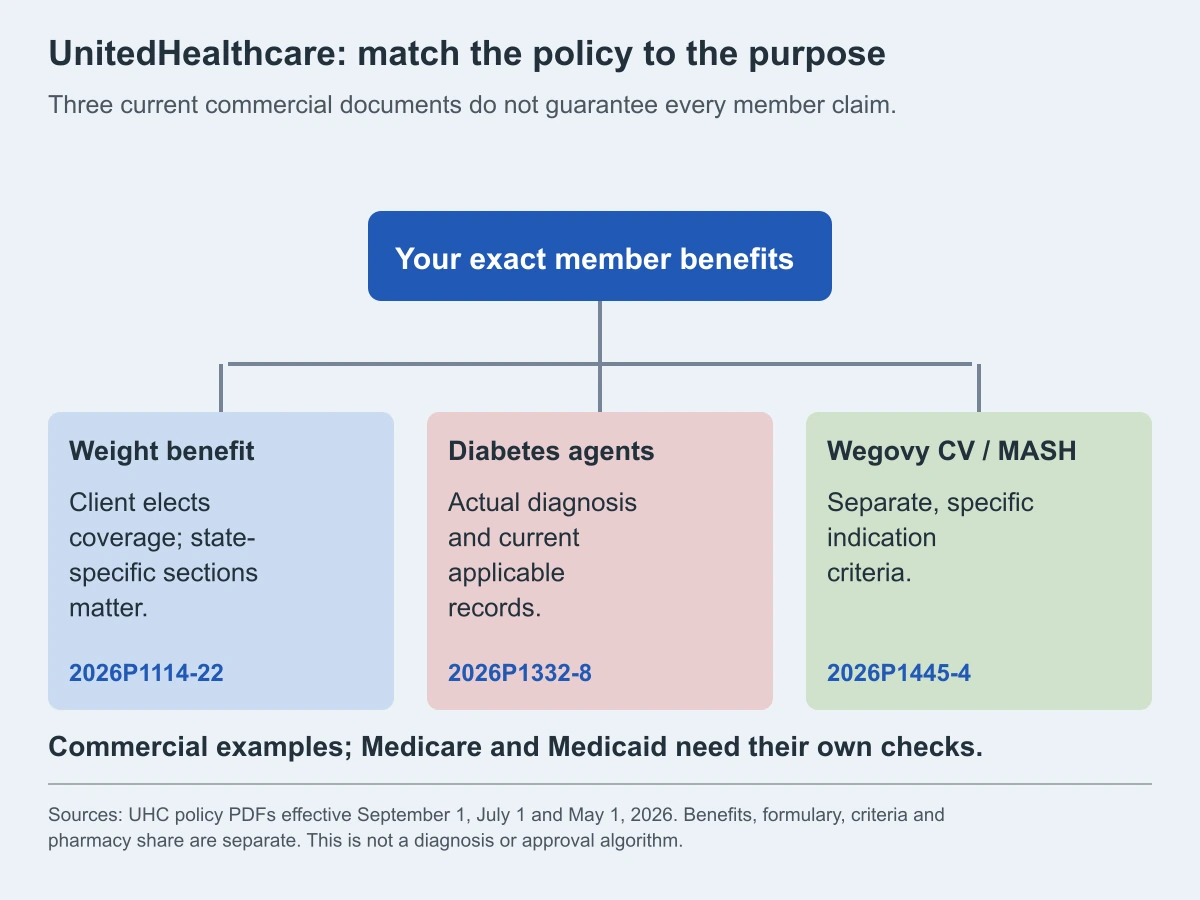
Three current commercial policies illustrate the differences
We reviewed the actual UnitedHealthcare commercial pharmacy policy documents below on October 1, 2026. Their identifiers and effective dates matter, especially when a search returns several versions.
| Verified commercial document | Effective date | Scope to understand |
|---|---|---|
| Weight Loss, 2026P1114-22 | September 1, 2026 | A program for clients that elect coverage, with additional state and indication-specific sections |
| Diabetes GLP-1/GIP-GLP-1 agents, 2026P1332-8 | July 1, 2026 | Diagnosis documentation for diabetes agents including Ozempic and Mounjaro |
| Non-Formulary Wegovy, 2026P1445-4 | May 1, 2026 | Specified cardiovascular-risk and MASH uses, distinct from a weight-only benefit |
The weight-loss policy, diabetes policy, and non-formulary Wegovy policy are separate documents. A member’s plan may use a particular program, exclude a benefit, or have other applicable rules. Their appearance on a provider website does not identify your coverage by itself.
These documents also are not Medicare or Medicaid formularies. Do not apply a commercial criterion to a different plan type because the insurance company name is the same.
Does UnitedHealthcare cover Wegovy for weight loss?
The current commercial weight-loss policy explicitly describes a program for clients that elect weight-management drug coverage. That is the key qualification before discussing a BMI threshold. An employer may offer a plan without that benefit, and a clinician’s prescription does not add an excluded benefit to the contract.
In the policy’s general section, weight-management criteria include lifestyle support and an initial BMI of at least 30, or at least 27 with a weight-related condition. Other requirements apply, and the policy includes exceptions and separate indication-specific branches. Its MASH review is not simply the same BMI test.
A separate North Dakota fully insured essential-health-benefit section uses different criteria, including a BMI threshold of at least 40 for adult weight reduction. That state-specific section is one reason a generic “UnitedHealthcare requires BMI 30” claim would be incomplete.
Age and product rules also need the applicable section. The policy discusses several medicines with different ages and presentations; it is not a universal prescribing eligibility chart. Wegovy tablets may also fall under an Excluded at Launch rule for some programs. Confirm the exact route and current plan rather than treating tablets and injections as automatically covered alike.
What happens after initial approval?
The general commercial weight-loss policy describes different initial authorization periods for different brands: five months for Wegovy and six months for Zepbound in the relevant program. Those periods are review windows, rather than promises of permanent coverage.
For continuation, the policy describes response documentation and ongoing lifestyle participation. For example, the general Wegovy weight-management continuation route includes at least 5% weight reduction from baseline, with other requirements. A MASH continuation branch looks at clinical response and liver-related criteria instead.
Ask your prescriber what baseline information will be documented and when renewal should be prepared. Keep the actual authorization letter and dates. A pharmacy refill history alone may not contain all records needed for continuation.
Do not independently increase a dose or change treatment to meet an insurer’s response threshold. The clinician must consider tolerability and health alongside the coverage process. Our first month on semaglutide guide and tirzepatide first-month guide explain useful follow-up questions without promising an early weight-loss target.
How are Ozempic and Mounjaro reviewed?
The current commercial diabetes policy requires documentation of type 2 diabetes through the specified diagnostic records or qualifying established diagnosis documentation. It describes a twelve-month authorization period under that review program. The policy is not a universal requirement to try metformin before every GLP-1 prescription.
The current Ozempic label and current Mounjaro label should be used to understand approved uses. The July 2026 diabetes policy’s background predates Mounjaro’s August 2026 label revision adding a specific cardiovascular-risk indication. That is a reason to ask how the plan handles the actual prescribed use, rather than treating an older policy summary as the full current label.
A diabetes-brand policy does not establish coverage for a person seeking weight loss without the required diagnosis. Nor should type 1 diabetes be relabeled as type 2 diabetes to fit a form. The Ozempic qualification guide and type 1 diabetes evidence guide explain those distinct clinical questions.
If your prescriber recommends a diabetes medicine, ask which applicable policy covers the actual indication, documentation, and presentation. The plan can explain benefit rules; the clinician establishes the medical diagnosis and treatment plan.
Can Wegovy be covered if the plan excludes weight-loss drugs?
Potentially, a different approved indication may have a separate pathway, but it requires the actual condition and applicable policy. The May 2026 non-formulary Wegovy document addresses specified cardiovascular-risk and MASH circumstances for programs in which a weight-management benefit is excluded.
Its cardiovascular branch is specific. It includes adult age and BMI requirements, established cardiovascular disease such as previous myocardial infarction, stroke, or symptomatic peripheral arterial disease, and other conditions involving diabetes status and guideline-directed treatment. The criteria are narrower than “I have a risk factor for heart disease.”
Its MASH branch concerns Wegovy injection and documented liver disease with specified fibrosis stages, using accepted diagnostic evidence and specialist prescribing or consultation. MASH means metabolic dysfunction-associated steatohepatitis. The policy includes additional treatment and continuation requirements; a generic report of fatty liver is not enough to infer eligibility.
These are coverage criteria under a named plan program, rather than the full FDA indication or a tool for diagnosing yourself. Ask your clinician whether a relevant condition is actually present and the plan which review process applies. Never choose a diagnosis merely to avoid a weight-management exclusion.
The Wegovy prescribing information is the source for current route-specific approved uses. Plan approval and clinical appropriateness remain separate judgments.

Why formulary status is only part of the answer
A formulary is a drug list, often with tiers and utilization requirements. Your benefit design can still determine whether a category is included, whether a particular route is covered, and how much you pay.
Ask whether the exact prescription is listed, preferred, nonpreferred, or excluded, and whether a quantity limit, authorization, or another review applies. Do not assume the same tier across all UnitedHealthcare plans. A colleague with a different employer can have different benefits despite a similar insurance card.
Pharmacy network status also matters. Ask about the actual pharmacy location and whether it is preferred or otherwise in network. A warehouse pharmacy being open to nonmembers does not establish your insurer’s network treatment; our Costco Wegovy price guide explains that separate issue.
What would you pay after approval?
A covered prescription may involve a deductible, fixed copayment, or coinsurance. Quantity and days’ supply affect the fill, while a savings program may have its own eligibility and cap. A public policy does not give one nationwide final price.
Ask whether a pharmacy quote reflects an actual processed claim or an estimate. If the claim rejects, request the precise reason and share it with the prescriber or plan. Missing authorization, an early refill, a quantity mismatch, a network issue, and a benefit exclusion have different explanations.
Use the Wegovy cost guide, Ozempic cost guide, and Zepbound cost guide to organize medicine charges and any separate care fees. Compare insurance, eligible manufacturer savings, and legitimate self-pay options under their actual rules; do not combine several unrelated discount headlines.
What can you do after a denial?
Get the written reason and the applicable policy identifier. Ask whether the decision concerns clinical criteria, missing documentation, formulary status, or an excluded benefit. A corrected chart submission is different from asking an employer to change a benefit exclusion.
The plan’s notice should identify the review or appeal process that applies to your case. Ask about required documents and deadlines directly; there is no universal deadline supplied by this article. Your clinician can explain medically relevant information, but cannot guarantee that an exception or appeal will be approved.
If you are nearing the end of your supply, contact the care team about continuity. Do not ration doses, substitute another brand, or buy an unverified preparation without guidance. FDA’s GLP-1 product warnings explain why product identity and reliable prescribing matter alongside access.
Our online prescription guide explains questions about assessment, availability, and costs. A different payment route should still involve a proper clinical evaluation and clearly identified medicine.
Medicare, Medicaid, and the Bridge are separate
A Medicare Advantage plan with drug coverage, a standalone Part D plan, and a Medicaid product do not necessarily use the commercial policies above. Check the exact plan’s current formulary and benefit rules, including the condition being treated.
The CMS Medicare GLP-1 Bridge is a conditional program outside ordinary Part D payment, currently running from July 1, 2026 through December 31, 2027. Eligible participants have a $50 monthly charge for qualifying products under its defined requirements. That does not mean every Medicare member qualifies or every presentation is eligible.
The Bridge and Part D coverage for other approved indications are distinct. A commercial employer’s benefit election cannot answer the Bridge question, and a manufacturer commercial savings card is not a Medicare eligibility rule. See the Medicare weight-loss medicine guide for the current pathway questions.

Your plan-specific checklist
Bring your member ID, exact prescription, and treatment purpose. Ask the plan:
- Which benefit and formulary apply to my current plan year?
- Is weight-management medicine coverage included or excluded?
- Which current policy number and indication apply to this product and route?
- What records does the prescriber need for the initial request?
- How long would authorization last, and what is needed for continuation?
- Which pharmacy can process the prescription in network?
- What is the estimated member share, and when can it be confirmed?
- What written denial or review process applies if coverage is declined?
For comparison, our Aetna coverage guide shows another insurer’s distinct documents. It should not be used to supply missing UnitedHealthcare criteria.
CoreAge Rx’s tirzepatide information and semaglutide information describe separate clinical-assessment options. Confirm the actual preparation, fees, and follow-up. Those pages do not establish UnitedHealthcare approval or branded medicine availability.
Frequently asked questions
Does UnitedHealthcare cover Wegovy for everyone with obesity?
No. The commercial weight-loss program depends on a client electing coverage and on additional criteria. Your benefits and applicable current policy determine the review.
Is BMI 30 the universal UnitedHealthcare requirement?
No. The policy includes general criteria, state-specific sections, and other indication routes. The North Dakota section is one example with a different threshold. Ask which section governs your case.
Is Ozempic coverage the same as Wegovy coverage?
No. Their indications and pharmacy review programs differ. A shared ingredient does not make their authorization requirements interchangeable.
Can a heart or liver indication change the coverage question?
It may create a separate review pathway when the actual diagnosis and relevant criteria apply. It is not a general exemption for anyone with obesity or a risk factor.
Does approval mean the medicine is free?
No. Deductibles, copayments, coinsurance, network status, and quantity can affect the final claim. Ask what the pharmacy quote represents.
Will an authorization from my old employer transfer?
Do not assume so. A new benefit design, policy, or formulary may require another review. Share the treatment history and previous approval with the new plan and your clinician.
Educational information for adults; individual treatment decisions require a qualified clinician. Sources reviewed October 1, 2026. Original AI-generated article images depict fictional people and objects, not patient outcomes. Other editorial images are illustrative. Graphics summarize the cited sources.