
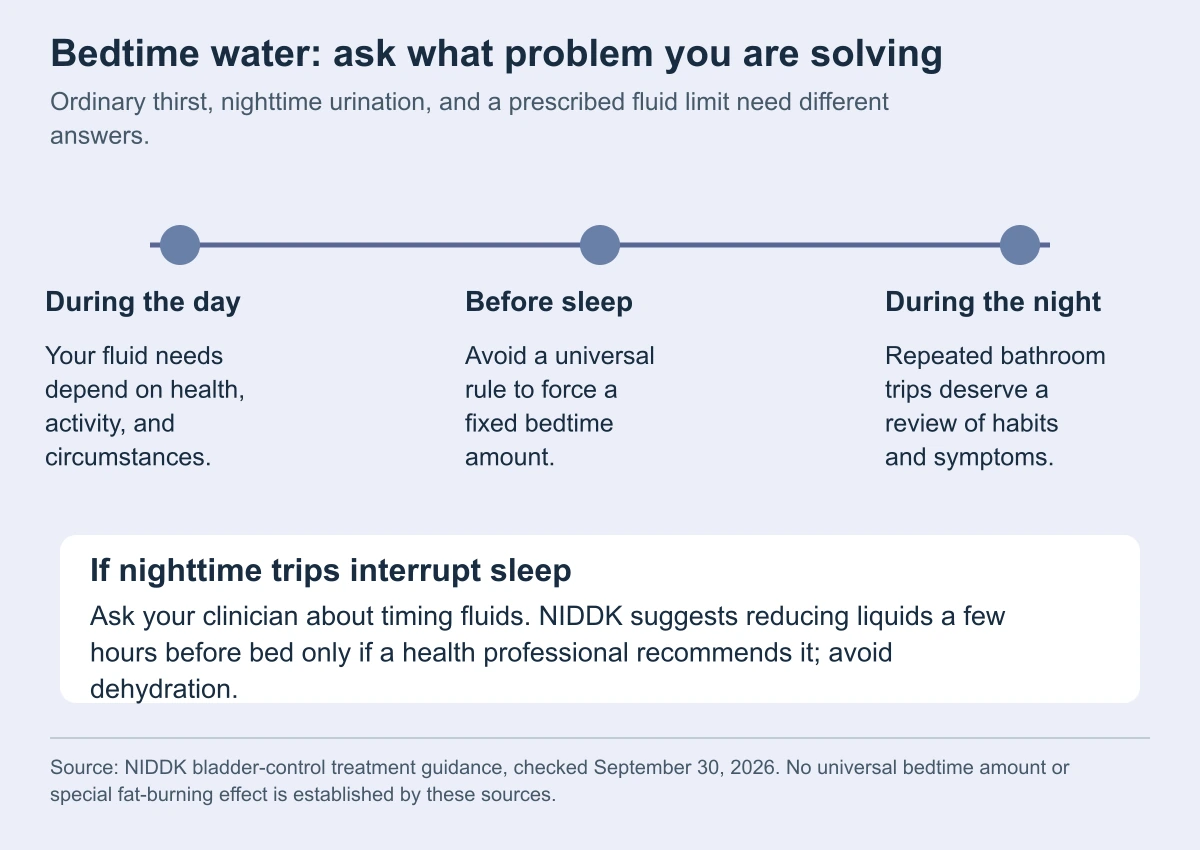
There is no universal rule that everyone should drink a fixed amount of water before bed. The useful answer depends on ordinary thirst, the fluids you have had during the day, nighttime bathroom trips, symptoms, and any fluid instructions from your clinician. Drinking water at bedtime is not an established shortcut to overnight fat loss.
If a bedtime glass fits your needs and does not interfere with sleep, the timing alone is not a reason to regard it as a weight-loss treatment. If you repeatedly wake to urinate, feel unusually thirsty, or have a prescribed fluid limit, those concerns need their own review. This guide helps separate the questions instead of treating all of them as a hydration challenge.
What problem are you trying to solve?
“Should I drink water before bed?” can mean several different things. You might be thirsty after a busy day, trying to replace an evening sugary drink, hoping to lose weight, or wondering whether water explains repeated bathroom trips. Each situation calls for different information.
Start by describing the pattern. Is the concern occasional or most nights? Are you drinking a large amount close to bedtime because you had little access to fluids earlier? Did nighttime urination begin recently? Are you following a medical fluid limit? Those details are more informative than a single rule about the last hour of the day.
Our water and weight-management guide covers the broader questions about drinks, hunger, and fluid needs. The bedtime question adds sleep and urinary symptoms to that discussion.
Can water before bed make you lose weight?
The primary sources reviewed for this article do not establish that bedtime water selectively burns fat or produces a predictable weight-loss result. Changing the timing of water is not the same as changing the overall eating and activity pattern.
Replacing a drink that contains calories with plain water changes the beverage choice. Whether that changes your overall intake depends on what you were drinking, how much, and what else you eat or drink. Read the actual beverage label rather than assuming every flavored drink has the same ingredients or energy content. FDA Nutrition Facts guidance
That distinction also applies to coconut water, juice, milk, sweetened tea, and drinks made from powders. Our coconut-water sugar guide explains why zero added sugar is different from zero total sugar. A bedtime routine should account for the drink you actually use, not only whether the word “water” appears in its name.
NIDDK describes weight management in terms of health, eating patterns, physical activity, and other contributing factors. It does not identify a bedtime water amount as a stand-alone obesity treatment. Weight-management overview
Does warm water work better than cold water?
The sources reviewed here do not establish a special overnight fat-loss benefit for warm water, cold water, lemon water, or a particular temperature routine. Choose a drink you find practical within your care instructions rather than treating temperature as a treatment dose.
If you add honey, sugar, juice, or a powder, the resulting drink has its own ingredients. Adding those ingredients should be considered separately from the temperature. A warm drink can be part of a personal routine without needing a claim that it melts fat or detoxifies the body.
For meal and energy questions, see the balanced-meal guide and calorie-intake guide. They explain why the complete pattern offers more useful information than an isolated drink habit.
Could drinking late make bathroom trips more disruptive?
NIDDK’s guidance for bladder-control problems says a health professional can advise how much and when to drink based on health, activities, and climate. For nighttime bathroom trips, it suggests considering a pause in liquids a few hours before bed only if the health professional recommends it. It also says not to limit liquids to the point of dehydration. Bladder-treatment guidance
This is not a universal cutoff time for everyone. The same page discusses limiting caffeine-containing foods and drinks and alcohol when they contribute to bladder symptoms. The right approach depends on the person and the problem being treated.
Repeated nighttime trips are therefore a reason to discuss the pattern, rather than simply forcing more water or stopping all fluids. Note whether you wake because you need to urinate or are already awake for another reason when you decide to go. That distinction can help describe your experience, although it does not diagnose the cause.

How much water should you drink before sleeping?
A universal bedtime volume would ignore information we do not have: your health, activity, medications, fluid losses, usual intake, and any existing instructions. NIDDK specifically describes fluid timing and amounts as individual decisions in its bladder-care guidance. NIDDK guidance
Do not assume that a popular “one large glass” or “two liters before bed” routine is appropriate because it is easy to remember. Likewise, do not use this article to override a fluid restriction or advice you received after a medical assessment.
A useful question for your clinician is: “I am drinking most of my fluids late in the day and waking repeatedly. How should I distribute them within my plan?” If you are mainly concerned about thirst, explain how often it occurs and whether it is new or unusually intense.
What if you wake feeling very thirsty?
New or persistent excessive thirst deserves a health review, particularly when it occurs alongside frequent urination or other symptoms. NIDDK lists increased urination and feeling very thirsty among common diabetes symptoms and advises discussing symptoms with a primary health professional. Those symptoms do not establish diabetes on their own. Diabetes symptoms guidance
Do not assume that a larger bedside bottle resolves the reason for unusually strong thirst. Record when it occurs, what else you notice, and any relevant medication changes. Your clinician can decide whether testing or another evaluation is needed.
Similarly, dry-mouth sensations and thirst may be described differently by different people. Explain the sensation in your own words instead of trying to name a condition from a search result. It is reasonable to ask whether medicines, sleep-related concerns, or other health factors should be reviewed, without deciding the explanation in advance.
What if you have a medical fluid limit?
Use the limit and timing instructions supplied by the clinician managing the condition. A general wellness article does not know why that limit was prescribed or how bedtime fluids fit within it.
If you are thirsty despite following the plan, or the limit is difficult to understand, ask for clarification. Bring a realistic example of your drinks and their timing, including soups, ice, and other items your team may ask you to count. Ask which items count toward your particular instructions rather than assuming a generic definition.
Avoid treating advice aimed at someone without a prescribed limit as a reason to add a large evening drink. The useful next step is to make your own plan understandable and workable.
Does GLP-1 treatment change the question?
If you are taking a medicine such as semaglutide or tirzepatide, bedtime water is only one part of the review. Your actual intake, appetite, vomiting or diarrhea, other medicines, and medical history matter more than a ritual at a certain hour.
For example, the current Zepbound label warns about kidney injury related to volume depletion and describes gastrointestinal adverse reactions. Persistent fluid losses or difficulty keeping fluids down should be discussed with the prescribing team. A bedtime glass does not replace evaluation of ongoing symptoms. Zepbound prescribing information
Our semaglutide questions guide, tirzepatide questions guide, and nausea and vomiting guide cover related treatment concerns. If you are comparing services, the semaglutide and tirzepatide information pages describe CoreAge Rx offerings; treatment suitability requires a clinical assessment.

Which urinary symptoms should prompt medical care?
NIDDK recommends seeing a health professional for bladder symptoms, including waking to use the bathroom, pelvic pain, leaking urine, or trouble urinating. It advises seeking care right away for inability to pass urine or empty the bladder, blood in urine, and bladder-infection symptoms such as painful urination. Bladder symptoms guidance
Those concerns should not be reduced to a question about drinking earlier or later. A change in fluid timing might be part of a care plan, but it does not establish the cause of a new symptom.
For a routine appointment, a short record can make the discussion clearer:
- When and roughly how much you drink.
- Caffeine and alcohol use, if relevant.
- How often sleep is interrupted and what wakes you.
- Urgency, leakage, pain, or other urinary changes.
- Medicines, supplements, and any prescribed fluid instructions.
You do not need to diagnose yourself before asking for help. The record is simply a way to describe the pattern.
Questions people commonly ask
Should everyone stop drinking after dinner?
No single evening cutoff is established for everyone by these sources. For people with nighttime urinary symptoms, NIDDK makes changes in fluid timing conditional on a health professional’s advice and emphasizes avoiding dehydration.
Does bedtime water count toward daily fluids?
The water does not become a different drink because of the clock. If you have a prescribed fluid plan, ask how to account for evening drinks within it. Timing may affect the routine, but it does not erase what you drink.
What if you are also fasting?
Clarify the purpose of the fast. A personal eating window, a fasting blood test, and a procedure can have different rules. Our water-while-fasting guide explains those distinctions. Follow the instructions for a medical test or procedure rather than using a bedtime-hydration habit to decide what is allowed.
What is a practical next step tonight?
Avoid starting a large-volume bedtime challenge. Consider the question you are trying to answer, follow any existing care instructions, and note symptoms that recur. If nighttime trips, excessive thirst, or fluid limits make the decision difficult, ask your clinician for a plan that accounts for both hydration and sleep.
Educational information for adults; individual treatment decisions require a qualified clinician. Sources reviewed September 30, 2026. Original AI-generated article images depict fictional people and objects, not patient outcomes. Other editorial images are illustrative. Graphics summarize the cited sources.