Sleep can change during the menopause transition for several reasons. Night sweats may cause awakenings, but insomnia, sleep apnea, mood symptoms, pain, medicines, and everyday schedules can also contribute. A treatment that helps one part of the problem may not resolve the whole pattern.
The KEEPS and MsFLASH research programs provide randomized evidence about hormone therapy and self-reported sleep. Their results suggest modest benefits in selected women, while showing why “HRT improves sleep” needs a more precise explanation.
Which part of sleep is being measured?
A person may struggle to fall asleep, wake repeatedly, wake too early, feel unrefreshed, or have daytime impairment. Researchers use different tools to assess these experiences.
The Pittsburgh Sleep Quality Index, or PSQI, summarizes self-reported sleep across several domains. The Insomnia Severity Index, or ISI, measures perceived insomnia symptoms and their impact. Lower scores generally indicate fewer problems on both instruments, but the scales are not interchangeable.
A questionnaire also differs from polysomnography, an overnight study that records physiological sleep measures. Feeling that sleep improved is a meaningful outcome, yet it does not automatically establish more deep sleep, a change in sleep stages, or resolution of sleep apnea.
Our HRT, hot flashes, and sleep guide introduces the practical questions. This review focuses on what the original trials actually measured.
Who participated in the KEEPS sleep analysis?
KEEPS enrolled healthy women relatively soon after menopause. The sleep analysis included 653 participants: 209 assigned to oral conjugated equine estrogens, 201 to transdermal estradiol, and 243 to placebo. Both active hormone groups also received cyclic micronized progesterone. Original KEEPS sleep report.
The research regimens used oral estrogen 0.45 mg daily or transdermal estradiol 50 micrograms daily, with progesterone 200 mg cyclically. These doses describe the study and are not individualized prescribing instructions.
Participants completed the PSQI at baseline and at 6, 18, 36, and 48 months. The analysis therefore offered a longer view than a short symptom trial, but it remained a study of selected recently menopausal women rather than all ages and all causes of insomnia.
Because progesterone accompanied both active estrogen regimens, the trial does not isolate estrogen’s effect from progesterone’s contribution. It also does not establish what the result would be with a different progestogen schedule or no endometrial-protection component.
How much did sleep quality improve in KEEPS?
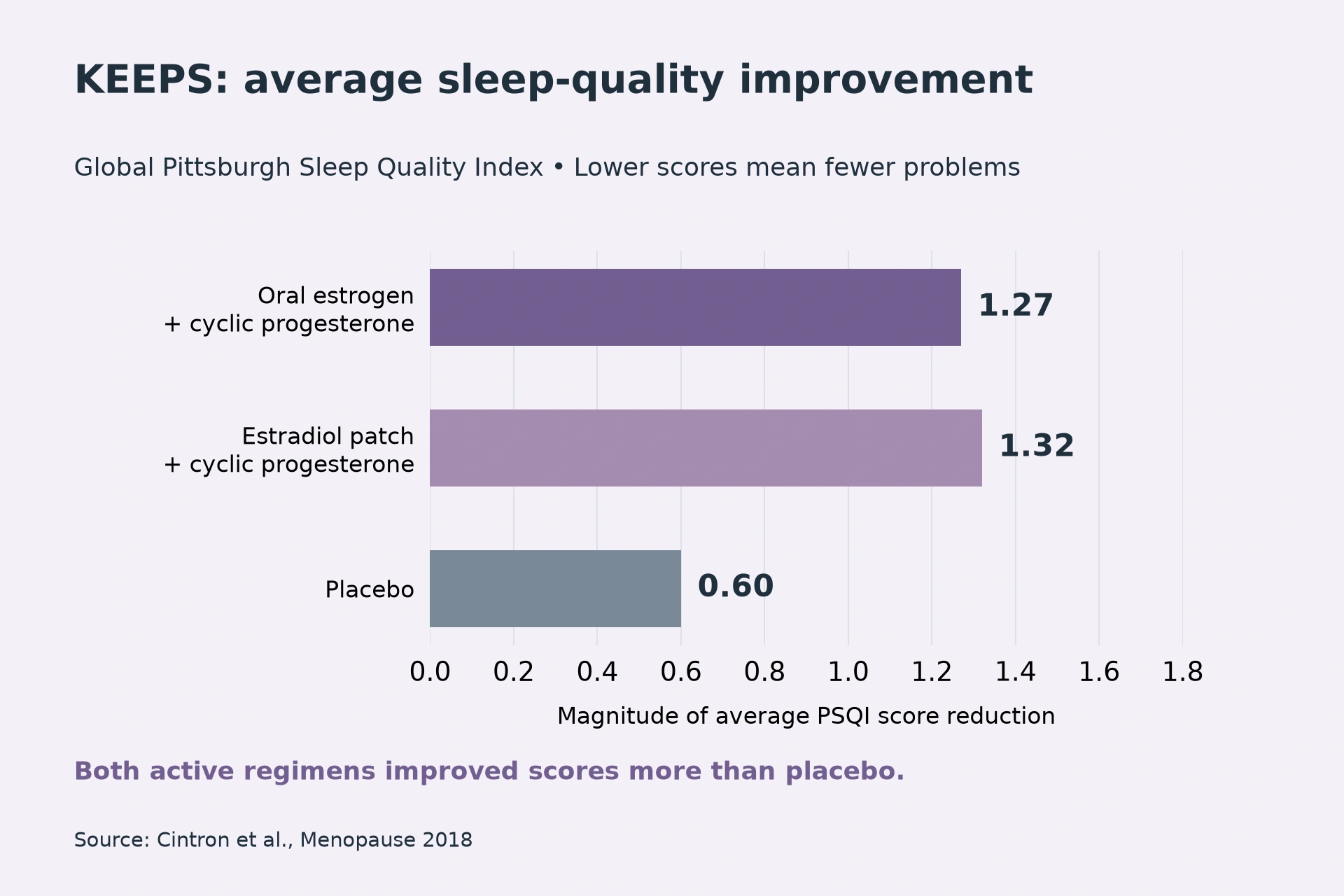
The average global PSQI change was −1.27 points with oral estrogen, −1.32 with transdermal estradiol, and −0.60 with placebo. Both active groups improved significantly compared with placebo. KEEPS results.
The simple differences in average changes were approximately 0.67 and 0.72 points beyond placebo. These numbers are useful because they show the size of the average benefit rather than only whether a statistical test was positive.
A one-point-scale change is not a unit of sleep time. It cannot be translated directly into an extra hour of sleep, a percentage increase in deep sleep, or a guarantee of waking refreshed. Individual experience may also be more or less noticeable than the average difference.
Did one hormone route clearly win?
Both regimens improved global sleep-quality scores compared with placebo. Certain domains differed: sleep satisfaction and latency improved with both, while the sleep-disturbance domain improved more with transdermal estradiol than with oral estrogen or placebo. Domain analysis.
That is more nuanced than saying patches are universally better for sleep. Global scores and individual domains answer related but different questions, and multiple comparisons can complicate interpretation.
Route selection also involves factors beyond sleep, including symptom pattern, medical history, preferences, and the exact product. Our estrogen patch-versus-pill guide can help frame those questions without treating one secondary sleep finding as a universal prescribing rule.
How were hot flashes related to sleep in KEEPS?
Changes in several sleep domains correlated with changes in hot-flash and night-sweat severity. That supports the idea that vasomotor symptom relief can contribute to better perceived sleep. However, a correlation does not prove that every sleep benefit was caused by fewer night sweats.
Someone may have both night sweats and another sleep disorder. If sweating improves but repeated awakenings or daytime sleepiness continue, the remaining symptoms should be evaluated on their own merits.
The study’s reliance on self-report also matters. It can describe perceived improvement and patterns across questionnaires, but it cannot establish a complete physiological mechanism for the observed changes. KEEPS methods and interpretation.
What did MsFLASH add?
MsFLASH randomized 339 women with bothersome hot flashes to low-dose oral estradiol, venlafaxine extended release, or placebo for eight weeks. Its sleep report examined ISI and PSQI results as secondary outcomes. Original MsFLASH sleep paper.
The women were selected because of hot flashes, not because they all had a diagnosis of chronic insomnia. Follow-up sleep data were available for 325 women on the ISI and 312 on the PSQI. Those sample sizes should remain attached to the respective instruments.
The sleep paper comes from the same trial as the MsFLASH hot-flash review. It is a separate report about different outcomes, not a second independent group of 339 participants.
Why must the two MsFLASH scales be read separately?
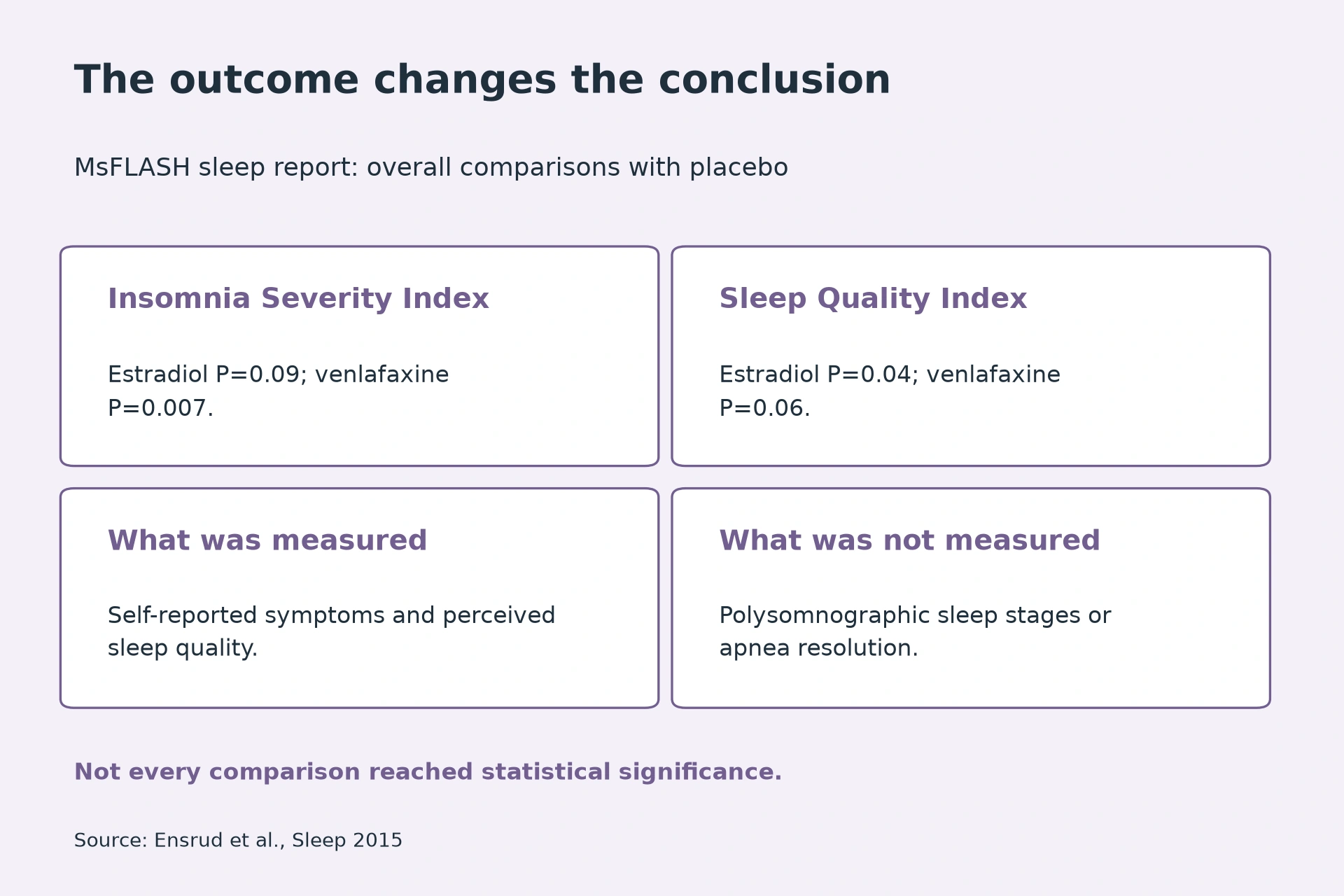
At eight weeks, mean ISI changes were −4.1 with estradiol, −5.0 with venlafaxine, and −3.0 with placebo. For the overall treatment comparison versus placebo, the reported P values were 0.09 for estradiol and 0.007 for venlafaxine.
On the PSQI, changes were −2.2 with estradiol, −2.3 with venlafaxine, and −1.2 with placebo. The corresponding overall comparison P values were 0.04 and 0.06. MsFLASH sleep results.
| Outcome | Estradiol change | Venlafaxine change | Placebo change | Interpretation of overall comparison |
|---|---|---|---|---|
| ISI | −4.1 | −5.0 | −3.0 | Venlafaxine significant; estradiol not at 0.05 |
| PSQI | −2.2 | −2.3 | −1.2 | Estradiol significant; venlafaxine not at 0.05 |
The exact pattern matters. Saying that both medicines significantly improved both scales would be inaccurate. It is more faithful to describe modest average improvements with differing statistical results across outcomes.
Were these large insomnia-treatment effects?
The MsFLASH authors noted that the observed changes were smaller than those generally considered meaningful in trials enrolling patients specifically for clinical insomnia. The study did not perform polysomnography and did not establish effects beyond eight weeks. Limitations and clinical interpretation.
The trial also was not adequately powered to prove one active treatment noninferior to the other for sleep. A small numerical difference cannot establish that they are interchangeable.
These qualifications do not make the results useless. They help set realistic expectations: treating hot flashes may modestly improve perceived sleep, but persistent insomnia may need a treatment plan directed specifically at insomnia.
Why is HRT not a universal sleep medicine?
Hormone therapy is usually considered in the context of menopause symptoms and an individual’s benefit-risk assessment. The Menopause Society distinguishes systemic treatment for vasomotor symptoms from local vaginal therapy for genitourinary symptoms. It also emphasizes age, timing, medical history, and the actual regimen. Hormone-therapy guidance.
A person without bothersome vasomotor symptoms may have a different sleep-treatment question from the women enrolled in these studies. Likewise, findings in recently menopausal healthy women cannot automatically be extended to older women starting therapy many years later or to people with major excluded conditions.
The HRT risks-and-benefits guide and estrogen-progesterone guide provide broader context. A sleep goal does not remove the need to consider uterus status and endometrial protection with systemic estrogen.
What else should be assessed when sleep remains poor?
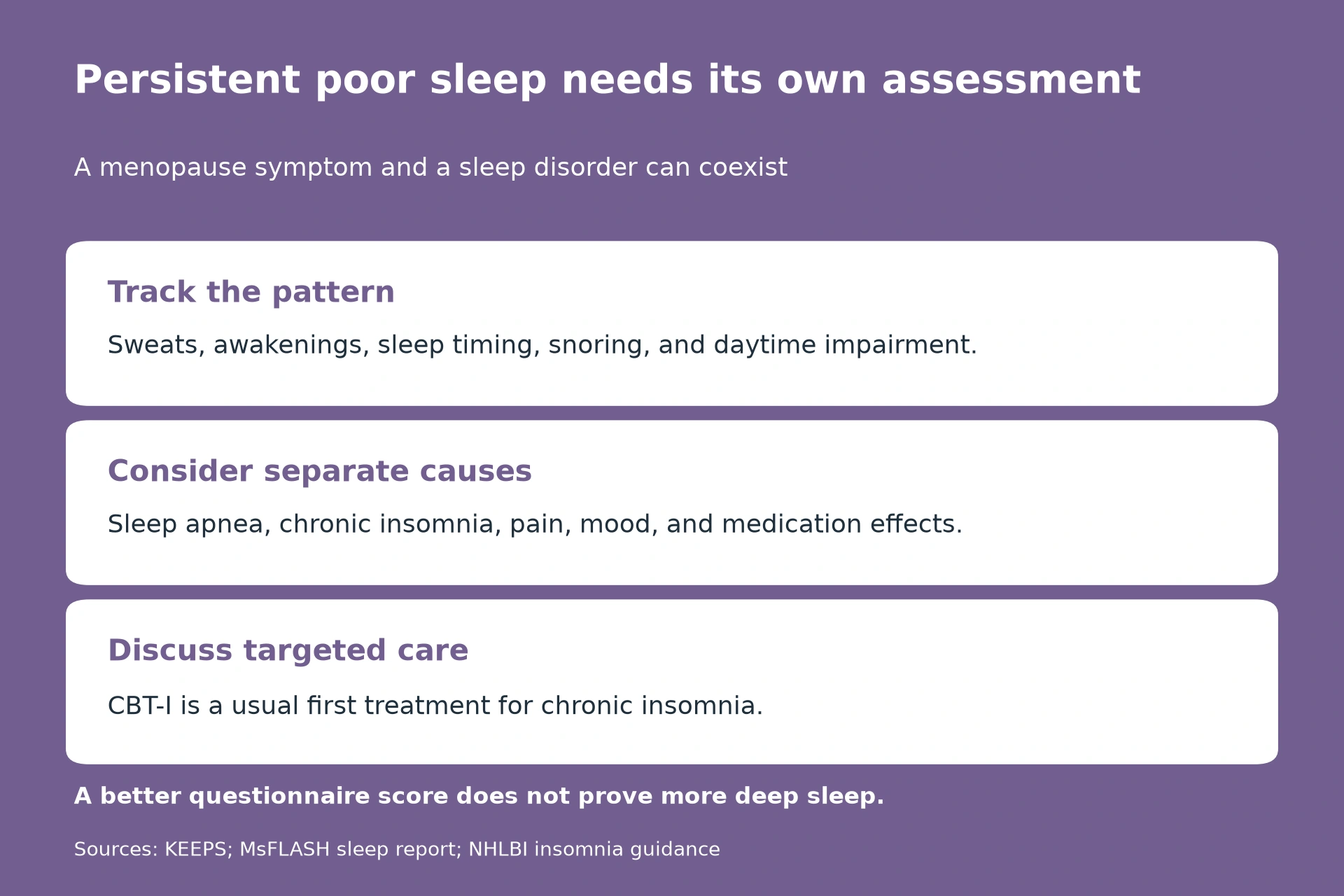
Describe the pattern rather than only the label “bad sleep.” Note bedtime, wake time, awakenings, night sweats, daytime sleepiness, snoring, witnessed breathing pauses, leg discomfort, pain, and medicines or substances that may affect sleep.
A clinician can determine whether a sleep disorder, mood condition, medication effect, or another medical issue needs attention. Hormone therapy does not replace evaluation for sleep apnea, and the KEEPS and MsFLASH reports did not establish it as an apnea treatment.
For chronic insomnia, the NHLBI describes cognitive behavioral therapy for insomnia, or CBT-I, as a usual first treatment. It is a structured approach addressing thoughts and behaviors that maintain insomnia, rather than simply a list of generic sleep tips. NHLBI insomnia treatment guidance.
How do current HRT labeling changes fit this discussion?
The FDA’s February 2026 announcement described approved labeling changes for six initial menopausal hormone-therapy products, including removal of selected risk statements from boxed warnings. FDA announcement.
The change does not turn HRT into a general treatment for all sleep complaints. It also does not mean the research has proven more deep sleep or eliminated every risk. Use current product labeling and a clinical assessment, while keeping the specific sleep evidence distinct from broader regulatory language.
The CoreAge Rx estrogen information page can support a discussion of a particular treatment option. Ask which symptoms it is intended to improve, what formulation is offered, and how response and adverse effects will be reviewed.
What would useful follow-up look like?
Agree on a few concrete goals, such as fewer awakenings related to sweating, less time awake after bedtime, or better daytime functioning. A short record can make the pattern easier to discuss, especially if several symptoms or medicines change at once.
If hot flashes improve but sleep does not, that is useful information rather than a reason to keep increasing treatment automatically. The two problems may overlap without sharing a single solution.
The starting-HRT questions guide can help organize follow-up. The HRT dementia review addresses a separate question: an improvement in perceived sleep does not establish prevention of dementia or a general cognitive benefit.
Watch: managing sleep during menopause
This Mayo Clinic video offers general context about menopause and sleep. It does not present the KEEPS or MsFLASH numerical results and should not replace assessment of persistent insomnia or breathing-related symptoms.
Common questions about HRT and sleep research
Does a lower PSQI score mean more deep sleep?
No. The PSQI is a self-reported sleep-quality questionnaire. It does not directly measure sleep stages.
Can I expect an extra hour of sleep from HRT?
These results do not establish that prediction. A change in a questionnaire score cannot be converted directly into a specific number of minutes slept.
Does progesterone explain all the KEEPS benefit?
The trial did not isolate that question. Both active estrogen regimens included cyclic progesterone, so their individual contributions cannot be separated from this comparison alone.
What if night sweats improve but insomnia continues?
Discuss the remaining sleep pattern with a clinician. Another contributor or a separate insomnia-focused approach may need attention.
What is the most useful conclusion?
Hormone therapy can modestly improve perceived sleep in some women with menopause symptoms. The best interpretation keeps the population, questionnaire, effect size, and alternative causes of poor sleep visible.
Original papers and supporting sources
The references distinguish full research papers, published abstracts, and official guidance. This educational narrative review is not a systematic review or an individual treatment recommendation. Sources were checked in October 2026.
- Cintron D et al. Effects of oral versus transdermal menopausal hormone treatments on self-reported sleep domains and their association with vasomotor symptoms in recently menopausal women enrolled in the Kronos Early Estrogen Prevention Study (KEEPS). (2018). Full text reviewed. DOI: 10.1097/gme.0000000000000971. Open full text.
- Ensrud KE et al. Effects of estradiol and venlafaxine on insomnia symptoms and sleep quality in women with hot flashes. (2015). Full text reviewed. DOI: 10.5665/sleep.4332. Open full text.
- The Menopause Society. Hormone Therapy. Professional society guidance.
- NHLBI. Insomnia treatment. NIH patient guidance.
- FDA. Labeling changes to six menopausal hormone therapy products, February 12, 2026. FDA labeling announcement.